

Auto Insurance California
Buying auto insurance California drivers can actually rely on starts with knowing what the state requires – and California’s rules are genuinely different from most other states, in ways that affect both what you must carry and what you are allowed to be charged.
There is also a change worth knowing about: the state minimum auto insurance limits went up on 1 January 2025, for the first time in decades. A policy that has not been reviewed since then may still be written at the old figures.
Rais Insurance is an independent broker in Anaheim. We are not an insurance company – we place business with a number of carriers, which means one set of details from you gets quoted across several markets. See the insurance companies we represent.
What California Requires You to Carry
The California auto insurance requirements start with financial responsibility: every driver must be able to demonstrate it, and for almost everyone that means carrying liability insurance. The minimum limits are:
- $30,000 for bodily injury to any one person
- $60,000 for bodily injury to all persons in one accident
- $15,000 for property damage
Written in shorthand, that is 30/60/15. It replaced the long-standing 15/30/5 minimum with effect from 1 January 2025, and a further increase is scheduled for 2035.
The practical consequence is worth a moment. If your policy was written before 2025 and has not been reviewed since, check the liability line on your declarations page. Most carriers moved existing policyholders up at renewal – but renewal cycles differ, notices get missed, and a policy sitting at the old limits is now below the legal minimum.
Why the Legal Minimum Is Rarely the Right Answer
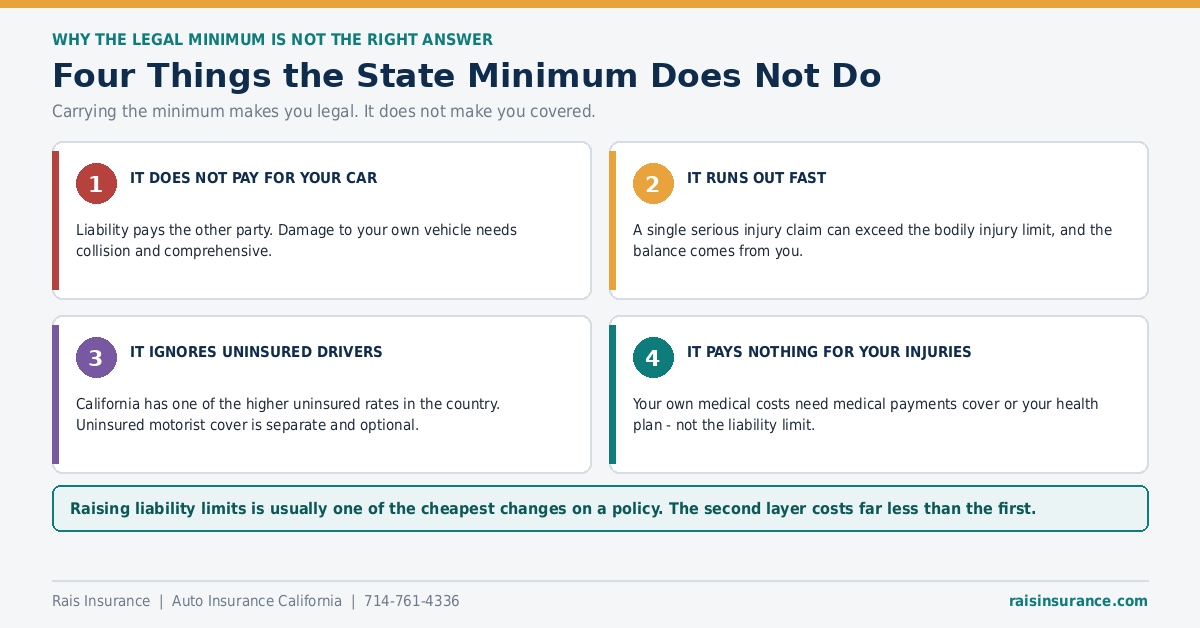
Carrying the minimum car insurance California law demands makes you legal. It does not make you covered, and the distinction matters in four specific ways:
- It does not pay for your car. Liability pays the other party. Damage to your own vehicle needs collision or comprehensive – both optional, both separate.
- It runs out. A single serious injury claim can exceed $30,000 without difficulty, and the balance is yours to find. Medical costs in California are not modest.
- It ignores uninsured drivers. California has one of the higher uninsured driving rates in the country. If one hits you, your own uninsured motorist cover is what responds – and it is optional.
- It pays nothing towards your own injuries. Those need medical payments cover or your health plan.
The useful thing to know is that raising liability limits is one of the cheapest changes on a policy. The second layer of cover costs far less than the first, because serious claims are rare relative to ordinary ones. Most drivers carrying minimum auto insurance are doing so because nobody showed them the price of the alternative.
What Happens If You Drive Without Insurance
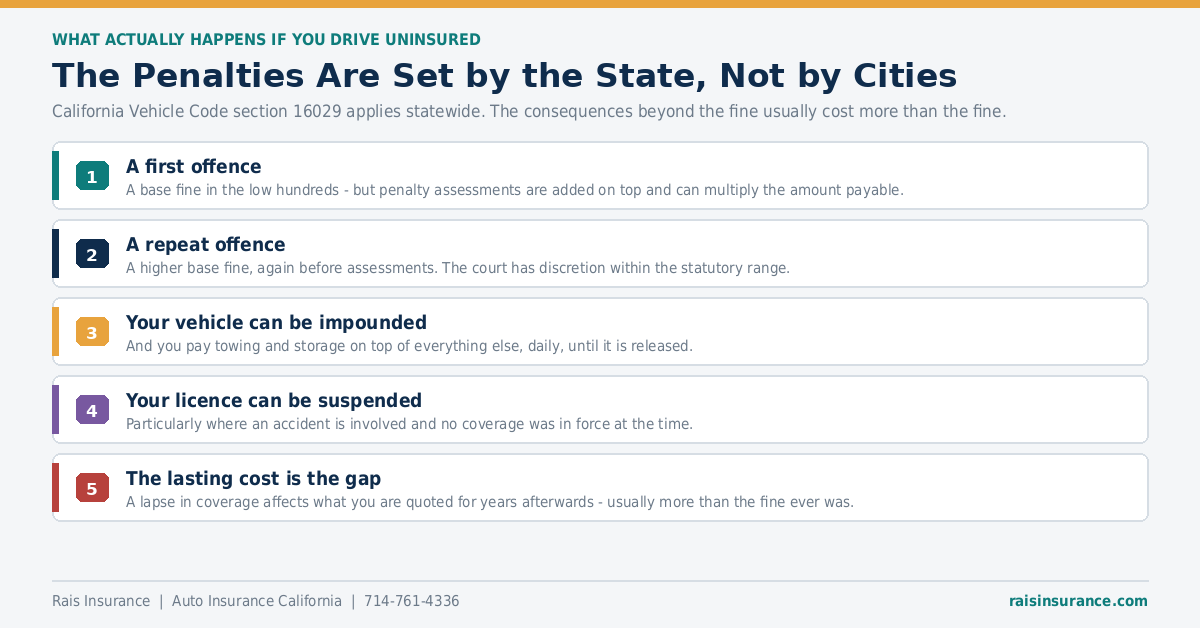
The original version of this page suggested that some cities impose auto insurance penalties of up to $1,000. That is worth correcting: penalties for driving uninsured in California are set by state law – Vehicle Code section 16029 – and apply statewide, not city by city.
- A first offence carries a base fine in the low hundreds. Penalty assessments are then added on top, and they can multiply the amount actually payable.
- A repeat offence carries a higher statutory range, again before assessments.
- Your vehicle can be impounded, with towing and daily storage charges on top of the fine.
- Your licence can be suspended, particularly where an accident occurred with no coverage in force.
- And the lasting cost is the gap itself. A lapse in coverage affects what you are quoted for years afterwards – in most cases costing considerably more than the fine ever did.
Current fine amounts and assessment schedules for driving without car insurance are published by the courts and the DMV, and they change – so confirm the figure rather than relying on any article.
What Goes On a California Auto Policy
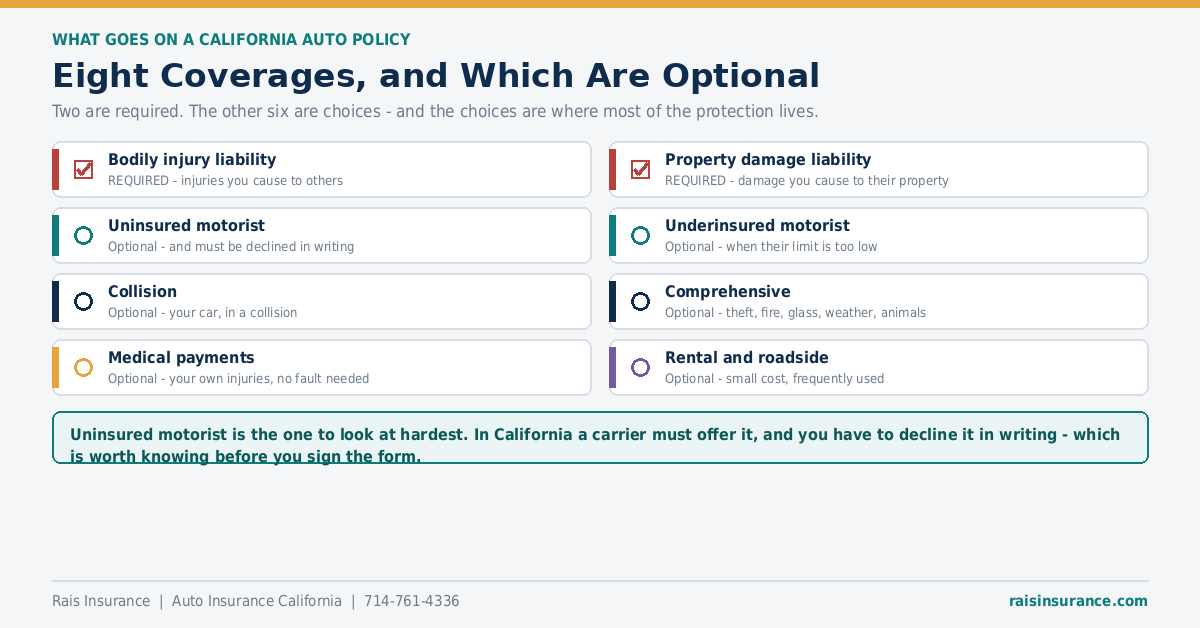
An auto insurance policy in California carries up to eight coverages. Two are required; the other six are choices, and the choices are where most of the actual protection lives:
- Bodily injury liability – required on every California car insurance policy. Injuries you cause to other people.
- Property damage liability – required. Damage you cause to their vehicle or property.
- Uninsured motorist – optional, but a carrier must offer it and you have to decline it in writing. Worth knowing before you sign the form.
- Underinsured motorist – optional. For when the at-fault driver carries auto insurance, but not enough of it.
- Collision – optional. Your vehicle, in a collision, regardless of fault.
- Comprehensive – optional. Theft, fire, glass, weather, vandalism, animals. Not included in minimum car insurance.
- Medical payments – optional. Your own injuries and your passengers’, paid without establishing fault.
- Rental reimbursement and roadside assistance – optional, inexpensive, and used more often than most people expect.
A note on the phrase “full coverage”: it is not a policy type and it has no legal definition. It generally means liability plus collision plus comprehensive, but two quotes both described that way can be very different policies. Ask which coverages and which limits, not whether it is full.
For classic and collector vehicles, a standard auto policy is usually the wrong product – see classic car insurance. For vehicles used in a business, see business insurance in California.
Where the Savings Actually Are
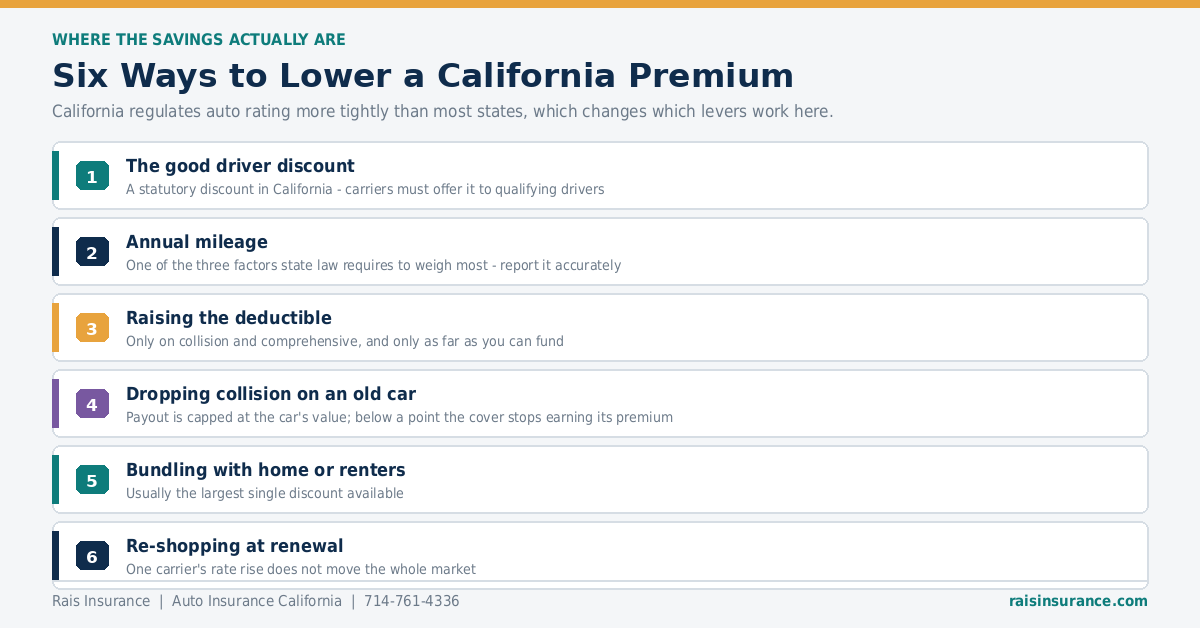
Everybody wants cheap car insurance, and California regulates auto rating more tightly than most states – which changes which levers actually work here. Six that do:
- The good driver discount – California law requires carriers to offer it to drivers meeting the statutory definition. Confirm you are receiving it rather than assuming.
- Annual mileage – one of the factors state law requires to weigh most heavily in your rate. Report it accurately; an out-of-date figure from a longer commute costs you money.
- Raising the deductible – on collision and comprehensive only, and only as far as you could genuinely pay from savings.
- Dropping collision on an older vehicle – the payout is capped at the car’s actual cash value, so below a certain point the premium stops earning its keep. Liability and uninsured motorist do not scale with the car’s value, so those stay.
- Bundling your car insurance with home insurance in California or renters insurance – usually the single largest discount available.
- Re-shopping your car insurance at renewal – one carrier’s rate filing does not move the whole market, and this is the step most people never take.
There is also a state programme providing low-cost auto liability cover to income-eligible drivers in California. If cost is the barrier to being insured at all, it is worth asking about.
Working With Rais Insurance
We have been placing car insurance California drivers rely on for many years, from our office in Anaheim, and the most useful thing we do is not the quote itself – it is telling you which limits and coverages your situation actually calls for before anybody discusses price.
One clarification on how this works. We are an independent insurance broker, not an insurance company – the policy is issued by the carrier and we place it. There is no fee to you for the comparison; a broker is compensated by the carrier that writes the business. See our authorized Mercury Insurance agent page for one of the carriers we work with most.
We serve Anaheim, Orange, Garden Grove, Buena Park and Fullerton directly, and write across California.
Auto Insurance in California – Frequently Asked Questions
Q1. What is the minimum auto insurance required in California?
California raised its minimum liability limits with effect from 1 January 2025. The requirement is now $30,000 bodily injury per person, $60,000 bodily injury per accident and $15,000 property damage – written as 30/60/15. The previous minimum, in place for decades, was 15/30/5. A further increase is scheduled for 2035, and current figures are published by the California Department of Insurance.
Q2. My policy was written before 2025. Is it still legal?
It may not be. A policy written at the old 15/30/5 limits and never reviewed could now sit below the legal minimum. Most carriers moved existing policyholders up at renewal, but not every policy renews on the same cycle and not every driver reads the notice. Check the liability line on your declarations page – it takes a minute and it is worth doing.
Q3. Does liability insurance cover damage to my own car?
No, and this is the most common misunderstanding in auto insurance. Liability pays the other party when you are at fault. Damage to your own vehicle needs collision cover if it happened in a collision, or comprehensive if it was theft, fire, glass, weather or an animal. Both are optional, and both are separate from the state minimum.
Q4. What is ‘full coverage’?
It is not a policy type and it has no legal definition – it is shorthand for liability plus collision plus comprehensive. Because it means different things to different people, it is worth asking exactly which coverages and which limits are being quoted rather than accepting the phrase. Two ‘full coverage’ quotes can be very different policies.
Q5. Do I have to buy uninsured motorist coverage in California?
No, but a carrier must offer it and you have to decline it in writing. That requirement exists because California has one of the higher uninsured driving rates in the country – if an uninsured driver hits you, your own uninsured motorist cover is what responds. Underinsured motorist works the same way when the other driver’s limit is too low to cover your injuries.
Q6. What is the penalty for driving without insurance in California?
Penalties are set by state law – California Vehicle Code section 16029 – and apply statewide rather than being set by individual cities. A first offence carries a base fine in the low hundreds, with penalty assessments added on top that can multiply the amount payable. Repeat offences carry a higher range. Your vehicle can be impounded and your licence suspended.
Q7. What is the California good driver discount?
A discount California law requires carriers to offer drivers who meet the statutory good driver definition – broadly, a clean enough record over the qualifying period. It is one of several ways California regulates auto rating more tightly than most states, and it is worth confirming you are receiving it rather than assuming.
Q8. Should I drop collision cover on an older car?
Possibly. A collision claim pays no more than the car’s actual cash value, so below a certain value the premium stops earning its keep. The calculation is the premium plus the deductible against what the car would actually pay out. Note that liability, uninsured motorist and medical payments do not scale with the car’s value at all – those you keep.
Q9. Can I switch insurance companies mid-policy?
Yes. You can cancel mid-term and receive a pro-rata refund of unused premium in most cases – you do not have to wait for renewal. The important thing is that the new policy is bound before the old one ends, so there is no gap. A lapse in coverage affects what you are quoted for years afterwards.
Q10. How do I get an auto insurance quote in California?
Call Rais Insurance on 714-761-4336, email rai@raisinsurance.com, or visit 2612 W. Lincoln Avenue, Suite 103, Anaheim, CA 92801. Having your current declarations page to hand makes it quicker – it shows your limits, deductibles and renewal date in one place. As an independent broker we quote across several carriers from one set of details.
Get Auto Insurance Quotes in California
contact Rais Insurance on 714-761-4336, email rai@raisinsurance.com, or visit 2612 W. Lincoln Avenue, Suite 103, Anaheim, CA 92801.
Have your current car insurance declarations page to hand if you can. Two lines are worth checking before you call: your liability limits, and whether you carry uninsured motorist cover at all.
