

Auto Insurance Garden Grove California
Auto insurance for Garden Grove drivers, quoted across several carriers by Rais Insurance.Areas we serve: 92840 | 92841 | 92842 | 92843 | 92844 | 92845 | 92846
What are you actually paying for when you add comprehensive to a policy? Is it worth the extra premium for situations that may never happen – or would you be better keeping minimum coverage and saving the difference?Every auto insurance garden grove quote we prepare starts with exactly this kind of question, not just a premium number.
Those are the right car insurance questions, and they deserve an answer with numbers in it rather than reassurance. This car insurance guide sets out what the cover genuinely includes, what it does not, and how to work out whether it earns its premium on your car. If you are comparing auto insurance Garden Grove options, that is the part worth getting right. This is exactly the standard car insurance quotes in garden grove, ca should be held to — numbers, not reassurance.
What Comprehensive Actually Covers
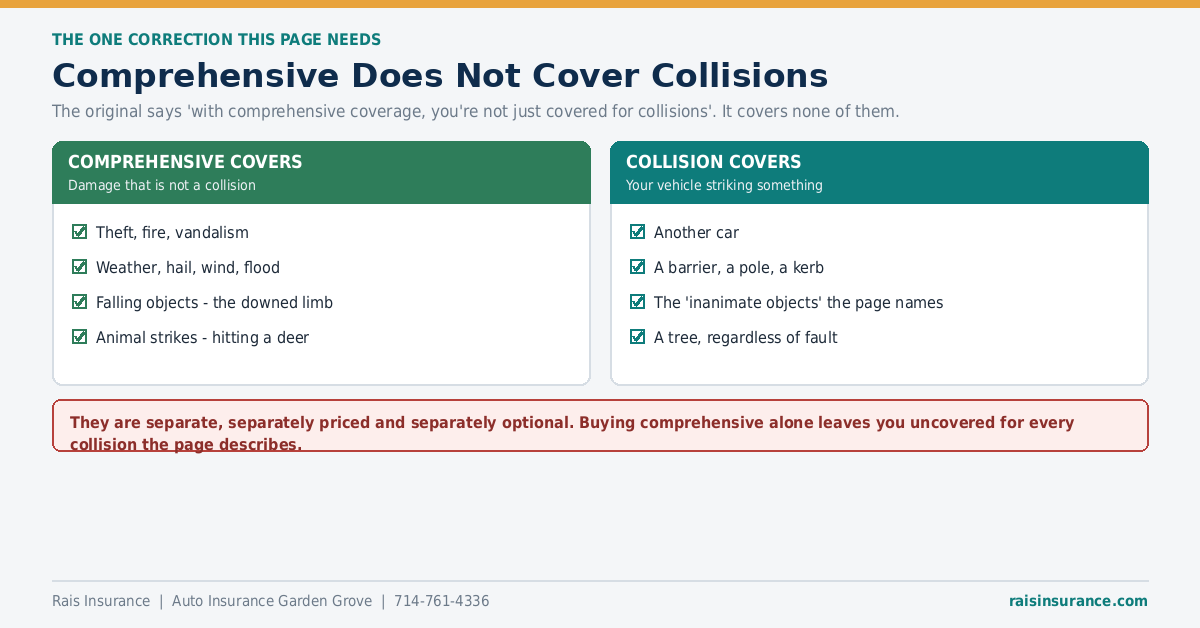
One correction first, because everything else depends on it. The original version of this page says that with comprehensive coverage “you’re not just covered for collisions”. Comprehensive covers none of them.
- Comprehensive cover answers damage that is *not* a collision: theft, fire, vandalism, weather, hail, flood, falling objects and animal strikes.
- Collision answers your vehicle striking something: another car, a barrier, a pole, a kerb, a tree.
They are separate coverages, separately priced and separately optional, each with its own deductible. A driver who buys the one without the other is not covered for any collision at all – which matters, because a collision is the commonest kind of accident there is. See what comprehensive coverage actually covers. Not all car insurance companies in garden grove, ca price theft and vandalism exposure the same way, which is exactly why comparing matters.
The four examples, sorted
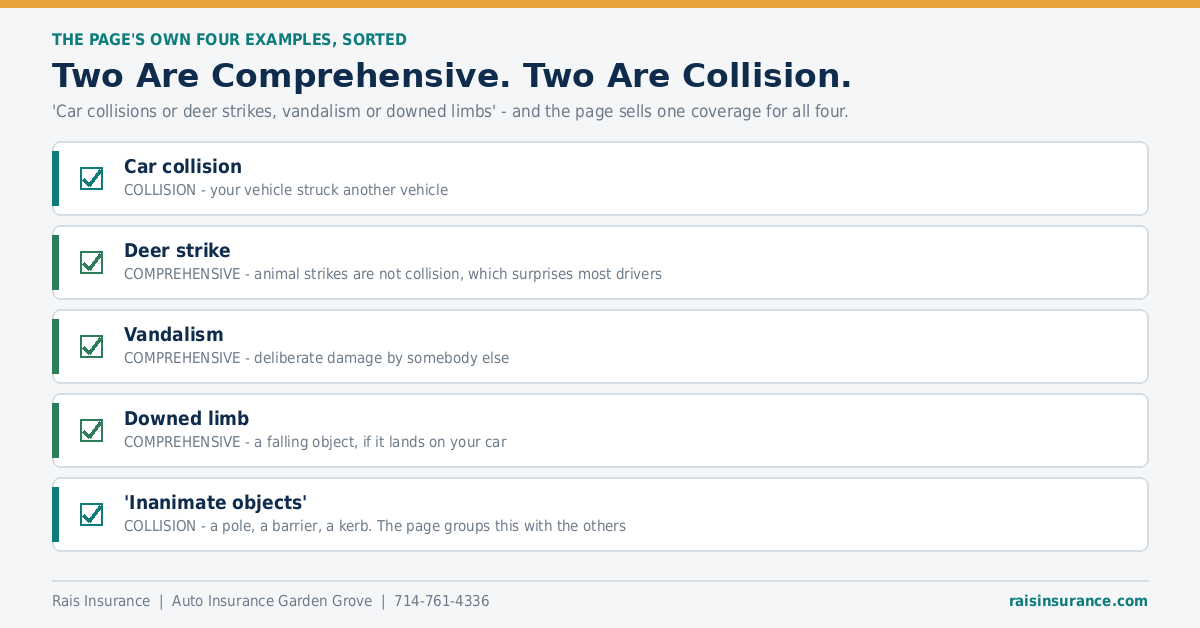
The original names four risks in one sentence – “car collisions or deer strikes, vandalism or downed limbs” – and offers a single coverage for all four. In fact they split:
- Car collision – collision coverage.
- Deer strike – the comprehensive side. Animal strikes are not collision claims, which is the single most surprising thing on this list and which the original gets right.
- Vandalism – also comprehensive.
- A downed limb landing on your car – the same side. Though driving *into* a fallen branch is a collision claim.
The page also mentions “collisions with inanimate objects” – a pole, a barrier, a kerb. Those are collision claims too. See three road hazards and three coverages for the same sorting applied to potholes. Knowing which coverage responds is half the battle when insurance repairs garden grove residents need get underway quickly.
Is It Worth the Extra Premium?
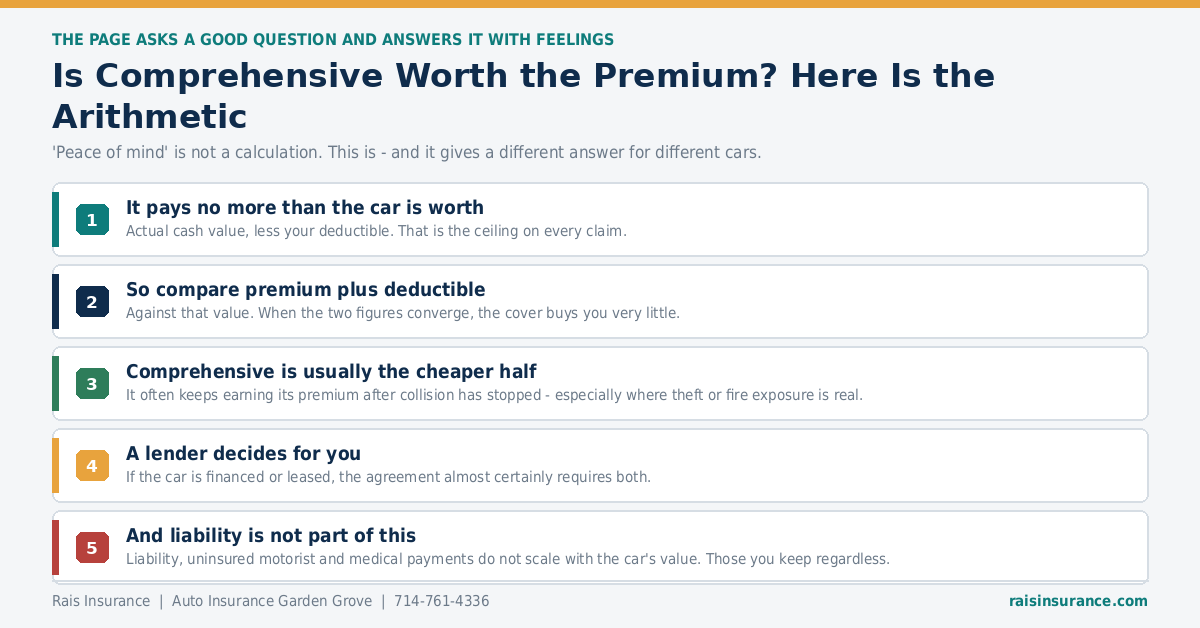
The original answers this with peace of mind. That is a real thing to want, but it is not a calculation – and the honest answer is that comprehensive is clearly worth it on some cars and clearly not on others:
- It pays no more than the car is worth. Actual cash value, less your deductible. That is the ceiling on every claim, whatever you have paid in premium.
- So compare premium plus deductible against that value. As the two figures converge, the cover is buying you progressively less. There is no fixed threshold – it depends on the car and how easily you could replace it.
- It is usually the cheaper half. The cover often keeps earning its premium after collision has stopped, particularly where theft, fire or weather exposure is real.
- A lender may decide for you. If the vehicle is financed or leased, the agreement almost certainly requires both coverages for the life of the loan.
- Liability is not part of this calculation. Liability, uninsured motorist and medical payments do not scale with the car’s value – they scale with what you could be sued for. Those you keep regardless.
The full working is on our when collision and comprehensive stop earning their premium page. Chasing cheap car insurance garden grove quotes without running this math can mean paying for cover that’s barely worth its premium.
One thing minimum coverage does not do
The original suggests carrying “minimum coverage for collisions and liability” as the alternative. Worth being precise: California’s minimum is liability only – bodily injury and property damage. Collision is not part of it. So the choice is not between more and less; it is between covering your own vehicle and not covering it at all. See how liability limits actually work. It’s a distinction worth understanding before you assume auto insurance in garden grove, ca at the state minimum covers your own car.
One more coverage belongs in any version of this decision and is missing from the original: uninsured and underinsured motorist. It is optional in California, a carrier must obtain your decline in writing, and it is what responds when the driver who hits you has no insurance or not enough of it.
The Risks That Actually Exist Here
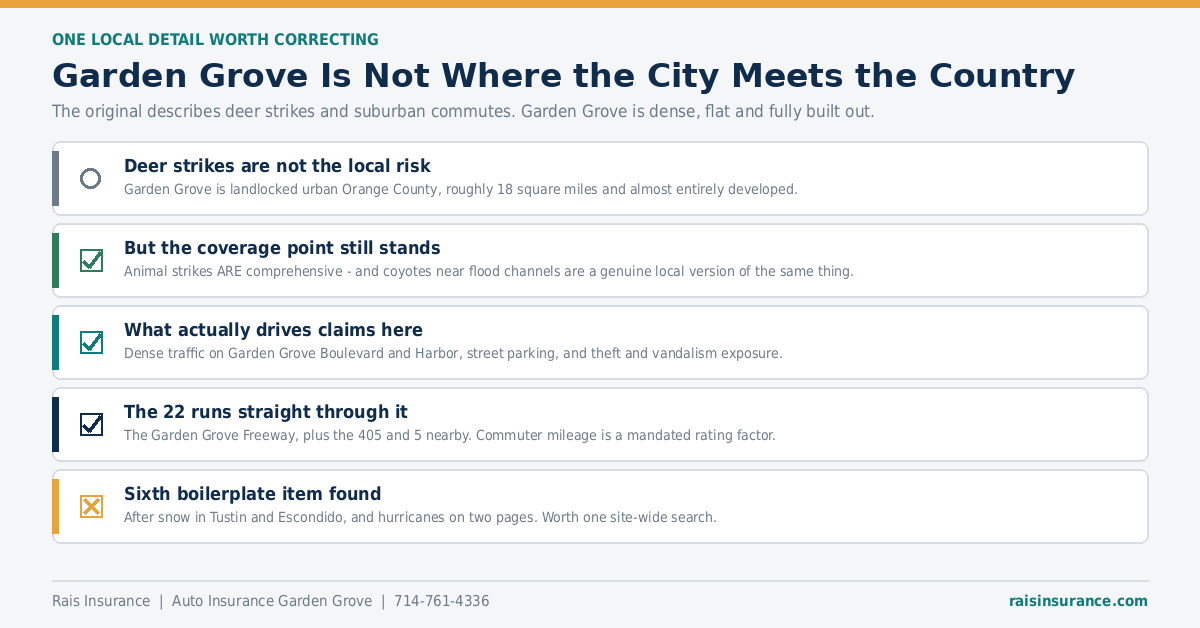
The original describes “suburban areas” where “the city and the country meet”, with deer strikes and long evening commutes. That is a fair picture of somewhere – it is not a picture of Garden Grove, which is dense, flat and almost entirely built out across about eighteen square miles.
The car insurance point survives the correction, though, and it is worth keeping: animal strikes really are comprehensive rather than collision. The local version is coyotes near the flood control channels rather than deer, and the claim works identically.
What genuinely drives claims here is dense arterial traffic, street parking, and theft and vandalism exposure – all of which this cover answers. These are the real risks a car insurance garden grove policy should be priced against, not a generic suburban template.
Driving in Garden Grove
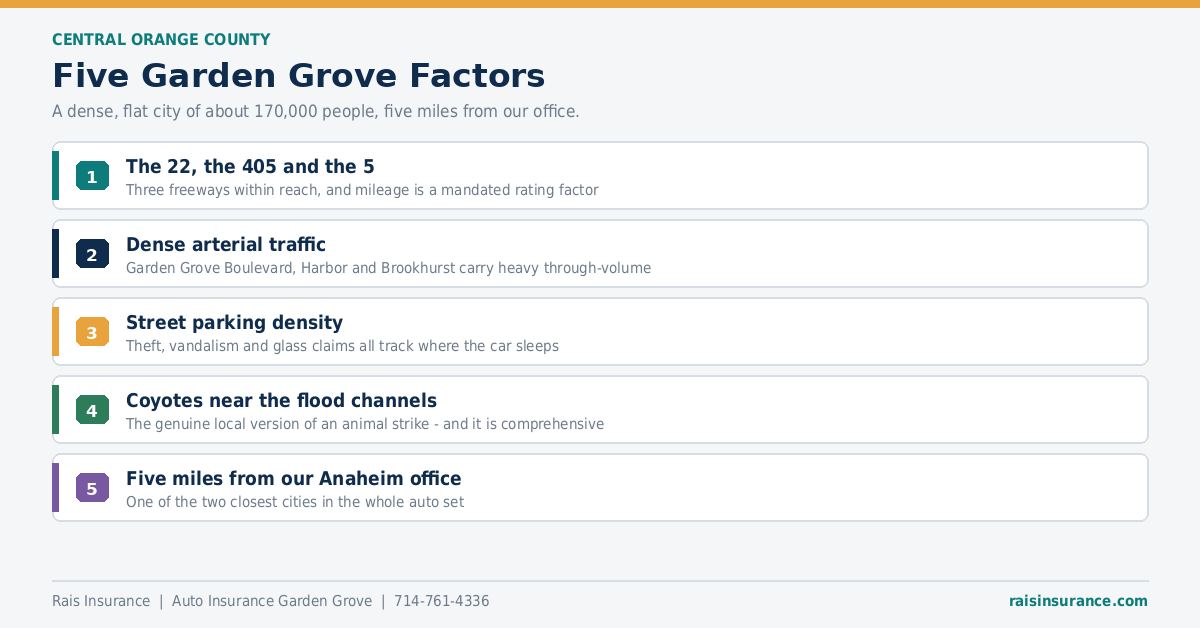
Five things that shape car insurance Garden Grove rates specifically, on top of the auto insurance Garden Grove basics above:
- The 22, the 405 and the 5. The Garden Grove Freeway runs straight through the city, and annual mileage is one of the factors California law requires to weigh most heavily.
- Dense arterial traffic. Garden Grove Boulevard, Harbor and Brookhurst carry heavy through-volume for a city of this size.
- Street parking density, which drives theft, vandalism and glass claims.
- Coyotes near the flood channels, which is the genuine local animal-strike exposure.
- About five miles from our Anaheim office – one of the two closest cities in our whole auto set.
These five factors are exactly what shape car insurance in garden grove, ca pricing, more than a generic statewide estimate ever could.
Working Out What You Need
The original’s underlying point is sound: an unpredictable accident should not put a financial strain on your family. Where we would put it differently is that the way to prevent that is not to buy the broadest possible policy – it is to know which coverages you hold, which you have declined, and why.
We can work through your auto insurance with you. As an independent broker we place business across a panel of carriers rather than selling one company’s products, so one set of details gets quoted several times – see the insurance companies we represent. We are not an insurance company; the carrier issues the policy and pays the claim, and there is no fee to you for the comparison. The current minimum requirements are on our auto insurance in California page. Every one of our auto insurance quotes in garden grove, ca starts from that same principle — know what you hold before deciding what to add.
Auto Insurance in Garden Grove – Frequently Asked Questions
Q1. Does comprehensive coverage cover collisions?
No. Comprehensive answers damage that is not a collision – theft, fire, vandalism, weather, falling objects and animal strikes. If your vehicle strikes another car, a barrier or a pole, that is collision coverage, which is separate and separately optional. Holding comprehensive without collision is more common than people realise. It’s one of the more common mix-ups car insurance companies in garden grove, ca see on new applications.
Q2. Is hitting a deer comprehensive or collision?
Comprehensive, which surprises most drivers because it feels like a collision. It generally works in your favour: comprehensive claims are often treated more leniently at renewal than at-fault collision claims, and comprehensive usually carries the lower premium of the two.
Q3. Is comprehensive coverage worth the extra premium?
It depends on the car, and the calculation is straightforward. Comprehensive pays no more than the vehicle’s actual cash value, less your deductible – so compare your annual premium plus the deductible against what the car would actually return. As those figures converge, the cover buys you less. Comprehensive is usually the cheaper of the two physical damage coverages, so it often keeps earning its premium after collision has stopped. That’s the real test behind any cheap car insurance garden grove quote — not just the sticker price.
Q4. Is comprehensive the same as full coverage?
No. ‘Full coverage’ has no legal definition – it is shorthand for liability plus collision plus comprehensive together. Comprehensive alone covers none of your collisions and none of your liability to other people, so it is one part of a policy rather than a complete one. Knowing this is basic homework before buying auto insurance in garden grove, ca.
Q5. Does comprehensive cover vandalism and falling branches?
Yes to both. Deliberate damage by somebody else is a comprehensive claim, and so is a falling object such as a tree limb landing on your parked car. Note the distinction from collision: if you drive into a fallen branch, that is a collision claim.
Q6. What happens if my car is stolen?
Comprehensive pays its actual cash value at the time of the theft, less your deductible – not what you paid for it and not what a replacement costs today. On an older vehicle that ceiling arrives sooner than most people expect, which is part of the decision about whether to carry the coverage at all. That ceiling is worth knowing before insurance repairs garden grove shops give you an estimate on an older vehicle.
Q7. Do I still need comprehensive once my car is paid off?
The lender requirement disappears, so the decision becomes yours. Run the same arithmetic: premium plus deductible against the car’s current value. Many drivers keep comprehensive longer than collision, because it is cheaper and because theft, fire and weather do not care how old the vehicle is.
Q8. Are there animal strike risks in Garden Grove?
Deer, realistically no – Garden Grove is dense urban Orange County. Coyotes near the flood control channels are the genuine local version, and a collision with one is a comprehensive claim exactly as a deer strike would be. The coverage point in the original is right even though the example is not local. It’s the kind of local detail worth checking on any car insurance garden grove policy.
Q9. What is a comprehensive deductible?
The amount taken off before the carrier pays anything on a comprehensive claim. It is separate from your collision deductible and can be set at a different level. Glass claims are often the exception, with many California policies applying a lower or waived deductible to windscreen repair.
Q10. How do I get a Garden Grove auto insurance quote?
Call Rais Insurance on 714-761-4336, email rai@raisinsurance.com, or visit 2612 W. Lincoln Avenue, Suite 103, Anaheim, CA 92801 – about five miles away. We are an independent broker, so one set of details is quoted across several carriers, and there is no fee to you for the comparison. That’s the fastest way to get an auto insurance garden grove quote built around your actual coverage needs, and it’s the fastest way to get auto insurance quotes in garden grove, ca that reflect your actual coverage needs.
Get a Car Insurance Quote in Garden Grove
contact Rais Insurance on 714-761-4336, email rai@raisinsurance.com, or visit 2612 W. Lincoln Avenue, Suite 103, Anaheim, CA 92801. We’re happy to walk through your car insurance in garden grove, ca options over the phone before you commit to anything. Ask us for car insurance quotes in garden grove, ca that spell out exactly which of these coverages you’re carrying.
Have your car insurance declarations page to hand and check one line before you call: whether you carry collision as well as comprehensive. They answer different accidents, and holding only one of the two is commoner than most drivers expect.
FIND US ON THE MAP
