

General Liability Insurance Lakewood
Optimists will tell you the best is yet to come. In insurance, the next claim is usually somewhere closer than that. The useful question is not whether you are covered, it is which of your policies would actually answer when something goes wrong – because the answer changes completely depending on whether the accident happened in your private life or in the course of your business.
That distinction is what this page is about. Personal liability and general liability insurance are both called liability insurance, both protect you from being personally out thousands or hundreds of thousands of dollars, and neither one answers the other’s claims. Below: which policy covers what, where dog bite and breed exclusions actually sit, and the four situations that fall in the gap between the two.
Personal Liability or Commercial Liability? They Are Not the Same Policy
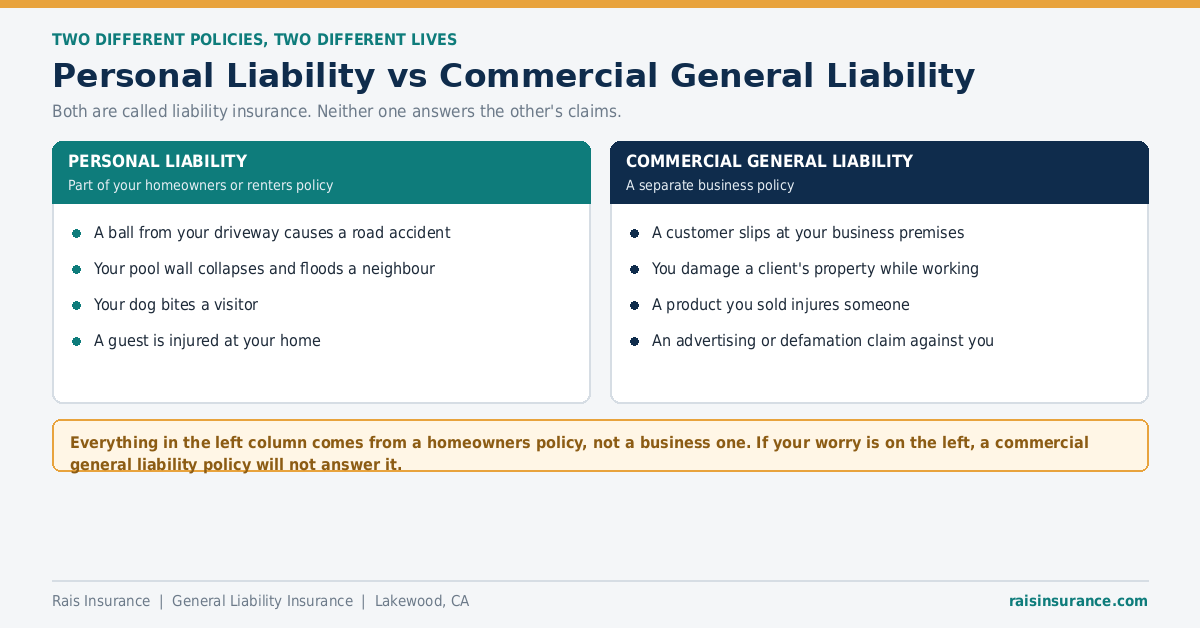
Consider the kind of thing that goes wrong in ordinary life. You are shooting hoops in the driveway, the ball bounces into traffic and causes a pile-up. Do you have tens of thousands of dollars for the medical bills, plus the cost of the cars? Or a pool wall gives way and hundreds of gallons of water go racing into your neighbour’s basement. Normal life produces genuinely bizarre situations, and the bills attached to them are real.
Every one of those is a personal liability claim, answered by the liability section of a homeowners or renters policy. So is a guest injured at your home, and so is a dog bite. None of them is a commercial general liability claim, and a business policy will not respond to any of them.
General liability insurance – the commercial policy this page sits under – answers a different set entirely: a customer slipping at your business premises, damage you cause to a client’s property while working, a product you sold injuring somebody, or an advertising or defamation allegation arising from your business. If you want the detail on how that policy is built, see what a commercial general liability policy actually covers.
The practical test is simple: was the activity part of how you earn a living, or part of how you live? Personal liability stops precisely where business activity begins.
Know Your Exclusions – Starting With the Dog
The one thing you have to be aware of with any policy is the exclusions. They are where a policy tells you the truth about its scope, and the most commonly encountered one in Lakewood is animal-related.
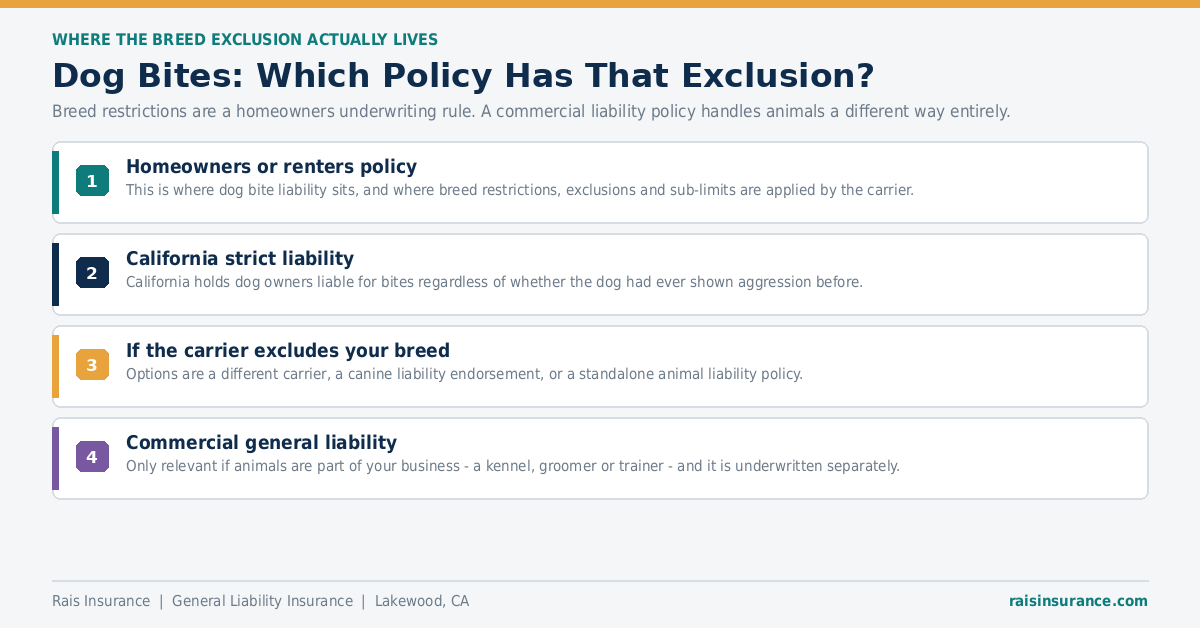
If you own a certain breed of dog, you need to know whether your carrier covers a bite at all. Breed restrictions, sub-limits and outright exclusions are common – and they are a homeowners underwriting rule, not a commercial one. Dog bite liability lives on your home policy, so that is the document to check.
Three things worth knowing before you look:
- California is a strict liability state for dog bites. The owner is liable regardless of whether the animal had ever shown aggression before. The widespread belief that a dog gets one free incident does not apply here.
- Carriers differ enormously. One insurer’s excluded breed is another’s standard risk. If your current carrier excludes your dog, moving carrier is often the whole solution.
- There are alternatives. A canine liability endorsement, or a standalone animal liability policy, will cover a dog your home insurer will not.
Animals only become a commercial liability question if they are part of your business – a kennel, a groomer, a trainer – and that is underwritten separately. For what a business policy excludes, see what general liability does not cover.
One more exclusion worth naming while you have the wording open, because the pool example above brushes against it: water that enters from outside the property is excluded from both policies. Surface water, rising water and mudflow need flood insurance in California, which is bought separately.
The Gap in the Middle – Where Neither Policy Responds
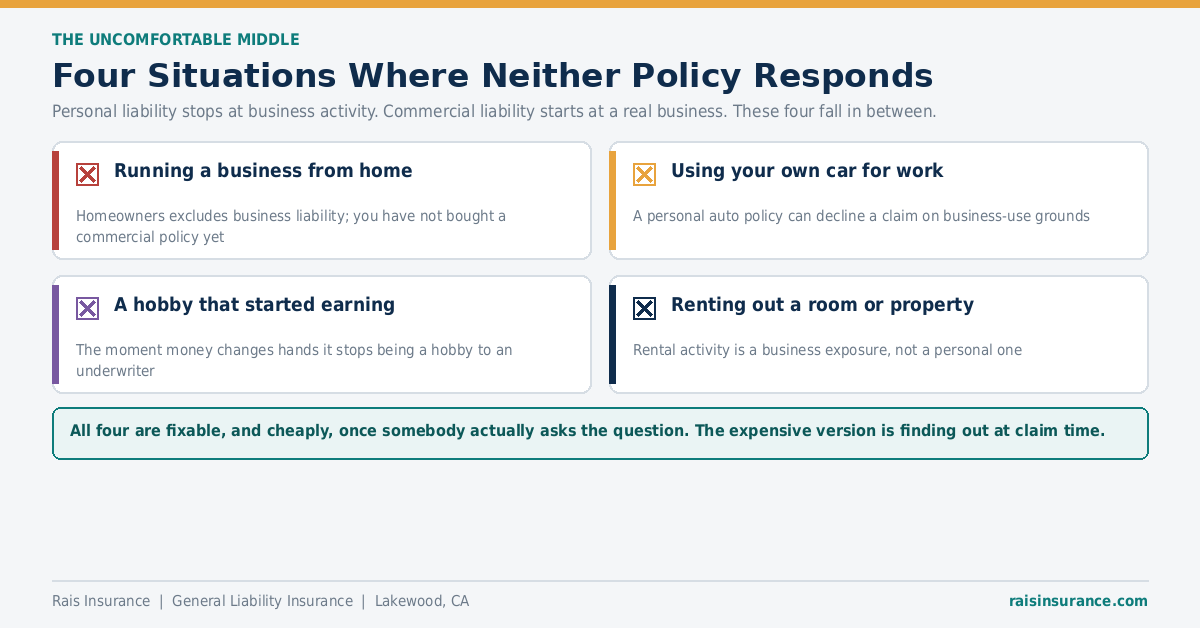
Personal liability stops at business activity. Commercial liability starts at a recognisable business. Four very common situations fall in between, and in each one people generally assume they are covered:
- Running a business from home. Your homeowners policy excludes liability arising out of a business, and you have not bought a commercial policy because it did not feel like a real business yet.
- Using your own car for work. Commuting is fine. Deliveries, carrying tools, visiting job sites or transporting clients is business use, and a personal auto carrier can decline a claim on exactly that basis.
- A hobby that started earning. Underwriters look at whether you are selling, advertising, taking bookings or holding stock – not at how you describe it. Money changing hands regularly is usually the line.
- Renting out a room or a property. Rental activity is a business exposure, not a personal one, and it needs a landlord policy, a home-sharing endorsement or commercial liability depending on the arrangement.
All four are inexpensive to fix once somebody asks the question. The expensive version is finding out at claim time, when the answer arrives in a declination letter.
Running a Business From Home in Lakewood
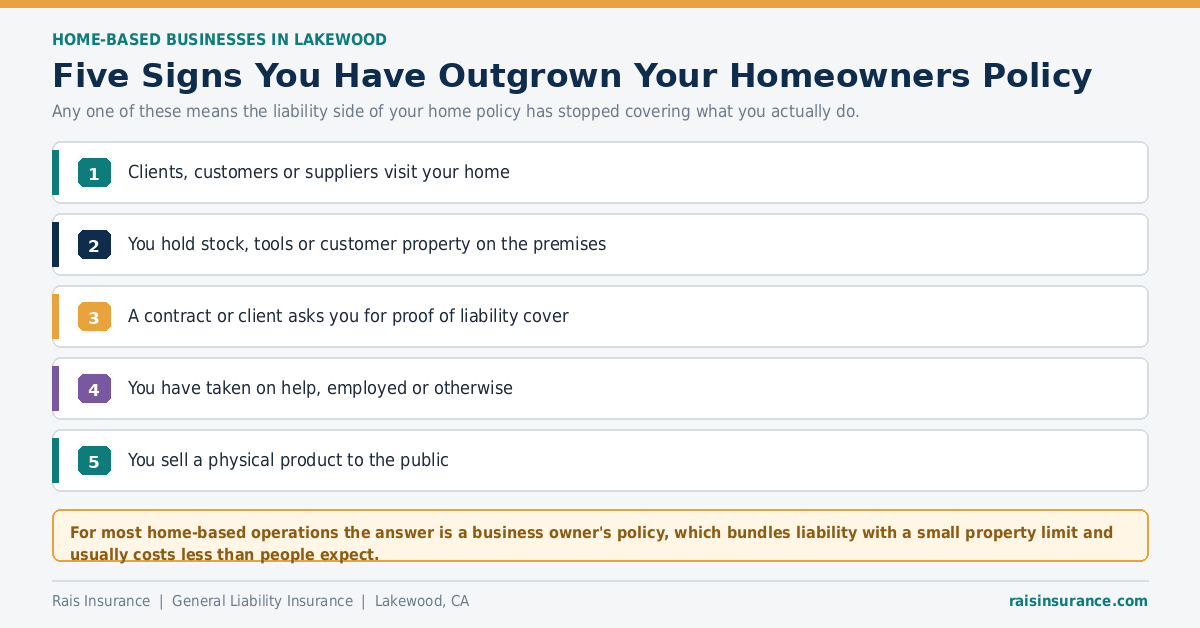
Lakewood is overwhelmingly residential, which means a large share of the businesses here are run from home. Any one of the following signs means the liability side of your home policy has stopped covering what you actually do:
- Clients, customers or suppliers come to your home
- You hold stock, tools or customer property on the premises
- A contract or a client has asked you for proof of liability cover
- You have taken on help, employed or otherwise
- You sell a physical product to members of the public
For most home-based operations the answer is a business owner’s policy, which bundles general liability with a small property limit and normally costs less than people expect. See how general liability fits alongside the other business policies, and if your work is a licensed trade, what a licensed California contractor has to carry.
If It Turns Out You Need a Commercial Policy
For a good number of Lakewood readers the honest answer to this page is that the exposure is commercial, not personal. If that is you, here is what a first general liability insurance policy looks like in practice, without the jargon:
- Limits. One million dollars per occurrence and two million in the annual aggregate is the standard starting point, and it is what most contracts ask for. Going higher costs far less than doubling, because severe claims are rare relative to ordinary ones.
- What it answers. Bodily injury and property damage you cause to somebody outside your business, personal and advertising injury claims, and small no-fault medical payments for a visitor hurt on your premises.
- Defence costs. Under a standard policy the insurer pays to defend you in addition to the limit, not out of it. For most small businesses that is worth more than the limit itself.
- The certificate. Clients, landlords and general contractors will ask for proof. A broker can issue a certificate of insurance, and add them as an additional insured, usually the same day.
- Bundling. Liability and a small property limit bought together in a business owner’s policy is normally cheaper than buying either separately.
None of that is expensive for a home-based or small operation, and business liability insurance bought early is considerably cheaper than the first claim it would have answered.
When the Underlying Limit Is Not Enough
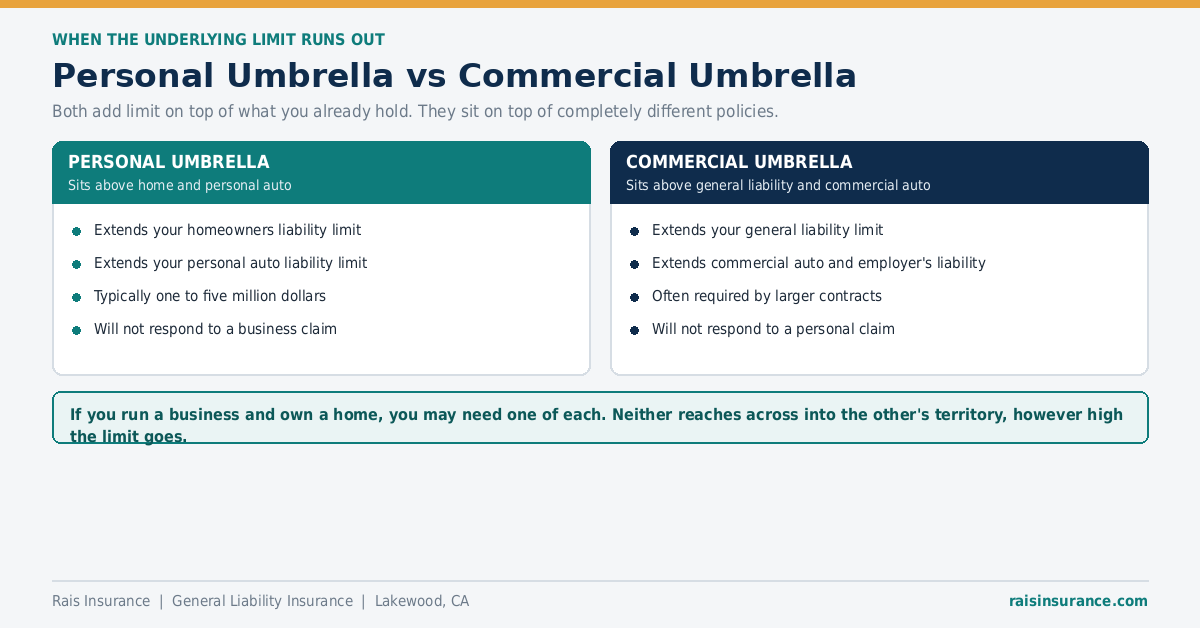
Both sides of this page have the same weakness: a liability limit that looked generous when you bought it and looks thin next to a serious injury claim. Umbrella cover is how you fix that, and there are two kinds.
A personal umbrella sits above your homeowners and personal auto liability, typically adding one to five million dollars. A commercial umbrella sits above your general liability, commercial auto and employer’s liability, and is frequently required by larger contracts.
They do not overlap. A personal umbrella will not respond to a business claim, however high the limit goes, and a commercial umbrella will not respond to a personal one. If you own a home and run a business, you may genuinely need one of each – and for most households the personal umbrella is the cheapest meaningful protection available anywhere in insurance.
Getting the Right Cover with Rais Insurance
The professional agents at Rais Insurance can point you towards the best general liability insurance Lakewood has available, or towards the right personal cover if that is where your exposure actually sits. It is not just about being covered – it is about knowing that ordinary daily life, or an ordinary day at work, will not leave you personally out of pocket for something you could have insured against.
Three questions usually settle it. Is the exposure you are worried about personal or commercial? Does your current policy exclude anything specific to your household – a breed, a pool, a home business? And is your liability limit anywhere near what a serious injury claim actually costs?
If the answer turns out to be commercial, what sets a commercial liability premium covers what you will pay and why. And if a claim is ever brought against you, the duty to defend and how a claim against you is handled sets out what your insurer owes you.
We serve Lakewood, Long Beach, Paramount, Downey and Signal Hill from our Anaheim office, and we write across California.
Liability Insurance in Lakewood – Frequently Asked Questions
Q1. What is the difference between personal liability and general liability insurance?
Personal liability is part of your homeowners or renters policy and answers accidents arising from your private life – a guest injured at your home, your dog biting someone, damage you cause to a neighbour’s property. Commercial general liability is a separate business policy answering claims that arise from business operations. Neither one reaches into the other’s territory, which is why many people need both.
Q2. Does homeowners insurance cover dog bites?
Usually yes, under the personal liability section, and it is one of the most common homeowners liability claims. But carriers apply breed restrictions, sub-limits and outright exclusions, and those vary considerably between insurers. If your carrier excludes your dog’s breed the options are a different carrier, a canine liability endorsement, or a standalone animal liability policy. Ask before a claim, not after.
Q3. Is California a strict liability state for dog bites?
Yes. California law holds a dog owner liable for a bite regardless of whether the animal had ever shown aggression before, so the common belief that an owner gets one free incident does not apply here. That makes the liability limit on your home policy, and any breed restriction attached to it, worth checking rather than assuming.
Q4. Does my homeowners policy cover my home-based business?
Only barely, and not the part that matters. Homeowners policies exclude liability arising out of a business, and cap business property at a very small on-premises limit. If clients visit, if you hold stock or customer property, or if a contract asks for proof of cover, the home policy will not answer. A business owner’s policy bundling liability with a small property limit is normally the right and inexpensive fix.
Q5. Does my personal auto policy cover me if I use the car for work?
Commuting is fine. Using the vehicle in the course of business – deliveries, carrying tools and materials, visiting job sites, transporting clients – is a different matter, and a personal auto carrier can decline a claim on business-use grounds. If the car is genuinely part of how you earn, the correct answer is either a business-use endorsement or a commercial auto policy.
Q6. When does a hobby become a business for insurance purposes?
In practical terms, when money starts changing hands with any regularity. Underwriters look at whether you are selling, advertising, taking bookings or holding stock rather than at how you describe it. The point matters because your homeowners liability stops at business activity, so a hobby that has quietly started earning can sit in a gap with nothing covering it.
Q7. Do I need business insurance to rent out a room or a property?
Rental activity is a business exposure rather than a personal one, so a standard homeowners policy is generally not the right home for it. Depending on the arrangement you may need a landlord or dwelling policy, a home-sharing endorsement, or commercial liability. Short-term letting in particular is written very differently by different carriers, so it is worth a specific conversation.
Q8. What is the difference between a personal umbrella and a commercial umbrella?
A personal umbrella adds limit above your homeowners and personal auto liability. A commercial umbrella adds limit above your general liability, commercial auto and employer’s liability. They sit on top of completely different underlying policies and neither one responds to the other’s claims. If you own a home and run a business, you may genuinely need one of each.
Q9. How do I find out what my policy excludes?
Read the exclusions section of your own policy wording rather than a summary, and pay particular attention to anything animal-related, anything business-related, and any named sub-limit. Exclusions are where a policy tells you the truth about its scope. If a broker cannot explain an exclusion to you in plain language, that is worth noticing in itself.
Q10. How much does liability insurance cost in Lakewood?
It depends entirely on which policy you actually need. Personal liability is normally bundled into a homeowners or renters premium rather than priced separately, and raising the limit is usually inexpensive. Commercial general liability is priced from your operations, revenue or payroll, claims history and limits. The first useful step is establishing which side of the line your exposure sits on.
Get a Liability Insurance Quote in Lakewood
contact Rais Insurance and we will work out which policy your exposure actually belongs to before quoting anything. Call 714-761-4336, email rai@raisinsurance.com, or visit 2612 W. Lincoln Avenue, Suite 103, Anaheim, CA 92801.
Bring your current homeowners declarations page. Two minutes with the liability limit and the exclusions page usually tells us whether you have a gap, and roughly what it would cost to close it.
