

General Liability Insurance Laguna Hills
One point of precision before anything else, because the wording matters at claim time: the policy responds to bodily injury and property damage, not to purely financial loss. A third party who simply loses money because of a decision you made, with nobody hurt and nothing damaged, is not making a claim this policy answers. That distinction decides more declined claims than any other.
This page is written mainly for contractors and trades working across Laguna Hills and the Saddleback Valley, because that is where the most expensive misunderstandings sit. Below: what a licensed California contractor actually has to carry, why your CSLB bond is not insurance, which policy answers which claim, and exactly what a general contractor will ask you for before you set foot on site.
Why Your Business Needs General Liability Insurance
Business liability insurance is the most basic and necessary form of cover a company buys. Accidents happen, and when they do somebody usually gets hurt or something gets broken. In the United States the injured party can sue you for the cost of their recovery or for the property they lost, and general liability insurance in Laguna Hills is the policy that stands between that claim and your own money.
Historically, groups of businesses facing the same perils pooled funds to protect each other against them. Modern insurers do that job at scale, which is what allows you to assemble a policy around the specific risks your operation actually faces rather than a generic bundle. This is the piece almost every business needs regardless of what else goes into that policy.
What the policy pays for and how the limits work are covered on our Hacienda Heights page – see what each coverage part of the policy actually does.
If You Are a Contractor, General Liability Is Not the Only Cover You Need
General liability insurance for contractors is often described as the only cover a trade needs, on the reasoning that contractors typically do not own commercial premises or run a payroll. The first half of that is fair. The conclusion is not, and acting on it leaves a licensed California contractor exposed in at least three directions.
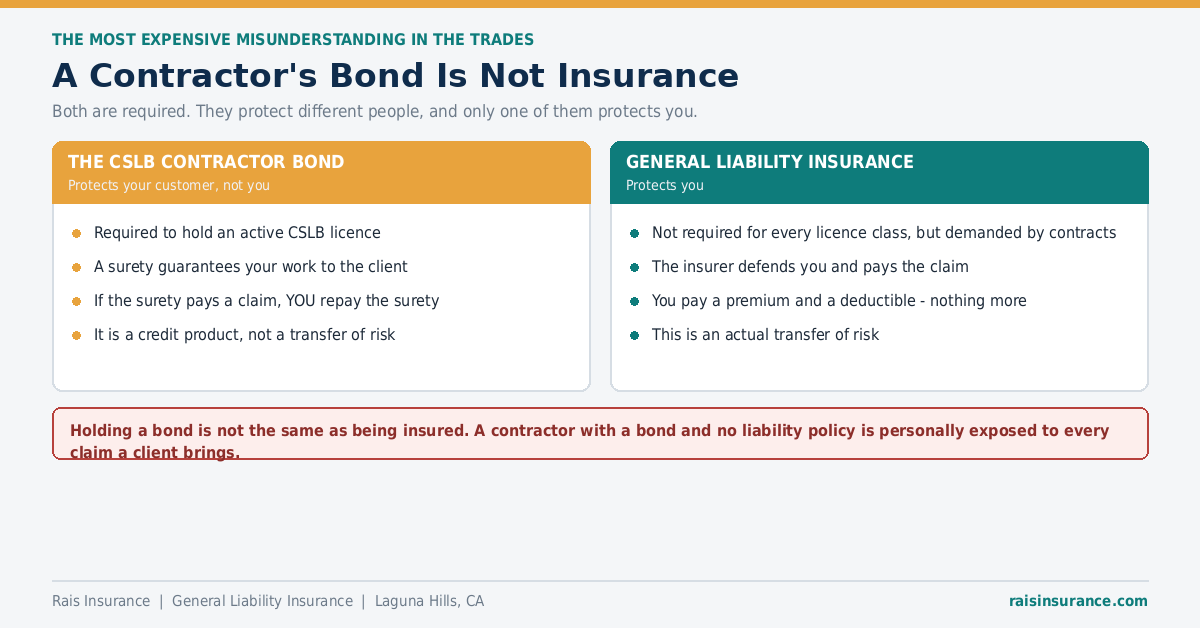
Here is what a licensed contractor in California realistically carries:
- The CSLB contractor bond. Required to keep your licence active. It is not insurance – see the next section, because this is the single most expensive misunderstanding in the trades.
- General liability. Not mandatory for every licence class, but effectively mandatory in practice, because no general contractor or commercial client will let you start without it.
- Workers’ compensation. Required from your first employee. Roofing contractors are required to carry it even with no employees at all, which catches people out every year.
- Commercial auto. Your truck is a business vehicle. A personal auto policy can decline a claim on exactly that basis, and frequently does.
- Tools and equipment cover. Inland marine. A property policy is written around a fixed address; your tools are not at a fixed address, which is the whole problem.
Which of those apply depends on your licence class and whether you employ anyone. The point is that the list has five items on it, not one. For how general liability and workers’ compensation interact once you do have a crew, see general liability paired with workers’ compensation for contractors.
Your Contractor’s Bond Is Not Insurance
This is worth stating as directly as possible, because a great many licensed contractors believe they are insured when they are only bonded.
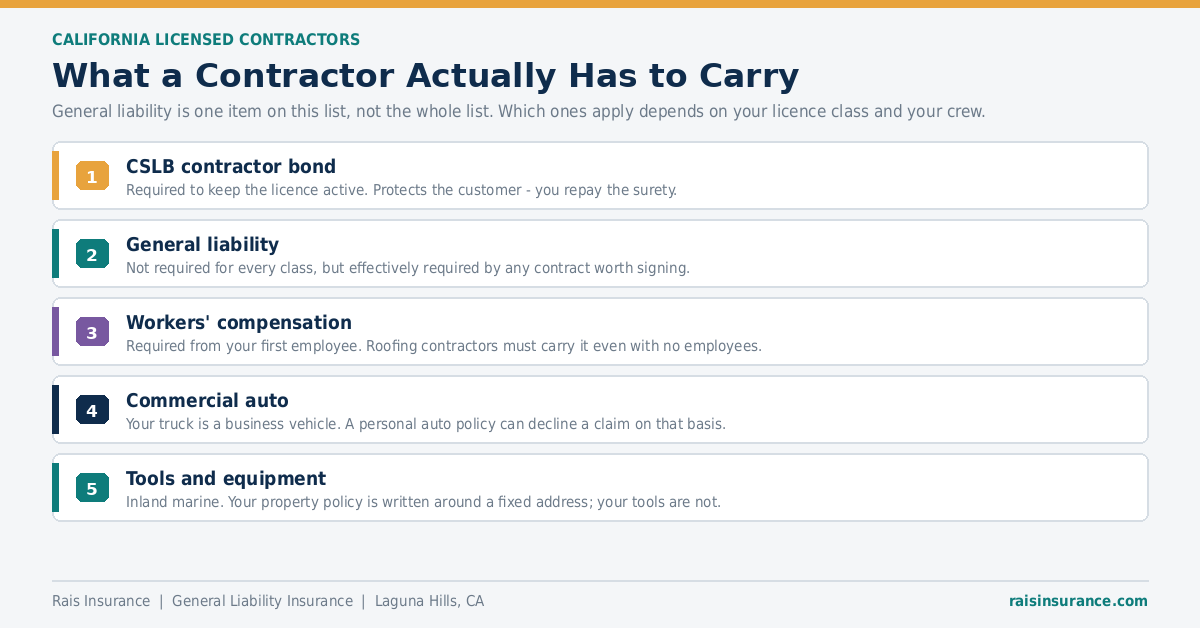
A bond protects your customer. Insurance protects you. The CSLB contractor bond exists so that a client who is harmed by your work has somebody to claim against. If the surety pays that claim, it then comes to you to be reimbursed – the money passes through the surety and lands back on your books. Economically the bond behaves far more like a credit facility than like insurance.
A liability policy does the opposite. The insurer defends the claim, pays what is owed, and your exposure stops at the premium and any deductible. Nobody comes back to you afterwards for reimbursement. That is what a genuine transfer of risk looks like, and it is the thing a bond does not do.
A contractor holding a bond and no liability policy is personally exposed to every claim a client brings. Both are needed, and they are not substitutes for one another.
Which Policy Pays for What
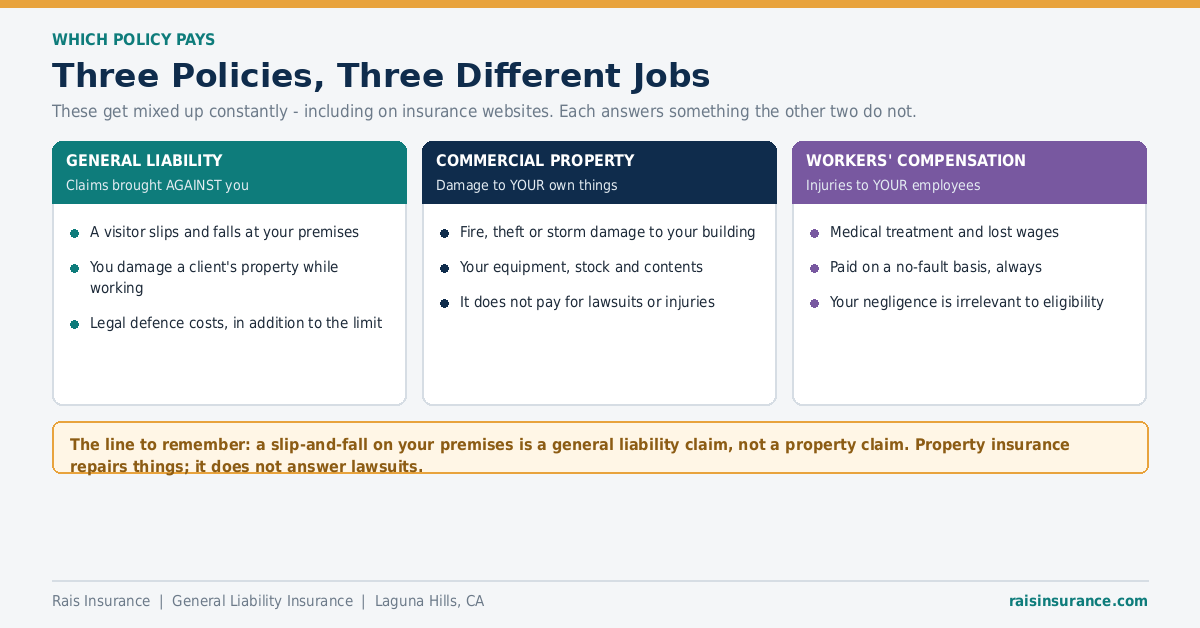
Three policies get mixed up more often than any others, including on insurance websites. Each answers something the other two do not.
Property insurance does not pay for lawsuits
It is sometimes said that property insurance covers the cost of lawsuits over injuries on your premises – a slip-and-fall, or something worse. That is not right, and it matters, because it describes the job general liability does.
Commercial property insurance repairs or replaces your own things – your building, your equipment, your stock – after events like fire, theft or storm damage. It does not answer a claim brought by somebody else and it does not pay their medical bills or a legal award. A slip-and-fall on your premises is a liability claim, answered under the premises section of the policy. If you want the detail on what a property policy does cover, see commercial property insurance.
Workers’ compensation has nothing to do with your negligence
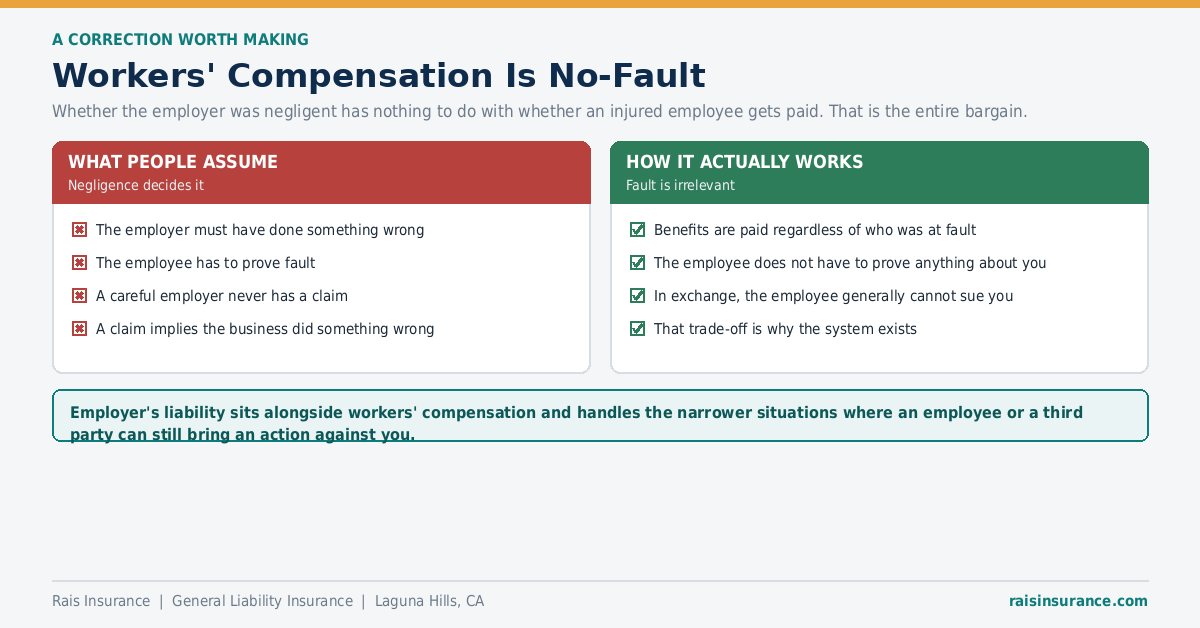
The other common framing is that workers’ compensation is there in case an employee is injured through the employer’s negligence. Fault does not come into it.
Workers’ compensation in California is no-fault. An injured employee receives medical treatment and wage replacement regardless of who was at fault, and does not have to prove that you did anything wrong. In exchange, the employee generally cannot sue you over the injury. That trade-off is the entire reason the system exists, and it is why a careful employer still has claims.
Employer’s liability sits alongside workers’ compensation and handles the narrower cases where an action against you is still possible.
What a General Contractor Will Ask You For
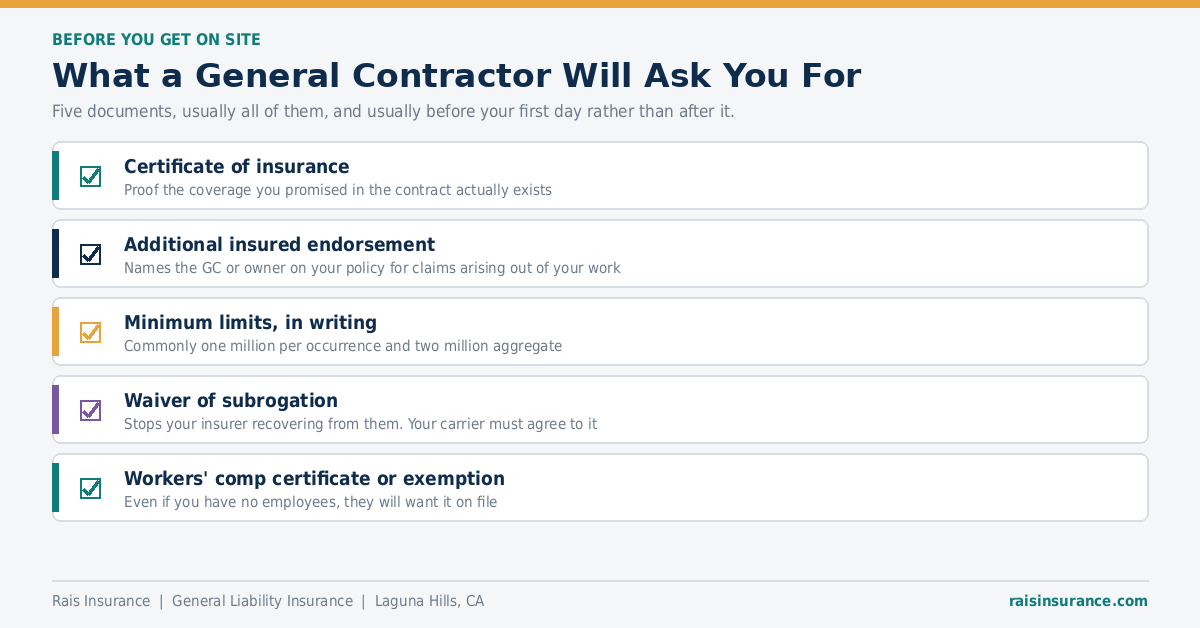
If you subcontract on residential or light commercial work around Laguna Hills, Mission Viejo or Lake Forest, expect to be asked for five things before your first day rather than after it:
- A certificate of insurance – proof that the cover you promised in the contract actually exists.
- An additional insured endorsement – naming the general contractor or property owner on your policy for claims arising out of your work.
- Minimum limits in writing – commonly one million per occurrence and two million aggregate on residential and light commercial work, more on larger projects.
- A waiver of subrogation – preventing your insurer from recovering against them. Your carrier has to accept it, normally by endorsement.
- A workers’ compensation certificate or exemption – they will want one on file even if you have no employees.
All five are routine and a broker can issue the paperwork quickly, usually the same day. The reason to sort them before you bid rather than after you win is simple: a limit you have not bought is a limit you cannot certify, and the job will wait while you buy it.
If You Run a Small Business Rather Than a Trade
Liability cover is still vital, and it is still not the only policy you need. Once you have employees you have a workers’ compensation obligation. Once you have premises, stock or equipment you have a property exposure. If clients pay you for advice or expertise rather than for a physical product, professional liability sits on top of all of it.
Most small Laguna Hills businesses can buy liability and a modest property limit together in a business owner’s policy, which is normally cheaper than buying the two separately. For how the wider set fits together, see how general liability fits alongside the other liability policies, and for what the policy will not answer, what general liability does not cover in detail.
General Liability Insurance in Laguna Hills and the Saddleback Valley
Laguna Hills sits in south Orange County alongside Laguna Woods, Aliso Viejo, Mission Viejo, Lake Forest and Laguna Niguel. It is a residential market above all, which shapes the insurance question: the businesses we place cover for here are overwhelmingly trades, home-service firms and small professional practices working inside other people’s homes.
That has a practical consequence. When your work happens at a customer’s property rather than at your own, almost every claim you are likely to face is a liability claim rather than a property one – damage to their home, injury to somebody in it, or a dispute over work you completed. It is the reason this page spends most of its length on liability and comparatively little on premises.
Setting Up the Right Policy with Rais Insurance
Whether you need this cover inside a broader business insurance policy, or on its own as a contractor or sole trader with no commercial premises and nobody on the payroll, we can help you put the right policy together for your business.
Four questions usually settle it. What does your licence class actually require? What do the contracts you sign require, which is often more? Which of the five items on the contractor list above genuinely apply to you? And are your limits high enough to certify without a scramble when a general contractor asks? Answer those four and the policy shapes itself.
If a claim does arrive, the first two days matter more than most people expect – see what to do in the first 48 hours after an incident. And if the claim is one you believe is unfounded, the duty to defend and how a false claim is handled covers what your insurer owes you.
General Liability Insurance Laguna Hills – Frequently Asked Questions
Q1. Is general liability the only insurance a contractor needs?
No, and this is a costly assumption. A licensed California contractor typically needs the CSLB contractor bond to keep the licence active, general liability because contracts demand it, workers’ compensation once there is a crew, commercial auto for the work truck, and inland marine for tools and equipment. Which ones apply depends on your licence class and whether you employ anyone, but general liability alone is rarely the complete answer.
Q2. Does my contractor’s bond mean I am insured?
No. A bond and an insurance policy do opposite things. The CSLB contractor bond protects your customer: if the surety pays out on a claim against you, it then comes to you to be reimbursed. General liability insurance protects you: the insurer defends the claim and pays it, and your exposure is limited to the premium and any deductible. A bond is closer to a credit product than to a transfer of risk.
Q3. Does property insurance cover a slip-and-fall on my premises?
No. Injuries to visitors on your premises are a general liability claim, under premises liability. Commercial property insurance repairs or replaces your own building, equipment and stock after events like fire or theft – it does not answer lawsuits and it does not pay somebody else’s medical bills or legal award. The two are frequently confused, including on insurance websites.
Q4. Do I need workers’ compensation if my employee’s injury was not my fault?
Yes. Workers’ compensation in California operates on a no-fault basis, so whether the employer was negligent has no bearing on whether an injured employee receives benefits. That is the bargain at the centre of the system: the employee is paid without having to prove fault, and in exchange generally cannot sue the employer. Employer’s liability sits alongside it for the narrower situations where an action is still possible.
Q5. Do I need workers’ compensation in California if I have no employees?
Usually not, with one significant exception: roofing contractors are required to carry workers’ compensation even with no employees. Beyond that, the moment you take on your first employee the requirement applies. Be careful with workers you treat as independent contractors – if the relationship does not hold up, an uninsured injury becomes your problem and a general contractor’s certificate file will not protect you.
Q6. What limits will a general contractor ask me to carry?
One million dollars per occurrence and two million in the aggregate is the common request on residential and light commercial work in Orange County, though larger projects ask for more. The contract will also usually require the general contractor or owner to be named as an additional insured, a certificate of insurance produced before you start, and sometimes a waiver of subrogation that your carrier has to accept in writing.
Q7. What is an additional insured endorsement and why does everyone want one?
It extends your liability policy to cover the general contractor or property owner for claims arising out of your work. It gives them the protection of your policy directly rather than relying on your promise to indemnify them, which is why it appears in almost every subcontract. Your broker can issue the endorsement and the accompanying certificate quickly, usually the same day.
Q8. How much does general liability insurance cost for a Laguna Hills contractor?
There is no flat rate. Premium is driven by your trade, your annual receipts or payroll, your claims history, the limits you buy, and how much of your work is subcontracted out. A handyman and a roofing contractor are priced very differently for identical limits, because the exposures are not comparable. A broker can put the same information to several carriers and show you the spread.
Q9. Does general liability cover damage to the work I performed?
Generally not. The standard policy excludes damage to your own completed work, on the reasoning that faulty workmanship is a business cost rather than an insurable accident. What it does answer is damage your work causes to other property – if a plumbing error floods a client’s finished floor, the floor is a claim while the pipework usually is not. This distinction catches out more contractors than any other.
Q10. Do I need general liability insurance if I work alone as a sole trader?
Almost certainly. Having no employees removes the workers’ compensation question in most trades, but it does nothing about liability – a sole trader can still injure somebody or damage a client’s property, and a homeowners policy excludes liability arising out of a business. In practice, most Laguna Hills clients and general contractors will not let you start without proof of cover anyway.
Get a General Liability Insurance Quote in Laguna Hills
contact Rais Insurance to talk it through. Call 714-761-4336, email rai@raisinsurance.com, or visit 2612 W. Lincoln Avenue, Suite 103, Anaheim, CA 92801.
If you are a contractor, bring your licence number and any subcontract you have been asked to sign. Between them they tell us what you are required to carry and what you are being asked to carry, and those two things are rarely the same.
