

General Liability Insurance Hacienda Heights
If you run a business in Hacienda Heights you already know the day rarely goes to plan. Preparing for the things you cannot predict is what keeps a bad afternoon from turning into a financial problem, and general liability insurance in Hacienda Heights is the policy that does most of that work.
What most pages on this subject skip is the part that actually matters when you claim: what each section of the policy does. That policy is not one pool of money. It is three named coverage parts plus defense costs, and knowing which part answers which situation is the difference between a claim being paid and a claim being declined.
Rais Insurance places general liability insurance for businesses across Hacienda Heights, La Puente, Rowland Heights, City of Industry, Walnut and La Habra Heights. Below: what is inside the policy, the seven named offenses under Coverage B, and the four exposures that are frequently described as general liability but belong to entirely different policies.
What Is Actually Inside a General Liability Policy
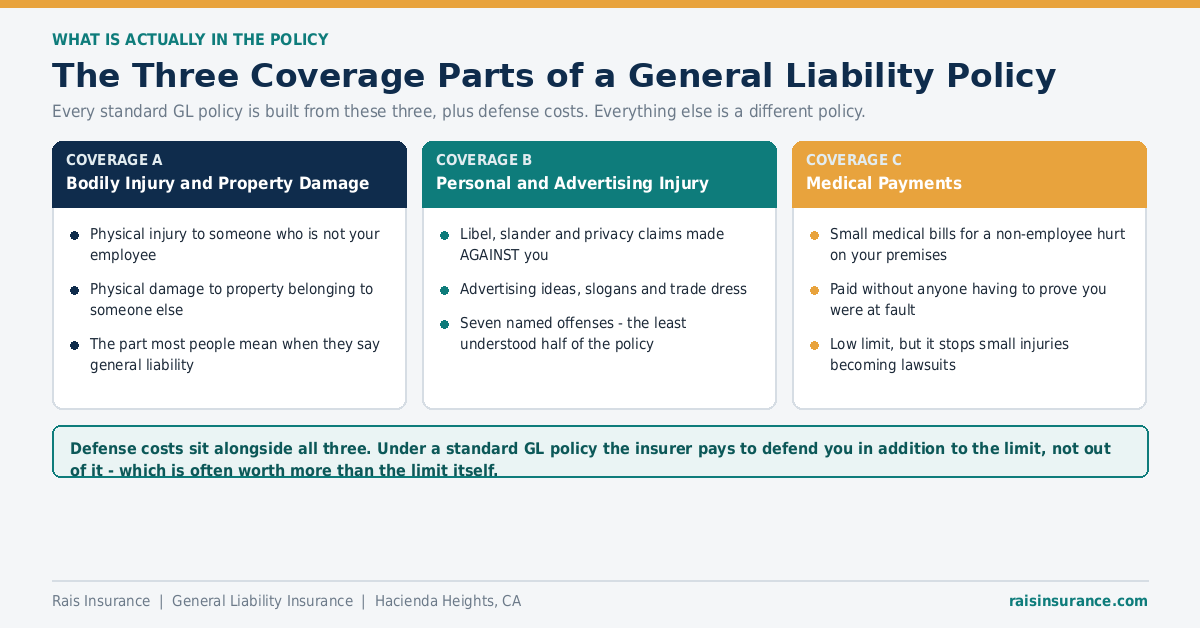
Every standard policy of this kind is built from three coverage parts. They are usually labelled A, B and C on the schedule, and they answer different things:
Coverage A – Bodily Injury and Property Damage
This is the part most people mean when they say general liability. It responds when someone who is not your employee suffers physical injury, or when property belonging to someone else is physically damaged, because of your business operations.
One point of precision worth making, because the wording is easy to get wrong: Coverage A answers bodily injury and property damage, not pure financial loss. A third party who loses money because of a decision you made, with nobody hurt and nothing damaged, is not a Coverage A claim. And the examples people reach for – an employee, a business partner – are exactly the people who are not third parties. Employees belong to workers’ compensation.
Damage to premises you rent is a special case with its own sub-limit. See damage to premises rented to you.
Coverage B – Personal and Advertising Injury
The half of the policy almost nobody explains, and the section this page spends most of its time on below. It answers claims about what you said or published rather than about something physically breaking.
Coverage C – Medical Payments
If somebody who is not your employee is injured on your premises, this helps cover their medical costs. What makes it useful is that it pays without anyone having to establish that you were at fault. The limit is small by design, but paying a modest bill quickly and without argument is often what stops a minor injury becoming a lawsuit under Coverage A.
Defense costs
If you need to defend your business against a claim, the policy pays for the attorney. Under a standard policy that defense sits in addition to your limit rather than coming out of it, which means legal fees do not eat the money available to settle. For most businesses that is worth more than the limit itself, because the majority of claims cost more to defend than to resolve. Some specialist wordings do erode the limit, so it is worth confirming on your own schedule. More on the duty to defend and how a false claim is handled.
Coverage B: The Half of the Policy Nobody Explains
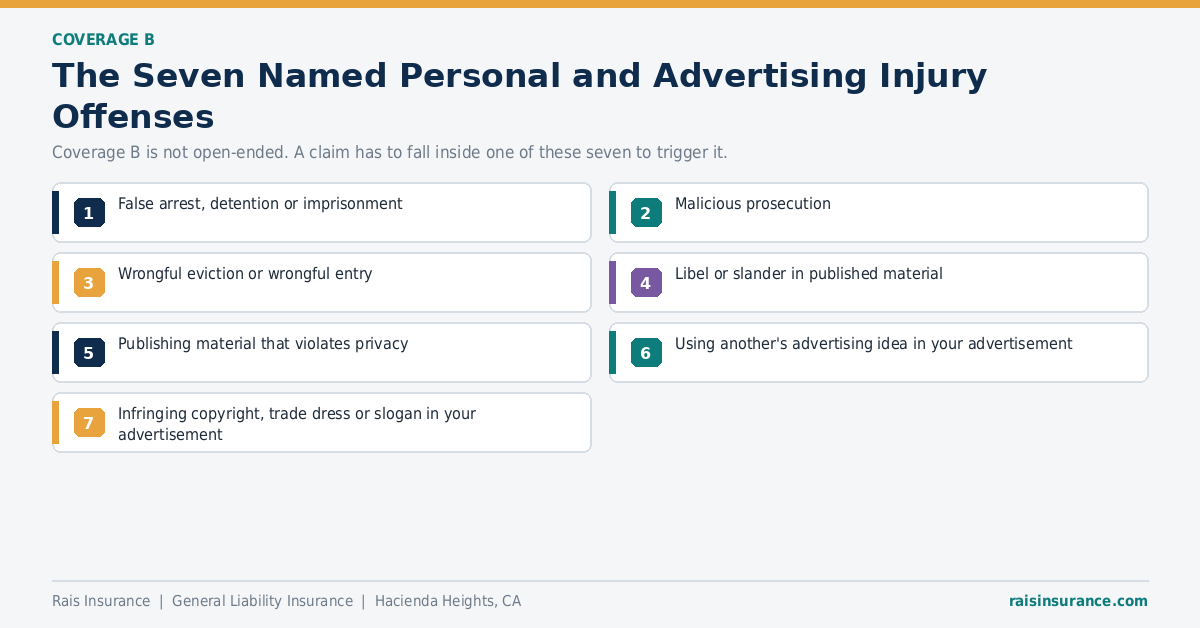
Personal and advertising injury is not an open-ended promise to handle anything reputational. It responds to seven specifically named offenses, and a claim has to land inside one of them:
- False arrest, detention or imprisonment
- Malicious prosecution
- Wrongful eviction, wrongful entry, or invasion of the right of private occupancy
- Oral or written publication of material that slanders or libels a person or organisation
- Oral or written publication of material that violates a person’s right of privacy
- Use of another party’s advertising idea in your advertisement
- Infringing upon another party’s copyright, trade dress or slogan in your advertisement
The last two matter more every year. Any Hacienda Heights business running social media, paid ads or a website is producing advertising, and the offenses above are written around exactly that activity.
Reputational harm runs the other way
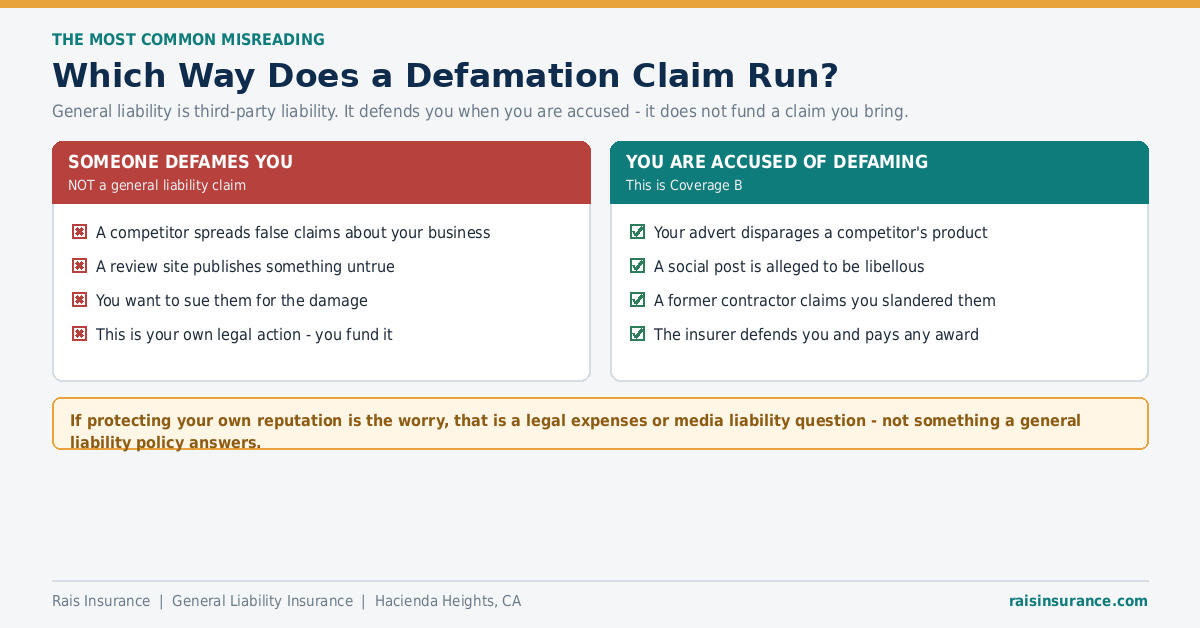
This is the single most common misreading of the whole policy, and it is worth being blunt about.
A GL policy is third-party liability. It exists to defend you when somebody accuses you of something. Coverage B responds if you are alleged to have libelled a competitor, slandered a former contractor, or published something that invaded somebody’s privacy – the insurer defends you and pays any award against you.
It does not fund a claim you want to bring. If a competitor spreads false statements about your business, or a review site publishes something untrue, that is your own legal action to pursue and to pay for. The policy will not answer it. If protecting your own reputation is the live worry, that is a legal expenses or media liability conversation, and it is a different product entirely.
How the Limits Work: Per Occurrence and Aggregate
A liability schedule usually shows two headline numbers, often written as something like one million and two million. They are not alternatives – both apply at the same time, and understanding the difference is what stops a nasty surprise late in a bad year.
- Per occurrence limit. The most the insurer will pay for any single claim or incident.
- General aggregate limit. The most the insurer will pay across all claims in the policy year, no matter how many there are. Once it is exhausted, the policy is finished until renewal.
- Products and completed operations aggregate. A separate annual pot for claims arising after your work is finished or your product has left you. Contractors and manufacturers should check this one specifically, because it is the limit their claims usually land against.
- Sub-limits. Damage to premises rented to you and medical payments each sit under their own smaller figure, well below the per occurrence limit.
The practical consequence: a business that has already had two claims this year does not have its full limit available for the third, and a contract requiring a specific limit is asking about a figure that may already be partly spent. If you sign contracts that specify limits, ask your broker to confirm what is left, not what was purchased.
Four Things General Liability Does Not Cover
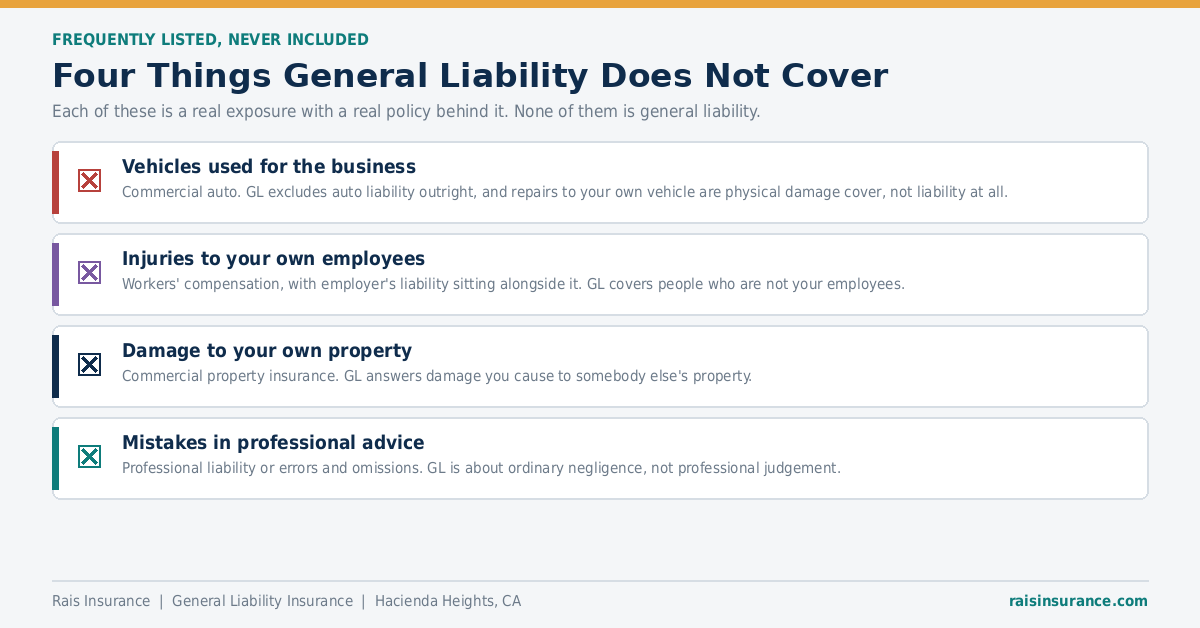
Each of the following is a genuine exposure with a genuine policy behind it. None of them belongs to this policy, and all four are regularly listed as though they did:
- Vehicles used for the business. The policy excludes auto liability outright – that is commercial auto. Two ideas are worth separating here as well: liability for harm you cause while driving is auto liability, while repairs or replacement of your own vehicle is physical damage coverage, which is not liability insurance at all.
- Injuries to your own employees. Workers’ compensation, required in California from your first employee, with employer’s liability alongside it. See general liability alongside workers’ compensation for contractors.
- Damage to your own property. That is commercial property insurance. Your GL policy answers damage you cause to somebody else’s property.
- Mistakes in professional advice or service. Professional liability, also called errors and omissions. This policy is about ordinary negligence, not professional judgement.
There is a longer list, and our Escondido page works through what general liability does not cover in detail.
What Sits Around General Liability for a Hacienda Heights Business
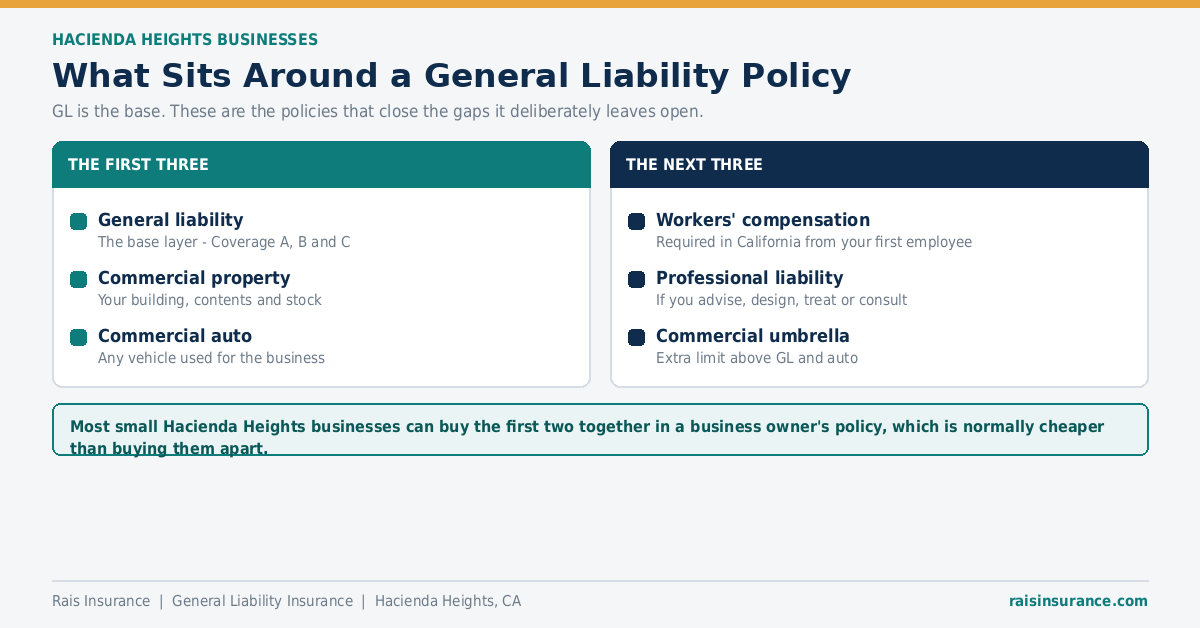
General liability is the base layer. Depending on what your business does, three to five other policies close the gaps it deliberately leaves open:
- Commercial property – your building, contents and stock
- Commercial auto – any vehicle used for the business, including personal vehicles used for work
- Workers’ compensation – required from your first employee in California
- Professional liability – if clients pay you for expertise rather than for a physical product
- Commercial umbrella – additional limit sitting above general liability and auto
Most small businesses can buy the first of those together with business liability insurance in a business owner’s policy, which is normally cheaper than buying them separately. For how these fit together, see how general liability fits alongside the other liability policies.
General Liability Insurance in Hacienda Heights, La Puente and Rowland Heights
Hacienda Heights is an unincorporated community in Los Angeles County, which has one practical consequence worth knowing: there is no city hall issuing your business licence. Permitting and business registration run through Los Angeles County, and the ZIP codes across this area straddle neighbouring communities – 91745 covers Hacienda Heights, 91746 reaches into La Puente, and 91748 into Rowland Heights.
That matters at renewal more than most people expect. Contracts, landlord requirements and county permits all specify liability limits, and the certificate you produce has to match what you actually signed. We handle both sides of that for clients across the area.
Getting the Right Policy from Rais Insurance
All of us at Rais Insurance know how hard it can be to work out which policy genuinely fits your business. That is why we are straightforward about differentiating each option, so you know exactly what you get with each one and nothing surprises you later.
Four questions usually settle whether a policy is fit for purpose. Are the limits high enough for the contracts you sign? Do defense costs sit outside the limit or inside it? Which of the standard exclusions actually bite for what you do? And which of the policies above do you still need alongside it? Four answers, and you know where you stand.
If a claim does arrive, the first two days matter more than most owners realise – our Carlsbad page covers what to do in the first 48 hours after an incident.
General Liability Insurance Hacienda Heights – Frequently Asked Questions
Q1. What does general liability insurance actually cover?
Three things, under three named coverage parts. Coverage A pays for bodily injury and property damage you cause to someone who is not your employee. Coverage B answers personal and advertising injury claims made against you, such as libel, slander or advertising infringement. Coverage C pays small medical bills for a non-employee hurt on your premises without anyone having to prove fault. Defense costs sit alongside all three.
Q2. Does general liability insurance cover my business vehicles?
No. Vehicle liability is specifically excluded from the policy and belongs to commercial auto. It is worth separating two ideas that often get merged here: liability for harm you cause while driving is commercial auto liability, while repairs or replacement of your own vehicle is physical damage coverage – collision and comprehensive – which is not liability insurance at all.
Q3. Does general liability cover me if somebody defames my business?
No, and this is the most common misreading of the policy. GL is third-party liability: it defends you when somebody accuses you. Coverage B responds if you are alleged to have libelled, slandered or invaded the privacy of another party. If a competitor or a reviewer defames you, that is a claim you would bring, and funding it is a legal expenses or media liability question instead.
Q4. What is personal and advertising injury coverage?
It is Coverage B, and it responds to seven specifically named offenses: false arrest or detention; malicious prosecution; wrongful eviction or entry; libel or slander in published material; publishing material that violates privacy; using another’s advertising idea in your advertisement; and infringing copyright, trade dress or slogan in your advertisement. A claim has to fall inside one of those seven to trigger it.
Q5. Are defense costs paid out of my policy limit?
Under a standard policy, no. The insurer’s duty to defend sits in addition to the limit rather than inside it, so legal fees do not erode the money available to pay a settlement. That is often worth more than the limit itself, because most claims cost far more to defend than to resolve. Some specialist policies do erode the limit, so it is worth confirming on your own wording.
Q6. Does general liability cover injuries to my employees?
No. Employee injuries go to workers’ compensation, which California requires from your first employee, with employer’s liability sitting alongside it. The policy is written for people who are not your employees – customers, visitors, delivery drivers, members of the public. Coverage C’s medical payments section says this explicitly by excluding anyone you employ.
Q7. What is the difference between general liability and professional liability?
A GL policy answers ordinary negligence – somebody is hurt or something is damaged because of how you operate. Professional liability, also called errors and omissions, answers claims about your professional judgement: advice that turned out wrong, a design that failed, a service that did not perform. If clients pay you for expertise rather than for a physical product, you probably need both.
Q8. How much does general liability insurance cost in Hacienda Heights?
There is no flat rate. Premium is built from what your business does, your revenue or payroll, your claims history, the limits you choose, and how much contact you have with the public. A consultant working alone and a roofing contractor with a crew are priced very differently for identical limits. A broker can market the same information to several carriers and show you the spread.
Q9. Why do my clients keep asking for a certificate of insurance?
A certificate is proof that the coverage you promised in a contract actually exists. Commercial clients, landlords and general contractors across Los Angeles County usually require one before work starts, and often ask to be added as an additional insured so your policy responds to claims arising out of your work for them. Both are routine and a broker can issue them quickly.
Q10. Do I need business liability insurance if I work from home in Hacienda Heights?
Usually yes. A homeowners policy excludes liability arising out of a business, so if a client visits, if you work at customer sites, or if a contract requires proof of cover, the homeowners policy will not answer. For a small home-based operation a business owner’s policy bundling liability with a small property limit is normally the straightforward and inexpensive answer.
Get a General Liability Insurance Quote in Hacienda Heights
We can save you time by doing the work of setting out what each policy does and does not do, in plain terms. contact Rais Insurance on 714-761-4336, email rai@raisinsurance.com, or visit 2612 W. Lincoln Avenue, Suite 103, Anaheim, CA 92801.
If you already hold a policy, bring the declarations page and any contract that specifies your limits. Those two documents answer most of this page in a single conversation.
