

General Liability Insurance Bellflower, California
When you are getting a business off the ground, accounting for everything that could go wrong is a genuinely difficult thing to do — and you work better knowing somebody has your back. At Rais Insurance, one of our specialities is general liability insurance in Bellflower, and it is usually the first policy a new business buys. What follows is the short primer we would give you across the desk, including the one thing about your premises this policy does not do.
What Exactly Do We Mean By This Type of Coverage?
Sometimes referred to as commercial general liability, this is usually the first type of coverage a business invests in, because it covers the risks that occur most often across almost every industry. In simple terms, it is there to help when somebody outside your business is harmed as a result of your day-to-day operations, or when their property is damaged because of what you do.
Those packages also cover medical payments for people who are hurt on your premises — a coverage that works differently from the rest of the policy, and one we come back to below.
Four Things That Go Wrong at Your Premises — and Who Pays
This is where a lot of new business owners are given the wrong impression, so it is worth being exact. Four things can happen at your unit, and they do not all land on the same policy:
- A visitor is injured on your floor. General liability. Third-party bodily injury is precisely what the policy is for.
- A fire damages the unit you rent. Potentially general liability, but only through a narrow, separate sub-limit called damage to premises rented to you — explained in the next section.
- Your own equipment, stock, or furniture is destroyed. Commercial property insurance. Your property is not third-party property, so general liability does not respond.
- You own the building and it burns. Commercial property insurance, firmly. Owning the premises puts them outside general liability entirely.
The short version: general liability covers harm to other people and their property. Your own building and your own contents need their own policy, usually bought alongside it in a business owner’s policy.
Damage to Premises Rented to You
If you lease your unit, there is one line on your declarations page worth finding. Most general liability policies carry a separate limit for damage to premises rented to you, commonly defaulting to $100,000 — a number that has nothing to do with your $1,000,000 per occurrence limit and is often far too low for the space.
It responds where premises you rent are damaged and you are legally liable for that damage. Classically it applies to fire, which is why it is sometimes still called fire legal liability. Some policy editions broaden it and some do not, so the perils and the limit both need to be read off your own form rather than assumed.
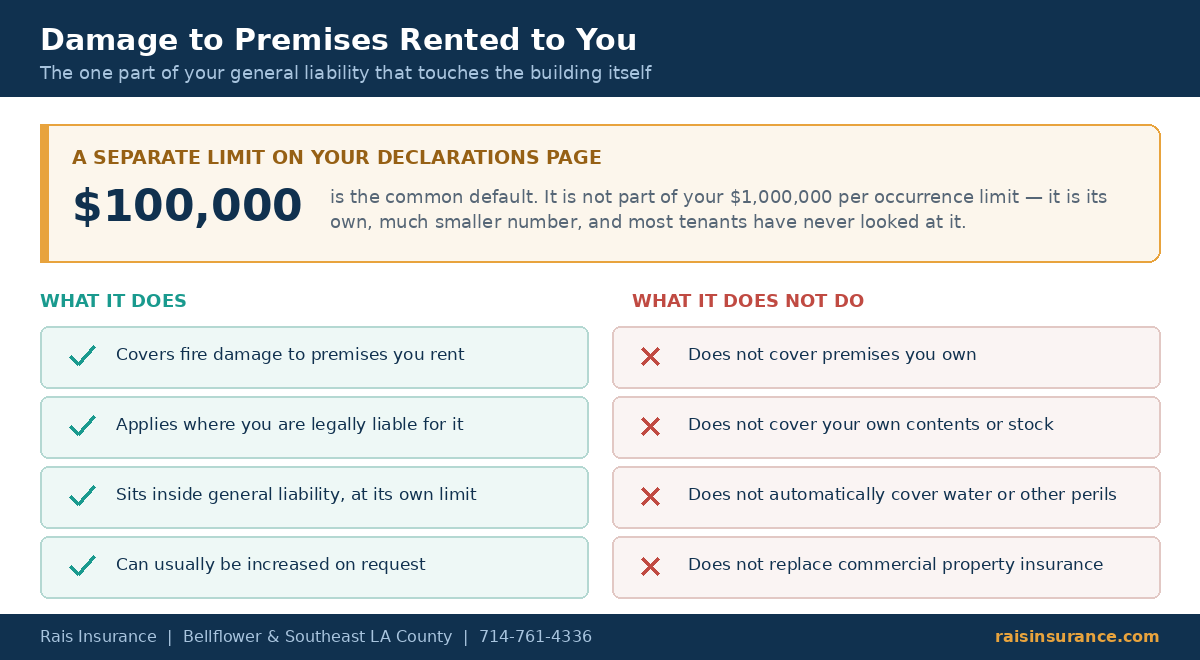
What it does not do is replace commercial property insurance. It will not cover premises you own, it will not cover your contents, and it will not automatically extend to every peril. If your landlord has asked for a specific figure here, bring us the lease and we will match it.
Medical Payments: The Coverage That Pays Without Blame
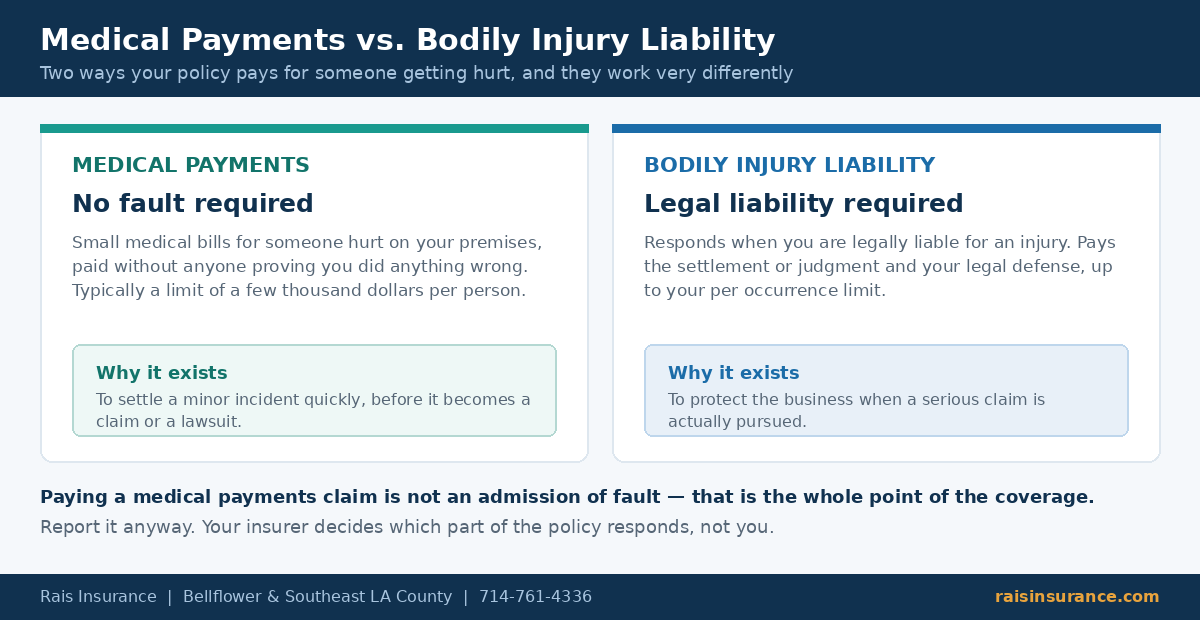
Most of a general liability policy only responds once you are legally liable for something. Medical payments coverage is the exception, and it is genuinely useful.
It pays small medical bills for someone hurt on your premises without anyone having to establish fault — typically a few thousand dollars per person. A customer trips, grazes a knee, and needs a clinic visit: the policy can pay for it directly, quickly, and without a dispute about whose fault it was.
Paying a medical payments claim is not an admission of fault; that is the entire reason the coverage exists. Report the incident to us anyway and let the insurer decide which part of the policy responds. Handled well, a lot of incidents end there instead of becoming claims.
What General Liability Does Not Cover
Being clear about the edges saves an unpleasant conversation later. General liability does not cover:
- Your own building, contents, equipment, or stock — commercial property insurance.
- Injuries to your own employees — workers’ compensation, which California requires from your first hire.
- Accidents involving business vehicles — commercial auto.
- Mistakes in professional advice or services — professional liability.
A business owner’s policy bundles general liability with commercial property in one form, and for most Bellflower tenants with a unit and some equipment it is the sensible starting structure rather than general liability alone.
Before You Buy Your First Policy
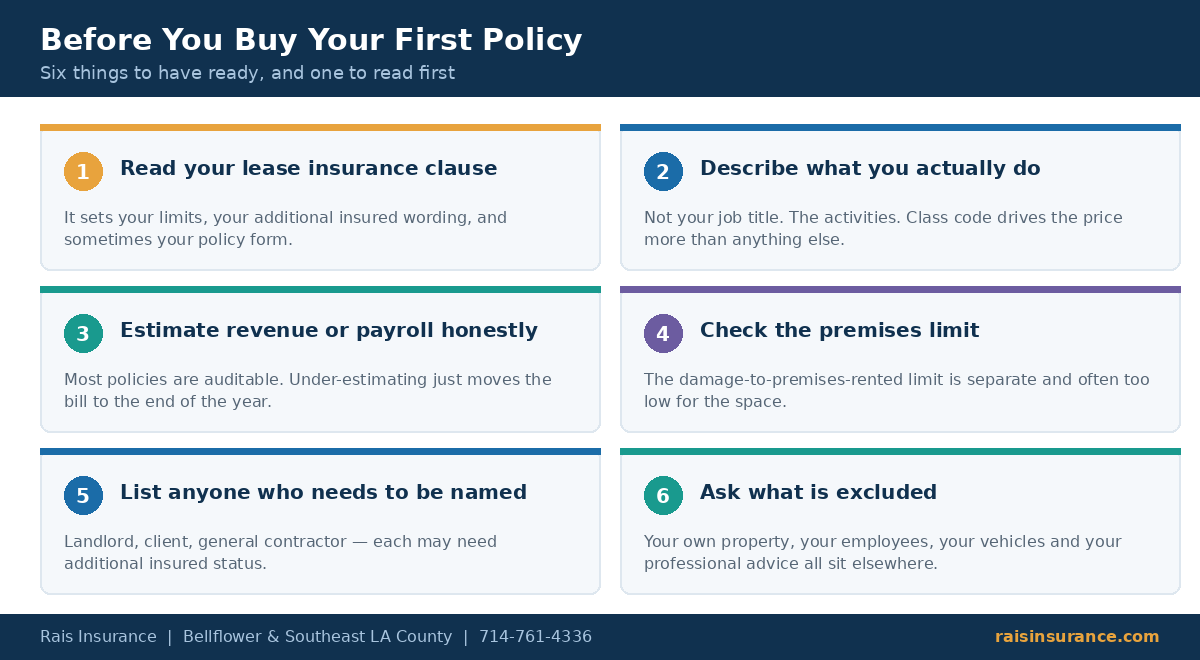
Six things to have ready, and one to read first:
- Read your lease insurance clause. It sets your limits, your additional insured wording, sometimes your policy form, and often a minimum damage-to-premises-rented figure.
- Describe what you actually do. Not your job title — the activities. Your class code moves the price more than anything else on the application.
- Estimate revenue or payroll honestly. Most policies are auditable, so under-estimating only moves the bill to the end of the year.
- Check the premises limit. The default is often too low for the unit you have taken.
- List anyone who needs naming. Landlord, client, general contractor — each may require additional insured status.
- Ask what is excluded. Your property, your employees, your vehicles, and your professional advice all sit elsewhere.
We Can Help Protect Your Enterprise
Now that you have a clearer idea of what this coverage does, you know where to find the best Bellflower general liability insurance. Get in touch and one of our team will walk you through the steps to putting your own package together.
Because we also write commercial property insurance, workers’ compensation, and commercial auto insurance, the cover general liability leaves out comes from the same place and renews on the same calendar. See our full general liability insurance coverage, or our pages for businesses in Cerritos, Costa Mesa, and Carlsbad.
Serving Bellflower and Southeast Los Angeles County
We write business insurance for Bellflower companies and across southeast Los Angeles County — Downey, Paramount, Lynwood, South Gate, and Compton — from our office in Anaheim, about fifteen miles away. Most of it is handled by phone and email, and certificates are issued the same day.
Get a General Liability Insurance Quote in Bellflower
Send us your lease, a plain description of what your business does, and an estimate of your first year’s revenue. That is usually enough to quote it properly and to tell you what you do not need.
Whatever commercial insurance Bellflower businesses need — general liability, commercial property, workers’ compensation — it comes from one agency and one renewal calendar.
Let us help, and you will be one step closer to knowing your business is properly protected. Call 714-761-4336 or email rai@raisinsurance.com.
Bellflower General Liability Insurance FAQs
Does general liability insurance cover damage to my own building?
No. General liability covers harm to other people and damage to property belonging to others. A building you own is your property, so fire, water, or storm damage to it is commercial property insurance. The only part of general liability that touches a building is the damage-to-premises-rented limit, and that applies to space you rent, not space you own.
What is damage to premises rented to you?
It is a separate, much smaller limit inside your general liability policy that responds when premises you rent are damaged and you are legally liable for it. A limit of $100,000 is a common default, shown on its own line on your declarations page. It is not part of your per occurrence limit and it does not replace commercial property insurance.
Does general liability cover fire damage to the office I rent?
Potentially, through the damage-to-premises-rented limit, if you are legally liable for the fire. That limit is usually far smaller than your main policy limit, and the perils it covers vary by policy edition and carrier. Check the exact wording on your own form rather than assuming, and ask about increasing the limit if the space warrants it.
Does general liability cover my equipment, stock, or furniture?
No. Your own business personal property needs commercial property coverage, usually bought alongside general liability in a business owner’s policy. General liability responds only to property belonging to somebody else, which is why a page that promises it will replace your damaged stock is describing a different policy.
What is medical payments coverage?
It pays small medical bills for someone hurt on your premises without anyone having to prove you were at fault. Limits are typically a few thousand dollars per person. It exists so a minor incident can be settled quickly and courteously before it becomes a liability claim or a lawsuit.
Is paying a medical payments claim an admission of fault?
No, and that is the point of the coverage. Medical payments are paid on a no-fault basis, so the insurer can cover a visitor’s minor treatment without anyone conceding liability. Report the incident to your broker either way and let the insurer decide which part of the policy responds.
Is general liability the first insurance a new business should buy?
For most businesses, yes. It is usually the first policy bought because it covers the broadest set of everyday risks and because landlords and clients demand it before you can trade. Whether you need anything alongside it depends on whether you have employees, premises, vehicles, or professional services.
What insurance does my landlord require me to carry?
Nearly every commercial lease requires general liability at a stated limit, the landlord named as an additional insured, and a certificate of insurance before you take possession. Many also require a waiver of subrogation and a minimum damage-to-premises-rented limit. Read the insurance clause before you sign, not after.
What do I need to get my first general liability quote?
A plain description of what your business actually does day to day, your estimated annual revenue or payroll, your lease if you have one, the limits any contract requires, and the address of your premises. That is usually enough for a quote in a single conversation.
Does general liability cover injuries in the parking lot outside my unit?
It depends on whether you control that area and whether you are legally liable for the injury. In a multi-tenant property, common areas are often the landlord’s responsibility, which is one reason your lease and your policy need to be read together. Bring us the lease and we will map who is responsible for what.
