

Car Insurance Orange California
Sorting out car insurance in Orange CA is one of the last things anyone wants to deal with after a move, and the rules genuinely do change at the state line. The original version of this page is right about that, and right that knowing what you don’t need matters as much as knowing what you do.
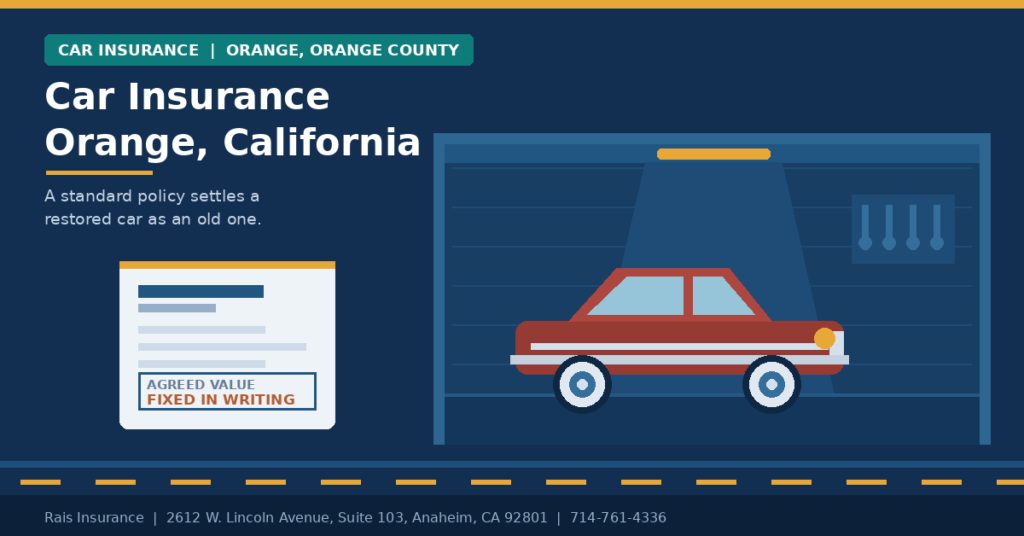
There is one situation where getting it wrong is especially expensive, and it applies to a good number of households here: if you own a classic, restored or collector vehicle, a standard policy will not settle it for anything close to what it is worth.
Why a Standard Policy Fails a Classic
A standard auto policy pays actual cash value — the depreciated market value of the vehicle at the time of loss. For an ordinary car that is a reasonable basis. For a restored one it produces a figure nobody would accept.
A 1968 car that has had thirty thousand dollars of restoration work put into it is, to a standard policy, a fifty-odd-year-old vehicle. The work does not appear in the valuation. Neither does the rarity, the originality, the show record, or what the same car sells for at auction.
Worse, the valuation happens after the loss — which is precisely the moment you have the least leverage to argue about it.
Agreed Value Car Insurance in Orange County CA
This is the answer, and it is the whole reason a separate classic policy exists.
Agreed value means the figure is settled in writing before anything happens. You and the carrier agree what the vehicle is worth, that number goes on the policy, and if the car is a total loss that is what you are paid — no depreciation, no argument, no appraiser deciding after the fact.
Three terms get confused, and the difference matters:
- Agreed value — the figure is fixed in writing and paid in full on a total loss. This is what you want.
- Stated value — you state a figure, but the carrier may pay the lesser of that figure or actual cash value. This is not the same thing, and the wording is worth checking.
- Actual cash value — depreciated market value, assessed after the loss. What a standard policy does.
Establishing the agreed figure usually means an appraisal, photographs, restoration receipts or documented comparable sales. It is a short exercise and it is the single most valuable piece of paperwork a collector owner holds.
What Else a Classic Policy Does Differently
Agreed value is the headline, but several other terms differ from a standard policy:
- Mileage limits. Classic policies typically cap annual mileage, which is why they cost considerably less than standard cover on the same valuation.
- Storage requirements. Most carriers require a locked garage, and some specify security features.
- Use restrictions. Pleasure driving, shows, club events and parades — not commuting. A classic policy is not a policy for a daily driver.
- A regular use vehicle requirement. Most carriers expect you to own another car for everyday driving.
- Spare parts cover. Often included, which matters if you hold a stock of period parts.
- Choice of repair shop. Usually explicit, which is more important on a classic than almost any other vehicle — the wrong shop can reduce the car’s value even after a competent repair.
Worth being straight about the trade-off: if you drive the car regularly, or use it to get to work, a classic policy is probably not the right product. That is a genuine limitation rather than a formality.
California’s Minimum Requirements
The original version of this page describes these, and the structure needs correcting because it reads as three separate categories when it is two coverages:
Bodily injury liability carries two limits — a maximum per injured person, and a higher maximum for all injuries in a single accident. So the first two figures on the original page are one coverage with two caps, not two different things.
Property damage liability is a separate figure entirely, for damage to other people’s vehicles and property.
Worth noting that California’s minimum limits were scheduled to increase, so it is worth confirming the current figures rather than relying on a number published a while ago. Ours are on the California requirements page, and we will confirm them when you call.
The Coverage the Page Is Right About
The original makes a genuinely good point that most pages skip: California does not require uninsured motorist coverage, and a collision with an uninsured driver leaves you picking up costs you did not cause.
That is correct, and it matters more than it sounds. In a fault-based state, what you recover depends entirely on the other driver’s limits — and if they have none, nothing else on your policy responds. A carrier must obtain your decline in writing, so it is checkable on your declarations page.
The page is also right that minimum cover does nothing for “acts of nature.” Comprehensive is the coverage that handles animal collisions, weather, flood, fire, vandalism, falling objects and theft. On a classic vehicle it is arguably more important than on a daily driver, because the car spends most of its life parked.
One small correction: collisions with stationary objects are a collision claim rather than a comprehensive one. Hitting a wall, a post or a parked car is collision; a tree falling on the car is comprehensive.
Driving and Storing in Orange
Five things that shape car insurance Orange rates and classic cover specifically:
- Orange County rating, and California rates by garaging territory rather than by city name.
- Old Towne Orange, with its historic district, car shows and weekend footfall — one reason the collector community here is as active as it is.
- Garage storage is common in Orange’s older neighbourhoods, which is exactly what classic carriers require.
- The 22, the 55 and the 5 all cross the city, and annual mileage is one of the three factors state law requires carriers to weigh most heavily.
- Four miles from our office, which makes Orange the closest city in our whole service area.
Why Use a Broker
Classic and collector cover is a specialist market. Carrier appetite varies by vehicle age, valuation, storage arrangements and how the car is used — and the agreed value process differs between them. A carrier comfortable with a restored muscle car may decline a modified one, or a vehicle without documented provenance.
We place business across a range of carriers rather than offering one company’s product, so one set of vehicle details is quoted several times. We are not an insurance company — the carrier issues the policy and pays the claim; we place the business and stay involved at renewal and when a claim arises. There is no fee to you for the comparison.
Car Insurance Orange — Frequently Asked Questions
What is agreed value car insurance?
Cover where you and the carrier settle the vehicle’s value in writing when the policy is written. If the car is a total loss, that agreed figure is what you are paid — no depreciation applied and no valuation dispute after the event. It is the defining feature of a classic car policy.
How is agreed value different from stated value?
Agreed value pays the fixed figure in full. Stated value allows the carrier to pay the lesser of your stated figure or actual cash value, which can leave you well short. The wording is worth checking carefully, because the two sound similar and behave very differently.
Will a standard policy cover my restored car?
It will insure it, but it settles on actual cash value — the depreciated market value of a vehicle that age. Restoration costs, rarity and originality do not enter the calculation, so the payout on a total loss is typically a fraction of what the car is actually worth.
Do classic policies restrict how much I can drive?
Usually yes. Most cap annual mileage and limit use to pleasure driving, shows and club events rather than commuting. Most carriers also expect you to own another vehicle for daily use. Those restrictions are why the premium is lower.
Does my classic need to be garaged?
Most carriers require a locked garage, and some specify additional security. Storage arrangements affect both eligibility and price, so it is worth raising early.
Does California require uninsured motorist coverage?
No — it is optional, and a carrier must obtain your decline in writing. The original version of this page is right to flag it: in a fault-based state, what you recover depends on the other driver’s limits, and if they have none nothing else on your policy responds.
What does comprehensive cover?
Animal collisions, weather, flood, fire, vandalism, falling objects and theft — damage that happens without a collision. On a classic it matters particularly, since the car spends most of its time parked. Hitting a stationary object is a collision claim rather than a comprehensive one.
What are California’s minimum liability limits?
Bodily injury liability with a per-person and a higher per-accident cap, plus a separate property damage figure. The minimums were scheduled to increase, so it is worth confirming the current numbers rather than relying on an older published figure.
I’m new to California — what changes?
Your out-of-state policy will not carry over, cover has to meet California requirements, and the rate is built on your new garaging address. New residents are also expected to obtain a California licence and register the vehicle within a set period of establishing residency.
How do I get a quote in Orange?
Call Rais Insurance on 714-761-4336 or email rai@raisinsurance.com. For a classic, have the year, make, model, current valuation, any appraisal or restoration documentation, and where the car is stored to hand.
Get a Quote
Call 714-761-4336 or email rai@raisinsurance.com for car insurance Orange CA drivers can rely on — standard or classic.
If you own a collector vehicle, find out one thing before you call: whether your current policy is written on an agreed value or actual cash value basis. It is a single line on the declarations page, it decides what a total loss is worth, and most owners of restored cars have never checked it.
FIND US ON THE MAP
