

Charter Bus Insurance Coverage and Quotes
Charter buses include any fleet of vehicles that transports passengers for a fee — tour buses, school buses, shuttles,
vans, and more. If you own a charter bus company, you are answerable and held accountable for any property or casualty
loss that happens on your watch. Charter bus insurance is what stands between a single multi-passenger incident and the
end of your operation. Picking the right policy, at the right limits, from a carrier that will actually pay and file on
your behalf, is a genuinely difficult task — and it is the one we do every day.
At Rais Insurance, we offer tailor-made insurance policies that cover all your needs. We build programs that combine
commercial auto liability, commercial general liability, commercial property, physical damage, and workers’ compensation
into one coherent structure — for a single shuttle or a fleet of coaches.
What Is Charter Bus Insurance?
Charter bus insurance — sold by some carriers as commercial bus insurance — is a commercial insurance program built
specifically for businesses that carry passengers for hire. It is not the same product as standard commercial auto
insurance. It carries far higher liability limits, it covers passenger exposure during loading and unloading rather than
only while the vehicle is in motion, and it is written by a narrower set of carriers that specialize in for-hire
passenger risk and can make the regulatory filings your operating authority depends on.
In order to minimize the adverse impact of these losses, the business itself and every stakeholder around it — the
public, your customers, your employees, and your investors — has to be covered.
Who Needs Charter Bus Insurance in California?
If you transport passengers for compensation in California, you are almost certainly a charter-party carrier, and
charter-party carriers are generally required to hold a TCP permit from the California Public Utilities Commission.
Evidence of insurance has to be on file before that permit is active.
That link matters more than most operators realize: your permit and your policy are tied together. Let the coverage
lapse and the filing drops, and your authority to operate can go with it. When we place a charter bus policy we confirm
the carrier can make the filings your permit requires before we present the quote, not after you have bound it.
If you cross state lines for hire, federal rules apply as well and you will need USDOT operating authority with the
corresponding filing.
What Charter Bus Insurance Coverage Includes
A well-balanced and holistic charter bus insurance program is built from these components:
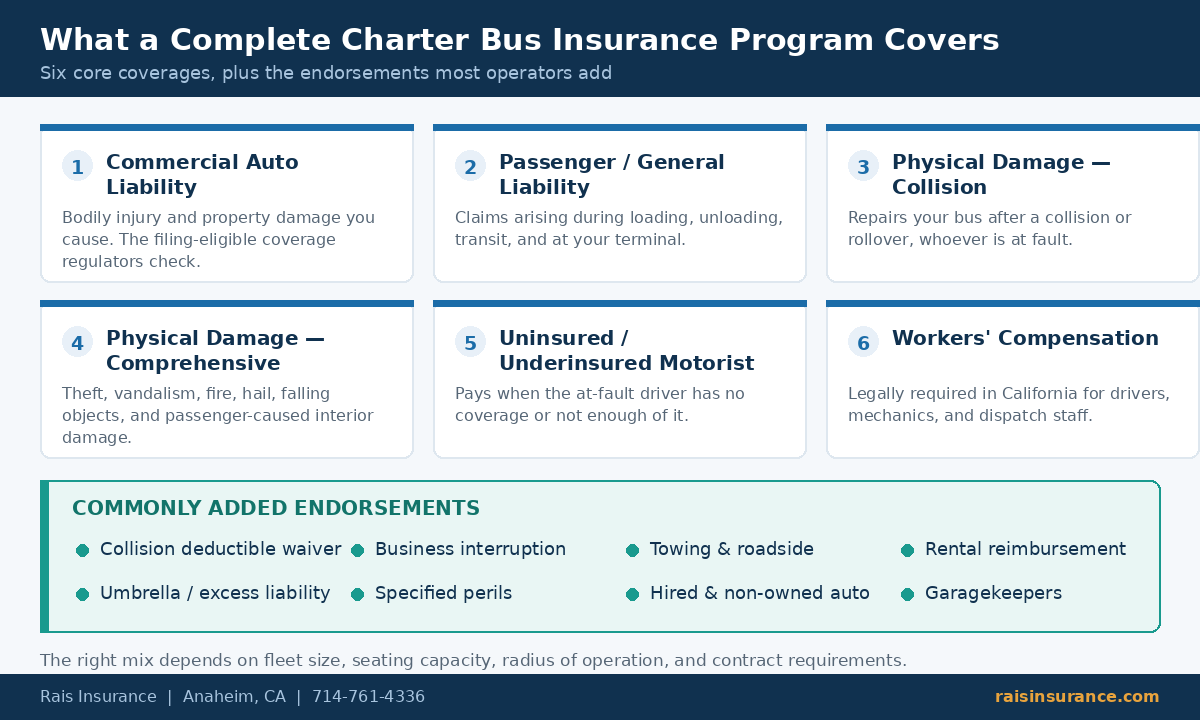
Commercial Auto Liability
This is the core of the program and the coverage regulators actually check. It responds to bodily injury and property
damage your operation causes to others, and it is the coverage your TCP or USDOT filing is made against. Limits here are
set by seating capacity, not by preference.
Property Damage or Personal Injury Liability
This insurance pays claims raised in the event of death, bodily injury, or property damage occurring during charter bus
operations. Every activity — loading, unloading, and a crash while traveling — is covered under this clause. The limit
required generally corresponds to the number of passengers the vehicle is designed to seat.
Collision Insurance
If your charter bus rolls over or collides with another vehicle, this coverage compensates for the damage to your own
bus, regardless of fault. The point is simple: the payout should be enough to repair the unit and get it earning again
rather than sitting in a yard. Choose the deductible deliberately — it is one of the few premium levers entirely within
your control.
Comprehensive Physical Damage Insurance
Sometimes the damage to a bus has nothing to do with a collision or rollover. The cause might be a thief who damaged the
vehicle in a failed attempt to steal it, vandalism, or the torching and stoning of buses during civil unrest. In some
cases it also covers the interior being trashed by passengers — an exposure party bus and entertainment operators know
well. Fire, hail, flood, and falling objects sit here too.
Uninsured or Underinsured Motorist Coverage
Given the range of people traveling on your buses, your business is exposed every time another driver on the road
carries no insurance or not enough of it. Extending the policy to cover your passengers in that situation protects them
from an unpleasant surprise — and protects you from the claim that follows.
Workers’ Compensation Insurance
Charter bus companies are under a legal obligation to carry workers’ compensation for their employees, and in
California that obligation starts with the first employee. It covers drivers, mechanics, and dispatch staff who suffer
illness or injury during employment. We work with highly regarded carriers to structure terms that hold up at claim time
and support driver retention.
Additional Coverages and Endorsements
Alongside the core program, the following coverages regularly earn their place on a charter bus policy:
- Collision deductible waiver — removes your deductible when another party is clearly at fault
- Business interruption insurance — replaces income while a damaged unit is out of service
- Property damage or bodily injury insurance — the primary third-party layer
- Towing insurance — recovery of a disabled coach is expensive and rarely budgeted
- Rental insurance — a replacement vehicle so a contract is not lost during repairs
- Umbrella insurance — excess liability above the primary limit, often contractually required
- Specified peril insurance — a narrower, lower-cost alternative to full comprehensive
- Hired and non-owned auto — for subcontracted units and staff vehicles used on company business
Minimum Liability Requirements for Passenger Carriers
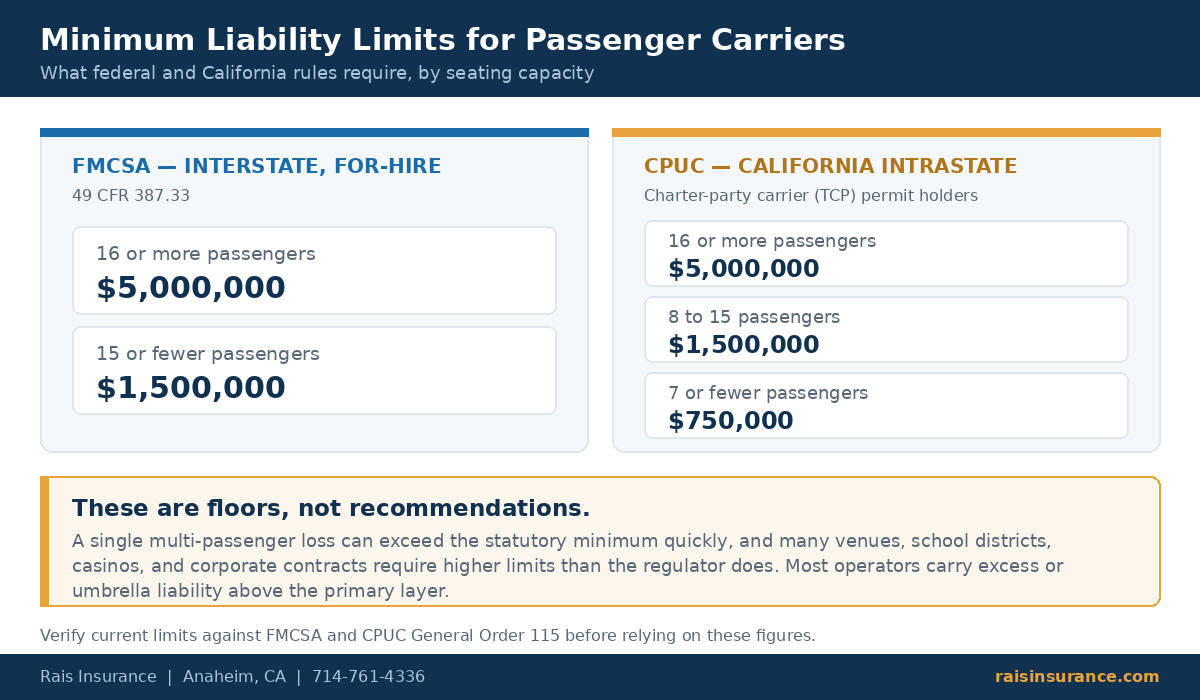
Liability limits for passenger transportation are set by regulation, not by negotiation, and they scale with seating
capacity.
Under federal rules for interstate for-hire carriers, vehicles designed to carry 16 or more passengers generally require
$5,000,000 in liability coverage, and vehicles designed for 15 or fewer generally require $1,500,000. California’s
intrastate charter-party rules use a tiered scale of a similar shape, stepping down for smaller-capacity vehicles.
Treat all of these as floors rather than recommendations. One multi-passenger loss can exceed a statutory minimum
quickly, and many school districts, casinos, venues, and corporate clients contractually require higher limits than any
regulator does. If you are bidding on that kind of work, the contract usually sets your limit before the law does.
How Much Does Charter Bus Insurance Cost?
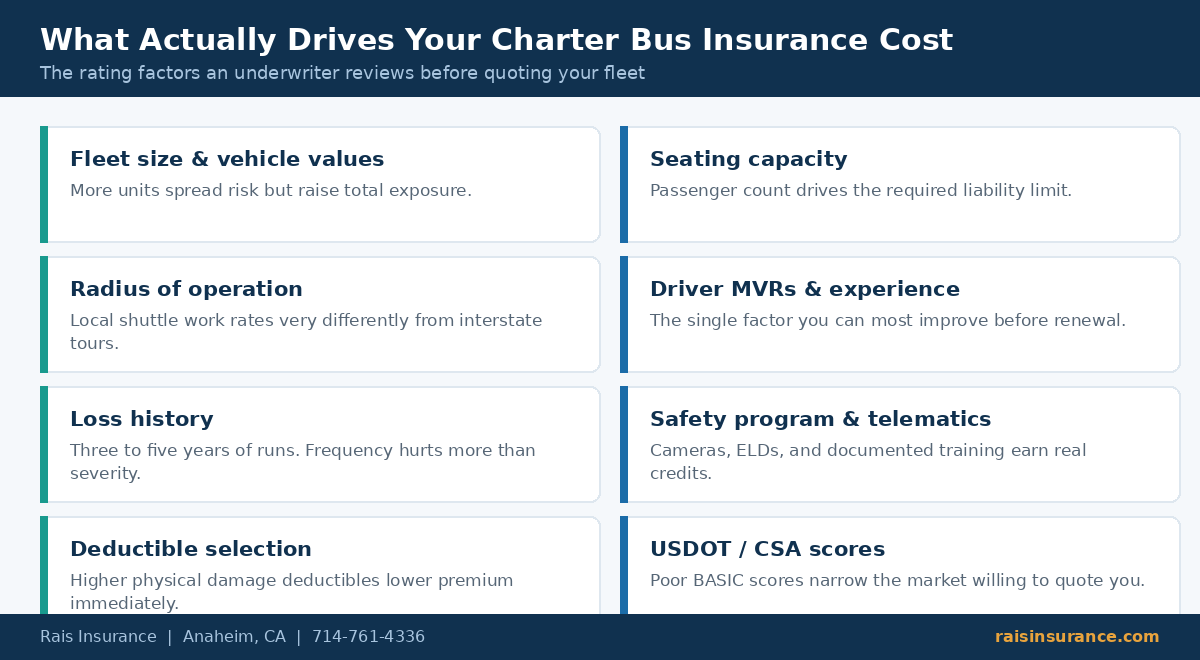
There is no flat rate for charter bus insurance, and any quote given without seeing your fleet is a guess. Underwriters
price passenger transportation on these factors:
- Fleet size and vehicle values — more units spread risk but raise total exposure
- Seating capacity — passenger count sets the liability limit you are required to carry
- Radius of operation — local shuttle work rates very differently from interstate touring
- Driver motor vehicle records and experience — the factor you can most improve before renewal
- Loss history — three to five years of loss runs; frequency hurts more than severity
- Safety program and telematics — cameras, ELDs, and documented training earn real credits
- Deductible selection — the fastest lever on physical damage premium
- USDOT and CSA scores — poor BASIC scores narrow the market willing to quote you at all
If your renewal came back higher than expected, the cause is usually driver records or loss frequency rather than the
market. Both are fixable, and both take a renewal cycle to show up in pricing — which is why we start the conversation
ninety days out, not two weeks out.
Vehicles We Insure
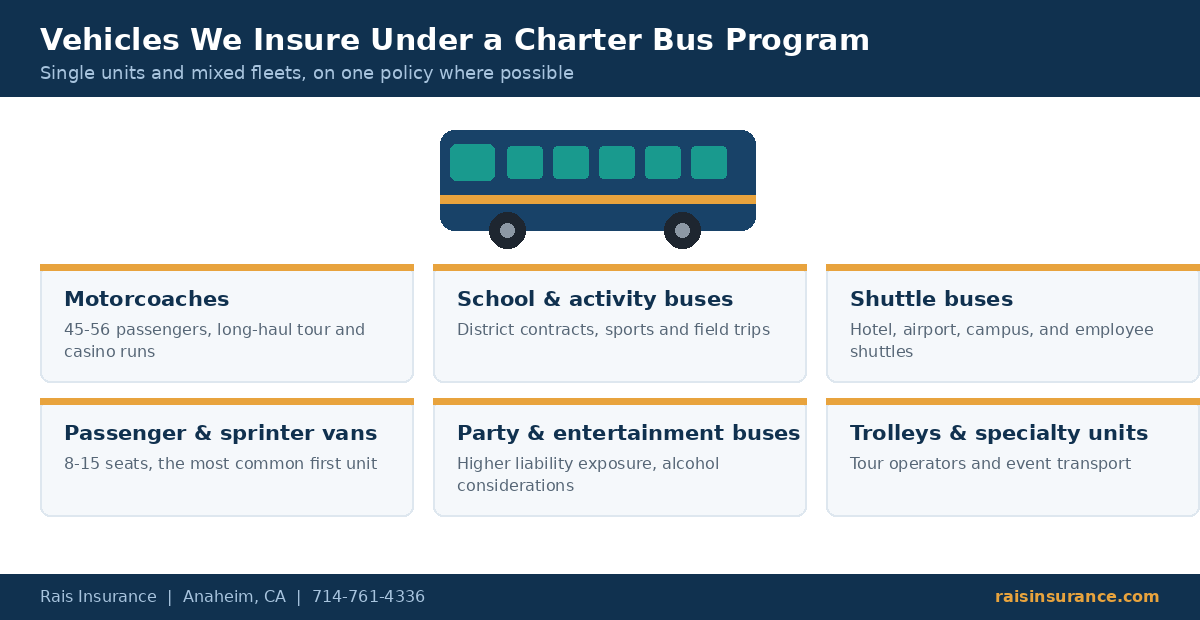
We write single units and mixed fleets. In most cases a varied fleet can sit on one commercial auto schedule rather than
several separate policies — which is what most operators mean when they ask about bus fleet insurance:
- Motorcoaches — 45 to 56 passengers, long-haul tour and casino runs
- School and activity buses — district contracts, sports and field trip work
- Shuttle buses — hotel, airport, campus, and employee shuttles
- Passenger and sprinter vans — 8 to 15 seats, usually an operator’s first unit
- Party and entertainment buses — higher liability exposure and alcohol considerations
- Trolleys and specialty units — tour operators and event transport
Why Operators Work With Rais Insurance
Rais Insurance represents our clients’ best interests while collaborating with well-established charter bus insurance
markets. We do not only place coverage for incidents — we help with risk management and mitigation before the incident
happens. We take pride in long-lasting relationships built on trust, and that standing gives us the leverage to strike
the right balance between cost and service.
Because we also write commercial auto insurance,
workers’ compensation, and commercial property
coverage, a transportation operator can keep the whole program under one roof and one renewal calendar.
Operators running limousines or black-car service alongside their buses can add that exposure through our California limo insurance program.
With Rais Insurance, you can be assured that your charter buses are steering in the right direction.
Get a Charter Bus Insurance Quote
To quote your operation properly we need four things: your fleet schedule with VINs and stated values, your driver list
with license numbers, your radius of operation, and three years of loss runs. Send those and we will market your account
to carriers that genuinely write passenger transportation rather than ones that will decline it a week later.
Call 714-761-4336, email rai@raisinsurance.com, or visit us at 2612 W. Lincoln Avenue, Suite 103,
Anaheim, CA 92801. We place charter bus insurance California operators depend on, from a single shuttle to a full
motorcoach fleet.
Charter Bus Insurance FAQs
Q1. What does charter bus insurance cover?
A complete charter bus insurance program covers commercial auto liability, passenger and general liability, collision,
comprehensive physical damage, uninsured and underinsured motorist coverage, and workers’ compensation. Most operators
add umbrella liability, towing, rental reimbursement, and a collision deductible waiver.
Q2. How much does charter bus insurance cost?
There is no flat rate. Premium is driven by fleet size, seating capacity, radius of operation, driver motor vehicle
records, loss history, deductible selection, and USDOT safety scores. A single 15-passenger shuttle and a ten-coach tour
fleet are priced on entirely different bases, so a quote requires your actual fleet schedule and loss runs.
Q3. How much liability insurance does a charter bus need?
Under federal rules for interstate for-hire carriers, vehicles designed to carry 16 or more passengers generally require
$5,000,000 in liability coverage, and vehicles carrying 15 or fewer require $1,500,000. California’s intrastate
charter-party carrier rules use a tiered scale based on seating capacity. Confirm current figures with FMCSA and the
CPUC.
Q4. Do I need a TCP permit to operate a charter bus in California?
Charter-party carriers of passengers operating within California are generally required to hold a TCP permit from the
California Public Utilities Commission, and evidence of insurance must be on file before the permit is active. Your
insurance and your permit are linked, so a lapse in one affects the other.
Q5. Is charter bus insurance different from commercial auto insurance?
Yes. Standard commercial auto is not built for passenger transportation for hire. Charter bus policies carry far higher
liability limits, cover passenger exposure during loading and unloading, and are written by carriers that specialize in
for-hire passenger risk and can make the required regulatory filings.
Q6. Does charter bus insurance cover damage caused by passengers?
Comprehensive physical damage coverage typically responds to vandalism and interior damage caused by passengers, subject
to your deductible. Party bus and entertainment operators face this exposure most often, and underwriters price it
accordingly.
Q7. What is an umbrella policy and do I need one?
An umbrella or excess liability policy sits above your primary liability limit and responds when a claim exceeds it.
Because one multi-passenger loss can exceed a statutory minimum quickly, and because many venue, school district, and
corporate contracts require higher limits than regulators do, most established operators carry one.
Q8. Can I insure a mixed fleet of buses and vans on one policy?
In most cases yes. Motorcoaches, school and activity buses, shuttles, passenger vans, and specialty units can usually
sit on a single commercial auto schedule, which simplifies administration and often improves pricing over separate
policies.
Q9. How do I lower my charter bus insurance premium?
The fastest levers are driver quality and documentation. Clean motor vehicle records, a written safety and hiring
program, telematics or camera systems, documented training, and a higher physical damage deductible all reduce premium.
Improving loss frequency matters more than any single large claim.
Q10. How quickly can I get a charter bus insurance quote?
Once we have your fleet schedule with VINs and values, driver list with license numbers, radius of operation, and three
years of loss runs, we can market your account to passenger transportation carriers and come back with options. Call
714-761-4336 to start.
