

General Liability Insurance Norco
If you employ anyone, workers’ compensation insurance in Norco is not optional. California requires it from your first employee, and the benefits it pays are set by the state rather than by the carrier – which means the questions worth asking are what an injured worker actually receives, what the law requires of you beyond buying a policy, and which other exposures this cover does not touch.
One correction before any of that, because it decides how you should be reading the rest: workers’ compensation is not a feature of general liability insurance. They are two separate policies, bought separately. Businesses here commonly carry both workers’ compensation and general liability insurance in Norco, and this page explains where each one starts and stops.
Workers’ Compensation and General Liability Are Two Different Policies
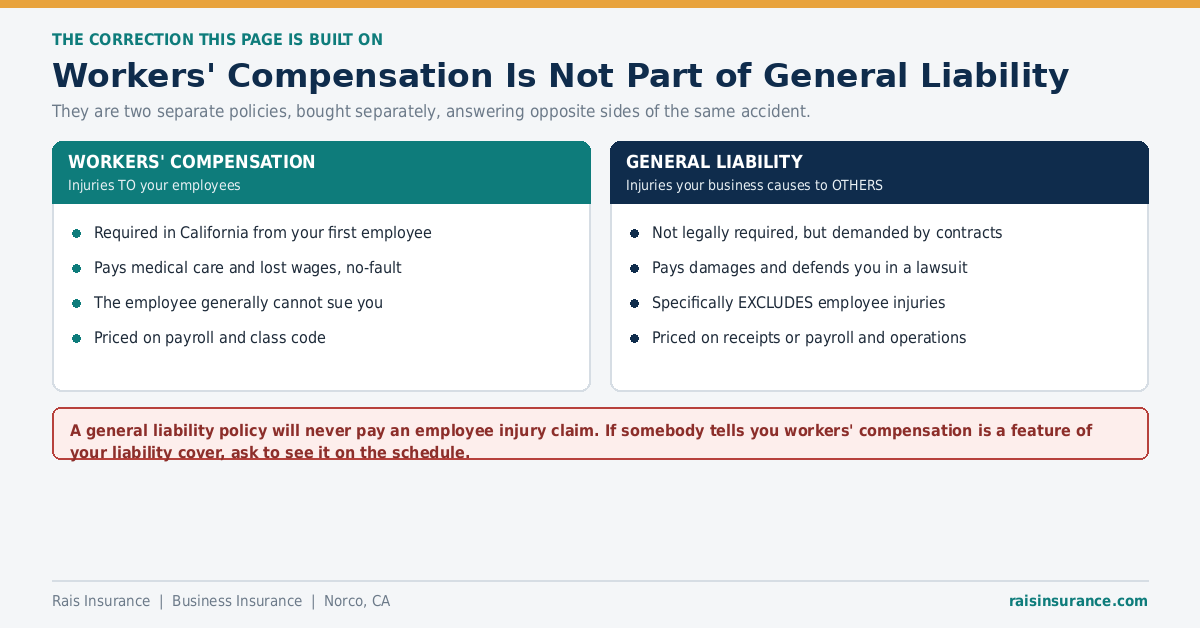
This matters more than it sounds, because assuming one policy includes the other leaves a business genuinely uninsured on one side of the accident.
Comp covers injuries to your own employees. It is legally required in California from the first employee, it pays medical care and lost wages on a no-fault basis, and in exchange the employee generally cannot sue you over the injury. It is priced from your payroll and classification code.
General liability covers injury or damage your business causes to other people. It is not legally required, though virtually every contract, landlord and client demands it. It pays damages and defends you in a lawsuit. And it specifically excludes injuries to your own employees – that exclusion exists precisely because workers’ compensation is meant to handle them.
So a general liability policy will never pay an employee injury claim, and a comp policy will never pay a customer’s. If anyone describes workers’ compensation as a feature or benefit of your liability cover, ask to see it on the schedule. For how the two work together on a jobsite, see how general liability and workers’ compensation work together for contractors, and for what the liability policy itself contains, what a general liability policy actually covers.
The Benefits an Injured Worker Actually Receives
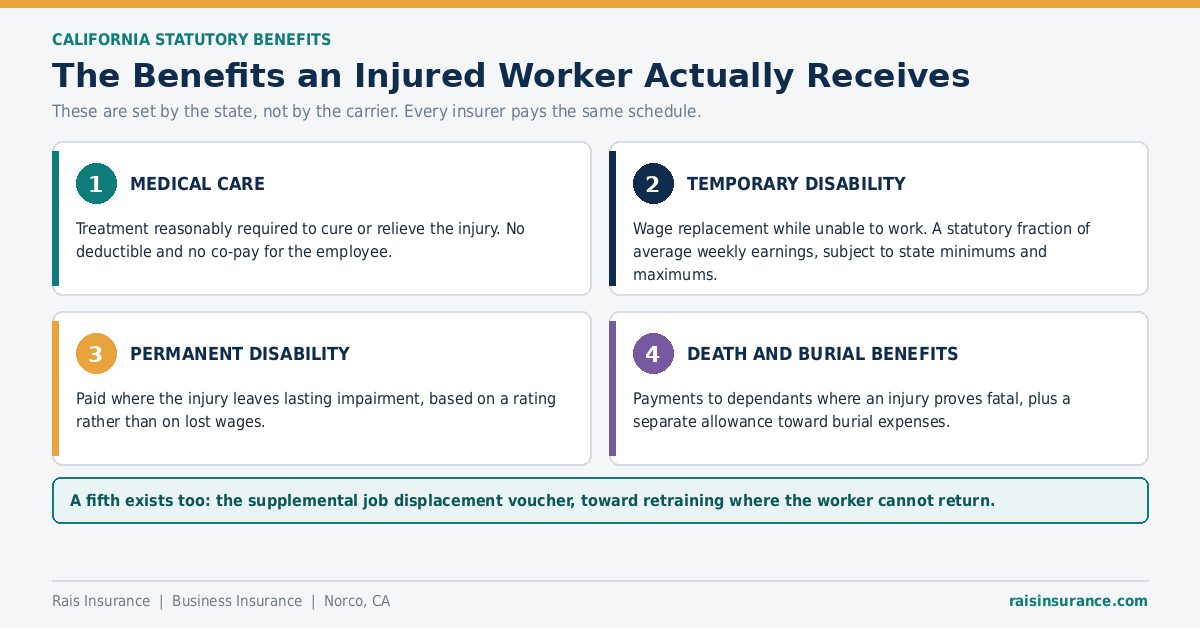
The original version of this page listed four benefit types – income, medical, burial and death. That list is close to right, and it is worth completing, because California’s benefit structure has five parts and the terminology the state uses is slightly different:
- Medical care. Treatment reasonably required to cure or relieve the effects of the injury. The employee pays no deductible and no co-pay – this is not health insurance and it does not work like it.
- Temporary disability. What the original called income benefits. It replaces a statutory share of average weekly earnings while the worker cannot work, subject to state minimums and maximums, and it stops when they return or their condition stabilises.
- Permanent disability. Paid where the injury leaves lasting impairment after recovery has plateaued. It is calculated from a disability rating rather than from wages lost, which makes it a different calculation entirely from temporary disability.
- Death benefits. Payments to dependants where a work injury proves fatal, based on the number of dependants rather than on a single flat figure.
- Burial expenses. A separate statutory allowance toward funeral costs, paid in addition to death benefits rather than as part of them.
There is a fifth benefit the original omitted, and it matters: the supplemental job displacement voucher. Where a work injury leaves lasting impairment and the employer cannot offer suitable regular, modified or alternative work, the worker receives a voucher toward retraining or skill enhancement. For someone who cannot return to the job they had, it is often the benefit with the longest reach.
Because these are statutory, every carrier pays the same schedule. What differs between insurers is service, claims handling and price – not the benefit itself. Current benefit rates are adjusted periodically, so confirm the figures for your claim year with your broker.
Why Fault Has Nothing To Do With It
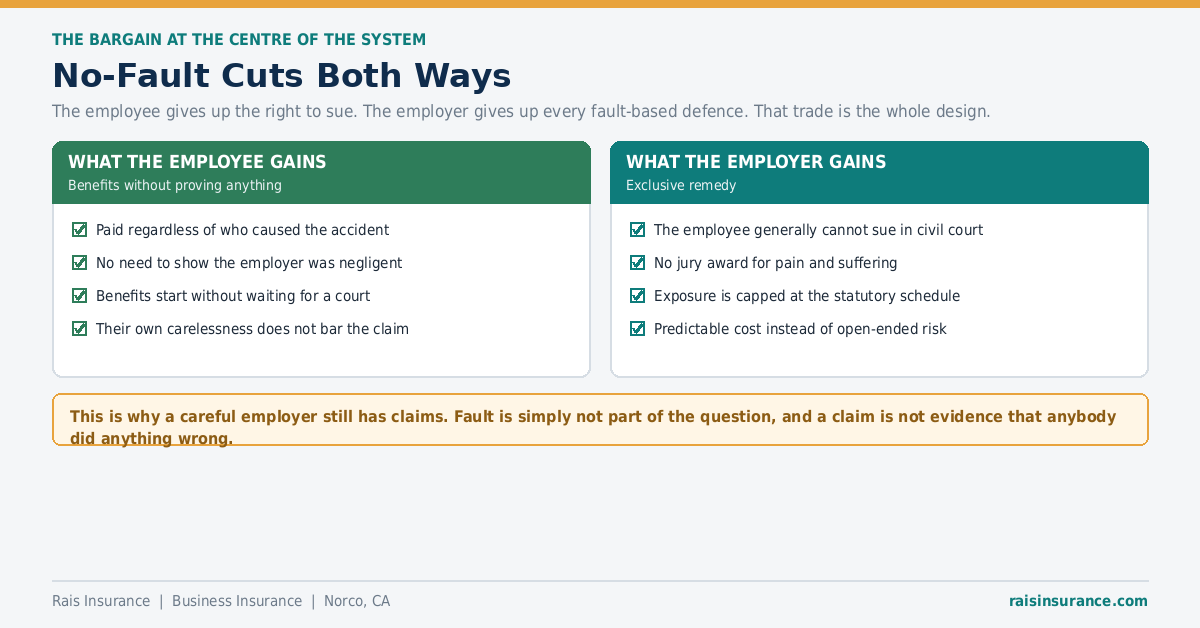
Workers’ compensation is a no-fault system, and understanding the bargain behind it explains most of how it behaves.
The employee receives benefits regardless of who caused the accident. They do not have to prove you were negligent, and their own carelessness generally does not bar the claim. In exchange, they give up the right to sue you in civil court over the injury – the exclusive remedy – which means no jury award for pain and suffering and no open-ended exposure for your business.
Two consequences follow. A careful employer still has claims, because fault was never the question. And a claim against your policy is not evidence that anyone did anything wrong. A separate coverage called employer’s liability sits alongside it to answer the narrow situations where an action against you is still possible.
Workers’ Compensation Insurance Norco Employers Must Carry
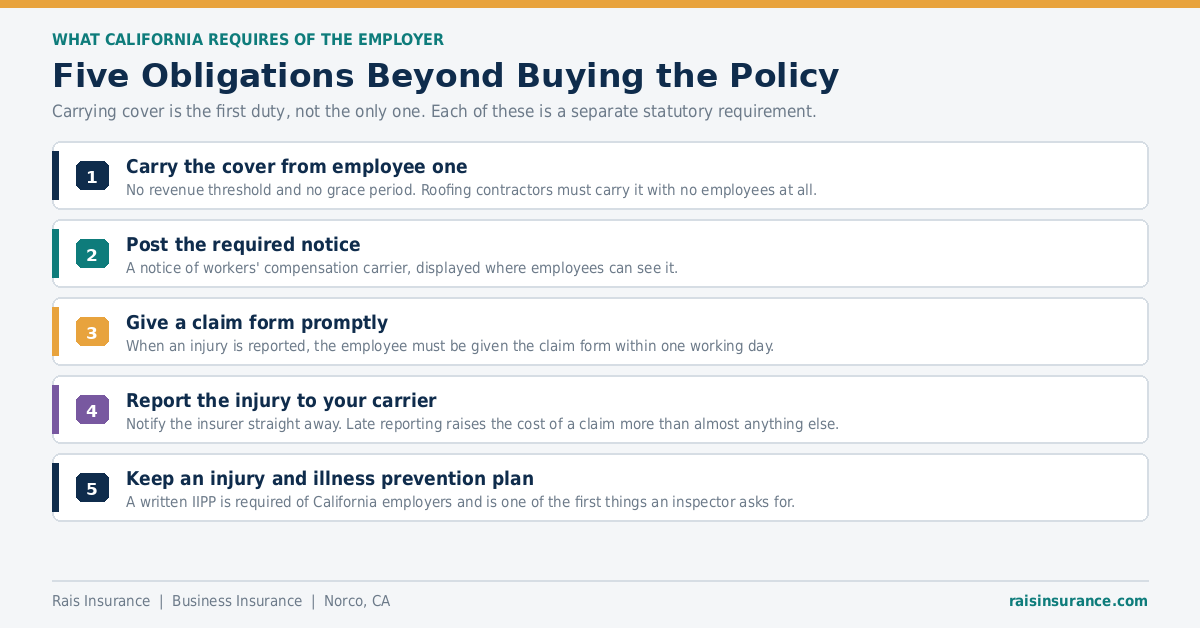
Buying the policy is the first obligation, not the only one. Five requirements sit alongside it:
- Carry cover from your first employee. No revenue threshold, no grace period. Roofing contractors are required to carry it even with no employees at all – see what a licensed California contractor has to carry.
- Post the required notice. A notice naming your workers’ compensation carrier, displayed where employees can see it.
- Provide a claim form within one working day. Once you learn of an injury, the employee must be given the claim form promptly. This deadline is short and it is missed often.
- Report the injury to your carrier. Straight away. Late reporting increases the cost of a claim more reliably than almost anything else an employer does.
- Maintain a written injury and illness prevention program. California requires one, and it is among the first documents an inspector asks to see.
On the consequences of not carrying cover at all: operating without workers’ compensation while having employees is a criminal offence in California, and it exposes you to substantial penalties, a stop order halting operations, and personal liability for the injured worker’s benefits. The employee also regains the right to sue you directly. Penalty figures are amended periodically, so confirm the current position with the state rather than relying on a number you read somewhere.
Injuries on the Road
The original made a fair point about employees hurt while driving – at the office, on the road, making deliveries, or travelling where the employer needs them. That is right, and the boundary is worth stating precisely.
An injury sustained while driving in the course of employment is generally covered: deliveries, travel between job sites, an errand run for the employer. The ordinary commute between home and a fixed workplace generally is not, which is known as the going-and-coming rule, though recognised exceptions exist where the employer requires the vehicle or the travel is part of the job.
One thing worth separating: the policy answers the employee’s injury. Damage to the vehicle, and injury to anybody else involved in the crash, is commercial auto. A business running vehicles in Norco needs both.
General Liability Insurance Norco Businesses Need Alongside It
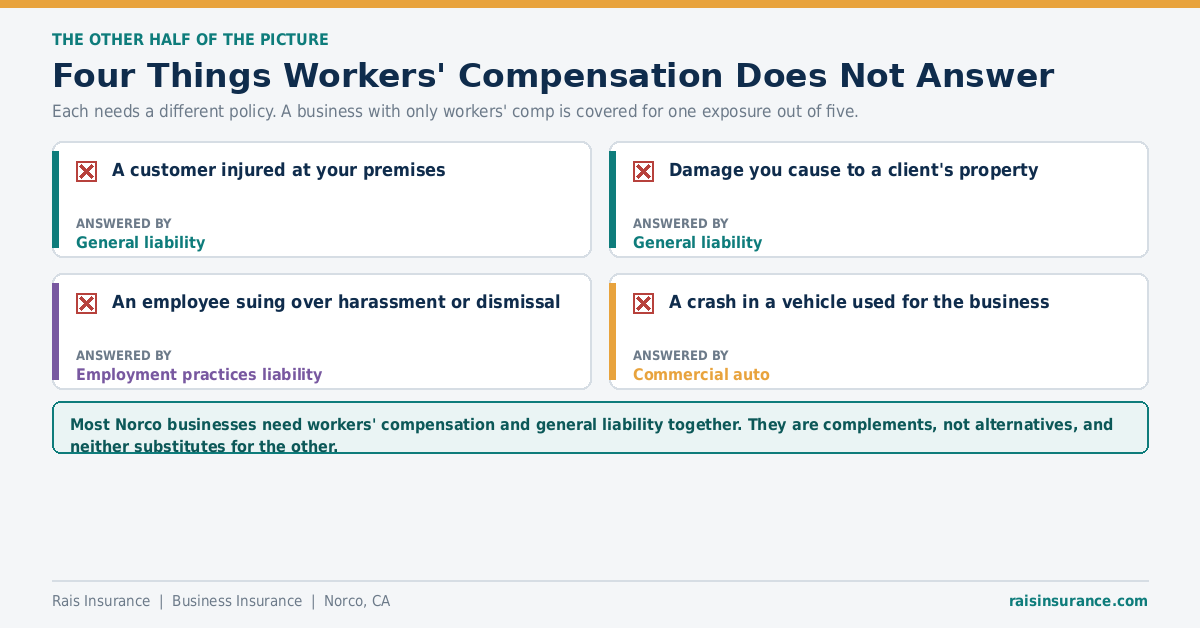
Comp is one policy covering one exposure. Four common situations sit entirely outside it:
- A customer injured at your premises. General liability.
- Damage you cause to a client’s property. General liability again – see what general liability does not cover for where that policy stops in turn.
- An employee suing over harassment, discrimination or dismissal. Employment practices liability. These are claims about how somebody was treated at work rather than how they were hurt, and neither comp nor general liability answers them.
- A crash in a vehicle used for the business. Commercial auto.
Add commercial property insurance for your own building, equipment and stock, and you have the shape of what most Norco businesses actually carry. Workers’ compensation and general liability are complements, not alternatives.
What It Costs and What Drives the Number
The premium is built primarily from your payroll and your classification code, then adjusted by your experience modification – the X-Mod – which measures your own claims history against businesses doing the same work. Payroll is the exposure basis, so the premium is provisional and audited at the end of the term.
Two things follow that are worth acting on. Classification accuracy matters enormously, because a misclassified business can pay a multiple of the correct rate for years without noticing. And because the premium is audited, an inaccurate payroll estimate does not save money – it defers a bill. The same logic applies on the liability side, covered in detail on our La Habra page: what actually sets a premium, and the year-end audit.
Getting Help from Rais Insurance
If you want to know which cover fits your situation, talk to us. Our agents are trained and skilled at working out what a business actually needs, and we can build a plan around the specific issues your operation faces rather than handing you a standard package. Reach out and we will either put a plan together or show you the choices available and what each one changes.
For a business shopping for workers’ compensation insurance in Norco, the practical starting point is short: do you have employees, do you have premises the public enters, and do you run vehicles? Three answers usually establish which policies you need before anybody quotes a price. On how much liability cover to carry once you get there, see how much liability cover a business needs.
We serve Norco, Corona, Eastvale, Jurupa Valley and Mira Loma from our Anaheim office, and we write across California.
Workers’ Compensation Insurance in Norco – Frequently Asked Questions
Q1. Is workers’ compensation part of general liability insurance?
No. They are two separate policies bought separately, and they answer opposite sides of the same accident. Workers’ compensation covers injuries to your own employees. General liability covers injury or damage your business causes to other people, and it specifically excludes employee injuries. Most businesses need both, but buying one does not give you any of the other.
Q2. Do I need workers’ compensation insurance in California?
If you have even one employee, yes. California requires it from the first employee, with no revenue threshold and no grace period. Roofing contractors are required to carry it even with no employees at all. Be careful about treating workers as independent contractors to avoid the requirement – if the classification does not hold up, an uninsured injury becomes your personal problem.
Q3. What are the main workers’ compensation benefits in California?
Medical care reasonably required to cure or relieve the injury, with no deductible or co-pay for the employee. Temporary disability, replacing a statutory share of lost wages while the worker cannot work. Permanent disability where lasting impairment remains. Death and burial benefits where an injury proves fatal. There is also a supplemental job displacement voucher toward retraining where the worker cannot return to their old job.
Q4. What is the supplemental job displacement benefit?
It is a voucher toward retraining or skill enhancement, available where a work injury leaves lasting impairment and the employer does not offer suitable regular, modified or alternative work. It is the fifth California benefit and it is routinely left off summaries of the system, which is unfortunate because it matters a great deal to a worker who cannot go back to the job they had.
Q5. Does workers’ compensation pay if the accident was the employee’s own fault?
Generally yes. The system is no-fault, so benefits do not depend on who caused the accident and the employee does not have to prove the employer did anything wrong. In exchange, the employee generally cannot sue the employer in civil court – that is called the exclusive remedy, and it is the bargain the whole system rests on. It is also why a careful employer still has claims.
Q6. What are my obligations as an employer beyond buying the policy?
Five, broadly. Carry cover from your first employee. Post the required notice naming your carrier where employees can see it. Provide a claim form to an injured employee within one working day of learning about the injury. Report the injury to your carrier promptly. And maintain a written injury and illness prevention program, which California requires and inspectors ask for early.
Q7. What happens if I do not carry workers’ compensation in California?
Operating without it while having employees is a criminal offence in California, and the consequences include substantial penalties, a stop order halting your business operations, and personal liability for the injured worker’s benefits and medical costs. The employee also regains the right to sue you directly, without the protection the exclusive remedy would otherwise give you. Confirm current penalty figures with the state, as they are periodically amended.
Q8. How is a workers’ compensation premium calculated?
Primarily from your payroll and your classification code, adjusted by your experience modification – the X-Mod – which reflects your own claims history against businesses of the same type. Payroll is the exposure basis, so the premium is provisional and audited at the end of the term. Accurate classification matters enormously here, because a misclassified business can pay a multiple of the correct rate.
Q9. Does workers’ compensation cover an employee injured while driving for work?
Usually yes, if the driving was in the course of employment – deliveries, travel between job sites, an errand for the employer. The ordinary commute to and from a fixed workplace is generally not covered, which is known as the going-and-coming rule, though there are recognised exceptions. Note that damage to the vehicle and injury to anyone else in the crash is commercial auto, not workers’ compensation.
Q10. Can an injured employee still sue me?
Usually not for the injury itself – that is what exclusive remedy means. There are exceptions, and a separate coverage called employer’s liability sits alongside workers’ compensation to answer some of them. Claims about how someone was treated at work rather than how they were hurt – harassment, discrimination, wrongful termination – fall outside both and need employment practices liability insurance.
Get a Workers’ Compensation Quote in Norco
Do not leave yourself, your employees or your family exposed in the event of an accident. Assess your options with us today – contact Rais Insurance on 714-761-4336, email rai@raisinsurance.com, or visit 2612 W. Lincoln Avenue, Suite 103, Anaheim, CA 92801.
Bring your payroll figures by job type and your current declarations page if you have one. Those two things establish your classification and your X-Mod, which between them decide most of what you pay.
