

General Liability Insurance Los Angeles
Most pages on this subject explain what a general liability policy covers. This one answers the question business owners in Los Angeles actually ask first: how much of it do I need? Below: why the number runs higher in LA than elsewhere in California, what businesses in different sectors typically carry, why the second million costs far less than the first, and who will demand a certificate before you can start work.
Rais Insurance places general liability insurance in Los Angeles, alongside the rest of the business insurance Los Angeles operations typically carry. Nobody controls when an accident happens, but the size of the policy standing behind it is entirely a decision you make in advance.
Why the Number Is Different in Los Angeles
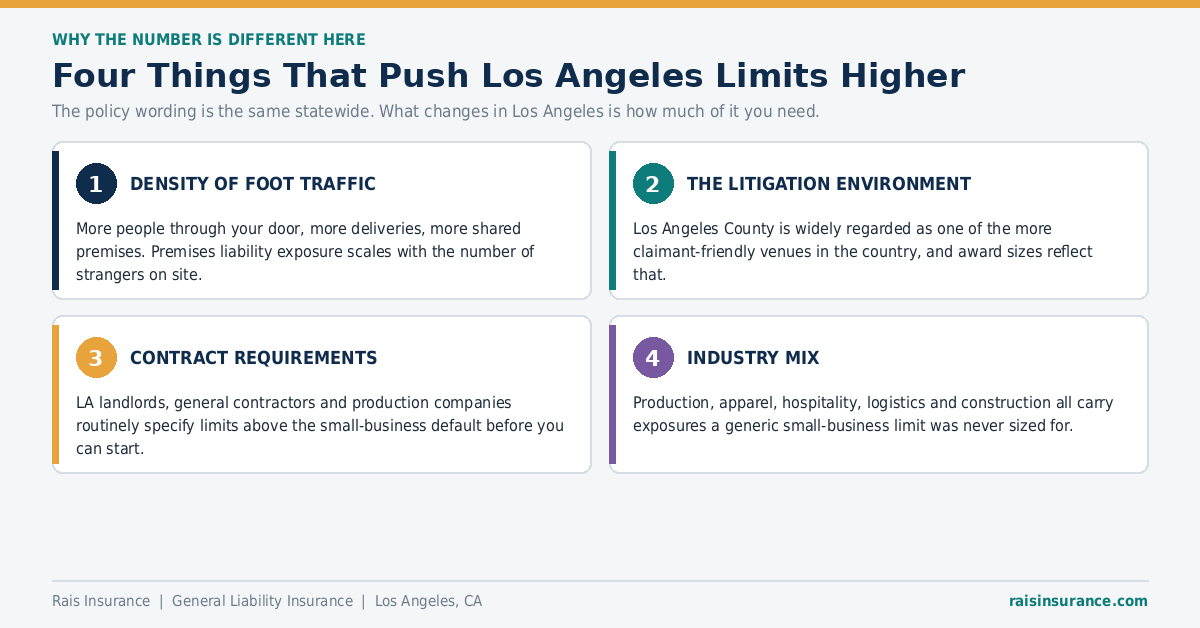
The policy wording is the same in Los Angeles as it is anywhere else in California. What changes is how much of it a business here needs, and four things compound to push that figure up:
- Density of foot traffic. More people through your door, more deliveries, more shared premises and shared parking than a suburban equivalent. Premises liability exposure scales with the number of strangers on your site, and in LA that number is high.
- The litigation environment. Los Angeles County is widely regarded as one of the more claimant-friendly venues in the country, and the size of awards reflects it. Whatever view you take of that, it is a fact your limit has to account for.
- Contract requirements. LA landlords, general contractors, production companies and commercial clients routinely specify limits above the small-business default. You are often not choosing the number at all – you are meeting one.
- The industry mix. Production, apparel, hospitality, logistics and construction each carry exposures that a generic small-business limit was never sized for.
The original point on this page was sound and worth keeping: the cost of handling a serious case – medical costs, damages paid to the injured party, and the legal expenses of the case itself – can reach several million dollars. That figure is the argument for reviewing your limit rather than the argument for having a policy at all.
How Much Cover Does a Los Angeles Business Need?
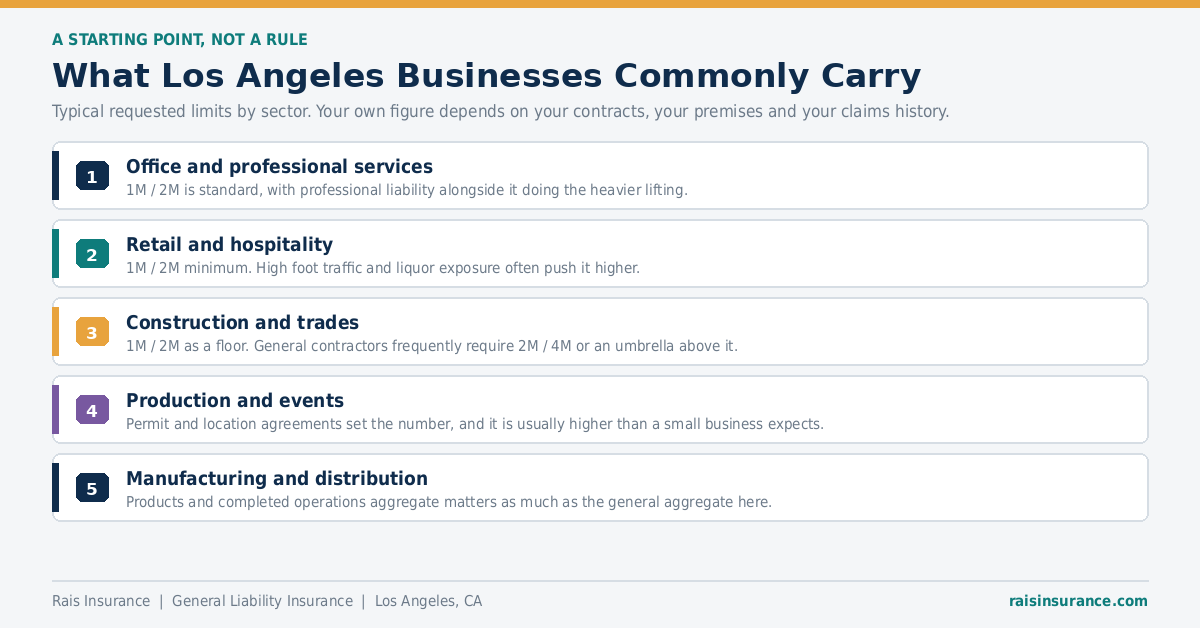
One million dollars per occurrence and two million in the annual aggregate is the usual starting point across California, and it is what most contracts request. In Los Angeles it is better treated as a floor than a target. Typical positions by sector:
- Office and professional services. One and two million is standard, with professional liability alongside doing the heavier lifting, since the general liability policy will not answer a claim about your advice.
- Retail and hospitality. One and two million as a minimum. High foot traffic, and any liquor exposure, commonly push it higher.
- Construction and trades. One and two million as a floor. General contractors frequently require two and four million, or an umbrella sitting above the primary. See what a licensed California contractor has to carry.
- Production and events. The permit and the location agreement set the number, and it is usually higher than a small production expects.
- Manufacturing and distribution. The products and completed operations aggregate matters as much as the general aggregate here, because that is the limit these claims land against.
Those are starting points for a conversation, not rules. Business liability insurance is sized to the operation, not to the sector label. Your own figure comes from your contracts, your premises, your claims history and what your business actually does.
The Second Million Costs Far Less Than the First
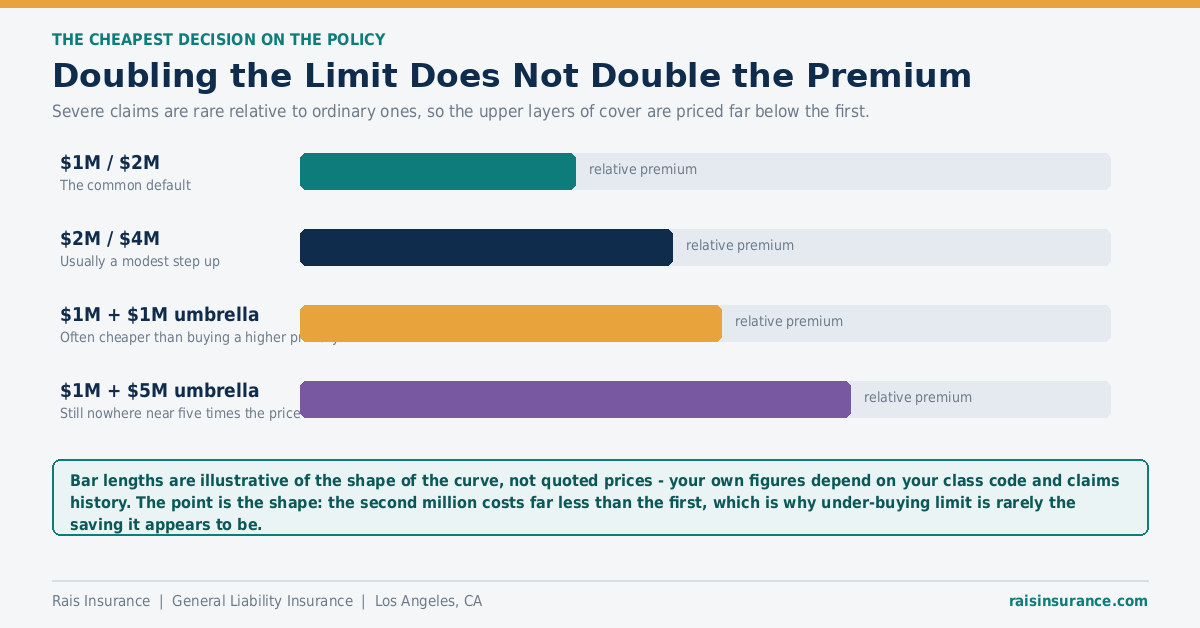
This is the single most useful pricing fact in liability insurance, and it is rarely explained at the point of sale.
Severe claims are rare relative to ordinary ones. A carrier expects to pay a great many small claims and very few catastrophic ones, so the upper layers of cover are priced far below the first. Moving from one million to two million typically costs a fraction of the original premium rather than a second copy of it.
The practical consequence: under-buying limit is rarely the saving it appears to be on a quote comparison. A business that shaves a modest amount off its premium by holding the minimum limit has taken on the entire gap above that limit personally, and that gap is where the claims that actually end businesses sit.
There is also a second route to the same place. A commercial umbrella sits above your general liability, commercial auto and employer’s liability at once, so it often buys more total protection per dollar than raising the general liability limit alone. Larger contracts frequently require one by name, which settles the question. Worth pricing both rather than assuming either.
What drives the base number in the first place is a separate subject – see what actually sets your premium, and the year-end audit.
In Los Angeles, the Certificate Is Often the Gate
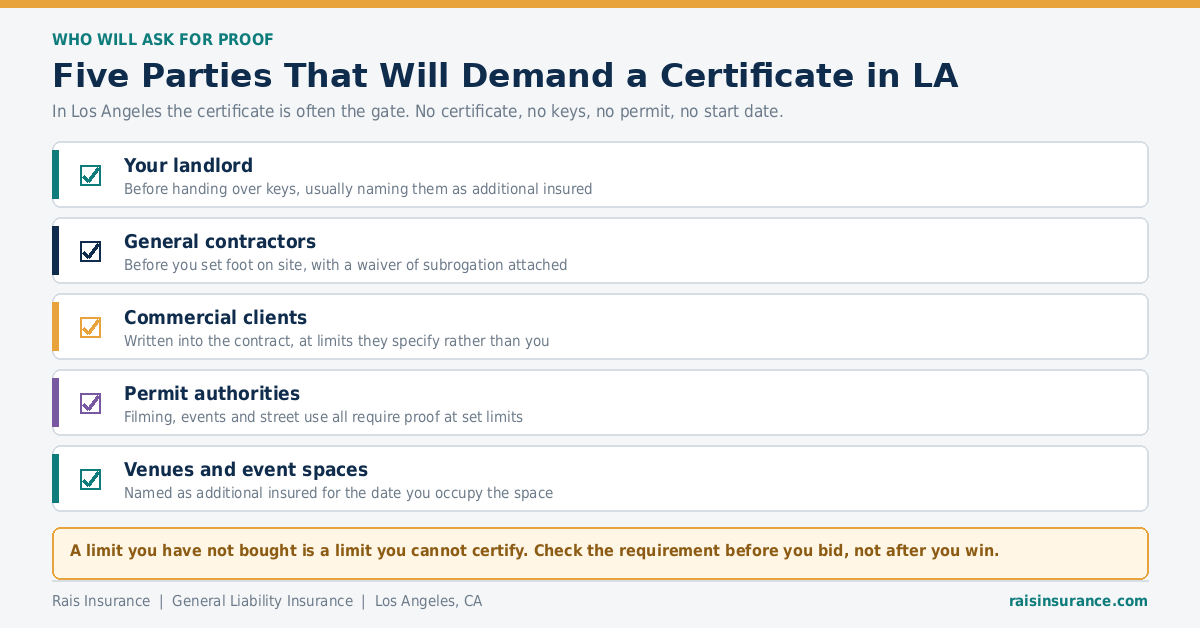
Adequate limits are not only about surviving a claim. In practice, a great deal of business in Los Angeles simply does not start until somebody has seen proof of cover. Five parties will ask:
- Your landlord, before handing over keys, and usually wanting to be named as an additional insured.
- General contractors, before you set foot on site, often with a waiver of subrogation attached that your carrier has to accept in writing.
- Commercial clients, under contract, at limits they specify rather than limits you choose.
- Permit authorities, for filming, events and street use. These set both the limit and the exact wording naming the relevant public entity, and the requirements change – confirm the current one for your specific permit rather than reusing what a previous job carried.
- Venues and event spaces, named as additional insured for the dates you occupy the space.
The rule that follows is simple: a limit you have not bought is a limit you cannot certify. Check the requirement before you bid, not after you win, because the job will wait while you buy the cover and sometimes it will not wait at all.
What the Policy Pays For – and What It Does Not
Since this page is mostly about the size of the cover, here is the shape of it in brief. A general liability policy pays damages you become legally obligated to pay for covered harm, up to your limit; the cost of defending the claim, which under a standard form sits in addition to that limit rather than eroding it; and small medical payments for a visitor injured on your premises, paid without anyone having to establish fault.
One correction worth making, because the wording on this page previously implied otherwise. General liability answers claims arising from your products and your operations. It does not answer claims about your professional judgement – advice that turned out wrong, a design that failed, a service that underperformed. The standard form carries a professional services exclusion precisely to keep those out, and they belong to professional liability instead. If clients pay you for expertise rather than for a physical product, you need both policies.
For the full picture on what general liability does not cover, and on the duty to defend and how a false claim is handled, see the linked pages.
Industries as Varied as the City Itself
Recognising that Los Angeles industries are as varied as the City of Angels itself, we work with each business to understand the liabilities it should genuinely be prepared for, then build the cover around that rather than around a template. A garment manufacturer in the Fashion District, a restaurant group, a production services company and a distribution operation near the ports have little in common on paper beyond needing the same policy name.
What that looks like in practice is short. We ask what your contracts require, what happens on your premises, what leaves your premises, and who else is involved in the work. Four answers, and the right limit becomes fairly obvious.
Where to Read More
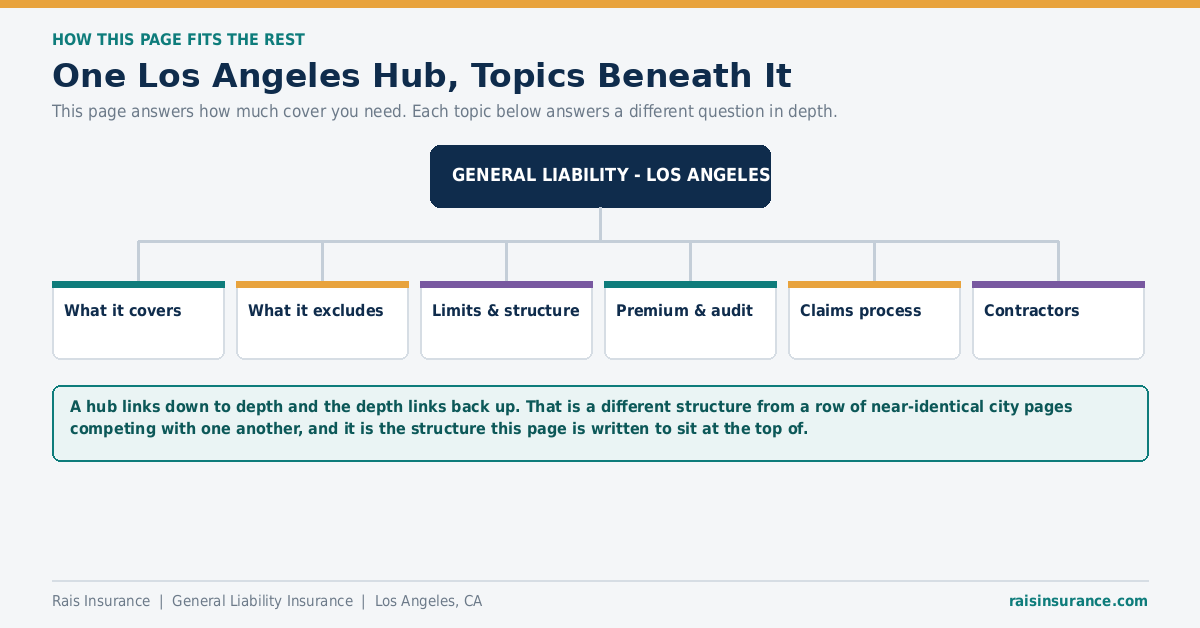
This page answers how much cover a Los Angeles business needs. Each of the following goes into depth on a different part of the same policy:
- what each coverage part of the policy actually does – Coverage A, B and C, and how per-occurrence and aggregate limits work
- the four edges of any policy, and why cover cannot be bought after the fact – the coverage grant, exclusions, sub-limits and the known loss principle
- what to do in the first 48 hours after an incident – reporting, evidence and how a claim runs
Getting the Right Cover from Rais Insurance
General liability insurance in Los Angeles acts as the first line of defence when something goes wrong, and getting the size of it right is the part that decides whether it holds. We can put your details to several carriers and show you what the difference between limits actually costs, so the decision is made on numbers rather than on a default.
We serve Los Angeles, Glendale, Burbank, Pasadena, Culver City and Inglewood from our Anaheim office, and we write across California.
General Liability Insurance Los Angeles – Frequently Asked Questions
Q1. How much general liability insurance does a Los Angeles business need?
One million dollars per occurrence and two million in the annual aggregate is the usual starting point, and it is what most contracts request. Whether that is enough depends on three things: how many people come through your premises, what your contracts specify, and what a serious injury claim in Los Angeles County would realistically cost to resolve. For many LA businesses the honest answer is that the default is a floor rather than a target.
Q2. Why do Los Angeles businesses carry higher limits than the state default?
Four reasons compound here. Density means far more foot traffic and shared premises than a suburban equivalent. Los Angeles County is widely regarded as a claimant-friendly venue, and award sizes reflect that. Landlords, general contractors and production companies routinely specify limits above the small-business default. And the local industry mix – production, apparel, hospitality, logistics, construction – carries exposures a generic limit was never sized for.
Q3. Does doubling my limit double my premium?
No, and the gap is usually large. Severe claims are rare relative to ordinary ones, so the upper layers of cover are priced far below the first. Moving from one million to two million typically costs a fraction of the original premium rather than a second copy of it. That pricing shape is why under-buying limit is rarely the saving it looks like on a quote comparison.
Q4. Should I buy a higher primary limit or add an umbrella?
It depends on the numbers in front of you, and it is worth pricing both. A commercial umbrella sits above your general liability, commercial auto and employer’s liability at once, so it often buys more total protection per dollar than raising the primary limit on general liability alone. Larger contracts frequently require an umbrella by name, which settles the question for you.
Q5. Who will ask me for a certificate of insurance in Los Angeles?
Landlords before handing over keys, general contractors before you set foot on site, commercial clients under contract, permit authorities for filming, events and street use, and venues for the dates you occupy them. Most will also want to be named as an additional insured, and some will want a waiver of subrogation your carrier has accepted in writing.
Q6. What insurance do I need for a filming permit in Los Angeles?
Permit authorities set their own liability requirements, and they specify both the limit and the wording naming the relevant public entity as an additional insured. The figures and the exact wording change, so confirm the current requirement with the permit office for your shoot rather than relying on what a previous production carried. A broker can issue the certificate and endorsement quickly once you have the requirement in writing.
Q7. Does general liability cover mistakes in the service my business provides?
No. The standard policy carries a professional services exclusion, so advice that turned out wrong, a design that failed or a service that underperformed belongs to professional liability, also called errors and omissions. General liability answers bodily injury, property damage and personal and advertising injury. If clients pay you for expertise rather than for a physical product, you need both policies.
Q8. What does general liability actually pay for when a claim is made?
Three things. Damages you become legally obligated to pay for covered harm, up to the limit you purchased. The cost of defending the claim, which under a standard form sits in addition to that limit rather than eroding it. And small medical payments for a visitor injured on your premises, paid without anyone having to establish fault. All three are subject to the coverage grant and the exclusions.
Q9. How much does general liability insurance cost in Los Angeles?
There is no flat rate. Premium is built from your classification code, your gross receipts or payroll, the limits you choose, your claims history and how much work you subcontract out. Two businesses on the same block buying identical limits can pay very different amounts because the exposures are not comparable. A broker can put the same information to several carriers and show you the spread.
Q10. I only have a small operation. Do I still need this?
Almost certainly, and usually sooner than expected. The trigger is rarely revenue – it is the first landlord, the first client contract, the first permit or the first person through your door. Cover also has to be in force before an incident rather than after it, so the practical moment to buy is when you sign the lease or take the first booking, not when the business feels established.
Get a General Liability Insurance Quote in Los Angeles
contact Rais Insurance and we will work out the right limit before quoting a price. Call 714-761-4336, email rai@raisinsurance.com, or visit 2612 W. Lincoln Avenue, Suite 103, Anaheim, CA 92801.
Bring your current declarations page and the insurance clause from any contract or lease you have signed. Those two documents usually show within minutes whether the cover you hold matches the cover you have already promised.
