

General Liability Insurance Escondido
While most of us do our best to avoid unnecessary harm and expense, the truth is that mistakes and accidents are inevitable. They are often unavoidable, too. Outside of work, these are rarely serious and can usually be settled with an apology. In business, they are taken very seriously, and even a small one can cost a company a great deal.
This is why general liability insurance is crucial for any business. It supports your business when something goes wrong and the unexpected costs start arriving — the injured customer, the damaged client property, the lawyer’s letter you did not see coming.
What General Liability Insurance Actually Covers
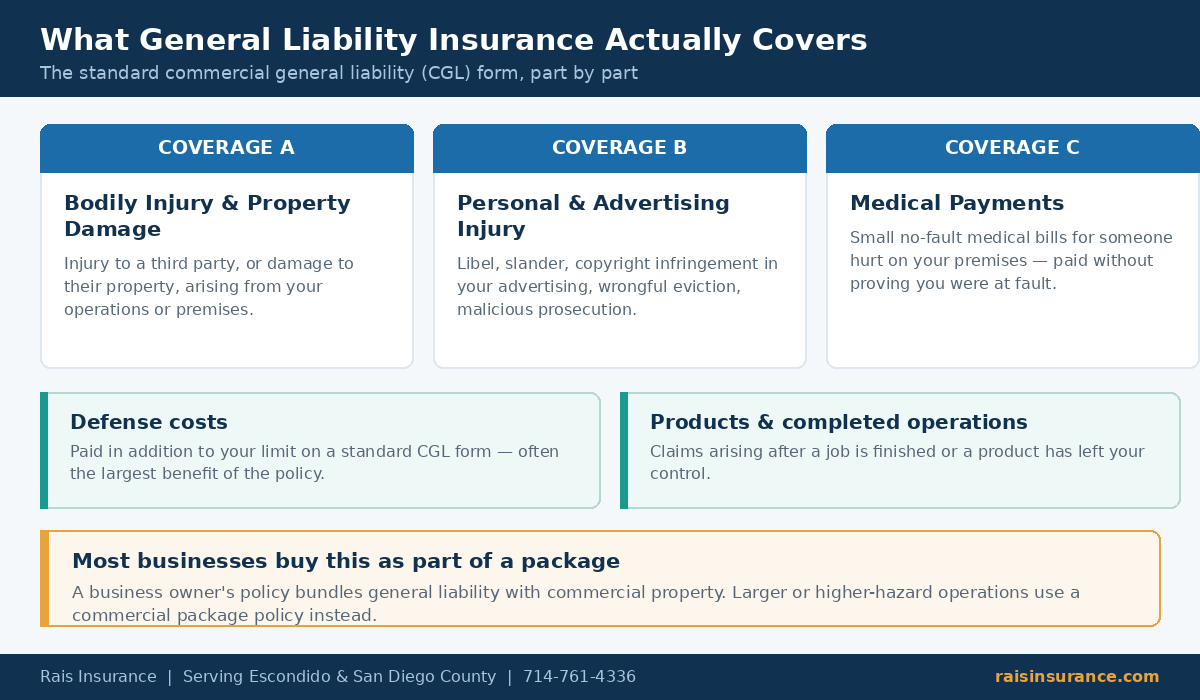
A commercial general liability policy — the CGL form nearly every insurer uses, and what most owners mean when they say business liability insurance — is built from three coverage parts:
- Coverage A: Bodily injury and property damage — injury to a third party, or damage to property belonging to someone else, arising out of your operations or your premises. A customer slipping in your shop, or your crew damaging a client’s floor.
- Coverage B: Personal and advertising injury — claims of libel or slander against your company, copyright infringement in your advertising, wrongful eviction, and malicious prosecution.
- Coverage C: Medical payments — small, no-fault medical bills for someone hurt on your premises, paid without anyone having to prove you were at fault. It exists to settle minor incidents before they become claims.
Two further points matter more than most business owners realise:
- Legal defense is paid in addition to your limit on a standard CGL form. Defending a claim you eventually win still costs money, and on this policy that money does not come out of the limit available to pay a settlement.
- Products and completed operations extends your coverage to claims that arise after a job is finished or a product has left your hands. For contractors and manufacturers this is often the most important part of the policy.
In practice, our general liability insurance in Escondido covers a wide range of accidents and expenses, giving you the peace of mind of knowing that your company — and your future — is in safe hands. Typical packages include bodily injury sustained on your premises, damage to third-party property, intellectual property claims arising from your advertising, defense against lawsuits, and claims of libel or slander against your company.
What General Liability Insurance Does Not Cover
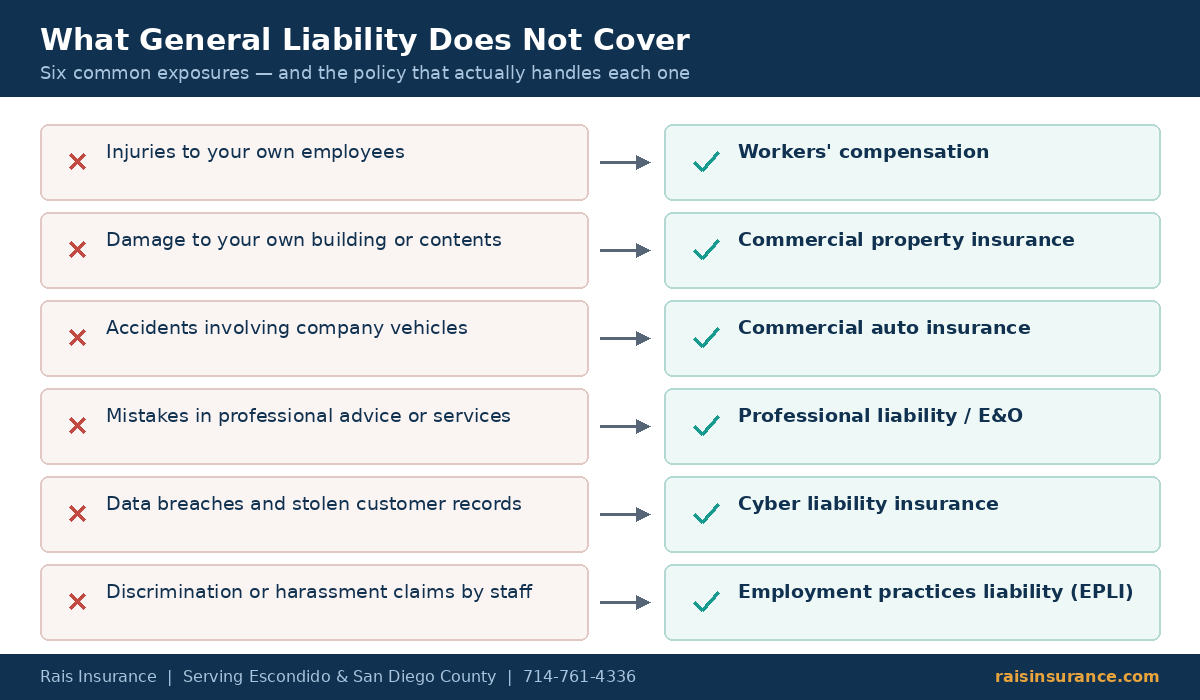
This matters as much as the coverage list, and it is where most small businesses discover a gap at the worst possible moment. General liability does not cover:
- Injuries to your own employees — that is workers’ compensation, which California requires once you have employees.
- Damage to your own building, equipment, or stock — theft, vandalism, and fire affecting your own property are commercial property insurance, not liability.
- Accidents involving company vehicles — commercial auto insurance.
- Mistakes in professional advice or services — professional liability, also called errors and omissions.
- Data breaches and stolen customer records — cyber liability. Note the distinction: your CGL does cover intellectual property claims arising from your advertising, but it does not cover a data breach.
- Discrimination, harassment, or wrongful termination claims by staff — employment practices liability insurance.
None of this means general liability is inadequate. It means it is one policy among several, and the job of a broker is to tell you which ones you actually need rather than selling you the one you asked for.
Per Occurrence and Aggregate Limits
Your policy carries two limits, and the second one is the one that catches people out. The per occurrence limit is the most the policy will pay for any single claim. The general aggregate is the most it will pay for all claims combined during the policy year.
On a common $1,000,000 per occurrence and $2,000,000 aggregate policy, two $800,000 claims are paid in full. A third $800,000 claim in the same year has only $400,000 of aggregate left, and the remaining $400,000 comes out of your business. The aggregate does not reset until renewal.
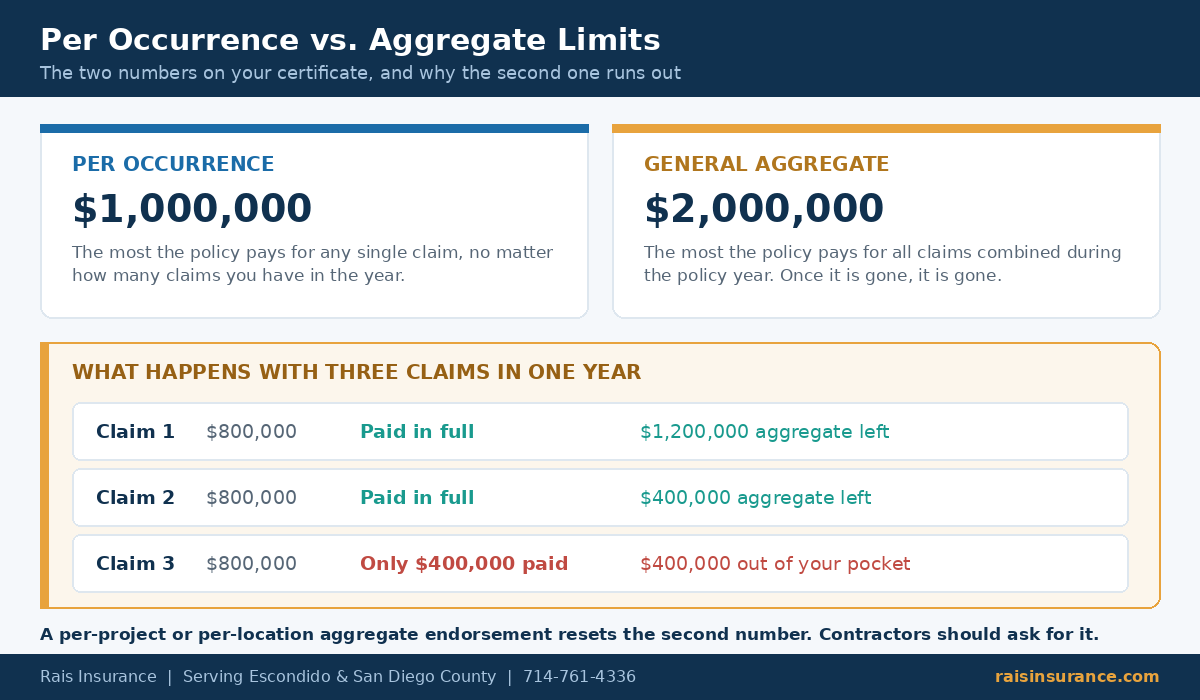
Contractors working several jobs at once should ask about a per-project aggregate endorsement, which gives each project its own aggregate instead of sharing one across the whole year.
Certificates of Insurance and Additional Insured Endorsements
Most businesses buy general liability because a contract requires it, and that contract usually asks for two specific things.
A certificate of insurance is a one-page summary proving your policy exists, what limits it carries, and when it expires. Landlords, clients, and general contractors ask for one before you start work. A certificate is evidence only — it does not grant anyone rights under your policy.
An additional insured endorsement is different, and it is the one that matters. It extends your liability coverage to another party — a client, a landlord, a general contractor — for claims arising out of your work. Unlike a certificate, it changes the policy itself. Many contracts also require primary and non-contributory wording and a waiver of subrogation, which are separate endorsements again.
Read the insurance clause of your contract before you buy the policy, not after. We will read it with you, and we issue certificates the same day.
How Much Does General Liability Insurance Cost?
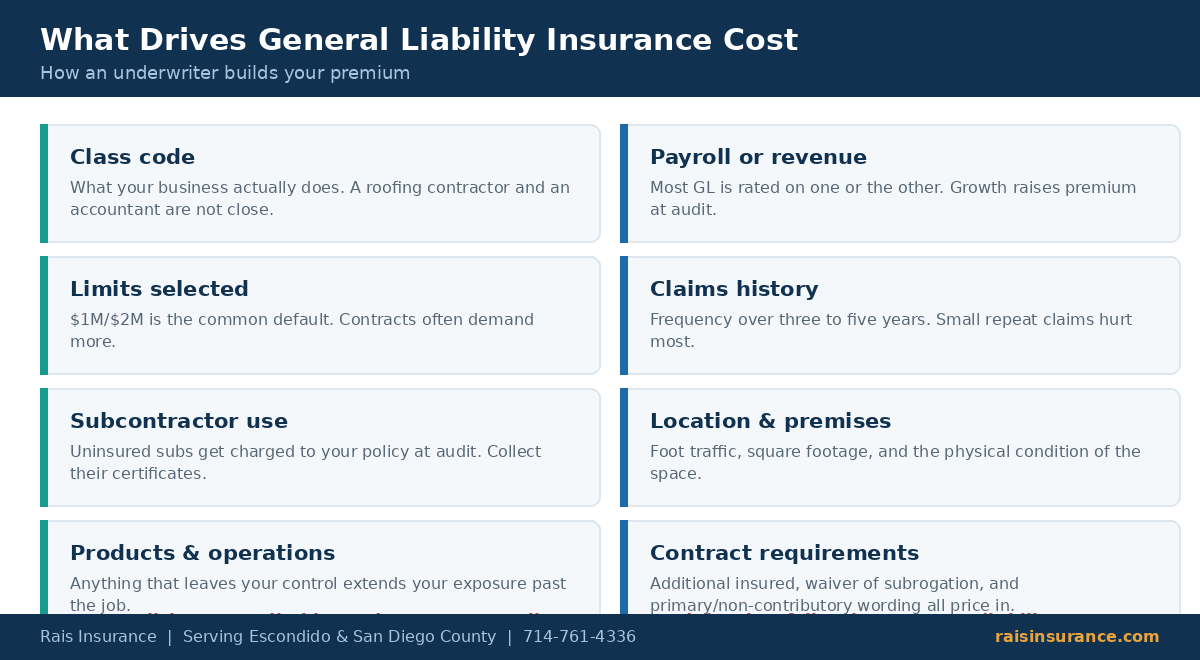
There is no flat rate. Underwriters price general liability on:
- Class code — what your business actually does. A roofing contractor and an accountant are not remotely comparable.
- Annual payroll or revenue — most GL policies are rated on one or the other, and most are auditable at year end.
- Limits selected — $1M per occurrence and $2M aggregate is the common default; contracts frequently demand more.
- Claims history — three to five years. Frequency of small claims hurts more than one large one.
- Subcontractor use — uninsured subs are charged to your policy at audit. Collect their certificates before they start.
- Premises and operations — foot traffic, square footage, and where the work is performed.
One warning: most general liability policies are auditable. Under-report payroll or revenue at the start of the year and the shortfall arrives as an audit bill at the end of it. It is better to estimate honestly and pay monthly than to be surprised.
Is General Liability Insurance Required in California?
For most businesses, general liability is not required by California statute. In practice it is required almost everywhere else: commercial leases, client contracts, general contractors hiring subcontractors, event venues, and many municipal permits all demand it, usually at a stated limit with additional insured status.
Workers’ compensation is a separate matter — California does require it by law once you have employees, and it is not part of general liability.
The businesses that most often need general liability in Escondido and across San Diego County are contractors and trades, retail and restaurants, professional service firms, property owners and landlords, and anyone running events or working on someone else’s premises.
Many smaller operations are better served by a business owner’s policy, which bundles general liability with commercial property coverage — usually for less than buying the two separately. We will tell you which structure fits before we quote.
We Provide Peace of Mind
Rais Insurance has been operating in the insurance industry since 1982, and we have seen our share of disasters and unfortunate incidents — some of which have destroyed entire businesses. We understand that disaster can arrive in any shape, size, or form, and that it usually arrives when you least expect it.
Because we also write commercial property insurance, workers’ compensation, and commercial auto insurance, we can close the gaps general liability leaves open rather than pointing them out and leaving you to solve them. See our full range of general liability insurance coverage for businesses across California.
Protect Your Future, Today
We are fortunate to live in a world where we can safeguard our futures with custom-tailored insurance packages. In the past there were no safety nets and no reimbursement when a home or business burned down, and people could do little to protect what came next.
This is what drives our commitment to general liability insurance in Escondido. We want to protect you from disaster and make sure your future is never compromised.
Serving Escondido and San Diego County
We write general liability insurance for businesses in Escondido and across San Diego County — including San Marcos, Vista, Poway, Rancho Bernardo, and Valley Center — and throughout California from our office in Anaheim. Most of this work is handled by phone and email, and certificates are issued the same day.
Get a General Liability Insurance Quote
To quote accurately we need four things: a description of what your business actually does, your annual revenue or payroll, any limits your contracts require, and three years of loss history if you have had claims.
Contact us at Rais Insurance today to find out more about our custom-tailored insurance packages, designed around your specific needs. Call 714-761-4336 or email rai@raisinsurance.com.

General Liability Insurance FAQs
Q1. What does general liability insurance cover?
General liability insurance covers third-party bodily injury and property damage arising from your business, personal and advertising injury such as libel, slander, and copyright infringement in your advertising, and medical payments for minor injuries on your premises. It also pays your legal defense costs, which on a standard form are paid in addition to your policy limit.
Q2. What does general liability insurance not cover?
General liability does not cover injuries to your own employees, damage to your own building or contents, accidents involving company vehicles, mistakes in professional advice, data breaches, or employment claims such as discrimination. Those need workers’ compensation, commercial property, commercial auto, professional liability, cyber liability, and EPLI respectively.
Q3. How much does general liability insurance cost?
Cost depends on your class code, annual payroll or revenue, the limits you select, your claims history, your use of subcontractors, and any contract requirements such as additional insured wording. A low-hazard office operation and a roofing contractor with the same revenue will price very differently.
Q4. Is general liability insurance required in California?
General liability is generally not required by California statute for most businesses. It is, however, routinely required by commercial leases, client contracts, general contractors hiring subcontractors, and event venues. Workers’ compensation is separately required by law in California once you have employees.
Q5. What is the difference between per occurrence and aggregate limits?
The per occurrence limit is the most the policy pays for any single claim. The general aggregate is the most it pays for all claims combined during the policy year. With a $1,000,000 / $2,000,000 policy, a third $800,000 claim in one year would only have $400,000 of aggregate remaining.
Q6. What is a certificate of insurance?
A certificate of insurance is a one-page summary showing that your policy exists, what limits it carries, and when it expires. Clients, landlords, and general contractors request one before you start work. A certificate is evidence of coverage — it does not itself grant anyone rights under your policy.
Q7. What is an additional insured endorsement?
An additional insured endorsement extends your liability coverage to another party, usually a client, landlord, or general contractor, for claims arising out of your work. Unlike a certificate, it changes the policy itself. Most commercial contracts require it, and many also require primary and non-contributory wording.
Q8. Does general liability insurance cover employee injuries?
No. Injuries to your own employees are covered by workers’ compensation, which California requires once you have employees. General liability responds to injuries suffered by third parties such as customers, visitors, and members of the public.
Q9. What is the difference between general liability and professional liability?
General liability covers physical harm — someone is injured or their property is damaged. Professional liability, also called errors and omissions, covers financial harm caused by your advice, designs, or services. A consultant whose recommendation costs a client money needs professional liability; general liability will not respond.
Q10. Are legal defense costs included in my policy limit?
On a standard commercial general liability form, defense costs are paid in addition to your limit rather than eroding it. Some policies, particularly professional liability and certain excess forms, include defense inside the limit instead. It is worth confirming which applies to your policy, because the difference can be substantial.
