

General Liability Insurance Riverside
The awkward thing about liability is that you rarely see it coming. Most business owners go through a week without noticing how close they came to being responsible for something – and without knowing whether the policy in the drawer would answer if they had been. General liability insurance in Riverside is the cover that stands between an ordinary mistake and a serious financial problem, and the useful question is not whether you have it but whether you can read it.
That is what this page is for. The earlier version made a genuinely good point and then stopped at it: insurance policies work like contract documents, so what matters is knowing exactly what yours says and does not say. Below, that point is finished — the six parts of an insurance contract, the seven lines on your declarations page worth four minutes today, and the four everyday words the policy quietly redefines.
Understanding Your Policy: The Six Parts of an Insurance Contract
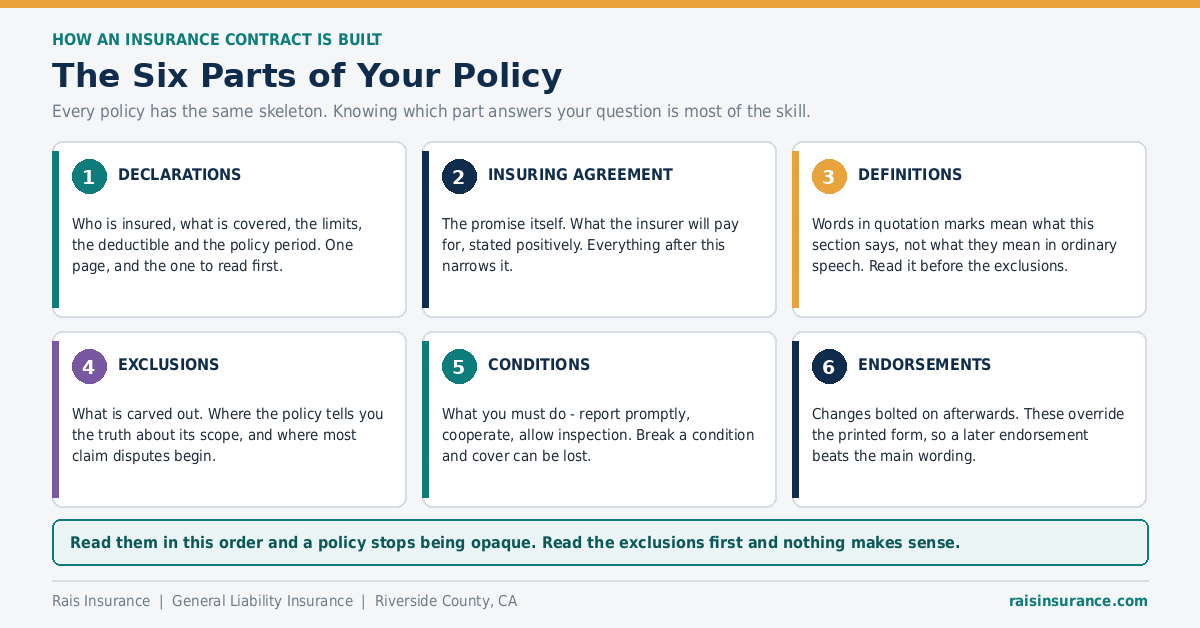
Every commercial general liability insurance policy has the same skeleton. Once you know it, a policy stops being opaque – and knowing which part answers your question is most of the skill:
- Declarations. Who is insured, what is covered, the limits, the deductible, the policy period. One page, written specifically for you, and the place to start.
- Insuring agreement. The promise itself, stated positively: what the insurer will pay for. Everything after this narrows it rather than widening it.
- Definitions. Words in quotation marks mean what this section says they mean. Read it before the exclusions or the exclusions will not make sense.
- Exclusions. What is carved out. This is where a policy tells you the truth about its scope, and where most claim disputes begin. See the full list of what general liability does not cover.
- Conditions. What you must do – report promptly, cooperate, allow inspection, refrain from admitting liability. Break a condition and cover can be lost on an otherwise valid claim.
- Endorsements. Changes attached after the printed form was drafted. Where an endorsement conflicts with the main wording, the endorsement generally controls.
Read them in that order and the document becomes navigable. Read the exclusions first, which is what most people do, and the whole thing looks arbitrary. On where the outer edges of any policy sit, see the four edges of any policy, and why cover cannot be bought after the fact.
Start With the Declarations Page
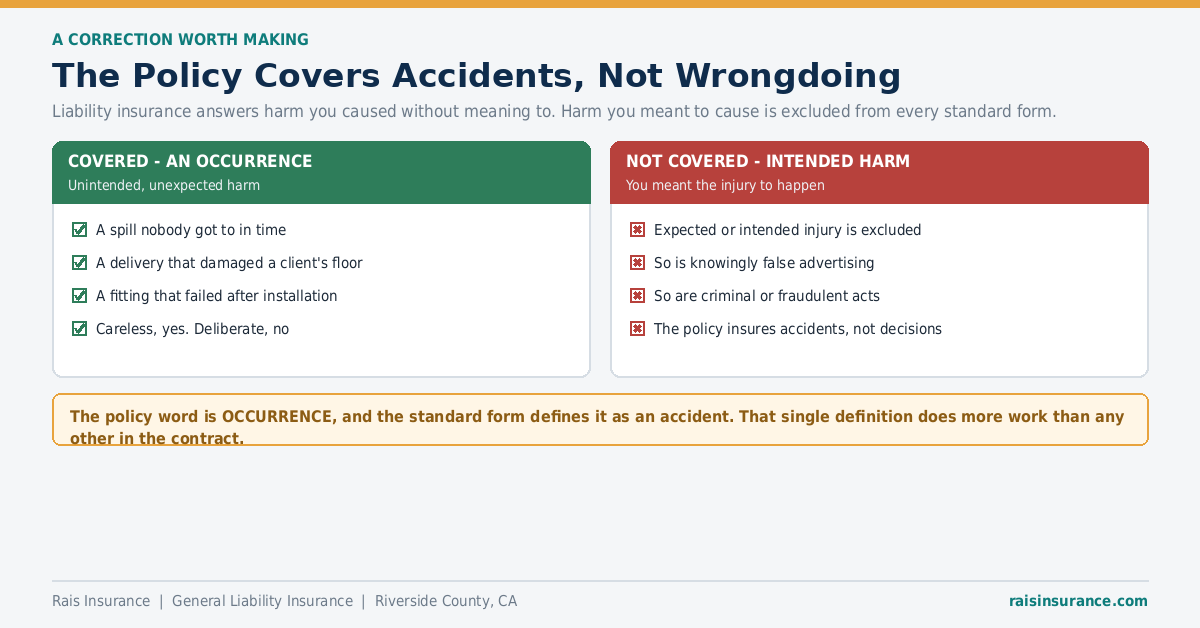
If you read one page of your business liability insurance policy this year, make it this one. Seven lines answer most practical questions:
- Named insured. Is it the legal entity that actually trades? A trading name or a superseded entity on this line is a genuine problem, not a formality.
- Policy period. The dates cover is in force. A gap here is permanent – anything that happened during it cannot be insured afterwards.
- Each occurrence limit. The most payable for any single claim.
- General aggregate. The most payable across the policy year, however many claims arise. Once exhausted, the policy is finished until renewal.
- Products and completed operations aggregate. A separate annual pot for claims arising after your work or product left you. Contractors and manufacturers should check this one specifically. More on all three in how the per-occurrence and aggregate limits work.
- Classification code. What the insurer believes you do. Businesses drift, and a firm still rated on what it did five years ago can be paying a multiple of the correct rate – see what actually sets your premium, and the year-end audit.
- Forms and endorsements list. Every attached change, by form number. This is where the surprises live, and it is the line people skip.
Words in Quotation Marks Are Not Ordinary Words
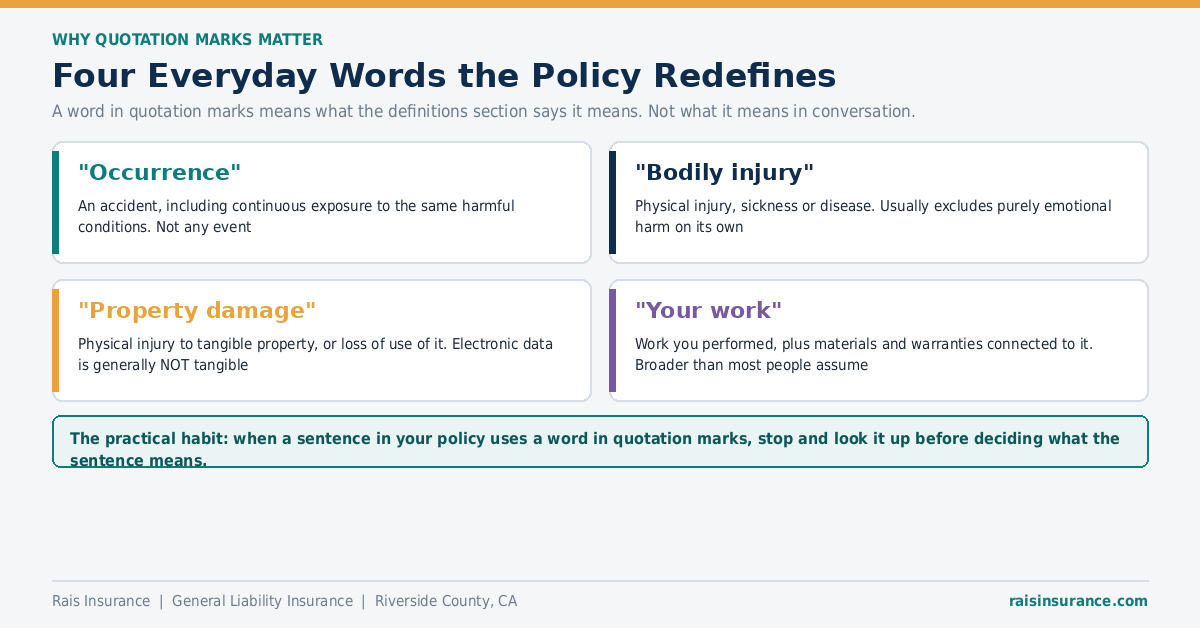
This is the single most useful habit to build, and it takes no expertise at all. When a sentence in your policy uses a word inside quotation marks, that word is a defined term – it means what the definitions section says, not what it means in conversation. Four examples that change the meaning of the sentences around them:
- “Occurrence” means an accident, including continuous or repeated exposure to substantially the same harmful conditions. Not any event, and not anything deliberate.
- “Bodily injury” means physical injury, sickness or disease. Purely emotional harm standing alone often falls outside it.
- “Property damage” means physical injury to tangible property or loss of use of it – and the standard form states that electronic data is not tangible property. Lost or corrupted data is a cyber question, not a general liability one.
- “Your work” covers work you performed plus materials and warranties connected to it. Broader than most people assume, and it matters because damage to your own completed work is generally excluded.
So the practical rule: when you hit a word in quotation marks, stop and look it up before deciding what the sentence means. Half the confusion in insurance comes from reading defined terms as ordinary English.
It Covers Accidents, Not Wrongdoing
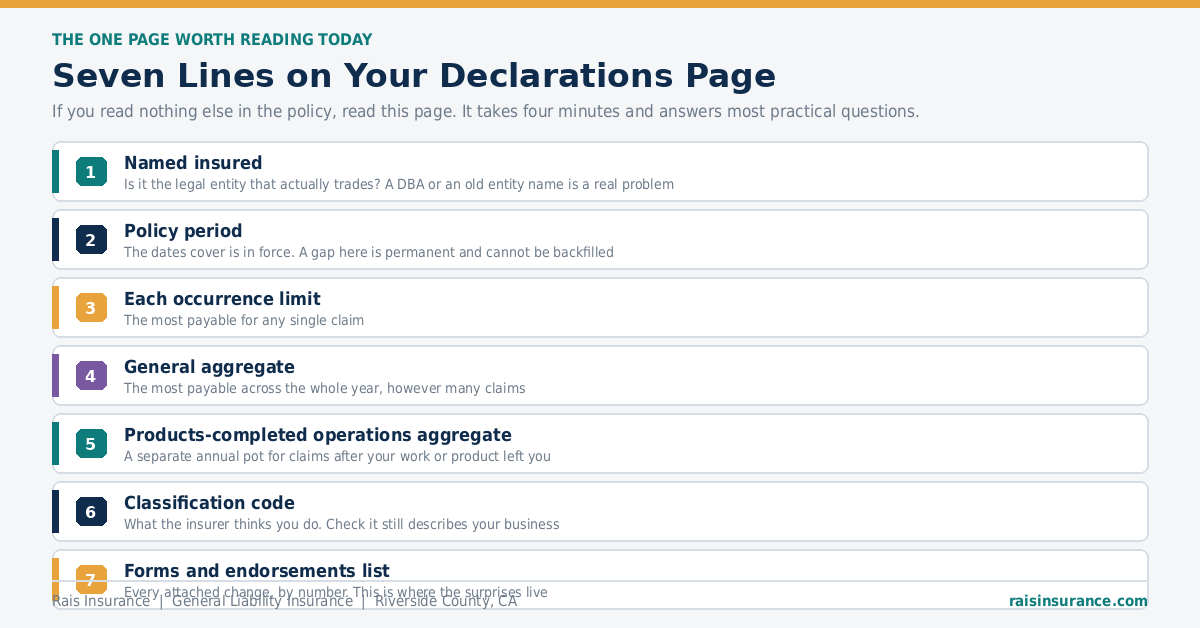
One correction worth making, because the framing matters. General liability insurance is not cover for wrongdoing – it is cover for accidents. That distinction runs straight out of the “occurrence” definition above.
The policy answers harm you caused without meaning to: a spill nobody got to in time, a delivery that damaged a client’s floor, a fitting that failed after installation. Careless, certainly. Deliberate, no.
Expected or intended injury is excluded from every standard form, and so are criminal and fraudulent acts and knowingly false advertising. The line is between an accident and a decision, and insurance transfers the risk of the first rather than the consequences of the second. Being covered for a simple accident is exactly right; being covered for a deliberate act was never on offer.
The Part That Depends On You
Most of a policy describes what the insurer owes you. The conditions section describes what you owe the insurer, and it is short enough to read in one sitting: report a claim promptly, cooperate with the investigation, allow inspection of your premises and records, do not admit liability or make voluntary payments, and preserve any right of recovery against another party.
Late reporting is the most common breach and the most avoidable one. If something happens and no claim has arrived yet, tell your broker anyway – most policies accept notice of circumstances, and doing so protects your position. See what to do in the first 48 hours after an incident.
Working With a Licensed Agent
Rais Insurance agents hold California licences and carry the continuing education those licences require, which means the working knowledge is current rather than remembered. In practice that matters for two specific things: reading an existing policy to confirm what it actually covers, and quoting a new one so that cover is in place before you need it – not after.
If you already hold a policy, the most useful conversation is a read-through rather than a quote. Send us the declarations page and the endorsement list, and we can tell you what you have before anybody discusses what you might buy.
Business Insurance in Riverside and Riverside County
Anyone shopping for business insurance Riverside CA employers rely on should start with the local risk picture. Riverside is the county seat and the largest city in Riverside County, and the local business base leans heavily toward logistics, distribution, light industrial and construction alongside the university and healthcare sectors. That mix has one practical consequence for liability cover: classification accuracy matters more here than in an office-dominated market, because the rate difference between adjacent class codes in industrial work is substantial.
We place general liability insurance Riverside CA businesses can actually rely on across Riverside, Moreno Valley, Perris, Woodcrest and Highgrove, and our sister page covers workers’ compensation and what California requires of employers for employers in the Norco and Corona corridor.
Where to Read More
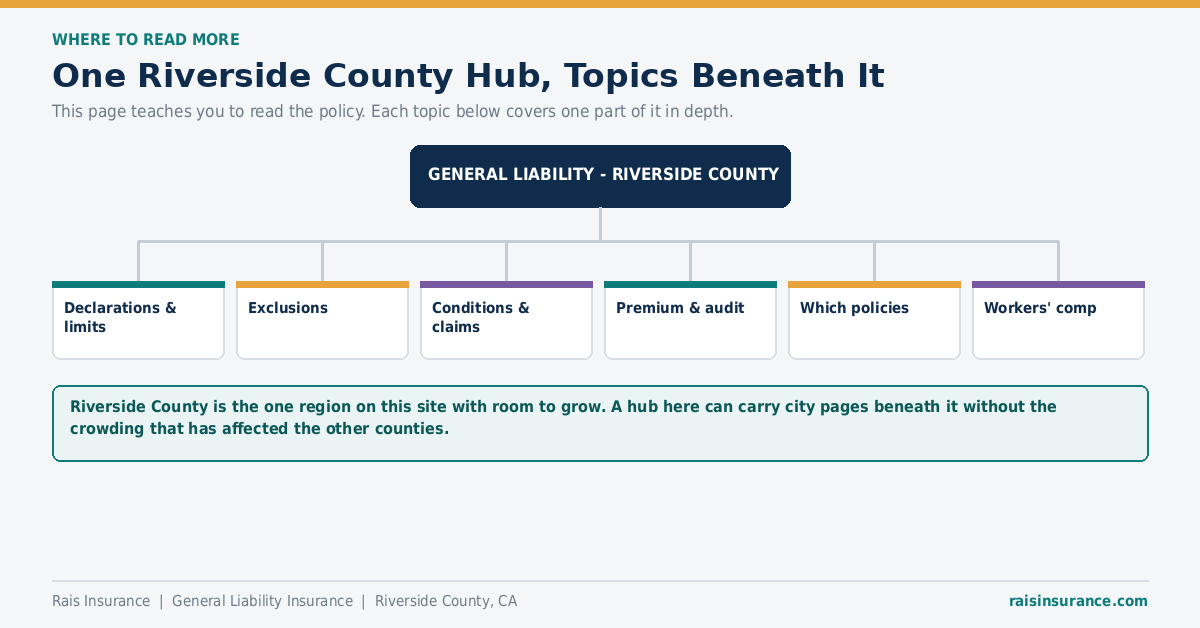
This page teaches you to read the policy. Each of the following covers one part of it in depth:
- how the per-occurrence and aggregate limits work – the declarations page numbers, explained
- the full list of what general liability does not cover – the exclusions section in full
- which policies your business actually needs – where this policy sits among the other four
General Liability Insurance Riverside – Frequently Asked Questions
Q1. How do I read my general liability insurance policy?
In order, and the order matters. Start with the declarations page, which names the insured, the limits, the deductible and the policy period. Then the insuring agreement, which is the promise itself. Then the definitions, because they change what the rest of the words mean. Then exclusions, conditions and endorsements. Reading the exclusions first, which is what most people do, makes the whole document look arbitrary.
Q2. What are the six parts of an insurance policy?
Declarations, the insuring agreement, definitions, exclusions, conditions and endorsements. The declarations are specific to you; the insuring agreement states what the insurer will pay for; definitions control the meaning of key words; exclusions carve things out; conditions set what you must do; and endorsements are changes attached afterwards that override the printed form.
Q3. What is a declarations page?
It is the front page of the policy and the only part written specifically for you. It shows the named insured, the policy period, your per-occurrence and aggregate limits, the deductible, your classification code, and a list of every form and endorsement attached. If you read one page of your policy this year, read this one – it takes about four minutes and answers most practical questions.
Q4. Why are some words in my policy in quotation marks?
Because they are defined terms, and they mean what the definitions section says rather than what they mean in ordinary speech. “Occurrence”, “bodily injury”, “property damage” and “your work” all carry specific meanings that differ from conversational use. The habit worth building is simple: when a sentence uses a word in quotation marks, look it up before deciding what the sentence means.
Q5. What does ‘occurrence’ mean in a general liability policy?
The standard form defines it as an accident, including continuous or repeated exposure to substantially the same harmful conditions. That single definition does more work than any other in the contract, because it is what limits the policy to accidental harm. Deliberate acts fall outside it, and that is why intentional wrongdoing is not covered.
Q6. Does general liability cover something I did deliberately?
No. Expected or intended injury is excluded from every standard form. Liability insurance answers harm you caused without meaning to – carelessness, oversight, an accident. It does not answer harm you meant to cause, and it does not cover criminal or fraudulent acts. The distinction is between an accident and a decision.
Q7. What is an endorsement and does it override my policy?
An endorsement is a change attached to the policy after the printed form was drafted – adding coverage, removing it, adding an additional insured, or amending a definition. Where an endorsement conflicts with the main wording, the endorsement generally controls. That is why the forms and endorsements list on your declarations page is worth reading: it is where the surprises live.
Q8. Is electronic data covered by general liability insurance?
Generally not. The standard form defines property damage as physical injury to tangible property, and it expressly states that electronic data is not tangible property. Lost, corrupted or stolen data is a cyber liability question rather than a general liability one. This catches out more businesses every year as more of what they hold stops being physical.
Q9. What happens if I break a condition of my policy?
Conditions are the obligations on your side – reporting a claim promptly, cooperating with the insurer, allowing inspection, not admitting liability. Breaching one can give the insurer grounds to reduce or decline a claim that would otherwise have been paid. Late reporting is the most common breach and the most avoidable, which is why notifying your broker early matters more than most owners expect.
Q10. How much does general liability insurance cost in Riverside, CA?
There is no flat rate. Premium is built from your classification code, your gross receipts or payroll, the limits you buy, your claims history and how much work you subcontract out. Riverside County’s heavy logistics and light industrial base means classification accuracy matters more here than in an office-dominated market. A broker can put the same information to several carriers and show you the spread.
Get a General Liability Insurance Quote in Riverside, CA
When your finances are on the line, the gap between thinking you are covered and knowing it is worth closing. contact Rais Insurance on 714-761-4336, email rai@raisinsurance.com, or visit 2612 W. Lincoln Avenue, Suite 103, Anaheim, CA 92801.
Bring your declarations page and the endorsement list. Fifteen minutes with those two documents will tell you more about your position than an hour of general discussion.
