

General Liability Insurance La Mirada
At Rais Insurance we understand that, and we place general liability insurance in La Mirada for businesses across southeast Los Angeles County. What follows is the part most pages on this subject skip: not a list of things that are covered, but an honest account of what covered actually means – where every policy stops, and why cover has to be in place before the incident rather than after it.
What Covered Actually Means – The Four Edges of Any Policy
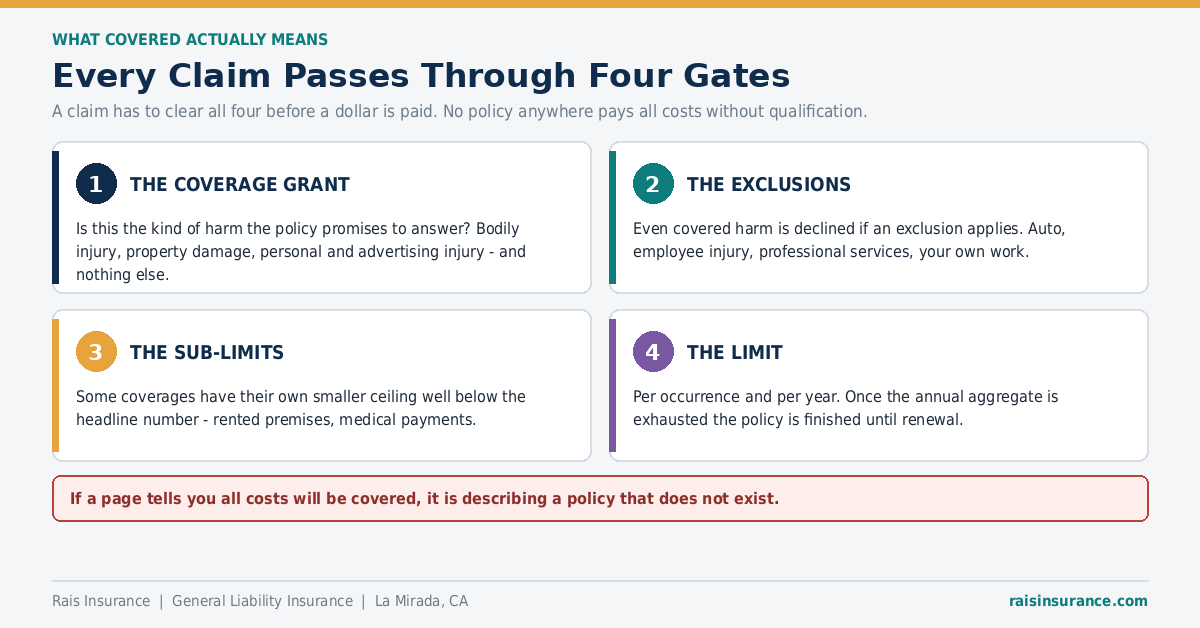
Ask what does general liability insurance cover and you will get a list. The more useful question is where the list stops. It is worth saying plainly, because a great deal of insurance marketing implies otherwise: no policy anywhere pays all costs without qualification. Every claim passes through four gates, and it has to clear all four before a dollar is paid.
1. The coverage grant
Is this the kind of harm the policy promises to answer at all? A commercial general liability policy responds to bodily injury, property damage, and personal and advertising injury. A claim that does not fit one of those descriptions never reaches the second gate, however unfair that feels.
2. The exclusions
Covered harm is still declined if an exclusion applies. Vehicles, injuries to your own employees, professional advice, damage to your own completed work – each has its own policy and each is carved out of this one. See the full list of what general liability does not cover.
3. The sub-limits
Some coverages carry their own smaller ceiling, well below the headline figure on your schedule. Damage to premises rented to you and medical payments both sit under separate, much lower limits. People discover these at claim time far more often than at purchase.
4. The limit
Per occurrence, and per policy year. The per-occurrence limit caps any single claim; the annual aggregate caps everything the insurer will pay across the year. Once the aggregate is exhausted the policy is finished until renewal. See how the per-occurrence and aggregate limits work.
None of this makes the policy weak. It makes it a defined product rather than an open promise – and knowing where the edges are is what lets you decide whether the limits you hold are actually enough.
Four Promises Worth Reading Twice
Here is what a general liability policy genuinely does for a La Mirada business, stated the way the wording states it rather than the way marketing copy tends to:
Someone is injured on your premises
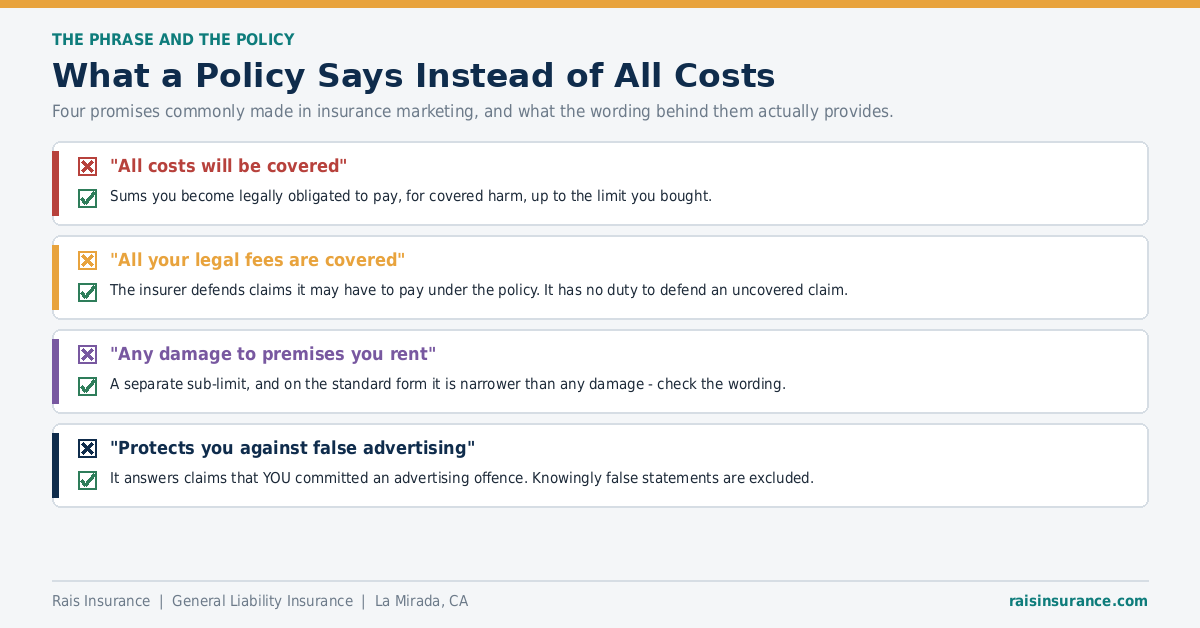
If a visitor is hurt at your business, or if you or an employee acting on your behalf causes injury or property damage to somebody else, the policy responds. What the general liability insurance policy pays is the sum you become legally obligated to pay for that covered harm, up to the limit you bought – not every cost that arises, without ceiling. That distinction only matters once, but it matters a great deal on that occasion.
Somebody sues you, including on a claim you believe is false
The insurer defends claims it may have to pay under the policy, and under a standard general liability insurance form that defence sits in addition to your limit rather than eroding it. For most small businesses that is worth more than the limit itself, because the majority of claims cost more to defend than to resolve.
The qualifier is real, though: the duty to defend attaches to claims the policy could cover. It does not extend to a claim that falls entirely outside the coverage grant. That is broad protection, not unlimited protection. See the duty to defend and how a false claim is handled.
You damage premises you rent
If you rent your unit, there is cover for damage you cause to it – but it lives under its own sub-limit, separate from and well below your main liability limit, and on the standard form it is narrower than any accidental damage you might cause. Read that line on your own schedule rather than trusting a summary. More on damage to premises rented to you.
An advertising or defamation claim
The policy answers claims alleging that you committed an advertising offence – using another party’s advertising idea, infringing a slogan or trade dress, or publishing something defamatory. It runs in that direction only. It does not fund a claim you bring against a competitor who defamed you, and material you published knowing it to be false is specifically excluded.
Why It Really Is Too Late Once You Are Being Sued
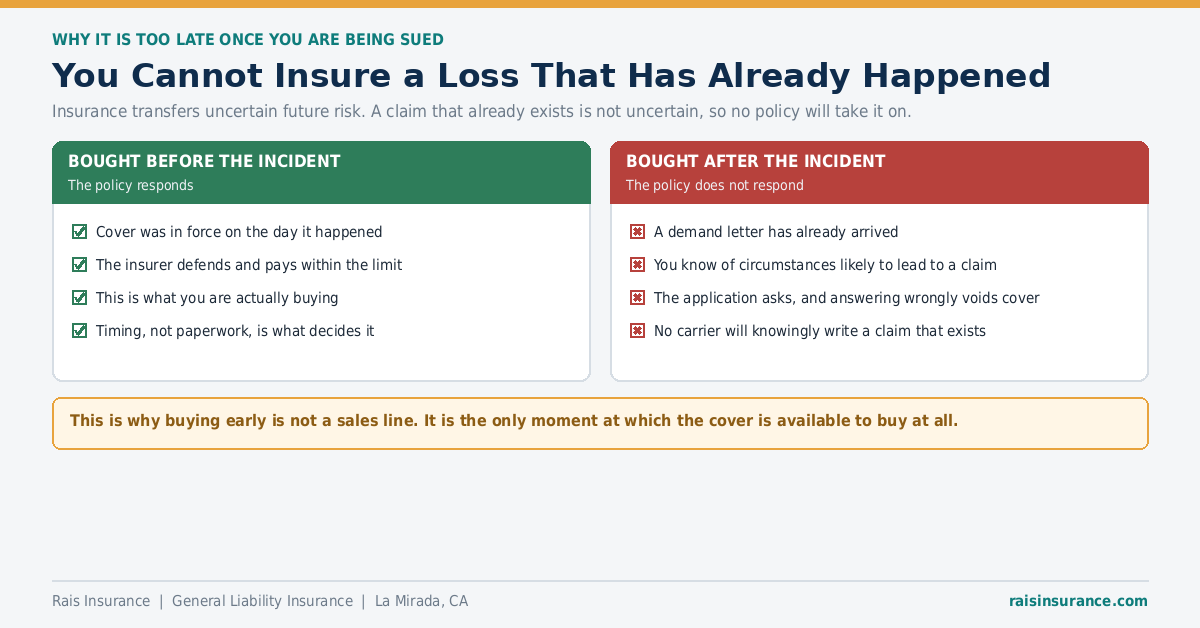
The original point stands and deserves more than one line: if you are looking for cover because you are already being sued, it is too late. The reason is worth understanding, because it is a principle rather than a policy of ours.
Insurance transfers uncertain future risk. A loss that has already happened is not uncertain, so there is nothing left to transfer. Insurers call this the known loss doctrine, and it is why every application asks whether you are aware of any circumstance likely to give rise to a claim. Answering that inaccurately does not get you cover – it gives the insurer grounds to void the policy entirely, which is a worse position than having no policy at all.
The practical version: the day you sign a lease, take a first booking, or hire your first person is a more sensible trigger for buying cover than the day you open. Not because a broker wants the sale earlier, but because that is the window in which the cover is available to buy at all.
If something has already happened but no claim has arrived yet, that is a different situation and worth acting on immediately – see what to do in the first 48 hours after an incident.
Which Policy Answers a Claim That Arrives Years Later
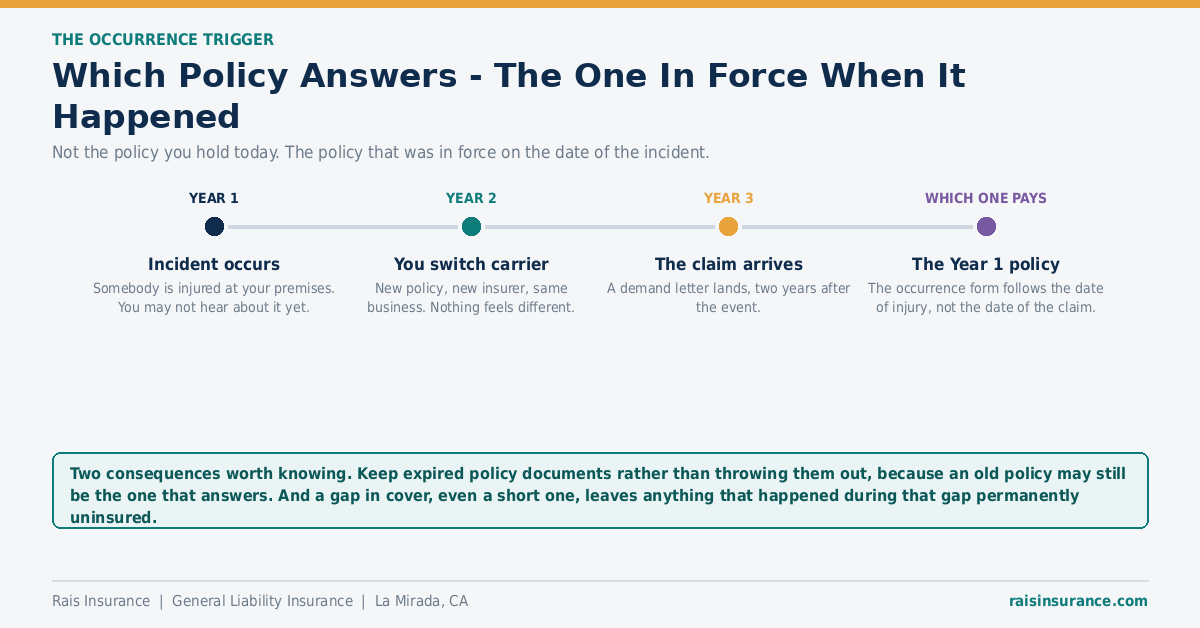
A related point that catches out businesses which have switched carrier. A standard general liability policy is written on an occurrence basis, which means the policy that responds is the one that was in force on the date the injury or damage happened – not the one you hold when the claim arrives.
So an incident in year one, a change of insurer in year two, and a demand letter in year three is answered by the year-one policy, from an insurer you no longer use. Two consequences follow:
- Keep expired policy documents. Do not discard a policy when you renew elsewhere. An old schedule may be the only proof of the cover that actually has to answer.
- A gap in cover is permanent. Even a short lapse between policies leaves anything that happened during that window uninsured forever. It cannot be backfilled afterwards, for the same reason a known loss cannot be insured.
How to Read an Insurance Page Honestly
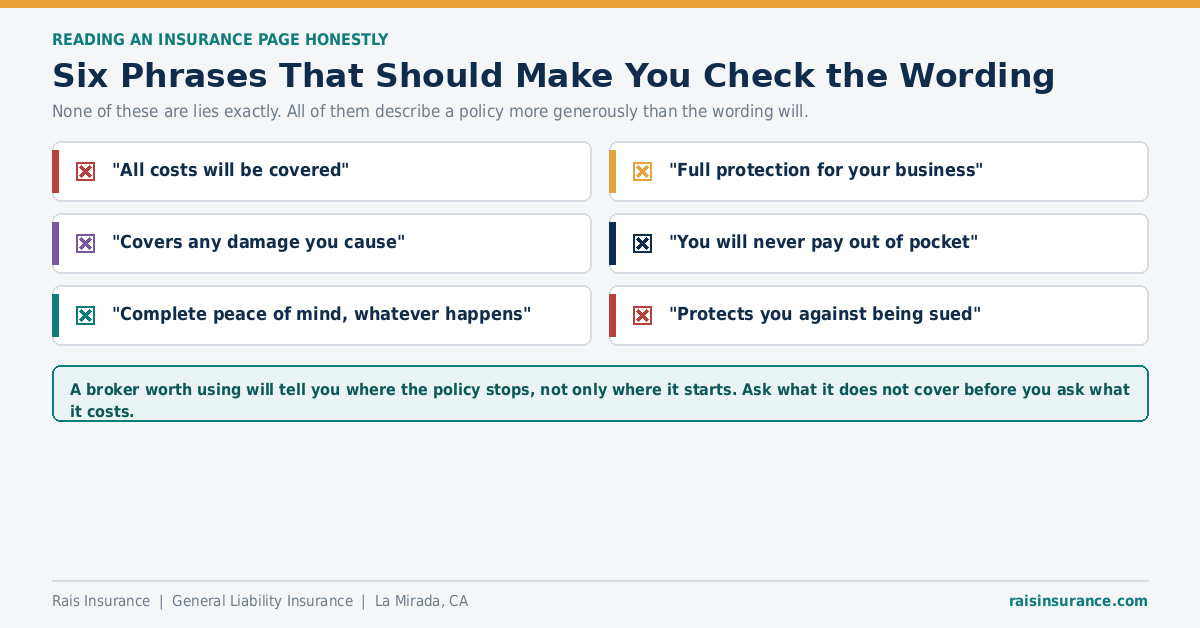
Since this page has spent some time on the gap between what insurance marketing says and what policies do, it seems fair to hand you the test. Six phrases that should prompt you to open the wording rather than take the sentence at face value:
- “All costs will be covered”
- “Full protection for your business”
- “Covers any damage you cause”
- “You will never pay out of pocket”
- “Complete peace of mind, whatever happens”
- “Protects you against being sued”
None of those are lies exactly. Each describes a policy somewhat more generously than the wording will, and each one is worth a follow-up question. A broker worth using will tell you where the policy stops, not only where it starts – so ask what a policy does not cover before you ask what it costs.
General Liability Insurance for La Mirada Businesses
La Mirada sits in the south-east corner of Los Angeles County, on the Orange County line, with Santa Fe Springs and Norwalk to the west and Buena Park immediately across the border. It carries a substantial light industrial and distribution base alongside a large service and professional sector, and a good number of businesses here work across both counties in the same week.
That cross-county pattern is worth one check at renewal. Confirm your limits satisfy the strictest contract you have signed rather than the average one, because a limit you have not bought is a limit you cannot certify when a client asks. What drives that number is covered on our La Habra page – what sets a liability premium.
Getting the Right Cover from Rais Insurance
Business liability insurance is worth buying properly rather than cheaply. Staying on the safe side means carrying enough cover to keep the business running whatever happens – and knowing precisely where that cover ends, so nothing is a surprise on the day you need it. That is what general liability insurance in La Mirada from Rais Insurance is meant to do.
Four questions usually settle whether a policy is fit for purpose. Is the limit high enough for the contracts you actually sign? Do defence costs sit inside or outside that limit? Which sub-limits apply, and where are they set? And which of the standard exclusions genuinely bite for the work you do?
If you are still deciding which policies you need beyond this one, how general liability fits alongside the other business policies sets out the wider picture.
We serve La Mirada, Santa Fe Springs, Norwalk and Buena Park from our Anaheim office, and we write across California.
General Liability Insurance La Mirada – Frequently Asked Questions
Q1. Does general liability insurance really cover all costs?
No policy does, and any page saying so is describing something that does not exist. A liability policy pays sums you become legally obligated to pay for harm the policy covers, up to the limit you purchased. Four things bound it: the coverage grant, the exclusions, any sub-limits, and the limit itself. Understanding those four is more useful than any promise about complete protection.
Q2. Does the policy cover all my legal fees?
It covers the defence of claims the insurer may have to pay under the policy, and under a standard general liability form that defence sits in addition to your limit rather than coming out of it. What it does not do is fund the defence of a claim the policy does not cover. The duty to defend is broad, but it is tied to the coverage grant rather than being unlimited.
Q3. Can I buy insurance after something has already gone wrong?
No. Insurance transfers uncertain future risk, so a loss that has already occurred is not insurable – the principle is usually called the known loss doctrine. Applications ask whether you are aware of circumstances likely to lead to a claim, and answering that inaccurately can void the policy. If a demand letter has arrived, buying cover now will not answer it.
Q4. A claim has arrived about something that happened three years ago. Which policy pays?
Under an occurrence form, the policy that was in force on the date the injury or damage happened – not the one you hold today. That has two practical consequences. Keep expired policy documents rather than discarding them, because an old policy may be the one that responds. And any gap in cover, however short, leaves everything that happened during that gap permanently uninsured.
Q5. Does general liability cover damage to premises I rent?
Partly, and far more narrowly than it is usually described. Damage to premises rented to you sits under its own separate sub-limit, well below your main liability limit, and on the standard form the cover is narrower than any accidental damage you might cause. Read that section of your own schedule rather than relying on a summary, because the wording varies.
Q6. Does the policy protect me against false advertising?
It answers claims alleging that you committed an advertising offence – using another party’s advertising idea, infringing a slogan or trade dress, or publishing something defamatory. It runs in that direction only. It does not fund a claim you bring against somebody else, and material you published knowing it to be false is specifically excluded.
Q7. How much liability cover should a La Mirada business carry?
One million dollars per occurrence and two million in the annual aggregate is the usual starting point, and it is what most contracts request. Moving to higher limits costs far less than doubling, because severe claims are rare relative to ordinary ones. The right figure depends on what you do, who visits your premises, and what your contracts require.
Q8. What happens if my annual aggregate is used up?
The policy stops responding until renewal. The per-occurrence limit caps any single claim; the aggregate caps everything the insurer will pay across the policy year. A business that has already had two significant claims does not have its full limit available for a third, which matters if a contract requires you to certify a specific limit. Ask your broker what remains, not what was bought.
Q9. Do I need liability insurance before I open?
Generally yes, and earlier than people expect. Landlords ask for it before handing over keys, clients ask before work starts, and cover has to be in force before the incident rather than after. Given that a claim which already exists cannot be insured, the day you sign a lease or take a first booking is a more sensible trigger than the day you open your doors.
Q10. How do I tell whether a policy is actually any good?
Look at what it excludes rather than what it advertises. Read the exclusions section, check every sub-limit, confirm whether defence costs sit inside or outside the limit, and ask what happens to the aggregate after a claim. A broker worth using will tell you where the policy stops. If the answer is a general reassurance rather than a specific one, ask again.
Get a General Liability Insurance Quote in La Mirada
Make the right choice while it is still a choice. contact Rais Insurance on 714-761-4336, email rai@raisinsurance.com, or visit 2612 W. Lincoln Avenue, Suite 103, Anaheim, CA 92801.
If you already hold a policy, bring the declarations page and any contract that specifies your limits. Ten minutes with both is usually enough to tell you whether the cover you have matches the cover you have promised.
