

Auto Insurance Bellflower California
Auto insurance Bellflower drivers carry is legally required, as it is everywhere in California. Because California is an at-fault state, the only coverage the law requires is liability – and this page is about what that coverage actually does, because it is more specific and more consequential than most people realise.
The state minimum limits and the penalties for driving without cover are set out on our main auto insurance in California page. This one explains how car insurance liability limits work once you have them.
What the Three Liability Numbers Mean
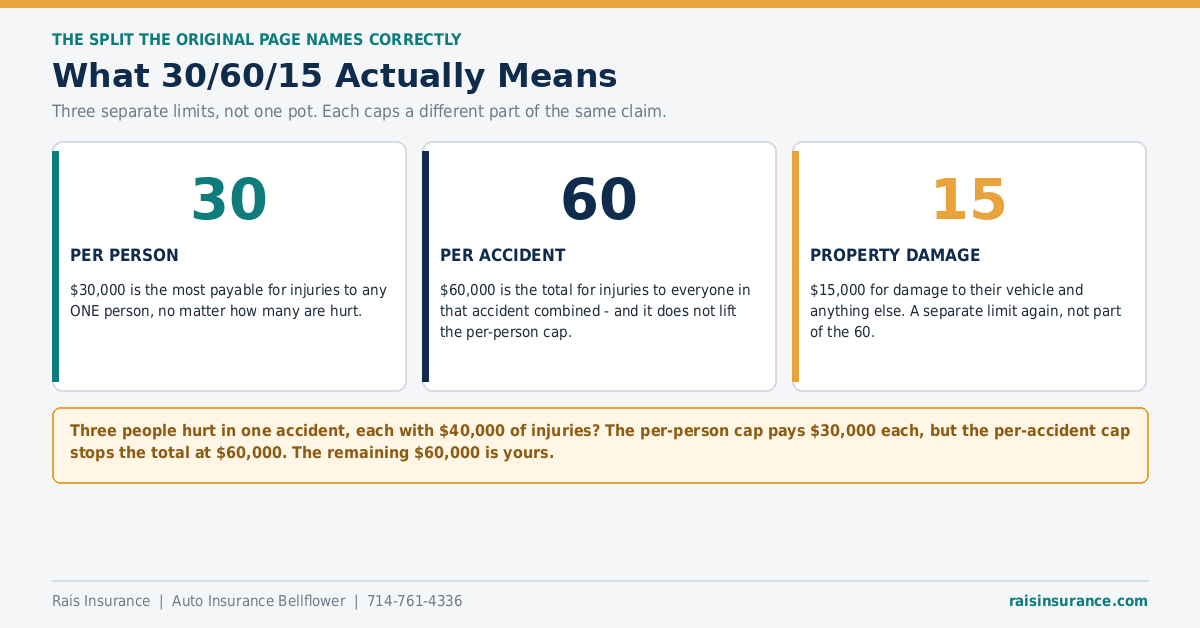
The original version of this page names the split correctly – total cost of injuries, cost of injuries per person, and property damage – and then does not explain it. It is worth explaining, because the mechanics decide what a claim actually pays.
California’s minimum is written 30/60/15, and those are three separate caps, not one pot:
- $30,000 per person. The most payable for injuries to any one individual, however many people are hurt.
- $60,000 per accident. The total for everyone injured in that accident combined. It does not lift the per-person cap – it sits above it.
- $15,000 property damage. For their vehicle and anything else you damaged. A separate limit again, not part of the sixty.
A worked example makes the interaction clear. Three people are injured in one accident, each with $40,000 of medical costs. The per-person cap pays $30,000 to each – but the per-accident cap stops the total at $60,000. So two people are partly paid, the third receives nothing from the policy, and $60,000 of the claim is yours to find.
Who Liability Cover Actually Pays
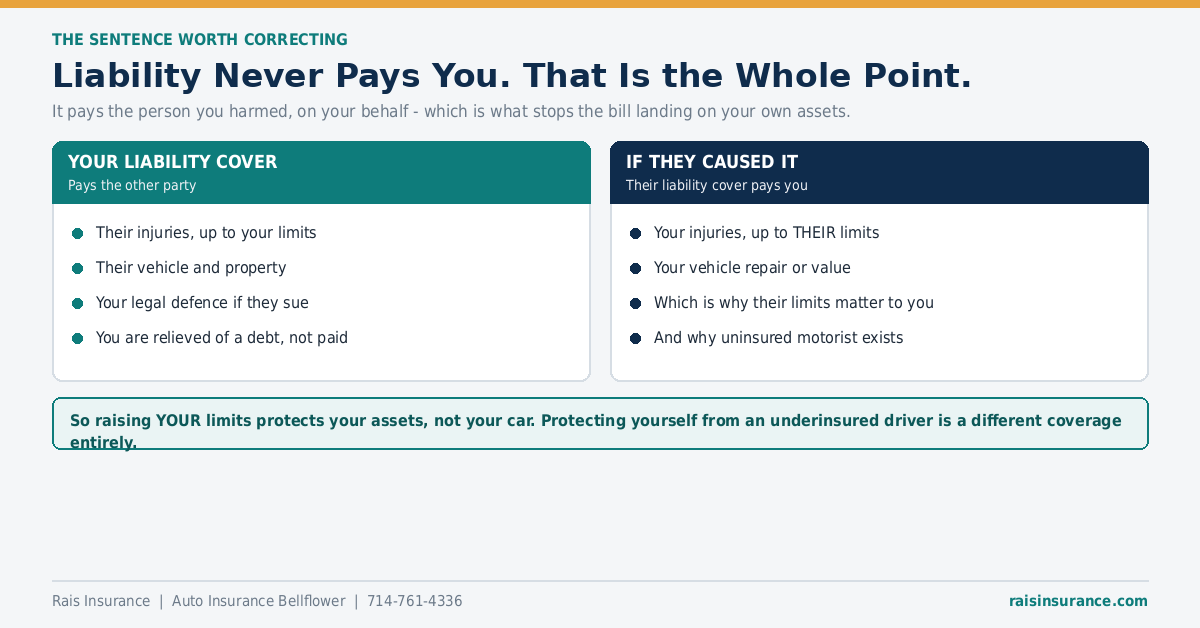
One correction worth making plainly, because the original runs two ideas together. Liability coverage never pays you. Liability coverage pays the person you harmed, on your behalf, up to your limits – and it funds your legal defence if they sue.
So if the other driver caused the accident, it is their liability coverage that pays for your injuries and your vehicle – not yours. That is why their limits matter to you as much as your own do, and it is exactly why uninsured and underinsured motorist cover exists as a separate purchase.
It also means raising your own liability limits protects your assets, not your car. Damage to your own vehicle is collision or comprehensive, both optional – see when collision and comprehensive stop earning their premium.
One smaller point of accuracy: the original says you can set your limits to whatever amount you choose. Broadly true, but each carrier has a maximum it will write, and beyond that you move to a personal umbrella – covered below.
Fault Is Rarely All or Nothing
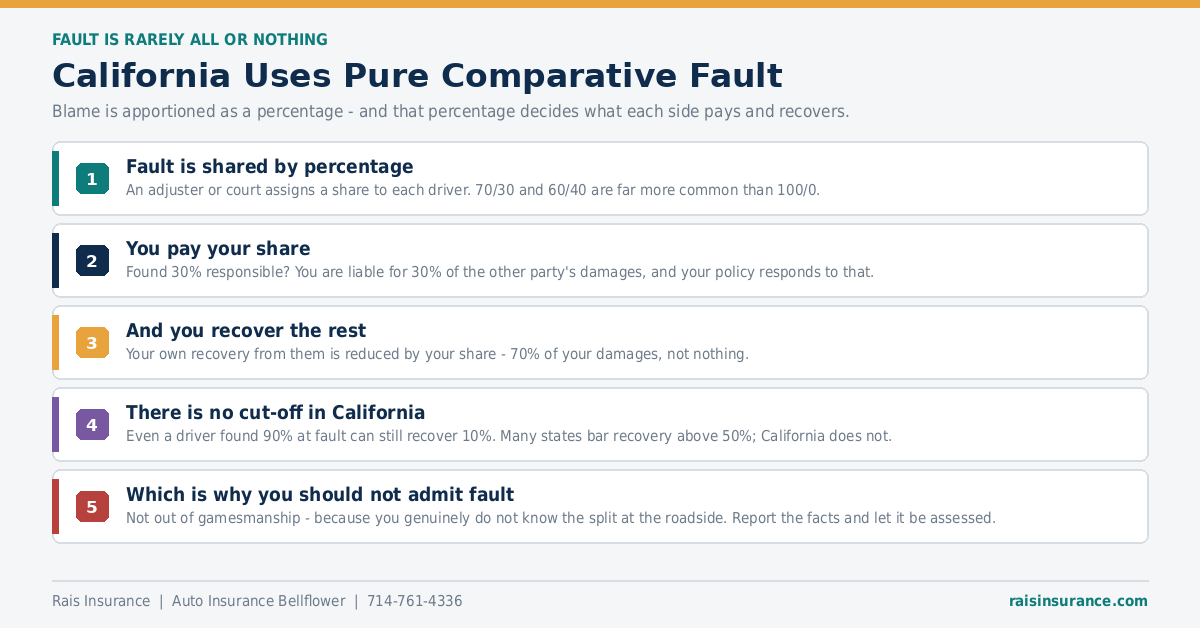
The original describes an accident “deemed your fault”, which implies a binary. In practice California apportions blame as a percentage, and it does so under a rule called pure comparative fault:
- Fault is shared by percentage. An adjuster or a court assigns a share to each driver. 70/30 and 60/40 are far more common outcomes than 100/0.
- You pay your share. Found 30 per cent responsible, you are liable for 30 per cent of the other party’s damages, and your policy responds to that.
- And you recover the rest. Your own recovery from them is reduced by your share – 70 per cent of your damages rather than nothing.
- There is no cut-off here. Even a driver found 90 per cent at fault can still recover 10 per cent. Many states bar recovery once you pass half the blame; California does not.
Which leads to a practical point: do not admit fault at the scene. Not as gamesmanship – because you genuinely cannot know the apportionment in the first minute. Report the facts accurately, exchange details, photograph everything, and let fault be assessed on the evidence.
What Happens Above the Limit
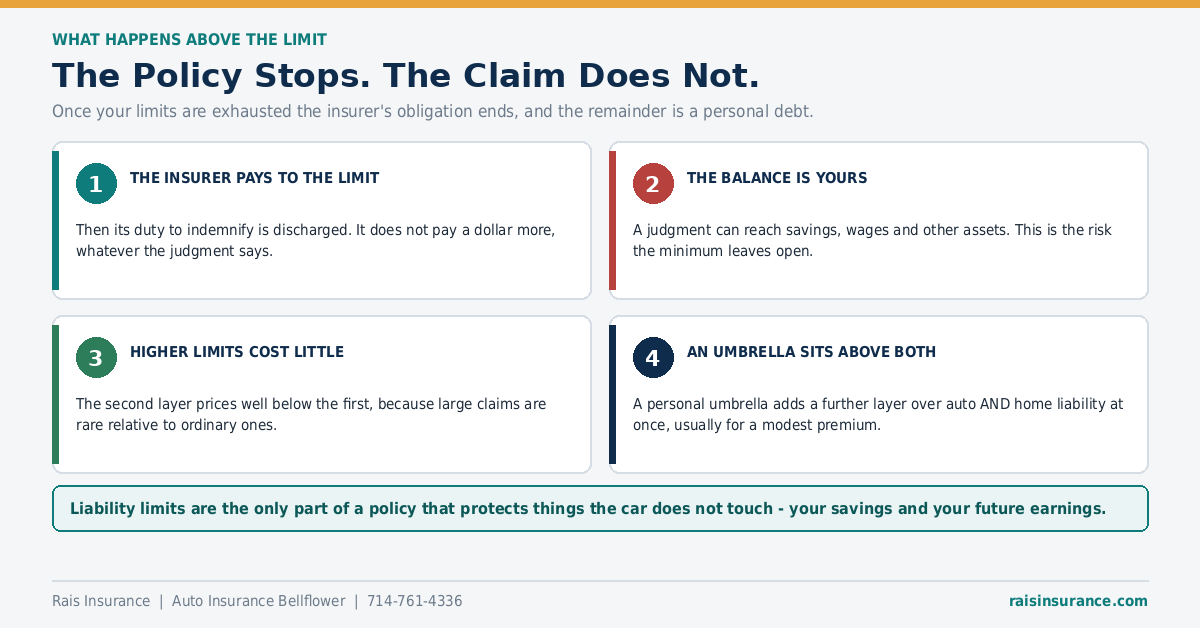
This is the part that decides how much cover to carry, and it is rarely said plainly:
- The insurer pays up to your limit, and its duty to indemnify is then discharged. It does not pay a dollar more, whatever the judgment says.
- The balance is yours. A judgment can reach savings, wages and other assets. That is precisely the risk the state minimum leaves open.
- Higher limits cost less than people expect. The second layer prices well below the first, because serious claims are rare relative to ordinary ones. Moving up a level is usually the cheapest meaningful improvement available on a policy.
- A personal umbrella sits above both. It adds a further layer over your auto and home liability at once, typically in million-dollar increments, and because it only responds after the underlying limits are exhausted it is inexpensive relative to what it does – see home insurance in California.
Liability is the only part of an auto policy that protects things the car never touches – your savings and your future earnings. That is a good reason to look at it before anything else on the schedule.
Collision, and the Coverages the Original Omits
Collision coverage repairs your own vehicle after a collision regardless of fault, subject to your deductible. It sits alongside liability coverage rather than replacing it. The original describes it accurately, though “a significant hike in insurance costs” overstates it – collision is a meaningful addition rather than a penalty, and on many vehicles it is modest.
Two coverages belong alongside it and were missing entirely:
- Comprehensive – theft, fire, vandalism, falling objects, weather, glass and animal strikes. Optional car insurance cover, and usually cheaper than collision.
- Uninsured and underinsured motorist – optional in California, and a carrier must obtain your decline in writing. Given everything above about the at-fault system, this is the coverage that answers the driver who has nothing for you to claim against.
For what a policy will never cover at all – maintenance, wear and mechanical breakdown – see what auto insurance does not cover.
Setting Limits for Bellflower
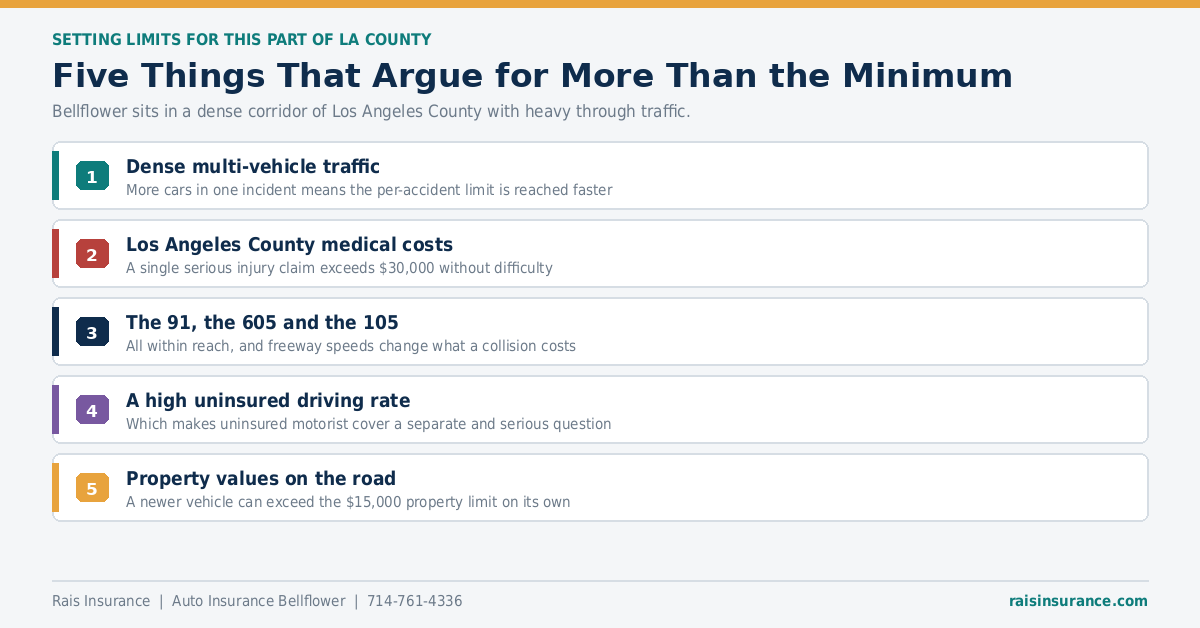
Auto insurance Bellflower rates reflect a dense part of Los Angeles County, and five local factors all argue the same way – toward carrying more than the state minimum:
- Dense multi-vehicle traffic. More cars involved in one incident means the per-accident cap is reached faster.
- Los Angeles County medical costs. A single serious injury claim exceeds $30,000 without difficulty.
- The 91, the 605 and the 105. All within reach, and freeway speeds change what a collision costs.
- A high uninsured driving rate. Which makes uninsured motorist cover a separate and serious question here.
- Vehicle values. A newer car can exceed the $15,000 property damage limit on its own, before anything else is damaged.
Car insurance Bellflower drivers buy is priced against an at-fault system, and how that works in practice is set out on our auto insurance in Anaheim page.
Working Out the Right Limits
We can help you work out which car insurance limits and coverages suit your circumstances, your budget and your vehicle – and as an independent broker we put one set of details to several carriers rather than one. See the insurance companies we represent.
One clarification on how this works, because the original blurs it: Rais Insurance is a broker, not the insurer. The carrier issues the policy and pays the claim; we place the business and stay involved at renewal and at claim time. There is no fee to you for the comparison – the carrier that writes the policy pays the broker.
Auto Insurance in Bellflower – Frequently Asked Questions
Q1. What do the three liability numbers mean?
They are three separate caps on the same claim. In 30/60/15, the first is the most payable for injuries to any one person – $30,000. The second is the total for everyone injured in that accident – $60,000, which does not lift the per-person cap. The third is property damage – $15,000, a separate limit again rather than part of the sixty.
Q2. Does my liability insurance pay for my own car?
No, and this is the most common misunderstanding in auto insurance. Liability pays the people you harmed. Damage to your own vehicle needs collision or comprehensive, both of which are optional. If the other driver was at fault, it is their liability coverage that pays you – which is why their limits matter to you as much as yours do.
Q3. Is 15/30/5 still legal in California?
No. The state minimum rose to 30/60/15 with effect from 1 January 2025. Most carriers moved existing policyholders up at renewal, but renewal cycles differ and notices get missed – so a policy written before 2025 and never reviewed may now sit below the legal minimum. It is worth checking the liability line on your declarations page.
Q4. What is pure comparative fault?
California apportions blame as a percentage rather than treating accidents as all-or-nothing. If you are found 30 per cent responsible, you are liable for 30 per cent of the other party’s damages and can recover 70 per cent of your own. California applies this purely, with no cut-off – even a driver found 90 per cent at fault can still recover 10 per cent. Many states bar recovery above 50 per cent; California does not.
Q5. Should I admit fault at the scene?
No, and not for tactical reasons. You genuinely cannot know the apportionment at the roadside – it depends on evidence, statements and sometimes reconstruction. Report the facts accurately to the police and to your insurer, exchange details, photograph everything, and let fault be assessed on the evidence rather than on an instinct in the first minute.
Q6. Can I be sued for more than my policy limits?
Yes. Once your limits are exhausted the insurer’s duty to indemnify is discharged, and the balance of any judgment is a personal debt – reachable against savings, wages and other assets. That is the risk carrying the state minimum leaves open, and it is the reason to look at your liability limit before anything else on the policy.
Q7. How much liability coverage should I carry?
More than the minimum, in almost every case. A useful rule of thumb is enough to protect what you could lose – savings, home equity, future earnings. The practical argument is that higher layers price well below the first: moving up a level typically costs far less than the initial cover did, because serious claims are rare relative to ordinary ones.
Q8. What is a personal umbrella policy?
A further layer of liability sitting above both your auto and home policies at once, typically in million-dollar increments. Because it only responds after the underlying limits are exhausted, it is usually inexpensive relative to the protection it provides – one of the better-value purchases in personal insurance.
Q9. Do I need uninsured motorist coverage?
It is optional in California, and a carrier must offer it and obtain your decline in writing. Whether you need it follows from everything above: because what you recover depends on the at-fault driver’s limits, a driver with no coverage – or not enough – leaves you with nothing to claim against. Your own uninsured and underinsured motorist cover is what fills that gap.
Q10. How do I get a Bellflower auto insurance quote?
Call Rais Insurance on 714-761-4336, email rai@raisinsurance.com, or visit 2612 W. Lincoln Avenue, Suite 103, Anaheim, CA 92801. We are an independent broker, so one set of details is quoted across several carriers. Having your declarations page to hand makes the comparison faster and more accurate.
Get a Car Insurance Quote in Bellflower
For car insurance Bellflower quotes, contact Rais Insurance on 714-761-4336, email rai@raisinsurance.com, or visit 2612 W. Lincoln Avenue, Suite 103, Anaheim, CA 92801.
Bring your car insurance declarations page. The liability coverage line is the one worth looking at first – it is the number that decides what stands between a serious claim and everything you own.
