

Auto Insurance Artesia California
What is not predictable is an accident, and that is where car insurance earns its place. However careful you are, the person in the other lane may not be – and the cost of that arrives without warning and in an amount you did not choose. Auto insurance Artesia drivers carry exists for exactly that, and understanding where it stops is as useful as understanding what it does.
What a Policy Pays For, and What It Never Will
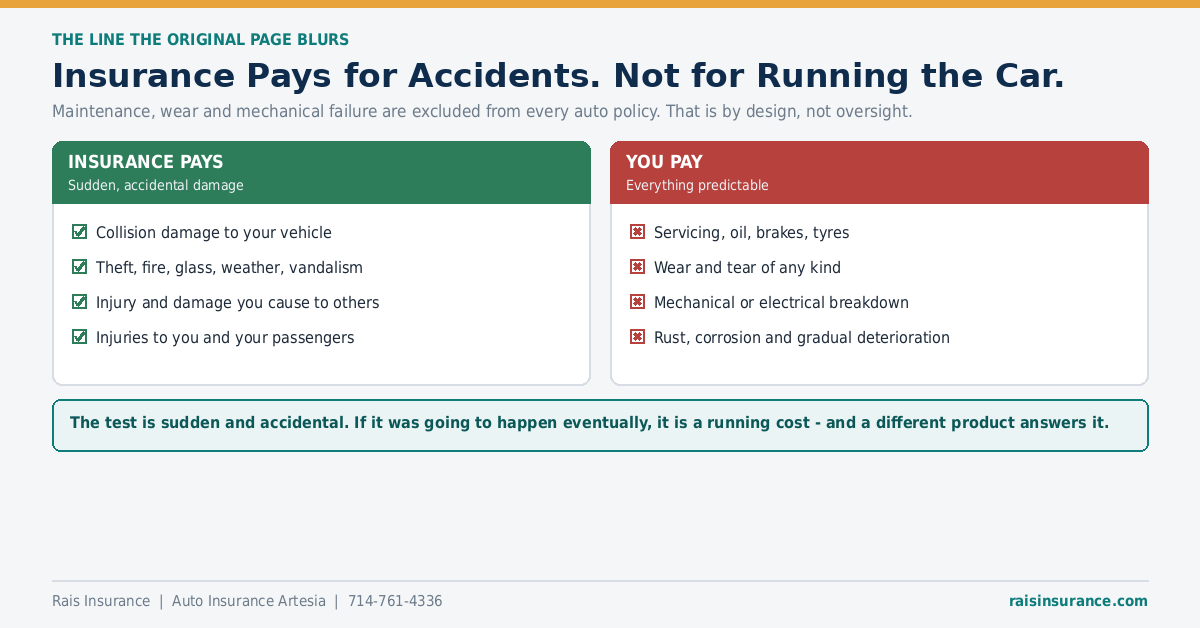
This is worth separating clearly, because the two are easy to run together. An auto policy responds to sudden, accidental damage. It does not pay for running the car.
So car insurance covers collision damage to your vehicle, theft, fire, glass, weather and vandalism, injury and damage you cause to other people, and medical costs for you and your passengers. What it does not cover, and never has:
- Servicing and consumables – oil, brakes, tyres, filters, batteries.
- Wear and tear of any kind. If a part gave out because it had done its miles, that is a running cost.
- Mechanical or electrical breakdown, however expensive. An engine that fails from wear is not an insured loss.
- Rust, corrosion and gradual deterioration – the same principle, over a longer timescale.
The test underneath all of it is sudden and accidental. If something was going to happen eventually, insurance is not the product that answers it – and no policy at any price changes that.
If Running Costs Are the Real Worry
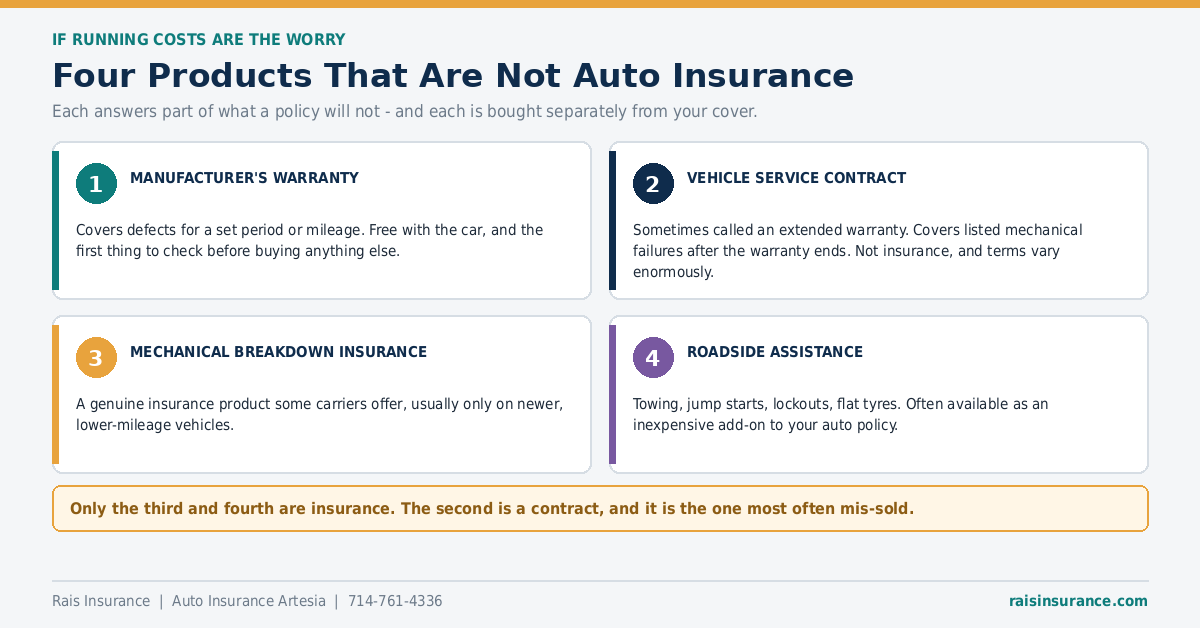
Which is a legitimate worry, and there are products for it – they are simply not car insurance:
- The manufacturer’s warranty. Covers defects for a set period or mileage, comes with the car, and is the first thing to check before buying anything else.
- A vehicle service contract, often sold as an extended warranty. It covers listed mechanical failures after the warranty ends. It is a contract rather than an insurance policy, terms vary enormously, and it is the product most often mis-sold in this area – read what is excluded before what is included.
- Mechanical breakdown insurance. A genuine insurance product that some carriers offer, usually only on newer, lower-mileage vehicles. Worth asking about if your car qualifies.
- Roadside assistance. Towing, jump starts, lockouts and flat tyres, frequently available as an inexpensive add-on to your auto policy.
Only the last two are insurance. Knowing which is which before somebody sells you one is most of the value here.
The Coverages, Named Properly
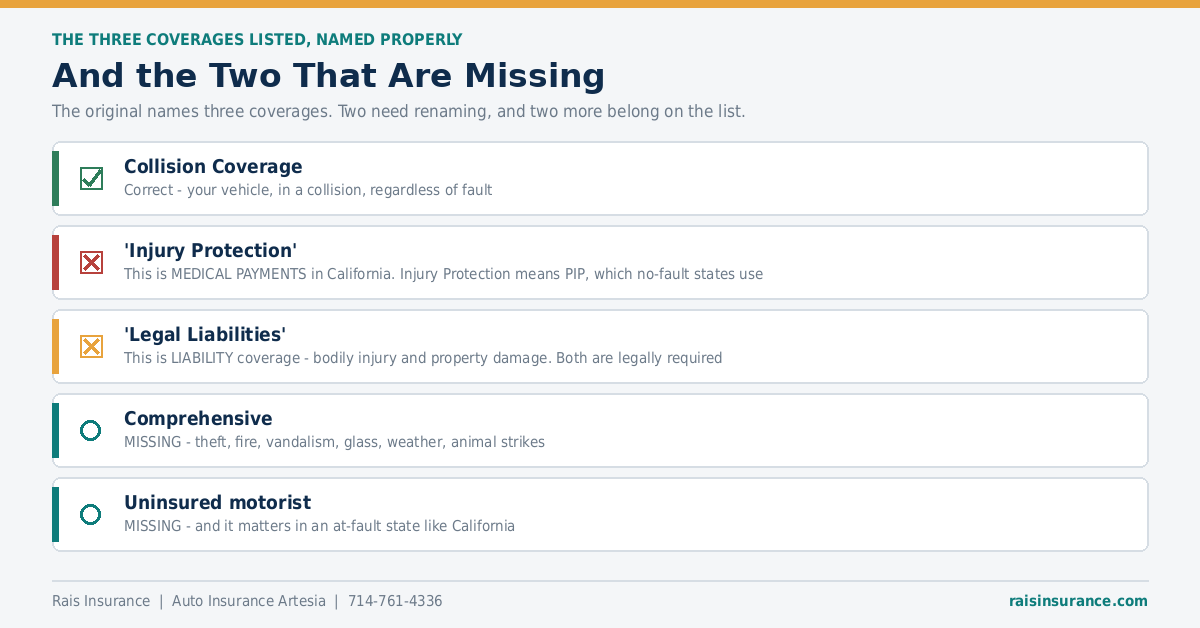
The car insurance coverages listed here were close, and two of the three simply need their California names:
- Collision – correct as described. It repairs your vehicle after a collision, regardless of fault, subject to your deductible.
- Liability – the original calls this “Legal Liabilities”. Liability cover means bodily injury liability and property damage liability, and both are legally required in California rather than optional. It pays the other party’s medical costs and property damage when you are at fault.
- Medical payments – the original calls this “Injury Protection”, which is worth correcting properly below.
And two coverages that belong on any California list and were missing entirely:
- Comprehensive – theft, fire, vandalism, falling objects, weather, glass and animal strikes. Optional, usually cheaper than collision, and the one that matters most if your car parks on the street.
- Uninsured motorist – optional here, and a carrier must obtain your decline in writing. Because California is an at-fault state, what you recover depends on the other driver’s limits; if they have none, this is the only thing that responds. See auto insurance in Anaheim for how the at-fault system works.
Injury Protection means PIP
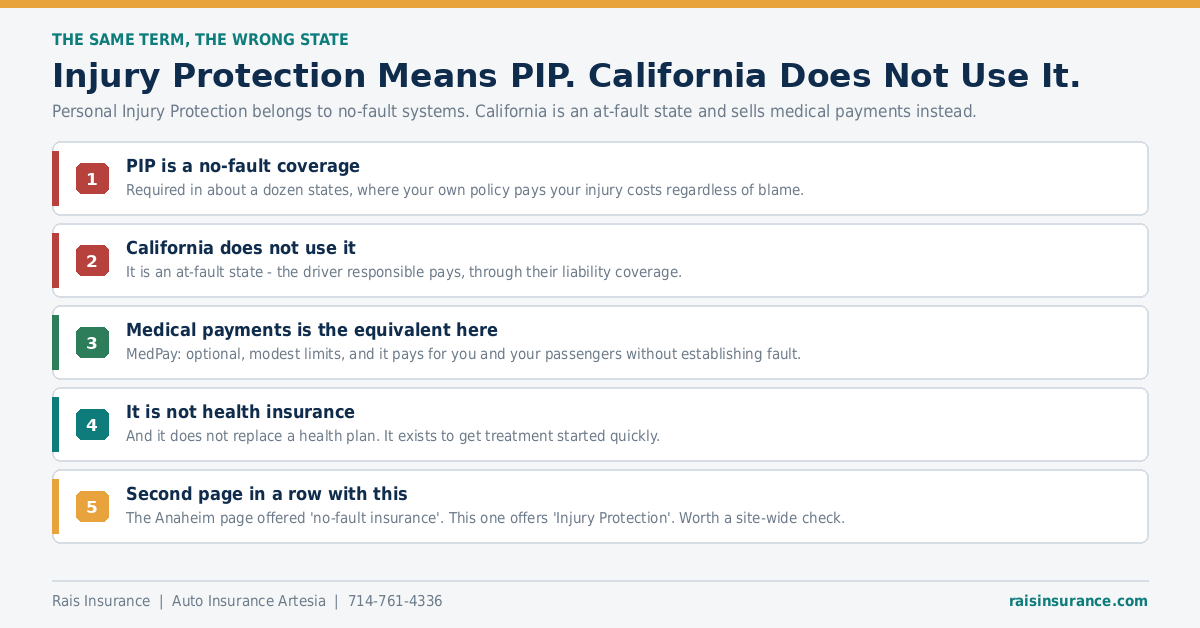
Personal Injury Protection is a no-fault coverage, required in about a dozen states where your own policy pays your injury costs regardless of who caused the accident. California is not one of them. PIP is not sold here, so a quote offering “Injury Protection” for a California vehicle is worth questioning.
What California sells instead is medical payments coverage – MedPay. It pays medical costs for you and your passengers without anybody establishing fault first, which is precisely the useful part: treatment starts while the fault question is still being argued. It is optional, the limits are modest, and it does not replace a health plan.
Driving in and Around Artesia
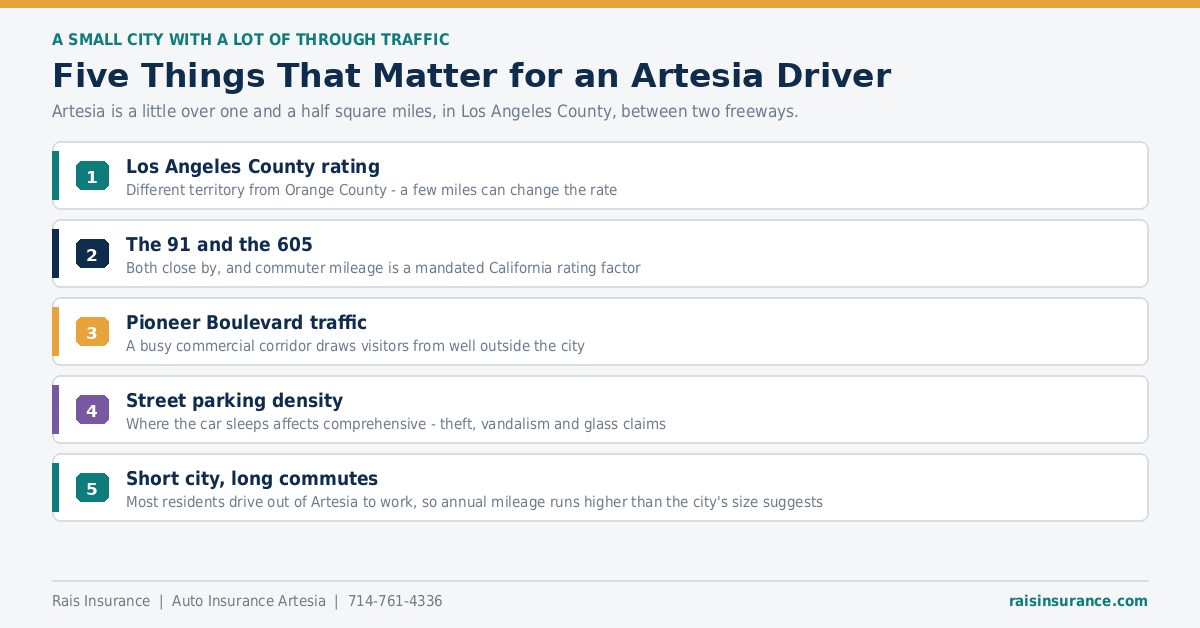
Artesia is a little over a square mile and a half, which makes it one of the smallest cities in Los Angeles County – and five things about that shape what car insurance Artesia residents pay:
- Los Angeles County rating. Artesia is in LA County, not Orange County, and California allows rating by territory – so a few miles across the county line can change what you pay.
- The 91 and the 605. Both close by, and annual mileage is one of the three factors California law requires to weigh most heavily in your rate.
- Pioneer Boulevard. A busy commercial corridor drawing visitors from well outside the city, which shows up in claim frequency.
- Street parking density. Where the car sleeps affects comprehensive in particular – theft, vandalism and glass claims all track it.
- Short city, long commutes. Most residents drive out of Artesia to work, so annual mileage runs higher than the city’s footprint suggests. Reporting it accurately matters.
Building the Right Policy
Every driver’s car insurance situation is different, and the honest version is not that everyone needs more cover – it is that the right answer depends on the car, the driving and what you could absorb yourself.
The state minimum limits, the full coverage list and the penalties for driving uninsured are set out on our auto insurance in California page. On the question of when collision and comprehensive stop being worth their premium, see when collision and comprehensive stop earning their premium.
Rais Insurance is an independent broker, so one set of details gets your car insurance Artesia quotes run across a number of carriers rather than one – which matters more than usual near a county line, because carriers weigh territory differently. See the insurance companies we represent. There is no fee to you for that comparison.
Auto Insurance in Artesia – Frequently Asked Questions
Q1. Does auto insurance cover maintenance and repairs?
No. An auto policy responds to sudden, accidental damage – a collision, theft, fire, vandalism, weather. It does not pay for servicing, oil changes, brakes, tyres, or anything that wears out with use. That distinction is deliberate: insurance transfers unpredictable risk, and maintenance is entirely predictable.
Q2. What if my engine fails?
Mechanical and electrical breakdown is excluded from every standard auto policy, regardless of how expensive the repair is. If the engine fails from wear or a component gives out, that is yours to pay. What might respond is a manufacturer’s warranty if the car is new enough, a vehicle service contract if you bought one, or mechanical breakdown insurance if you carry it.
Q3. What is the difference between a vehicle service contract and insurance?
A vehicle service contract – often sold as an extended warranty – is a contract to repair listed components, not an insurance policy. Terms vary enormously, exclusions can be extensive, and it is the product most often mis-sold in this area. Mechanical breakdown insurance is a genuine insurance product, but carriers usually only offer it on newer, lower-mileage vehicles.
Q4. Is Injury Protection available in California?
Not under that name. Personal Injury Protection, or PIP, is a no-fault coverage required in about a dozen states where your own policy pays your injury costs regardless of blame. California is an at-fault state and does not use PIP. The equivalent available here is medical payments coverage, which is optional and carries modest limits.
Q5. What does medical payments coverage do?
It pays medical costs for you and your passengers after an accident without anybody having to establish fault first, which is what makes it useful – treatment starts while the fault question is still being argued. It is optional in California, inexpensive, and it is not a substitute for health insurance.
Q6. What is comprehensive coverage?
It covers your vehicle for almost everything that is not a collision: theft, fire, vandalism, falling objects, weather, glass breakage and animal strikes. It is optional, it usually costs less than collision, and it was absent from the original version of this page entirely – which matters if your car parks on the street.
Q7. Do I need uninsured motorist coverage?
It is optional in California, and a carrier has to offer it and get your decline in writing. Whether you need it comes down to this: California is an at-fault state, so what you recover depends on the other driver’s limits. If they have no coverage, or not enough of it, your own uninsured motorist cover is the only thing that responds.
Q8. Does where I park affect my premium?
Yes. Rates are set by garaging territory rather than by city, and where the vehicle sits overnight affects comprehensive in particular – street parking carries more theft, vandalism and glass exposure than a garage. The address on your policy should be where the car actually sleeps, not simply where you receive post.
Q9. Is Artesia rated the same as Orange County?
No. Artesia is in Los Angeles County, and California allows rating by territory, so a few miles across a county line can change what you pay. It is one reason a broker quoting across several carriers is worth more here than in the middle of a large uniform market – carriers weigh territory differently from one another.
Q10. How do I get an Artesia auto insurance quote?
Call Rais Insurance on 714-761-4336, email rai@raisinsurance.com, or visit 2612 W. Lincoln Avenue, Suite 103, Anaheim, CA 92801. Having your current declarations page to hand makes it faster – it shows your limits, deductibles and renewal date in one document.
Get an Auto Insurance Quote in Artesia
For auto insurance Artesia quotes, contact Rais Insurance on 714-761-4336, email rai@raisinsurance.com, or visit 2612 W. Lincoln Avenue, Suite 103, Anaheim, CA 92801.
Bring your car insurance declarations page if you have one. And if you also insure a home or rent in the area, mention it – bundling with home insurance in California is usually the largest single discount available.
