

Auto Insurance La Habra California
Auto insurance for La Habra drivers, quoted across several carriers by Rais Insurance.Whether you drive an old vintage car or the latest minivan, the right policy is not the same policy – and the difference is bigger than price. Auto insurance La Habra drivers need depends on the vehicle in a way most quotes never explain. Getting car insurance la habra right starts with matching the policy to the car, not just the driver.
Car insurance is a legal requirement in California, as in most of the country, and here it is fault-based: every driver needs liability cover to be on the road. Liability is not the only coverage available, but it is the only one you definitely need. Everything above it is a decision – and the vehicle makes most of that decision for you. Every auto insurance la habra quote we prepare starts from that same principle.
Which Car You Drive Changes the Policy
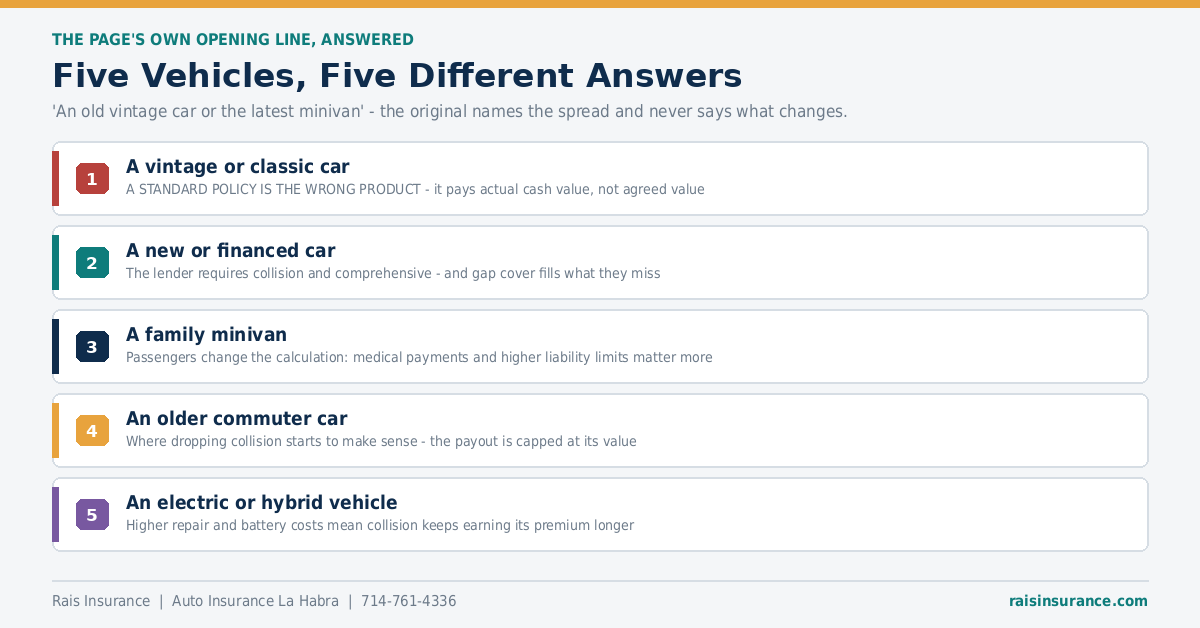
The original names the spread – vintage car to new minivan – and never says what actually changes between them. Five common cases, and five different car insurance answers:
- A vintage or classic car. A standard policy is the wrong product here, for reasons set out below.
- A new or financed car. Your lender will require collision and comprehensive for the life of the loan. Gap cover is worth considering too: a new vehicle can be worth less than the outstanding finance for the first year or two, and a standard policy pays only the vehicle’s value.
- A family minivan. Passengers change the emphasis. Your own passengers are third parties to you, so their injuries fall under your bodily injury liability – which makes the per-person and per-accident limits matter more with a full car. Medical payments cover becomes more useful too.
- An older commuter car. This is where dropping collision starts to make sense, because the payout is capped at the vehicle’s value: see when collision and comprehensive stop earning their premium.
- An electric or hybrid vehicle. Higher repair costs push the other way – collision keeps earning its premium for longer. Every one of our auto insurance quotes in la habra, ca accounts for which of these five categories your vehicle actually falls into.
The vintage car problem
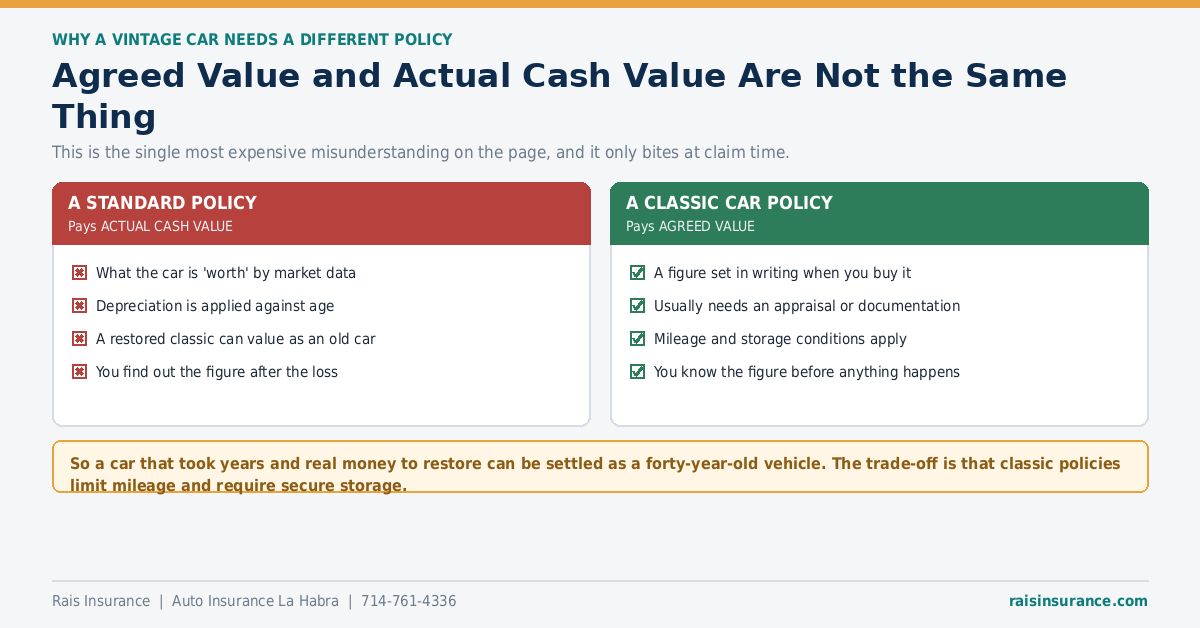
This is the most expensive misunderstanding on the page, and it only surfaces at claim time. A standard policy pays actual cash value – what market data says the vehicle is worth, with depreciation applied. So a car that took years and real money to restore can be settled as a forty-year-old vehicle.
A classic car policy pays agreed value instead – a figure set in writing when the policy is written, usually supported by an appraisal or documentation, and paid in full if the car is a total loss. The trade-off is that these policies limit annual mileage and generally require secure storage, so they suit a car driven occasionally rather than daily. See classic car insurance. Not all car insurance companies in la habra, ca write agreed-value policies the same way, which is exactly why comparing matters on a classic.
What Makes a Car Expensive to Repair
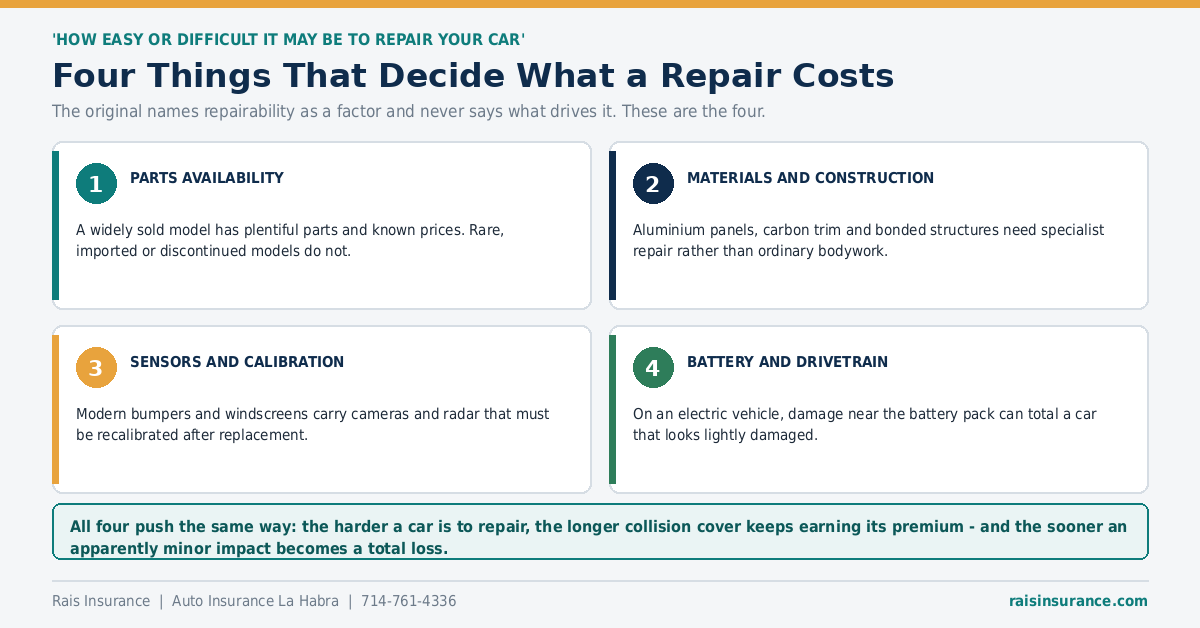
The original says the right auto insurance depends partly on “how easy or difficult it may be to repair your car”. That is a genuinely useful factor, and it is worth saying what drives it:
- Parts availability. A widely sold model has plentiful parts at known prices. Rare, imported or discontinued vehicles do not.
- Materials and construction. Aluminium panels, carbon trim and bonded structures need specialist repair rather than ordinary bodywork.
- Sensors and calibration. Modern bumpers and windscreens carry cameras and radar that must be recalibrated after replacement, which adds cost to what used to be a simple job.
- Battery and drivetrain. On an electric vehicle, damage near the battery pack can total a car that looks only lightly damaged.
All four push the same way: the harder a car is to repair, the longer collision cover keeps earning its premium – and the sooner an apparently minor impact becomes a total loss. It’s one of the more common things people search insurance near me hoping to understand before a repair estimate comes back higher than expected.
One Correction on Liability
The original describes liability well in most respects – it responds when a crash results from “negligence or oversight”, it covers the other party’s medical and vehicle damage, and it does not cover your own. All correct.
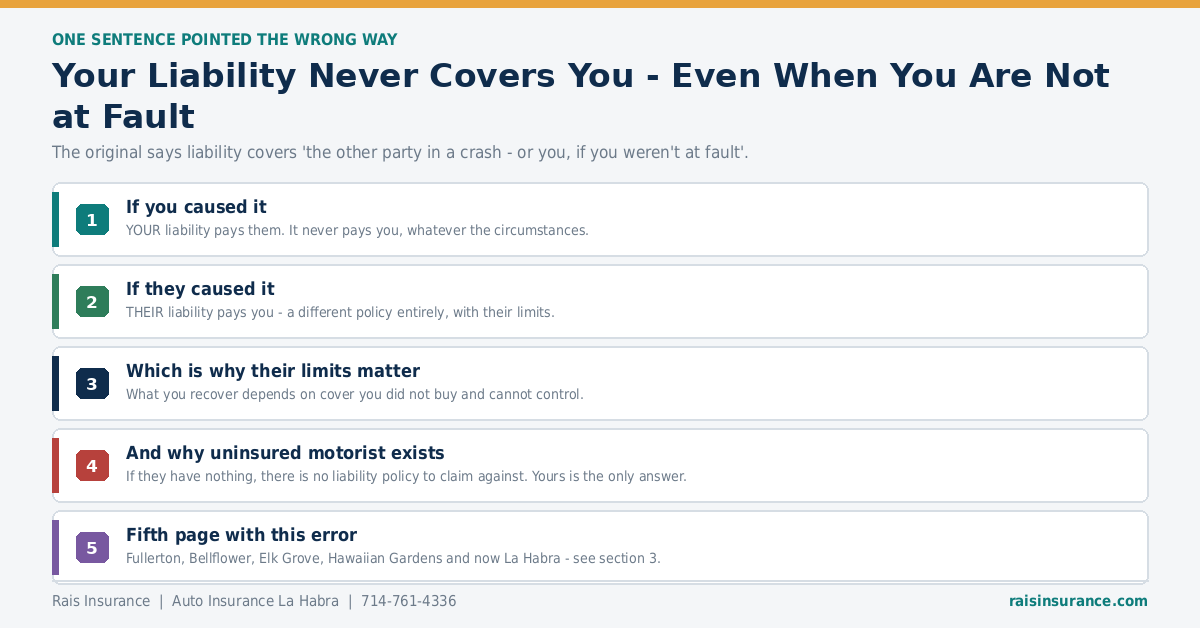
One phrase needs fixing though: it says liability covers “the other party in a crash – or you, if you weren’t at fault“. Your liability coverage never covers you, in any circumstance:
- If you caused it, your liability pays them.
- If they caused it, their liability pays you – a different policy entirely, with their limits.
- Which is why their limits matter to you, since what you recover depends on cover you did not buy and cannot control. See how liability limits actually work.
- And if they have nothing, there is no liability policy to claim against at all. That is what uninsured and underinsured motorist cover is for – optional in California, and a carrier must obtain your decline in writing. It is missing from the original entirely.
One more thing worth naming: liability has two required halves in California – bodily injury liability and property damage liability. The original refers to liability throughout without distinguishing them, and a reader cannot check for a coverage that has no name. It’s one of the more common things people search car insurance near me hoping to get a straight answer on.
Covering Your Own Vehicle
The original is accurate on both of these auto insurance coverages and they are kept close to as written:
- Collision covers your own vehicle’s damage after a crash, regardless of fault and subject to your deductible. Whether it is worth carrying depends on the car – which is what the sections above are about.
- Comprehensive covers damage that does not involve a crash at all: vandalism, disasters, theft, and anything else that leaves the car damaged or gone while you are not behind the wheel. See what comprehensive coverage actually covers.
The original’s framing of comprehensive – things that happen while you are not driving – is one of the clearer explanations of it in plain language, and it is retained. That’s the baseline every car insurance quotes in la habra, ca comparison should be checked against.
Driving in La Habra
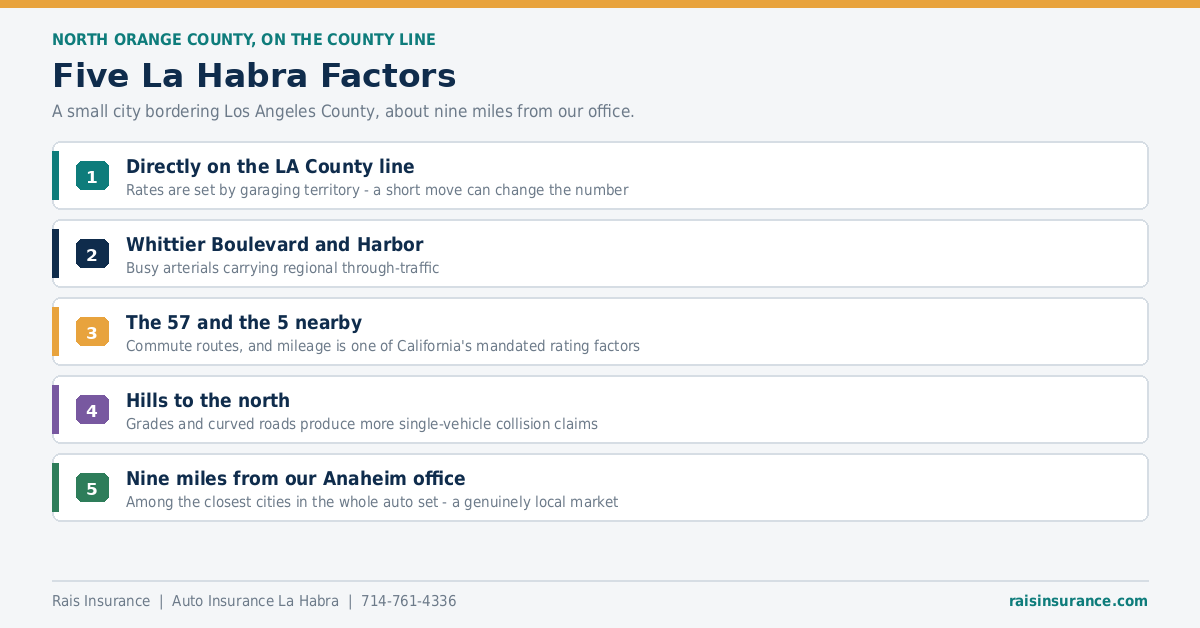
Five things that shape car insurance La Habra rates specifically, on top of the auto insurance La Habra basics above:
- Directly on the Los Angeles County line. Rates are set by garaging territory, so a move of a few streets can change the number materially.
- Whittier Boulevard and Harbor, busy arterials carrying regional through-traffic.
- The 57 and the 5 nearby, and annual mileage is one of the three factors California law requires to weigh most heavily.
- Hills to the north, where grades and curved roads produce more single-vehicle collision claims than flat suburban driving.
- About nine miles from our Anaheim office – among the closest cities in our whole service area. These five factors are exactly what we account for when quoting auto insurance in la habra, ca for a specific address.
Working Out What Fits
The original’s offer is the right one: we help you work out which car insurance policy fits your needs, your budget and your car model. The point of everything above is that the third of those does more work than people expect. That’s the standard we hold every car insurance in la habra, ca policy to, regardless of which carrier ultimately writes it.
As an independent broker we place business across a panel of carriers rather than selling one company’s products, so one set of details gets quoted several times – see the insurance companies we represent. We are not an insurance company; the carrier issues the policy and pays the claim, and there is no fee to you for the comparison. The current minimum limits are on our auto insurance in California page. Ask us at the same time about la habra, ca renters insurance quotes — bundling is usually the largest single discount available on both policies.
Auto Insurance in La Habra – Frequently Asked Questions
Q1. Can I insure a classic car on a normal policy?
You can, and it is usually the wrong product. A standard policy settles a total loss at actual cash value – what market data says the vehicle is worth, with depreciation applied – so a car that took years and real money to restore can be settled as an old vehicle. A classic car policy pays an agreed value instead, set in writing before anything happens. That’s the kind of detail worth confirming with car insurance companies in la habra, ca before you assume a standard quote covers a classic.
Q2. What is agreed value cover?
A figure you and the insurer agree when the policy is written, usually supported by an appraisal or documentation, and paid in full if the vehicle is a total loss. The trade-off is that classic policies typically limit annual mileage and require secure storage, so they suit a car that is driven occasionally rather than daily.
Q3. What does a new or financed car need?
Your lender will almost certainly require collision and comprehensive for the life of the loan. Worth also considering gap cover: a new vehicle can be worth less than the outstanding finance for the first year or two, and a standard policy pays only the vehicle’s value, leaving the balance with you. It’s exactly the gap a good auto insurance quotes in la habra, ca comparison should flag before you sign anything.
Q4. Does having passengers change what I should carry?
It changes the emphasis. Your passengers are third parties to you, so if you cause an accident their injuries fall under your bodily injury liability – which makes the per-person and per-accident limits matter more with a full car. Medical payments cover also becomes more useful, because it pays without anyone establishing fault first.
Q5. Are electric vehicles more expensive to insure?
Often, though not because of the badge. Repair costs are higher: panels and structures can need specialist work, sensors need recalibration after replacement, and damage near the battery pack can total a car that looks lightly damaged. That pushes the calculation toward keeping collision cover for longer. It’s one of the more common questions people searching insurance near me end up asking once they see an EV repair estimate.
Q6. What makes a car expensive to repair?
Four things mainly. Parts availability – a common model has plentiful parts at known prices. Materials, since aluminium and bonded structures need specialist repair. Sensors, because modern bumpers and windscreens carry cameras and radar that must be recalibrated. And on an EV, proximity to the battery pack.
Q7. Does my liability insurance cover me if I was not at fault?
No. Your liability coverage only ever pays other people. If the other driver caused the accident, it is their liability that pays you – a different policy, with their limits. That is why their coverage matters to you, and why uninsured motorist cover exists for the case where they have none. That’s the answer most people searching car insurance near me are actually looking for after an accident that wasn’t their fault.
Q8. What covers my own vehicle?
Collision, for damage from hitting something regardless of fault, and comprehensive for almost everything else – theft, fire, vandalism, weather, falling objects and animal strikes. Both are optional, both carry their own deductible, and the original version of this page describes both accurately. That’s the baseline every car insurance in la habra, ca policy should be checked against.
Q9. Do I need uninsured motorist coverage?
It is optional in California, and a carrier must obtain your decline in writing. It responds when the at-fault driver has no insurance or not enough of it – which in a fault-based state is the one situation nothing else on the policy answers. It’s the one gap auto insurance in la habra, ca shoppers most often overlook until it’s too late.
Q10. How do I get a La Habra auto insurance quote?
Call Rais Insurance on 714-761-4336, email rai@raisinsurance.com, or visit 2612 W. Lincoln Avenue, Suite 103, Anaheim, CA 92801 – about nine miles away. We are an independent broker, so one set of details is quoted across several carriers, and there is no fee to you for the comparison. That’s the fastest way to get a car insurance la habra quote built around your actual vehicle, and it’s the same standard behind every auto insurance la habra request we handle.
Get a Car Insurance Quote in La Habra
contact Rais Insurance on 714-761-4336, email rai@raisinsurance.com, or visit 2612 W. Lincoln Avenue, Suite 103, Anaheim, CA 92801. Ask us for car insurance quotes in la habra, ca that spell out exactly which of these coverages fits your vehicle.
Have the vehicle details ready as well as your car insurance declarations page – year, model and trim. On a classic or a recently financed car, mention that at the start: both change which product is appropriate rather than just what it costs. If you rent rather than own, ask about la habra, ca renters insurance quotes in the same call — it often bundles neatly with your auto policy.
