

Auto Insurance Fountain Valley California
Auto insurance for Fountain Valley drivers, quoted across several carriers by Rais Insurance.A drive with the family, music on, and then something goes wrong. It is a fair way to think about the car insurance Fountain Valley drivers need, because the useful question is not whether you have a policy – it is whether the part of it that answers *this particular accident* is the part you actually bought. Every auto insurance fountain valley quote we prepare starts from that same question — which part of the policy actually answers this accident.
The original version of this page opens by crashing into a tree, then explains comprehensive coverage. Those are two different things, and the gap between them is worth starting with. Getting car insurance fountain valley ca right means starting with that distinction, not glossing over it.
The Tree in the Opening Line
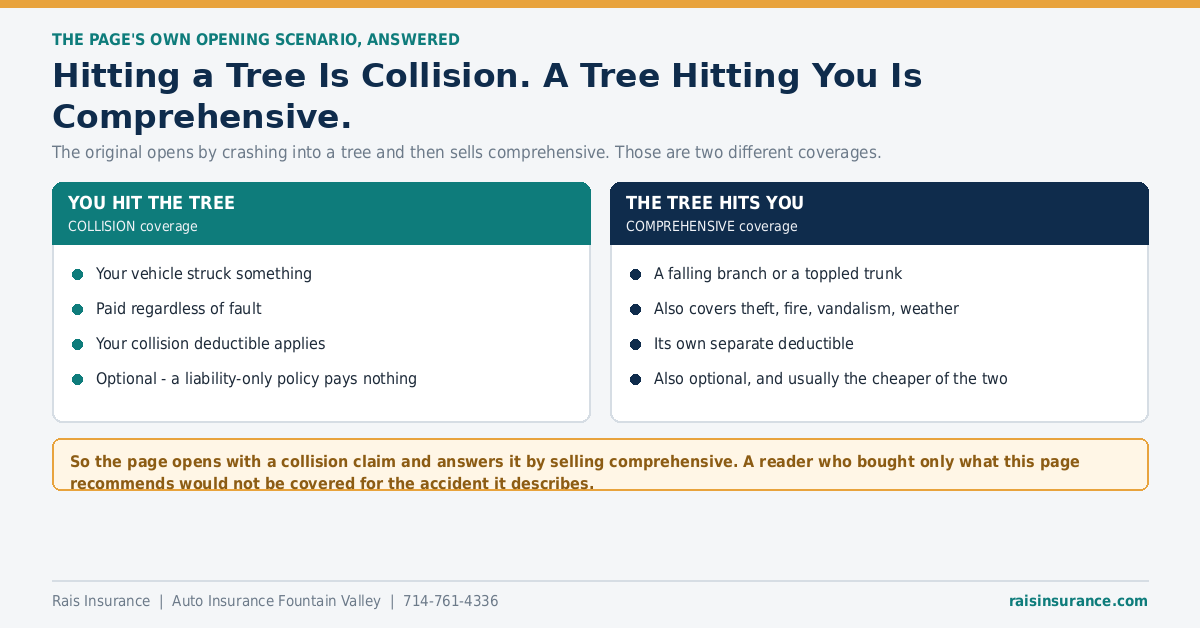
If you hit a tree, that is a collision claim. Collision coverage repairs your vehicle after it strikes something – another car, a barrier, a kerb, a tree – regardless of who was at fault, subject to your deductible.
If a tree hits you – a branch comes down on a parked car, or a trunk gives way in a storm – that is comprehensive. It answers falling objects, along with theft, fire, vandalism and weather.
Both are optional. So a driver who bought only what the original page recommends would not, in fact, be covered for the accident it describes in its opening paragraph. That is not a small distinction, and it is exactly the kind of thing worth checking on your own policy – see three road hazards and three coverages for the same sorting applied to potholes and animals. It’s exactly the kind of gap worth checking before you assume your car insurance in Fountain Valley, CA already covers it.
What Comprehensive Covers
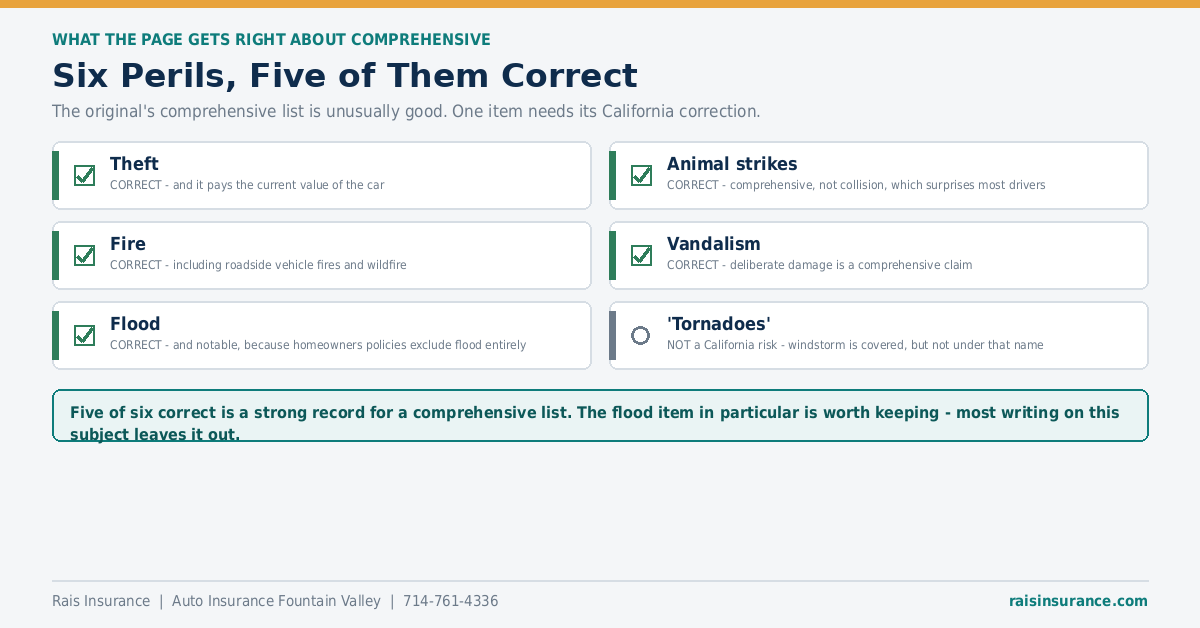
With that straightened out, the original’s account of this cover is unusually good – five of its six items are correct as written:
- Theft. If your car is stolen, comprehensive pays you its current value – the original puts this well. Note that is actual cash value rather than what a replacement costs today.
- Animal strikes. Correct, and it is the one drivers find most surprising: hitting an animal is comprehensive, not collision.
- Fire, including the roadside vehicle fires the original mentions, and wildfire.
- Vandalism – deliberate damage by somebody else.
- Flood, including damage to mechanical parts. Genuinely worth knowing, because home insurance works the opposite way: flood is excluded from a homeowners policy entirely and needs separate cover.
The sixth item needs a California correction. The original names tornadoes, which are rare here and generally minor. Windstorm damage is covered either way, so nothing is lost – but the perils that actually matter in this state are wildfire, flood and wind-driven debris. The full list is on our what comprehensive coverage actually covers page. Knowing which of these six perils your policy actually includes is basic homework before buying auto insurance in Fountain Valley, CA.
Four Coverages Under One Heading
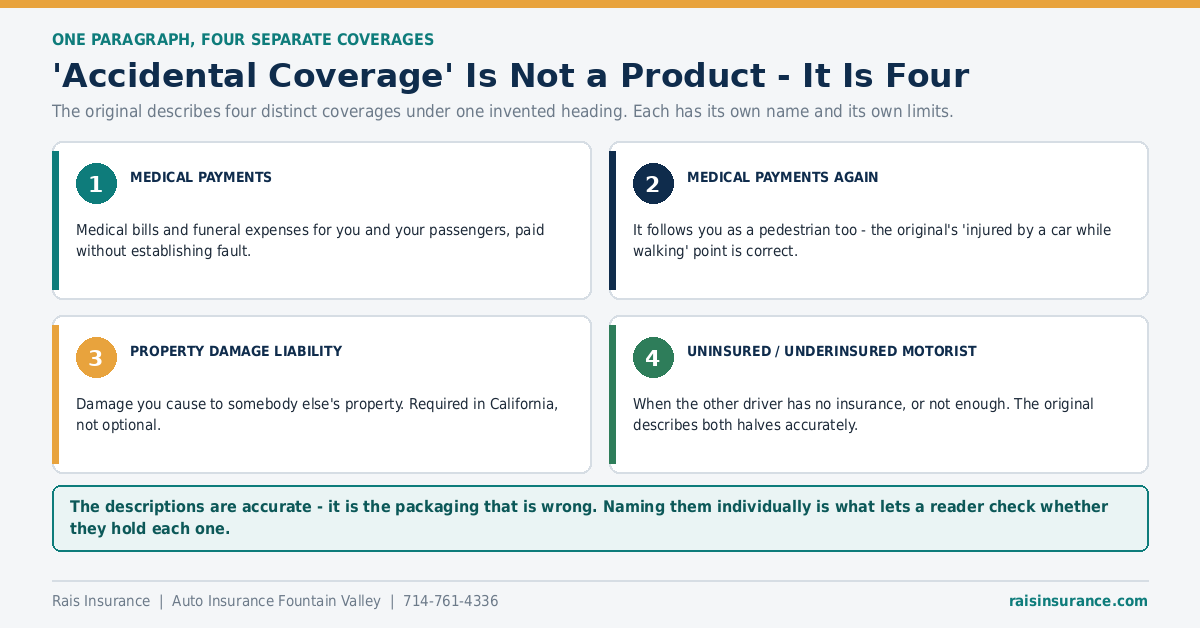
The original groups four things under “Accidental Coverage”, which is not a product name. The descriptions are accurate; it is the packaging that hides them. Named individually, so you can check whether you hold each one:
- Medical payments – medical bills and funeral expenses for you and your passengers, paid without anybody having to establish fault first. The original is also right that it follows you as a pedestrian, which is a detail most pages leave out.
- Property damage liability – damage you cause to somebody else’s property. This one is required in California rather than optional.
- Uninsured motorist – when the driver who hits you has no insurance at all.
- Underinsured motorist – when they have insurance but not enough to cover your loss. The original describes both halves accurately, which only three other pages in our auto set manage.
On whose injuries each coverage pays for – and the one person liability does not cover – see whose injuries each coverage pays for. Every one of our auto insurance quotes in fountain valley, ca lists these four separately, so nothing gets hidden under one invented heading.
What You Actually Need to Carry
One thing the original never says: liability is the only coverage California requires – bodily injury and property damage. Comprehensive, collision, medical payments and uninsured motorist are all optional, though a lender will usually require collision and comprehensive while a vehicle is financed.
Which makes “comprehensive auto insurance” a slightly misleading phrase for a whole car insurance policy. It is one coverage among several, and on its own it answers none of your collisions and none of your liability to other people. The current minimum limits are on our auto insurance in California page, and on whether comprehensive still earns its premium on an older car, see when collision and comprehensive stop earning their premium. Keep that in mind when comparing car insurance quotes in fountain valley, ca side by side — the cheapest one may just be the thinnest one.
Driving in Fountain Valley
Five things that shape car insurance Fountain Valley rates specifically, on top of the auto insurance Fountain Valley basics above:
- The 405 and the 73. Both bound the city, and annual mileage is one of the factors California law requires to weigh most heavily in your rate.
- Low elevation and flood channels. This cover answers flood damage to a vehicle, which the original names correctly and which is genuinely relevant here.
- Mature street trees, which is why the question at the top of this page is not hypothetical in this city.
- Dense residential street parking. Theft, vandalism and glass claims all track where the car sleeps overnight.
- About twelve miles from our Anaheim office – one of the closer cities in our set, and a genuinely local market for us.Not every one of the car insurance companies fountain valley drivers call prices these local risks the same way.
Why Work With Us
Two things the original offers, restated accurately. It promises a great discount for Fountain Valley residents – what we can actually do is check that every discount you qualify for is applied, including California’s statutory good driver discount, bundling, and an accurate annual mileage figure. Nobody can discount a carrier’s filed rate, because rates here are filed with the Department of Insurance and approved before use. Ask us at the same time about renters insurance in Fountain Valley, CA — bundling is usually where that good driver discount stretches furthest.
And it promises guidance from experienced people, which is the real offer. As an independent broker we place business across a panel of carriers rather than selling one company’s products, so one set of details from you gets quoted several times – see the insurance companies we represent. We are not an insurance company; the carrier issues the policy and pays the claim, and there is no fee to you for the comparison. Comparing across several car insurance companies in Fountain Valley, CA is really the only way to know which one applies every discount you qualify for.
Auto Insurance in Fountain Valley – Frequently Asked Questions
Q1. Does comprehensive cover hitting a tree?
No. If your vehicle strikes a tree, that is a collision claim – collision coverage repairs your car after it hits something, regardless of fault. Comprehensive would respond if the tree fell on your parked car. The distinction matters, because both are optional and a driver could hold one without the other.
Q2. What does comprehensive coverage actually cover?
Theft, fire including roadside vehicle fires and wildfire, vandalism, weather damage, flood, falling objects and animal strikes. The simplest way to hold it: comprehensive answers almost everything that can damage your car without another vehicle or object being struck by it. That’s the baseline every car insurance in Fountain Valley, CA policy should be checked against.
Q3. Does comprehensive cover hitting an animal?
Yes. Animal strikes fall under comprehensive rather than collision, which surprises most drivers because it feels like a collision. It usually works in your favour – comprehensive claims are often treated more leniently at renewal, and comprehensive is generally the cheaper of the two physical damage coverages.
Q4. If my car is stolen, what will I be paid?
Its actual cash value at the time of the theft, less your deductible – not what you paid for it and not what a replacement costs today. On an older vehicle that ceiling arrives sooner than people expect, which is part of the calculation behind whether to carry comprehensive at all. That ceiling is worth factoring in before you finalize auto insurance in Fountain Valley, CA on an older vehicle.
Q5. Does comprehensive cover flood damage to my car?
Yes, and it is worth knowing because homeowners policies work the opposite way – flood is excluded from a home policy entirely and needs separate NFIP or private cover. Comprehensive auto coverage does respond to flood damage to the vehicle, including damage to mechanical parts.
Q6. Do tornadoes affect California drivers?
Not meaningfully. Tornadoes in California are rare and generally minor. Windstorm damage is covered under comprehensive regardless, so nothing is lost by not thinking about tornadoes specifically – what does matter here is wildfire, flood and, on the coast, wind-driven debris. It’s one more thing car insurance companies fountain valley residents rarely get asked about directly.
Q7. What pays my medical bills after an accident?
Medical payments coverage pays for you and your passengers without anybody having to establish fault first, and it follows you as a pedestrian too. Beyond that, your health plan, the at-fault driver’s bodily injury liability if they caused it, and your own uninsured motorist cover if they had no insurance. If you’re comparing fountain valley, ca renters insurance quotes alongside auto, ask us to run both together.
Q8. What if the other driver has no insurance, or not enough?
That is what uninsured and underinsured motorist coverage is for. Uninsured motorist responds when they have no cover at all; underinsured motorist fills the gap when they have some but not enough for your loss. Both are optional in California, and a carrier must obtain your decline in writing.
Q9. Is comprehensive the same as full coverage?
No. ‘Full coverage’ has no legal definition – it is shorthand people use for liability plus collision plus comprehensive together. Comprehensive on its own covers none of your collisions and none of your liability to other people, so it is one part of a policy rather than a complete one. That’s a distinction worth clarifying with car insurance companies in Fountain Valley, CA before you assume ‘full coverage’ means everything.
Q10. How do I get a Fountain Valley auto insurance quote?
Call Rais Insurance on 714-761-4336, email rai@raisinsurance.com, or visit 2612 W. Lincoln Avenue, Suite 103, Anaheim, CA 92801 – about twelve miles away. We are an independent broker, so one set of details is quoted across several carriers, and there is no fee to you for the comparison. That’s the quickest way to get an auto insurance fountain valley quote built around your actual coverage needs, and it’s the fastest way to get auto insurance quotes in fountain valley, ca that reflect your actual coverage needs.
Get a Car Insurance Quote in Fountain Valley
Renewing, or insuring a car for the first time? contact Rais Insurance on 714-761-4336, email rai@raisinsurance.com, or visit 2612 W. Lincoln Avenue, Suite 103, Anaheim, CA 92801. We’re happy to walk through your car insurance fountain valley ca options over the phone before you commit to anything. Ask us for car insurance quotes in fountain valley, ca that break out collision and comprehensive separately, so you can see exactly what you’re buying.
Have your car insurance declarations page to hand, and check one line before you call: whether you carry collision as well as comprehensive. They answer different accidents, and holding only one is more common than people realise. If you rent rather than own, ask about renters insurance in Fountain Valley, CA in the same call — it often bundles neatly with your auto policy. We can also put together fountain valley, ca renters insurance quotes at the same time, so you’re comparing the full picture rather than just the car.
