

Auto Insurance La Palma California
The original version of this page states the principle exactly right: the key is knowing what you need and what you do not. What it never does is give the order – so that is where this car insurance guide starts.
Why More Than the Minimum
California is a liability state rather than a no-fault state, as the original correctly says: every vehicle owner needs liability cover, so that if they are found at fault their policy answers the other party’s medical and repair costs.
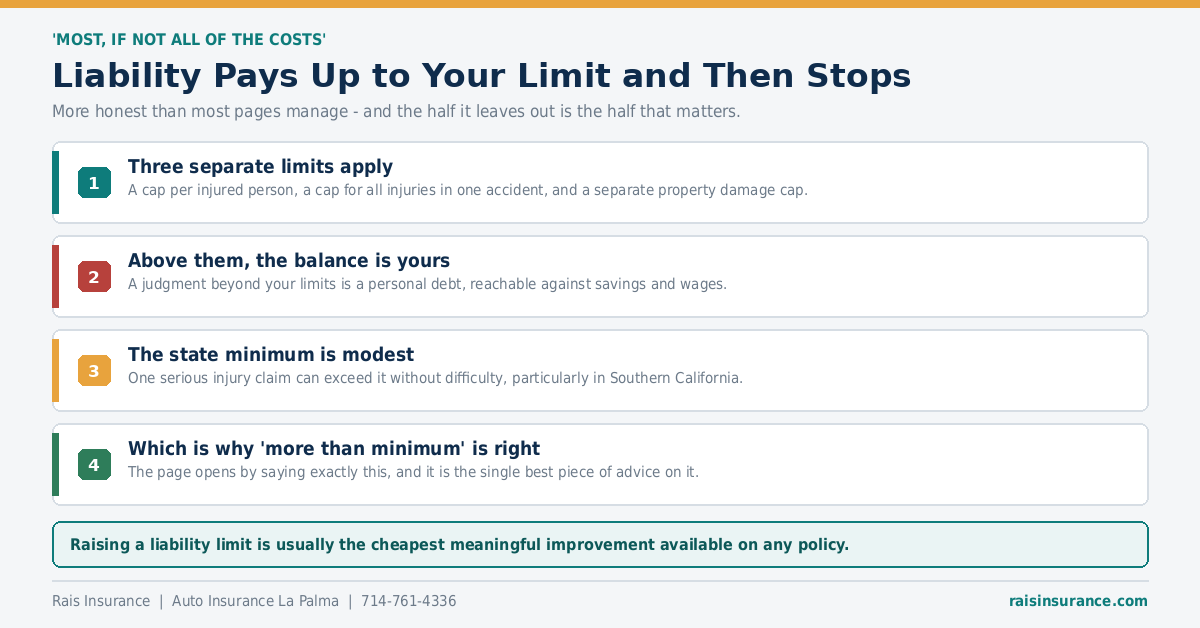
The page then says a policy can cover “most, if not all” of those costs – which is more honest than most insurance writing manages, and the half it leaves out is the half that matters:
- Three separate limits apply – a cap on injuries to any one person, a cap for all injuries in one accident, and a separate cap for property damage.
- Above them, the balance is yours. A judgment beyond your limits becomes a personal debt, reachable against savings and wages.
- The state minimum is modest, and one serious injury claim can exceed it without difficulty.
Which is exactly why the page’s opening advice is the best thing on it. How the limits interact, and what happens when they run out, is on our how liability limits actually work page.
Prioritising Coverage on a Budget
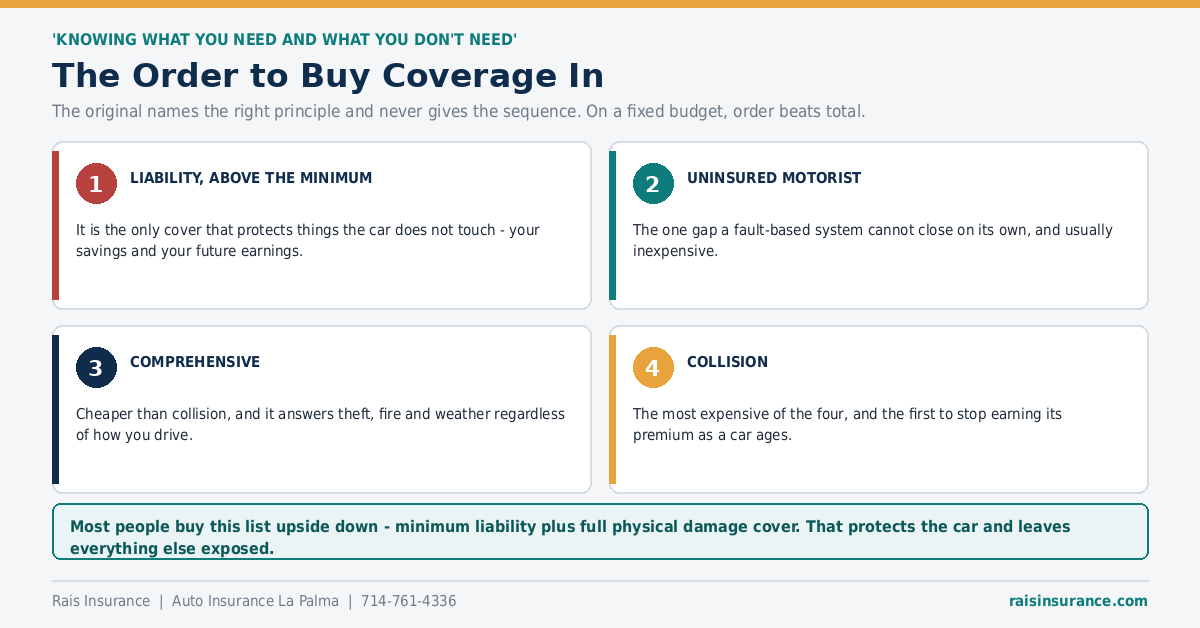
If you cannot buy every car insurance coverage, the sequence matters more than the total. Four, in the order we would add them:
- Liability, above the state minimum. It is the only cover that protects things the car does not touch – your savings, your home equity, your future earnings. Higher layers price well below the first, so this is usually the cheapest meaningful improvement available.
- Uninsured and underinsured motorist. The one gap a fault-based system cannot close on its own: if the driver who hits you has nothing, nothing else on your policy responds. Optional in California, and a carrier must obtain your decline in writing.
- Comprehensive. Generally the cheaper of the two physical damage coverages, and what it answers – theft, fire, vandalism, weather, falling objects – does not care how carefully you drive.
- Collision. The most expensive of the four, and the first to stop earning its premium as a vehicle depreciates: see when collision and comprehensive stop earning their premium.
Most people buy that list upside down – minimum liability with full physical damage cover on top. That protects the car and leaves everything else exposed, which is the opposite of what a limited budget should be doing.
The four-item list, checked
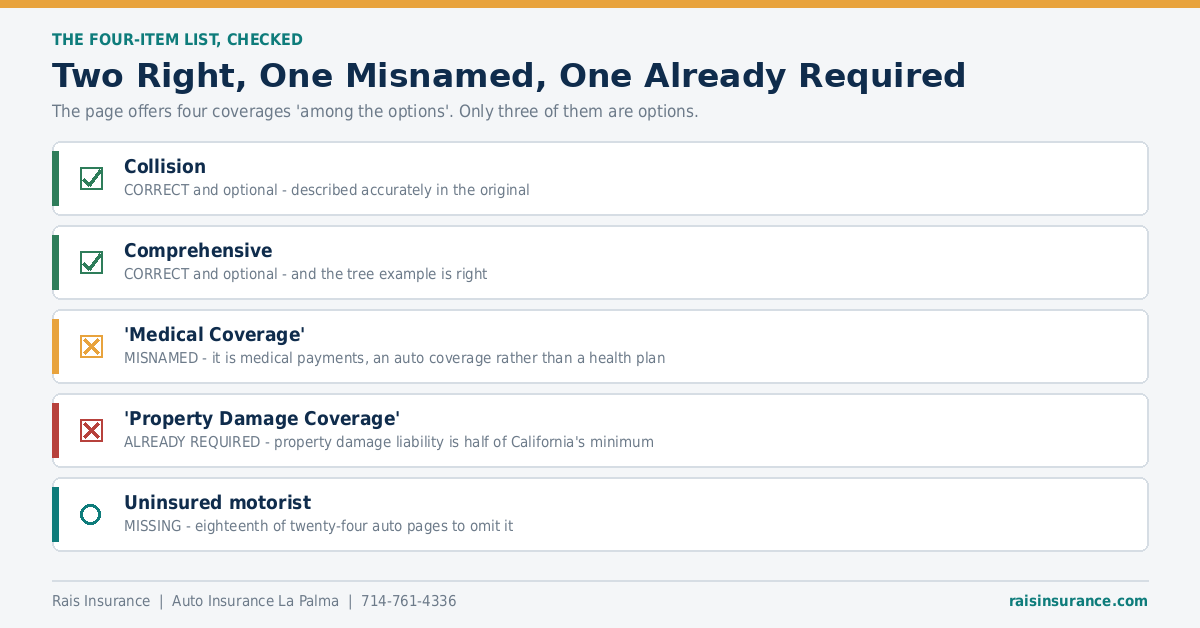
The original offers four auto insurance coverages “among the options”. Only three of them are options:
- Collision – correct and optional. The description is accurate: it helps pay for damage caused by the accident.
- Comprehensive – correct and optional, and the description is one of the better ones in plain language.
- “Medical Coverage” is medical payments – an auto coverage that pays for you and your passengers without anyone establishing fault first. The page is right that it saves digging into savings; naming it properly is what lets you ask for it.
- “Property Damage Coverage” is not optional. Property damage liability is one of the two coverages California requires. If you hold a legal policy you already have it.
And uninsured motorist belongs on any California list. It is missing from the original entirely, which is why it appears second in the priority order above.
The Tree Example, and Why It Is Right
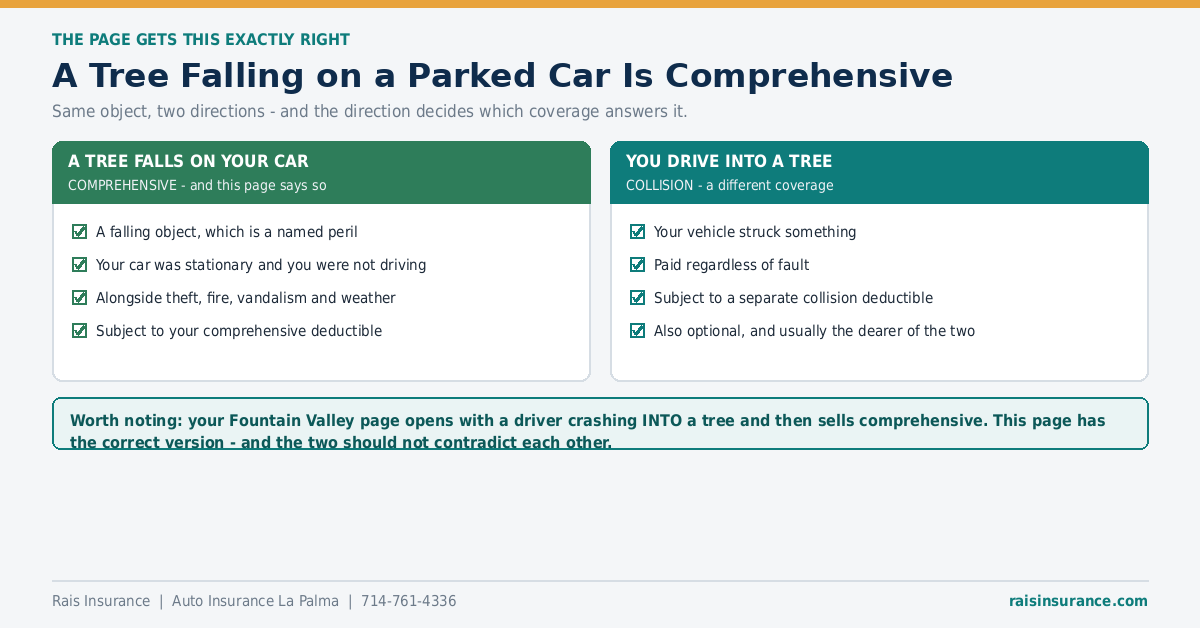
The original uses a tree falling on a parked car as its comprehensive example, and that is exactly right – falling objects are a named comprehensive peril, alongside theft, fire, vandalism and weather. It is worth drawing out, because the same object goes the other way too:
- A tree falls on your car – comprehensive. You were not driving, the vehicle was struck by something, and it sits with theft and weather.
- You drive into a tree – collision. Your vehicle struck something, and that is a separate coverage with a separate deductible.
Both are optional, and each carries its own deductible – so it is possible to hold one and not the other. See what comprehensive coverage actually covers and three road hazards and three coverages for the same sorting applied to potholes and animals.
This matters locally. La Palma has mature street trees throughout, which makes the example less hypothetical here than it would be in most cities.
Driving in La Palma
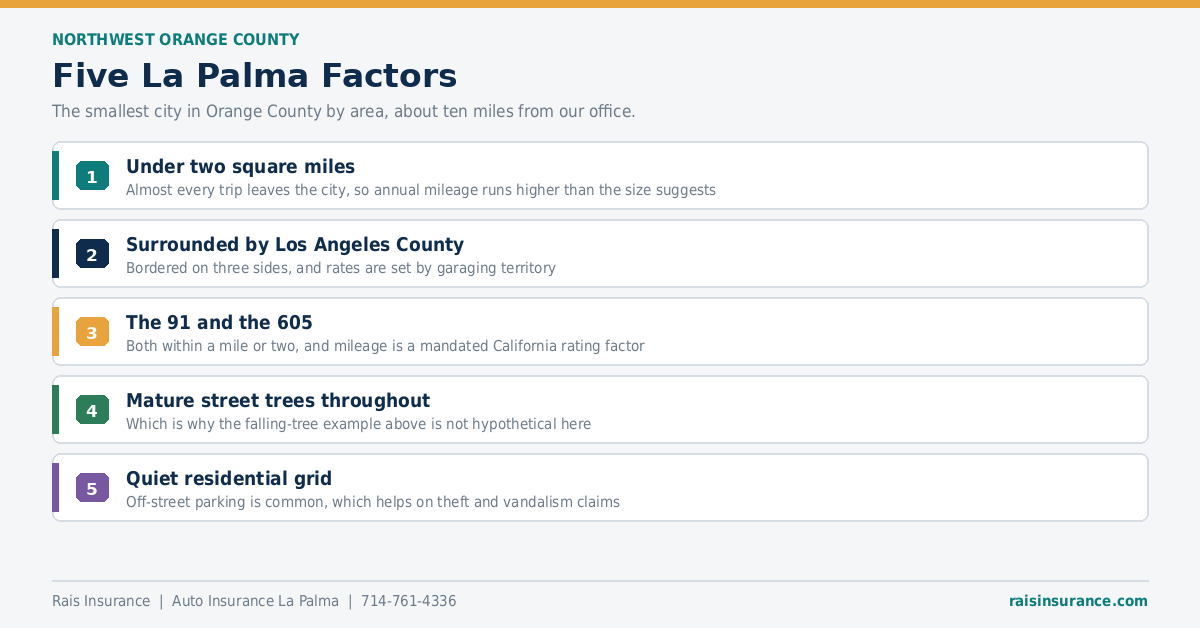
Five things that shape car insurance La Palma rates specifically, on top of the auto insurance La Palma basics above:
- Under two square miles. The smallest city in Orange County by area, so almost every trip leaves it – and annual mileage runs higher than the city’s size suggests. Mileage is one of the three factors California law requires to weigh most heavily.
- Bordered by Los Angeles County on three sides. Rates are set by garaging territory, so the number can change over very short distances here.
- The 91 and the 605, both within a mile or two.
- Mature street trees throughout, which is the falling-object exposure the section above describes.
- A quiet residential grid where off-street parking is common, which helps on theft, vandalism and glass claims.
Keeping the Cost Down Without Leaving Gaps
The original’s promise is a fair one: prioritise the cover, keep the cost down, and end up genuinely protected rather than merely insured. The car insurance order above is how we would actually do that – and it usually means spending less on the car and more on the liability that protects everything else.
As an independent broker we place business across a panel of carriers rather than selling one company’s products, so one set of details gets quoted several times – see the insurance companies we represent. We are not an insurance company; the carrier issues the policy and pays the claim, and there is no fee to you for the comparison. The current minimum limits are on our auto insurance in California page.
Auto Insurance in La Palma – Frequently Asked Questions
Q1. If I cannot afford everything, what should I buy first?
Liability, above the state minimum. It is the only coverage that protects things your car does not touch – your savings, your home equity, your future earnings. After that: uninsured motorist, then comprehensive, then collision. Most people buy that list upside down, taking minimum liability with full physical damage cover, which protects the car and leaves everything else exposed.
Q2. Why does uninsured motorist come so high in the order?
Because it is the one gap a fault-based system cannot close on its own. California is a liability state, so what you recover depends on the other driver’s coverage – and if they have none, nothing else on your policy responds. It is also usually inexpensive relative to what it does.
Q3. Should I keep comprehensive or collision if I can only keep one?
Comprehensive, in most cases. It is generally the cheaper of the two, and the things it covers – theft, fire, vandalism, weather, falling objects – do not care how carefully you drive or how old the car is. Collision is the first of the two to stop earning its premium as a vehicle depreciates.
Q4. Does insurance cover a tree falling on my parked car?
Yes, under comprehensive coverage – and the original version of this page states this correctly. Falling objects are a named comprehensive peril, alongside theft, fire, vandalism and weather. Note the reverse case: if you drive into a tree, that is a collision claim, which is a separate and separately optional coverage.
Q5. Is property damage coverage optional?
No. Property damage liability is one of the two coverages California requires, alongside bodily injury liability. If you hold a policy that meets the state minimum you already have it – it is not something to add. The genuinely optional coverages are collision, comprehensive, medical payments, and uninsured and underinsured motorist.
Q6. What is medical payments coverage?
An optional coverage inside your auto policy that pays medical costs for you and your passengers without anyone having to establish fault first. That is what makes it useful – treatment can start while the fault question is still being argued. The limits are modest and it is inexpensive, and it is not a health plan.
Q7. Does liability cover damage to my own car?
No, and the original version of this page says so correctly. Liability pays the other party when you are at fault. Your own vehicle needs collision for a crash and comprehensive for almost everything else, and both are optional.
Q8. What happens if a claim exceeds my liability limit?
Your insurer pays up to the limit and its duty is then discharged. The balance of any judgment is a personal debt, reachable against savings, wages and other assets. That is why the page’s opening advice – carry more than the minimum – is the best thing on it, and why raising a liability limit is usually the cheapest meaningful improvement available.
Q9. Is California a no-fault state?
No. California is a liability state, as the original correctly says – the driver at fault is responsible for the costs, and their liability coverage answers the claim. No-fault systems, where each carrier pays its own client regardless of blame, exist in about a dozen other states and require Personal Injury Protection, which is not sold here.
Q10. How do I get a La Palma auto insurance quote?
Call Rais Insurance on 714-761-4336, email rai@raisinsurance.com, or visit 2612 W. Lincoln Avenue, Suite 103, Anaheim, CA 92801 – about ten miles away. We are an independent broker, so one set of details is quoted across several carriers, and there is no fee to you for the comparison.
Get a Car Insurance Quote in La Palma
contact Rais Insurance on 714-761-4336 or email rai@raisinsurance.com.
If there is a budget you need to stay inside, say so at the start rather than at the end. Knowing the number changes which order we work through the auto insurance coverages in, and that is a more useful conversation than trimming a quote afterwards.
