

Auto Insurance Pico Rivera California
Auto insurance for Pico Rivera drivers, quoted across several carriers by Rais Insurance.There is a great deal of commentary about how insurance is going to change – demographics, technology, congestion. Some of it is worth reading. But almost none of it helps with the thing in front of you, which is what auto insurance Pico Rivera drivers should be carrying right now – and what the auto insurance Pico Rivera market currently offers. Every auto insurance pico rivera quote we prepare starts from what’s actually true today, not from an industry forecast.
So this page does the opposite of a forecast. It takes the three car insurance subjects the industry keeps raising and says what is actually true about each of them in California today – starting with the one that is worth money to a lot of people here. That’s the standard we hold every car insurance pico rivera policy to — facts you can act on, not speculation.
Getting Older, and What It Does to a Premium
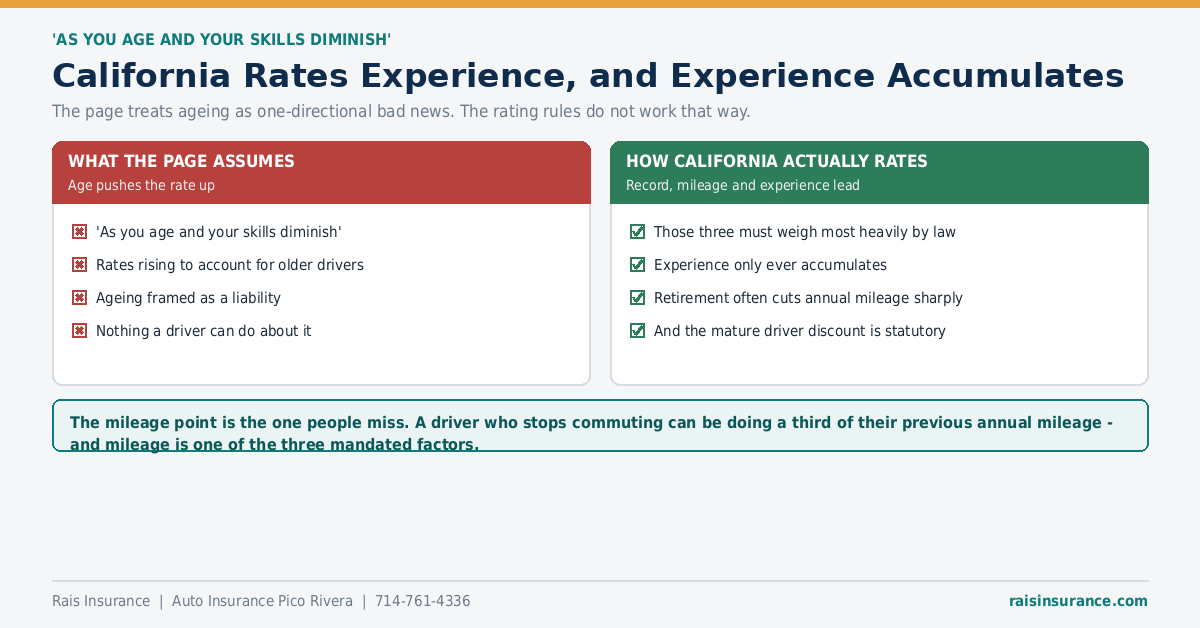
The ageing of the population is a real demographic fact, and the original version of this page is right to raise it. But it treats ageing as one-directional bad news – “as you age and your skills diminish” – and that is not how California car insurance rates work:
- Three factors must weigh most heavily by law: your driving safety record, your annual mileage, and your years of driving experience.
- Experience only ever accumulates. It is the one rating factor that improves with every year you hold a clean record.
- Retirement usually cuts mileage sharply. A driver who has stopped commuting may be doing a fraction of their previous annual miles – and mileage is one of the mandated three. See what determines your premium in California.
- And rates cannot simply rise for a demographic. California carriers file their rates with the Department of Insurance and must have them approved before use. It’s the kind of detail worth checking on any car insurance in pico rivera, ca policy before assuming age alone drives the price.
The discount most people over 55 never claim
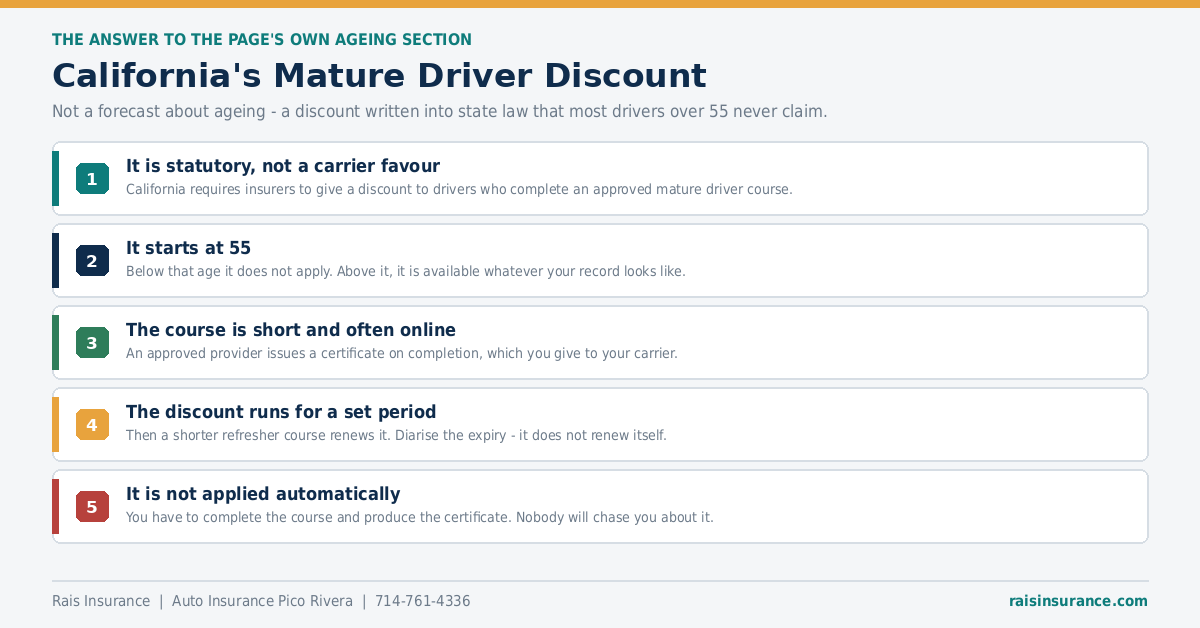
This is the part the original section should have contained, because it is a fact rather than a forecast. California requires insurers to give a discount to drivers who complete an approved mature driver improvement course, and it starts at age 55:
- It is statutory, not a carrier’s goodwill gesture.
- The course is short, and approved providers commonly offer it online.
- You receive a certificate on completion, which you give to your carrier.
- The discount runs for a set period and is renewed by a shorter refresher course – so the expiry is worth diarising.
- It is not applied automatically. You have to do the course and produce the certificate. Nobody will prompt you, which is precisely why so many eligible drivers never receive it.
If you are over 55 and have never done this, it is probably the single most cost-effective hour you can spend on your car insurance. Ask us at the same time about pico rivera, ca renters insurance quotes — bundling with home or renters cover is another discount many people never claim.
Telematics and Usage-Based Insurance
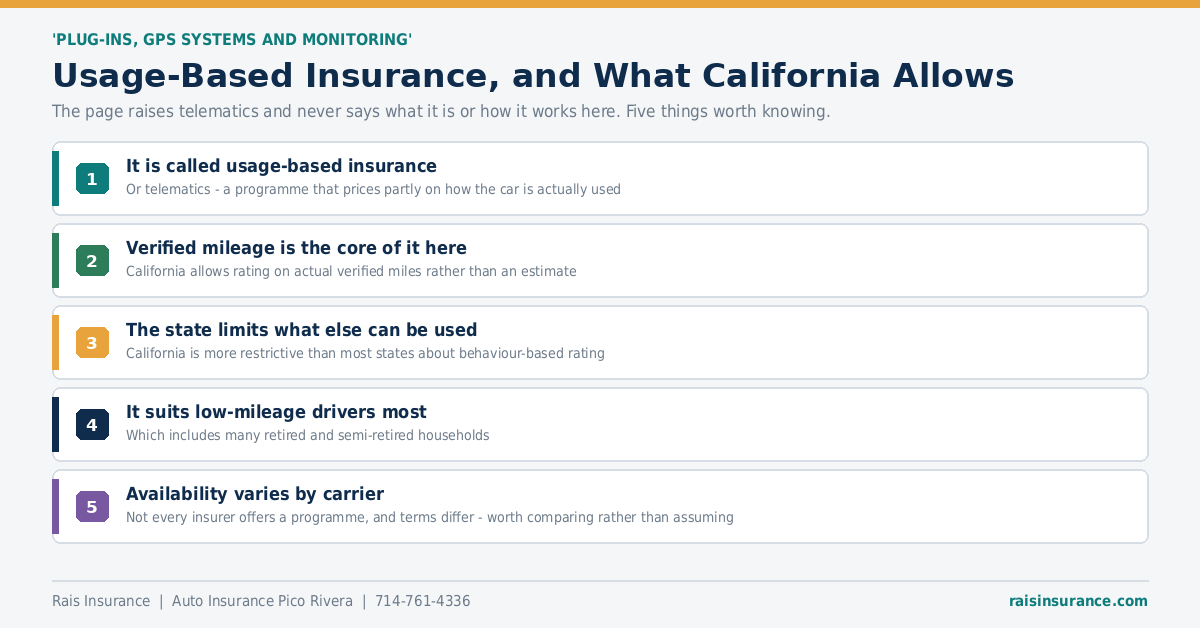
The original raises “plug-ins, GPS systems, and even additional monitoring within vehicles” and never says what any of it is. The proper name is usage-based insurance, or telematics – a programme that prices partly on how a vehicle is actually used rather than on estimates. Five things worth knowing about it here:
- Verified mileage is the core of it in California. The state permits rating on actual verified miles rather than an estimated figure.
- California is stricter than most states about rating on driving behaviour data, so these programmes look different here than elsewhere.
- They are opt-in. Nobody is obliged to let a carrier collect data.
- They suit low-mileage drivers most, which includes a great many retired and semi-retired households.
- Availability and terms vary by carrier, which is a straightforward argument for comparing rather than assuming.
On driverless cars: the original is right that they are not imminent, and nothing about them should influence a policy you buy this year. Not all car insurance companies in pico rivera, ca offer the same telematics terms, which is exactly why comparing matters.
More Cars on the Same Roads
The original’s third point is that population growth in warm-weather states puts more vehicles in the same places, which raises risk. That is broadly right, and it has a specific mechanism worth naming: California rates by garaging territory, so where a vehicle is kept overnight is a permitted factor and denser areas do generally rate differently.
What it means practically is narrower than the framing suggests. It is not a reason to expect sudden change – it is a reason to make sure the address on your policy is accurate, and to re-compare periodically, because carriers draw territory boundaries differently from one another. It’s the kind of local detail car insurance agents in pico rivera, ca should be checking at every renewal, not just at the first quote.
What a California Policy Contains
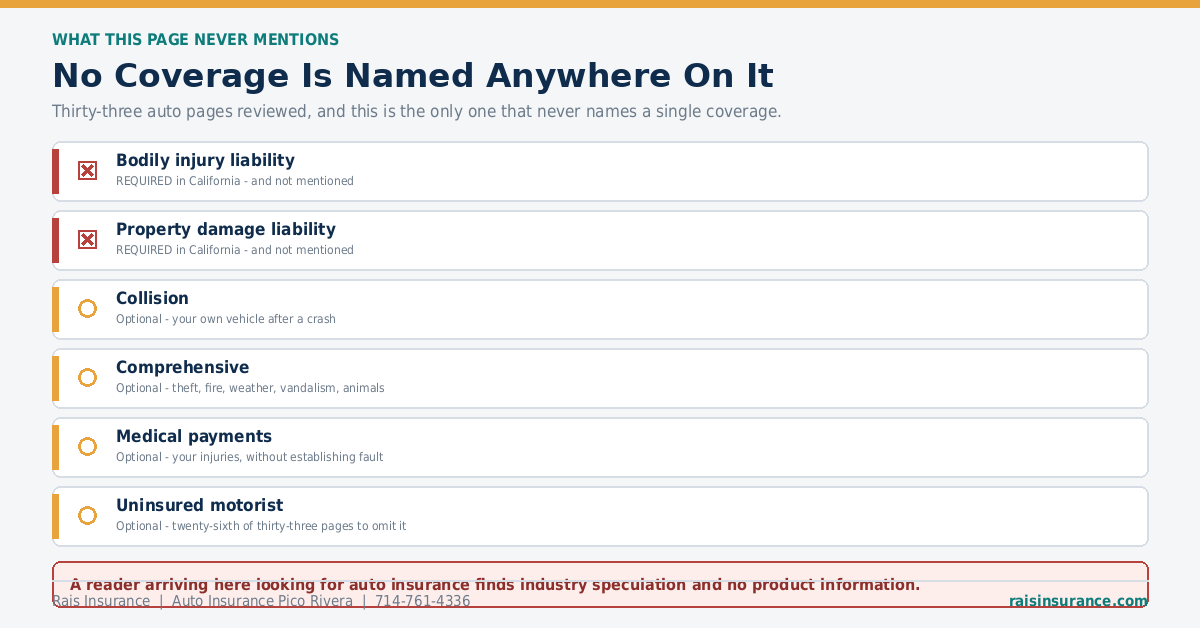
The original page discusses the insurance industry at some length without naming a single auto insurance coverage. Since that is what a reader arriving here is actually looking for:
- Bodily injury liability – required. Injuries you cause to other people.
- Property damage liability – required. Damage you cause to their vehicle or property. See how liability limits actually work.
- Collision – optional. Your own vehicle after a crash, regardless of fault, subject to your deductible.
- Comprehensive – optional. Theft, fire, weather, vandalism, falling objects and animal strikes: see what comprehensive coverage actually covers.
- Medical payments – optional. Your injuries and your passengers’, paid without anyone establishing fault first.
- Uninsured and underinsured motorist – optional, declined in writing, and the only thing that responds when the at-fault driver has no insurance.
Whether collision and comprehensive still earn their premium depends mostly on the vehicle’s value – see when collision and comprehensive stop earning their premium. The current minimum limits are on our auto insurance in California page. That’s the baseline every car insurance quotes in pico rivera, ca comparison should be checked against.
Driving in Pico Rivera
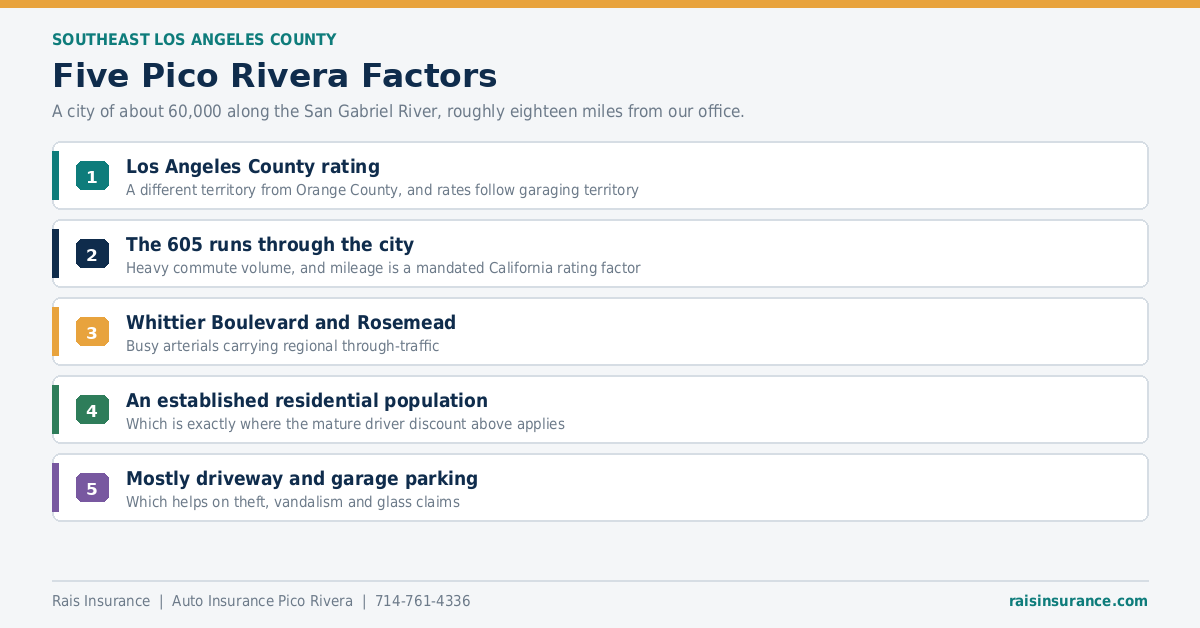
Five things that shape car insurance Pico Rivera rates specifically, on top of the auto insurance Pico Rivera basics above:
- Los Angeles County rating. A different territory from Orange County, and California rates by garaging territory.
- The 605 runs through the city, and annual mileage is one of the three factors state law requires to weigh most heavily.
- Whittier Boulevard and Rosemead Boulevard, busy arterials carrying regional through-traffic.
- An established residential population, which is exactly where the mature driver discount above is worth checking.
- Mostly driveway and garage parking, which helps on theft, vandalism and glass claims. These five factors are exactly what we account for when quoting auto insurance in pico rivera, ca for a specific address.
Worth Doing Now Rather Than Watching For
The original’s underlying suggestion is sound – talk to somebody rather than leave the policy alone indefinitely. What is worth talking about is not what the industry might do, but four car insurance things you already control: your liability limits, whether your mileage figure is current, whether you are claiming every discount you qualify for, and whether you have declined uninsured motorist cover without meaning to. Every one of our auto insurance quotes in pico rivera, ca starts from that same checklist, not just a premium number.
As an independent broker we place business across a panel of carriers rather than selling one company’s products, so one set of details gets quoted several times – see the insurance companies we represent. We are not an insurance company; the carrier issues the policy and pays the claim, and there is no fee to you for the comparison. If you rent rather than own, ask about renters insurance in pico rivera, ca in the same call — it often bundles neatly with your auto policy.
Auto Insurance in Pico Rivera – Frequently Asked Questions
Q1. What is California’s mature driver discount?
A discount written into state law: insurers are required to give it to drivers who complete an approved mature driver improvement course. It begins at age 55. The course is short, often available online from an approved provider, and you receive a certificate on completion which you give to your carrier.
Q2. Is the mature driver discount applied automatically?
No, and that is why so many eligible drivers never receive it. You have to complete the course and produce the certificate yourself – no carrier will prompt you. It also runs for a set period and is renewed by a shorter refresher course, so the expiry is worth diarising.
Q3. Does car insurance simply go up as you get older?
Not the way it is often assumed. California requires carriers to weigh three factors most heavily: driving record, annual mileage and years of driving experience. Experience only ever accumulates. And retirement often cuts annual mileage sharply, which pushes in the opposite direction – a driver who has stopped commuting may be doing a fraction of their previous mileage. That’s the baseline every car insurance in pico rivera, ca policy should be checked against before assuming age alone sets the price.
Q4. Can an insurer raise rates for a whole age group?
Not unilaterally. California carriers file their rates with the Department of Insurance and must have them approved before use, so a rate change is a filed and reviewed process rather than something a carrier can apply in response to a trend. That is worth knowing when you read predictions about rates rising for particular demographics.
Q5. What is usage-based insurance?
A programme, sometimes called telematics, that prices partly on how the vehicle is actually used rather than on estimates. In California the core of it is verified mileage – the state permits rating on actual miles driven, and is more restrictive than most states about rating on driving behaviour data. Programmes are opt-in and availability varies by carrier. It’s worth comparing across a few car insurance companies in pico rivera, ca before opting into any single carrier’s programme.
Q6. Does low mileage reduce my premium?
Yes, and it is one of the more reliable ways to reduce one. Annual mileage is one of the three factors state law requires to weigh most heavily, so an out-of-date figure on your policy costs money every year. If your driving has changed – a new job, retirement, a shorter commute – it is worth telling us.
Q7. What coverages does a California policy contain?
Two required: bodily injury liability and property damage liability. Four optional: collision, comprehensive, medical payments, and uninsured and underinsured motorist. A lender will usually require collision and comprehensive while a vehicle is financed. That’s the same list every car insurance quotes in pico rivera, ca comparison should include, coverage by coverage.
Q8. Do I need uninsured motorist coverage?
It is optional in California and a carrier must obtain your decline in writing. It responds when the at-fault driver has no insurance or not enough of it – the one situation nothing else on your policy answers, since what you recover otherwise depends on their limits. It’s the one gap auto insurance in pico rivera, ca shoppers most often overlook until it’s too late.
Q9. Should I be worried about future changes to insurance?
Less than the industry commentary suggests. Rates here are filed and approved, the factors carriers may use are set by regulation, and none of that changes quickly. What is worth attention is the current policy – your limits, your mileage figure, and whether you are claiming the discounts you already qualify for. That’s exactly the review a good car insurance agents in pico rivera, ca relationship should include every year, not just at renewal.
Q10. How do I get a Pico Rivera auto insurance quote?
Call Rais Insurance on 714-761-4336 or email rai@raisinsurance.com. Our office is in Anaheim, about eighteen miles away. We are an independent broker, so one set of details is quoted across several carriers, and there is no fee to you for the comparison. That’s the fastest way to get an auto insurance pico rivera quote built around your actual coverage needs, and it’s the same standard behind every auto insurance quotes in pico rivera, ca request we handle.
Get a Car Insurance Quote in Pico Rivera
contact Rais Insurance on 714-761-4336 or email rai@raisinsurance.com. We’re happy to walk through your car insurance pico rivera options over the phone, and if you rent rather than own, ask about renters insurance in pico rivera, ca in the same call.
If anyone on the policy is over 55, ask about the mature driver course when you call. It takes a few hours, the discount is required by law, and a surprising number of people who qualify have simply never been told about it. It’s the same kind of easily-missed discount that comes up when we prepare pico rivera, ca renters insurance quotes alongside an auto policy.
