

Auto Insurance San Clemente California
The original version of this page raises it in its opening paragraph and never comes back to it: how do you pay for the car if it is damaged during the move itself? The car insurance answer depends entirely on how the car gets here.
Damage During the Move Itself
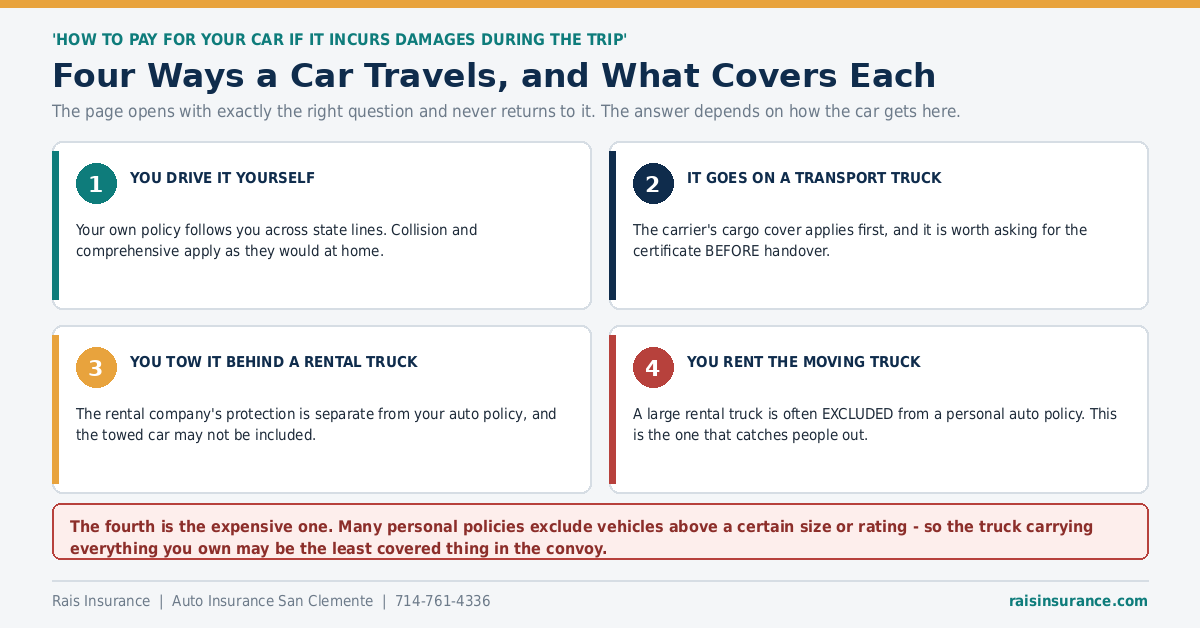
Four ways a vehicle travels, and four different car insurance answers:
- You drive it yourself. Your California policy follows the vehicle across state lines – collision and comprehensive apply as they would at home, and policies adjust to meet a higher minimum liability requirement if the state you are crossing has one. This is the straightforward case.
- It goes on a transport truck. The transport carrier’s cargo cover responds first. Ask for the certificate of insurance before you hand the keys over rather than after something happens.
- You tow it behind a rental truck. The rental company’s protection is separate from your auto policy, and the towed vehicle may or may not be included in either. Worth asking specifically.
- You rent the moving truck itself. This is the one that catches people out – many personal auto policies exclude vehicles above a certain size or weight rating, which is precisely what a large rental truck is.
That last point is worth sitting with. The truck carrying everything you own may be the least covered thing in the convoy, and the rental company’s counter protection is a decision better made in advance than at the desk on moving day.
For what changes on the policy once you have arrived – the garaging address, and why it matters more than people expect – see what changes when you move.
The Coverage List, Sorted
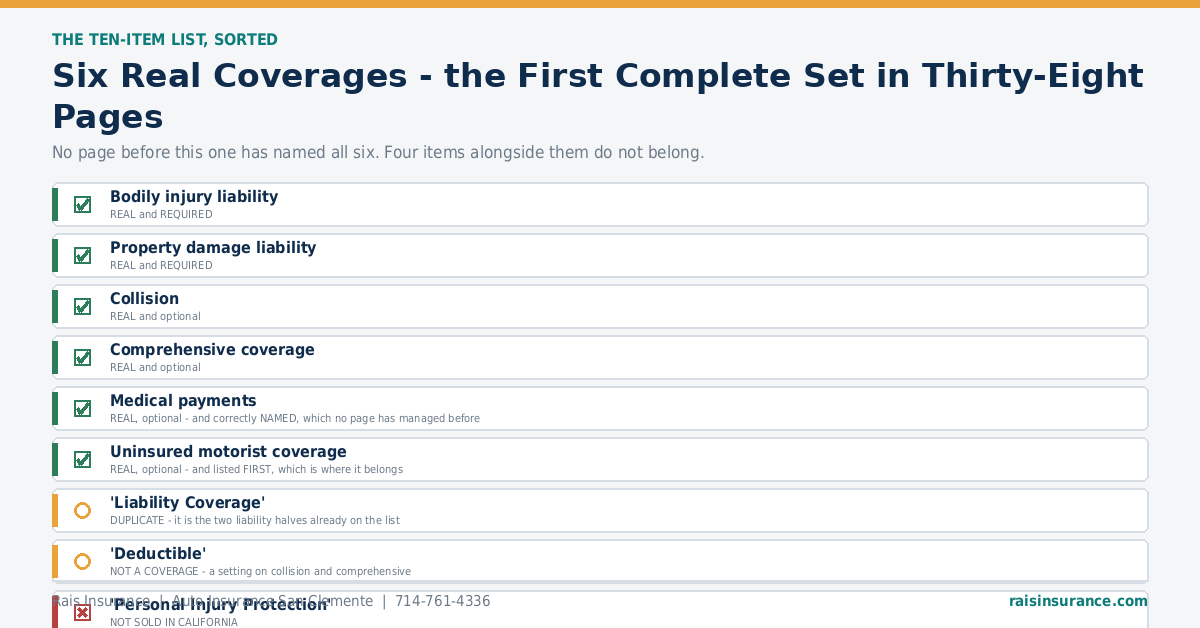
The original lists ten items, and something worth saying plainly: six of them are the complete set of auto insurance coverages a California policy can contain. No other page on this site names all six. Two details are better than most – uninsured motorist appears first, and medical payments is correctly named rather than called “medical coverage”.
- Bodily injury liability and property damage liability – the two coverages California requires. Bodily injury liability pays for injuries you cause; property damage liability pays for their vehicle and property.
- Collision and comprehensive – the two that cover your own vehicle.
- Medical payments and uninsured and underinsured motorist – the two that cover you.
Four items on the list do not belong:
- “Liability Coverage” is a duplicate – it is the two liability halves already named above it.
- “Deductible” is not a coverage. It is a setting on collision and comprehensive, taken off before the carrier pays anything.
- “Personal Injury Protection” is not sold in California.
- “No-Fault Insurance” is the same absent product under its other name. California is a fault-based state: see California is an at-fault state.
Do you need every single type?
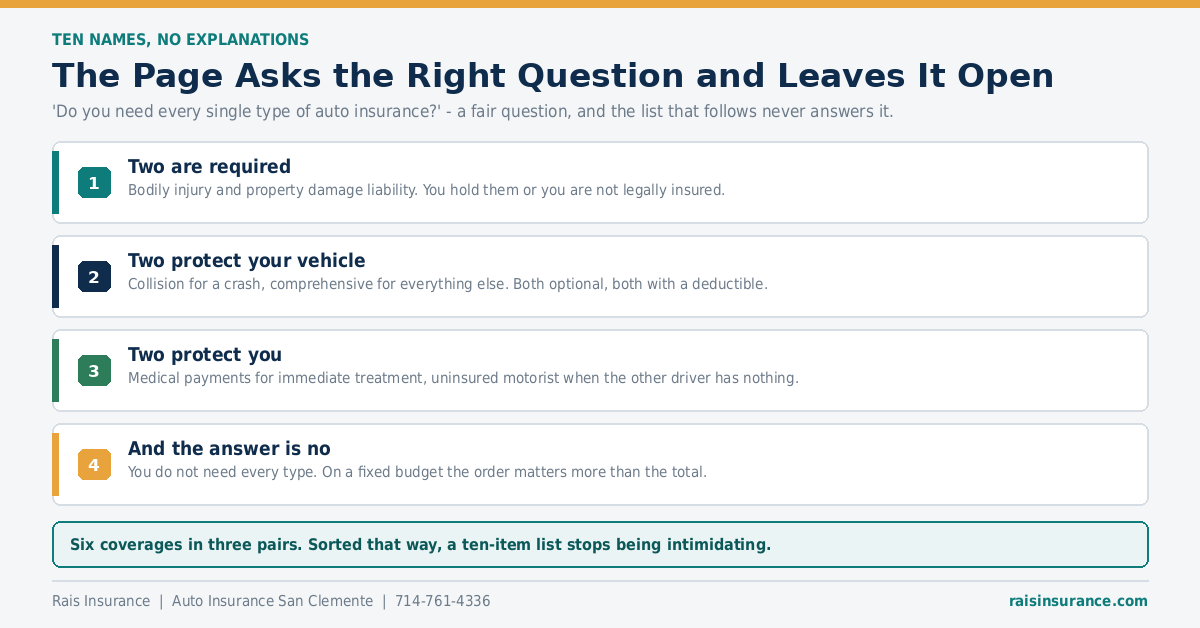
The original asks exactly this and leaves it open. The answer is no, and the six real coverages sort into three pairs that make the decision manageable:
- Two are required. Bodily injury and property damage liability. You hold them or you are not legally insured.
- Two protect your vehicle. Collision for a crash regardless of fault, comprehensive for theft, fire, weather, vandalism and falling objects – see what comprehensive coverage actually covers. Both optional, each with its own deductible.
- Two protect you. Medical payments for treatment without waiting on a fault determination, and uninsured motorist for when the driver who hits you has nothing.
On a tight budget the order matters more than the total – and the order is not the one most people choose: see the order to buy coverage in. The current minimum limits are on our auto insurance in California page.
How Long We Have Been Doing This
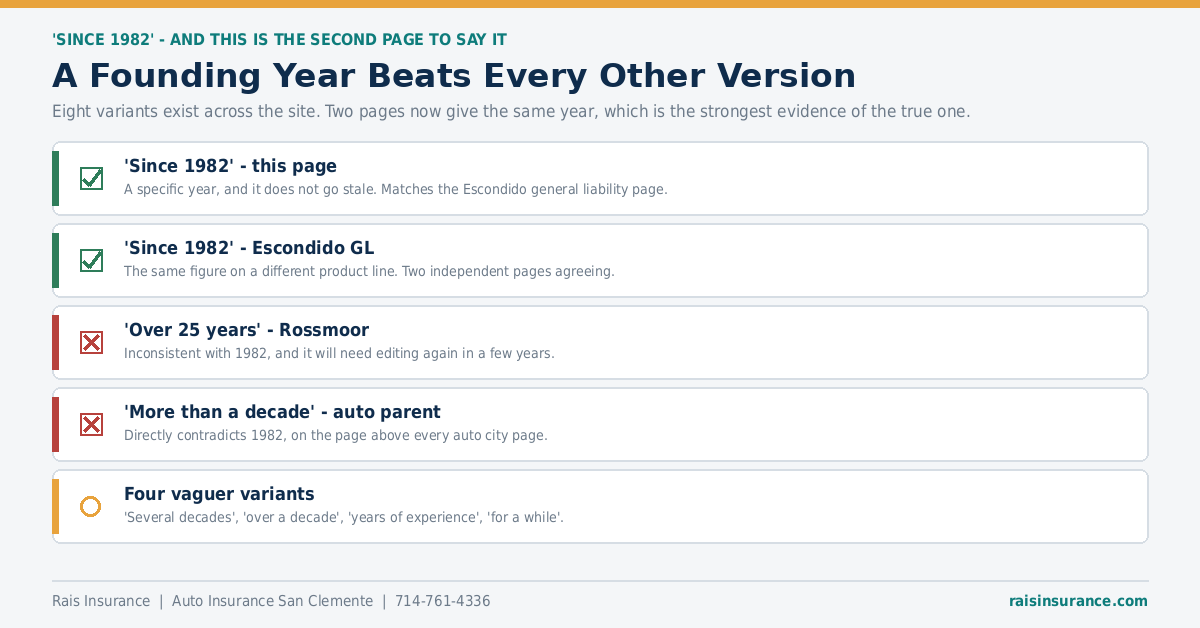
Since 1982. The original says so, and it is the version worth using everywhere – a founding year does not go stale the way “over 25 years” or “more than a decade” does, and both of those appear elsewhere on this site.
What that experience actually buys you is narrower and more useful than the phrase suggests: a working knowledge of which carriers write which risks, which ones decline what, and where a particular profile places best. That is the part that saves time.
Finding the Right Policy
The original’s point about the sheer number of car insurance policies on the market is fair, and it is most of what makes this difficult from the outside. Whether the budget is tight or comfortable, the work is the same – match the coverages to what you actually need rather than to what is available.
As an independent broker we place business across a panel of carriers rather than selling one company’s products, so one set of details gets quoted several times – see the insurance companies we represent. We are not an insurance company; the carrier issues the policy and pays the claim, and there is no fee to you for the comparison.
One small reframing: insurance is a risk transfer rather than an investment. You are not putting money in to get it back – you are paying a known amount so an unknown one never lands on you.
Driving in San Clemente
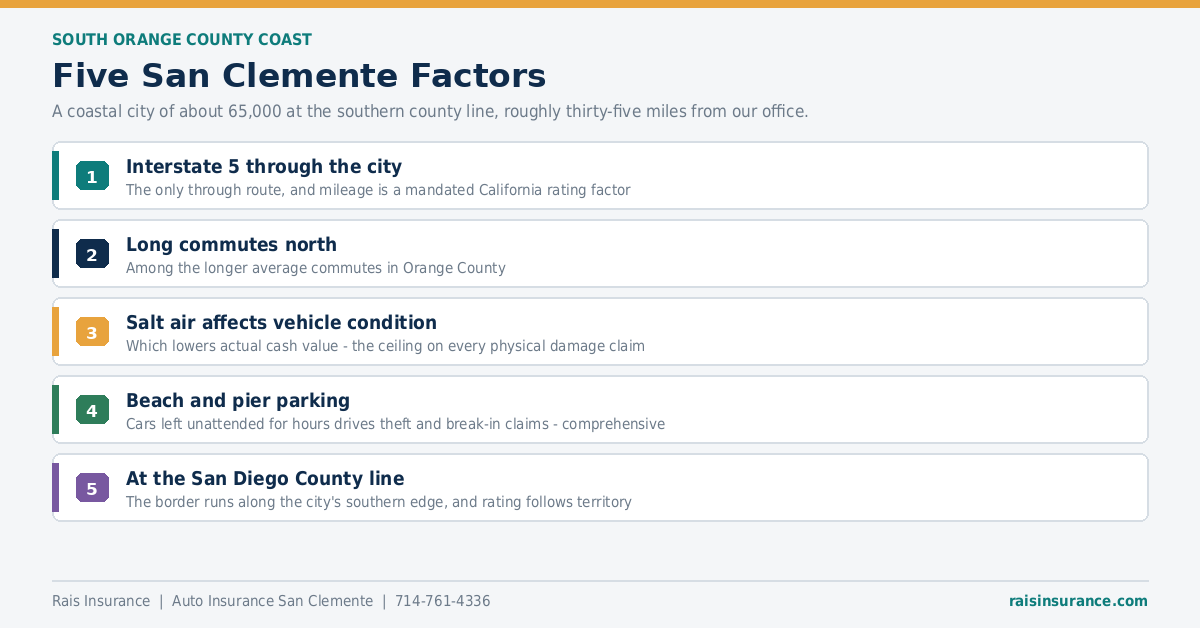
Five things that shape car insurance San Clemente rates specifically, on top of the auto insurance San Clemente basics above:
- Interstate 5 through the city, the only through route, and annual mileage is one of the three factors California law requires to weigh most heavily.
- Long commutes north, among the longer average commutes in Orange County.
- Salt air affects vehicle condition, and condition sets actual cash value – which caps every collision and comprehensive claim.
- Beach and pier parking, where cars sit unattended for hours. Theft and break-in claims are comprehensive.
- At the San Diego County line, which runs along the city’s southern edge – and California rates by garaging territory rather than by county.
Auto Insurance in San Clemente – Frequently Asked Questions
Q1. Does my insurance cover me in another state?
Yes. A California policy follows the vehicle across state lines, and collision and comprehensive apply as they would at home. Policies also adjust to meet the minimum liability requirements of the state you are driving in if those are higher than California’s. Driving your own car to a new home is the simplest of the four scenarios.
Q2. Does my policy cover a rental moving truck?
Often not, and this is the surprise that catches people out. Many personal auto policies exclude vehicles above a certain size or weight rating, which is exactly what a large rental truck is. The rental company will offer its own protection at the counter – worth deciding on that before the day rather than at the desk.
Q3. What if my car is shipped on a transport truck?
The transport carrier’s cargo cover responds first, and it is worth asking for the certificate of insurance before you hand the keys over rather than after a problem. Your own comprehensive cover may respond to some losses, but the carrier’s cover is the primary route.
Q4. What about a car towed behind a rental truck?
Worth raising specifically. The rental company’s protection is separate from your auto policy, and the towed vehicle may or may not be included in either. It is a short question before the trip and an expensive discovery afterwards.
Q5. Do I need every single type of auto insurance?
No, and the original version of this page is right to ask. Two coverages are required – bodily injury and property damage liability. Two protect your vehicle: collision for a crash, comprehensive for everything else. Two protect you: medical payments and uninsured motorist. On a fixed budget the order you buy them in matters more than the total.
Q6. Is a deductible a type of coverage?
No. It is a setting rather than a product – a figure you choose that applies to collision and comprehensive claims, taken off before the carrier pays. Liability carries no deductible, because that coverage pays somebody else rather than you. It appears on the original version of this page’s list, which is where the confusion starts.
Q7. Is personal injury protection available in California?
No. PIP is the coverage no-fault states require, and California is a fault-based state – the driver responsible for a collision is responsible for the cost. No-fault insurance and PIP are two names for the same absent product, and both appear on the original list.
Q8. What is medical payments coverage?
An optional coverage inside your auto policy that pays medical costs for you and your passengers without anyone having to establish fault first. The limits are modest and it is inexpensive. Worth noting that the original version of this page names it correctly – a good many pages call it ‘medical coverage’, which invites confusion with a health plan.
Q9. Why is uninsured motorist cover listed first?
Because that is arguably where it belongs. California is a fault-based state, so what you recover after a collision depends on the other driver’s coverage – and if they have none, nothing else on your policy responds. It is optional here and a carrier must obtain your decline in writing.
Q10. How do I get a San Clemente auto insurance quote?
Call Rais Insurance on 714-761-4336 or email rai@raisinsurance.com. Our office is in Anaheim, about thirty-five miles north. We are an independent broker, so one set of details is quoted across several carriers, and there is no fee to you for the comparison.
Get a Car Insurance Quote in San Clemente
contact Rais Insurance on 714-761-4336 or email rai@raisinsurance.com, and ask whatever you like – there is no such thing as too many questions at this stage.
If a move is still ahead of you, mention the date and how the car is travelling when you ask about car insurance. It is a two-minute conversation that occasionally saves a very expensive one.
