

Auto Insurance Los Alamitos California
The more useful car insurance question is which coverages actually exist here, because the list is shorter than most people expect and one commonly promised item is not sold in this state at all.
The Six Features, Checked
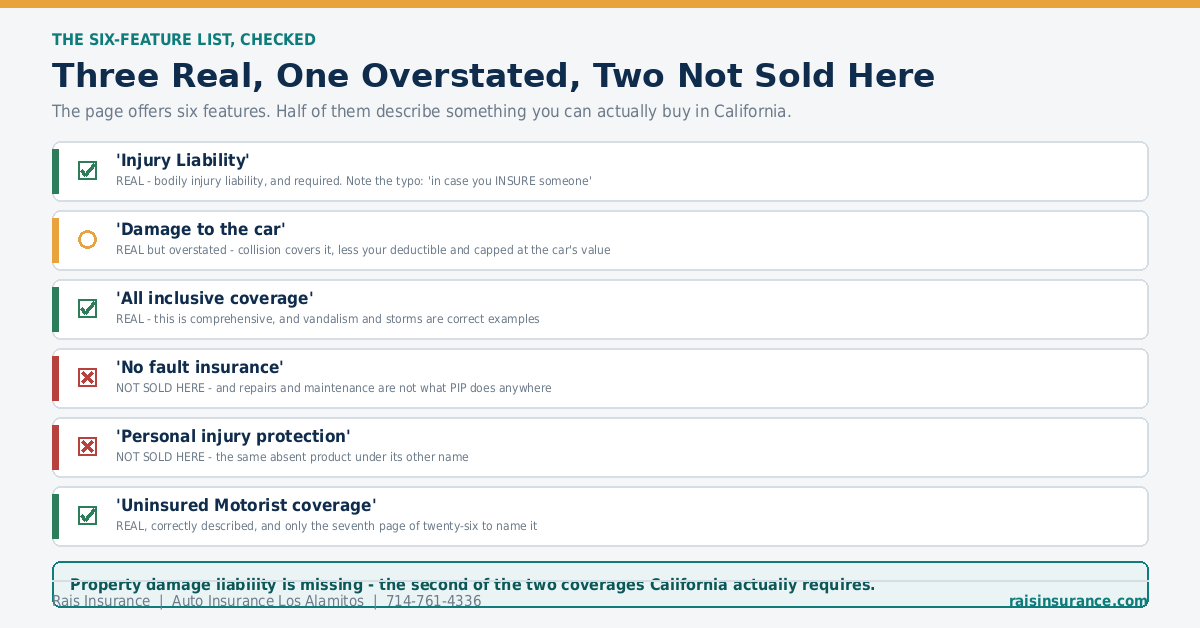
The original version of this page lists six auto insurance features. Three describe something you can buy in California, one overstates what it does, and two are the same unavailable product under different names:
- “Injury Liability” – real, and required. This is bodily injury liability, which pays for injuries you cause to other people. (Note the typo in the original: “in case you insure someone in a car accident” should read *injure*.)
- “Damage to the car” – real, but it does not cover *all* damages. Collision pays for your own vehicle less your deductible, and capped at the car’s actual cash value.
- “All inclusive coverage” – this is comprehensive, and the examples are correct: vandalism, storms, theft and other damage that does not come from a collision.
- “No fault insurance” – not sold in California. See below.
- “Personal injury protection” – the same absent product under its other name.
- “Uninsured Motorist coverage” – real, and described correctly: it covers bodily injury you sustain when the at-fault driver has no insurance. Worth saying that only a handful of pages in this set name it at all.
One coverage is missing from the list entirely: property damage liability, which is the second of the two coverages California actually requires, alongside bodily injury liability.
Two of them are the same missing product
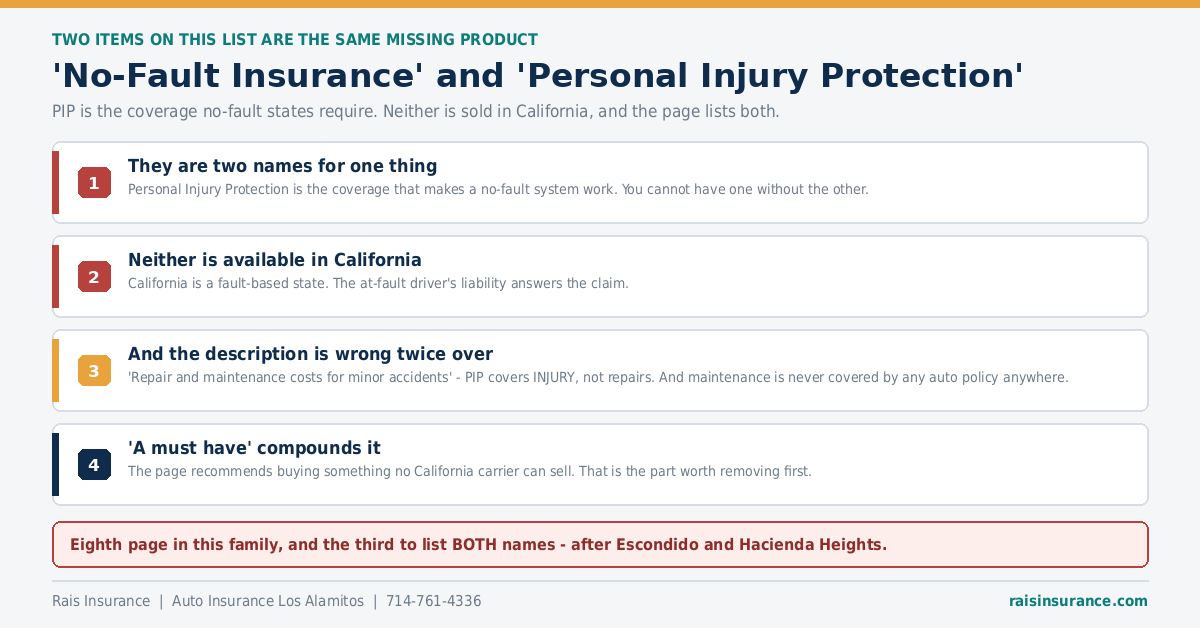
Personal Injury Protection is the coverage that makes a no-fault system work. You cannot have one without the other – so “no fault insurance” and “personal injury protection” are two names for a single thing, and California sells neither. It is a fault-based state: the driver responsible for a collision is responsible for its cost, and their liability coverage answers the claim. See California is an at-fault state.
The description attached to it needs correcting twice over as well. It says no-fault covers “repair and maintenance costs for minor accidents” – but PIP covers injury, not repairs, in the states that use it. And maintenance is never covered by any auto policy anywhere: see what auto insurance does not cover.
What Does PIP’s Job in California
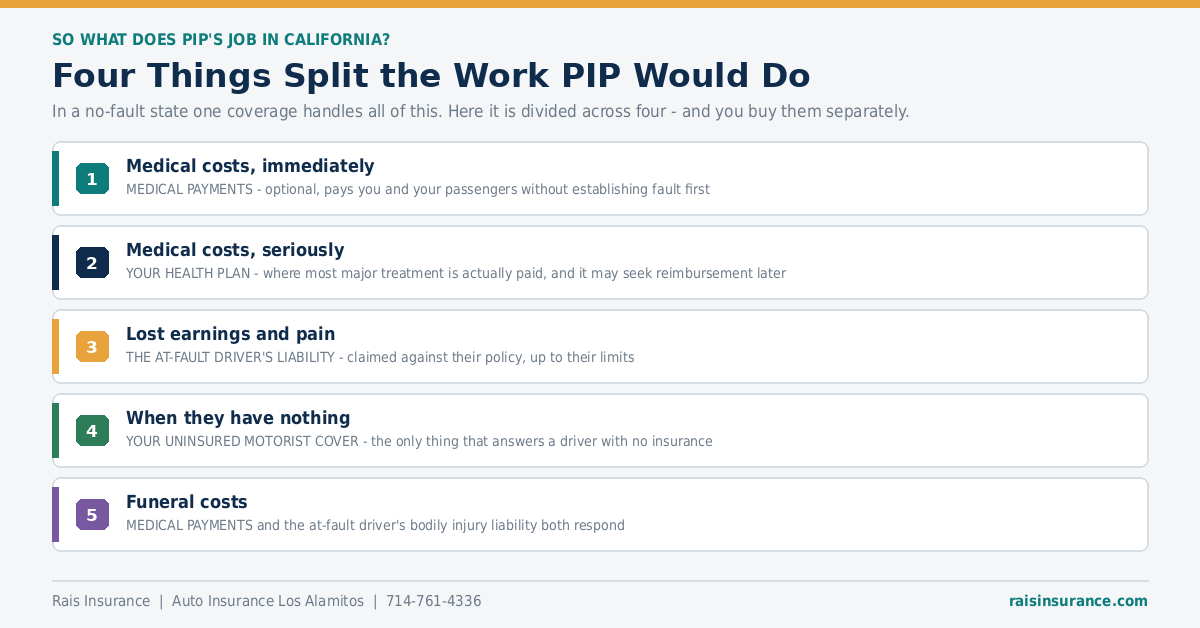
This is the part of California car insurance worth knowing, and almost nobody sets it out. In a no-fault state, one coverage handles everything after an injury. Here that work is split across four things, and you buy them separately:
- Medical costs, immediately – medical payments coverage. Optional, inside your auto policy, and it pays for you and your passengers without anyone establishing fault first. That immediacy is the point: treatment starts while the fault question is still being argued.
- Medical costs, seriously – your health plan, which is where the bulk of major treatment is actually paid. Note it may seek reimbursement from a settlement later.
- Lost earnings, pain and the wider claim – the at-fault driver’s bodily injury liability, claimed against their policy and capped at their limits. See whose injuries each coverage pays for.
- When they have nothing – your own uninsured motorist cover, which is the only thing that responds to a driver with no insurance. Optional in California, and a carrier must obtain your decline in writing.
Funeral costs, which the original attaches to PIP, are covered – by medical payments and by the at-fault driver’s bodily injury liability. So the benefit the page describes does exist; it simply arrives from a different direction, and under different names you have to ask for.
Why the Minimum Is a False Economy
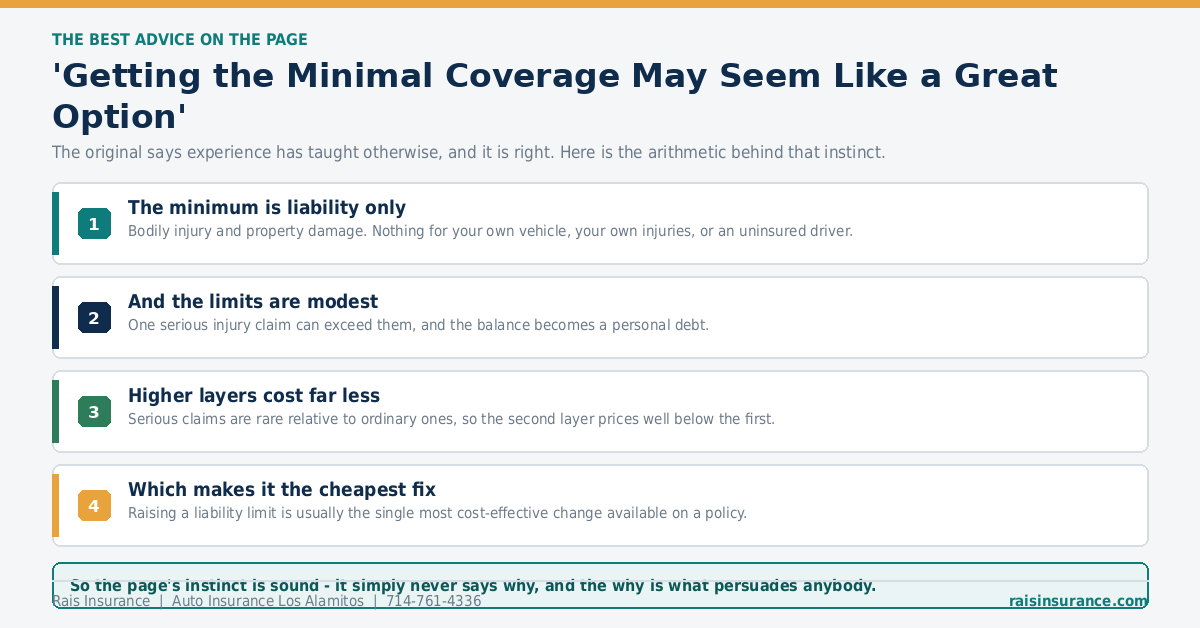
The original makes the best argument on the page and never finishes it: taking the minimal coverage looks like the economical option, and experience says otherwise. Here is why:
- The minimum is liability only – bodily injury and property damage. Nothing for your own vehicle, nothing for your own injuries, and nothing if the driver who hits you is uninsured.
- And the limits are modest. One serious injury claim can exceed them, and the balance of a judgment becomes a personal debt reachable against savings and wages.
- Higher layers cost far less than the first, because serious claims are rare relative to ordinary ones.
- Which makes raising a limit the cheapest meaningful fix available on most policies – see how liability limits actually work.
So the instinct behind “get more than the minimum” is right. What persuades anybody is the arithmetic, not the advice.
Driving in Los Alamitos
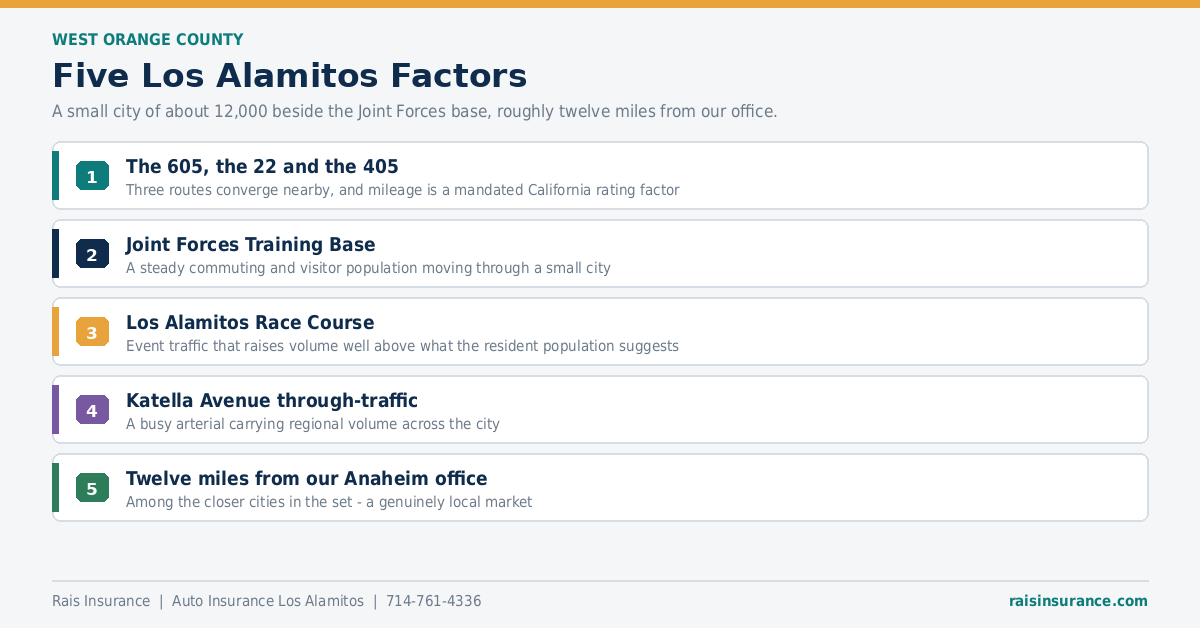
Five things that shape car insurance Los Alamitos rates specifically, on top of the auto insurance Los Alamitos basics above:
- The 605, the 22 and the 405. Three routes converge nearby, and annual mileage is one of the three factors California law requires to weigh most heavily.
- The Joint Forces Training Base, which brings a steady commuting and visitor population through a city of about twelve thousand people.
- Los Alamitos Race Course, and the event traffic that comes with it.
- Katella Avenue through-traffic, a busy arterial carrying regional volume across the city.
- About twelve miles from our Anaheim office – among the closer cities in our service area.
Working Out What You Need
The original’s offer is a fair one – personalised consultation and cover shaped around your situation rather than taken off a shelf. The work behind that is deciding your car insurance limits, which optional coverages to carry, what deductible to set, and which carrier writes the policy.
As an independent broker we place business across a panel of carriers rather than selling one company’s products, so one set of details gets quoted several times – see the insurance companies we represent. We are not an insurance company; the carrier issues the policy and pays the claim, and there is no fee to you for the comparison. The current minimum requirements are on our auto insurance in California page.
One small correction on framing: insurance is a risk transfer rather than an investment. You are not putting money in to get it back – you are paying a known amount so that an unknown one never lands on you.
Auto Insurance in Los Alamitos – Frequently Asked Questions
Q1. Does California have personal injury protection?
No. PIP is the coverage that makes a no-fault system work, and California is a fault-based state – the driver responsible for a collision is responsible for its cost, and their liability coverage answers the claim. PIP and no-fault insurance are two names for the same absent thing, so neither can be bought here.
Q2. Then what pays for my injuries after an accident?
Four things split the work. Medical payments coverage pays medical costs for you and your passengers without establishing fault first. Your health plan handles the bulk of serious treatment. The at-fault driver’s bodily injury liability covers lost earnings, pain and suffering and the wider claim. And your own uninsured motorist cover responds if they had no insurance at all.
Q3. What is medical payments coverage?
An optional coverage inside your auto policy that pays medical costs for you and your passengers without anyone having to establish fault. That immediacy is what makes it useful – treatment can start while the fault question is still being argued. The limits are modest, it is inexpensive, and it is not a substitute for health insurance.
Q4. Does any auto policy cover maintenance?
No, anywhere. Wear, servicing and mechanical breakdown sit outside every auto insurance policy in every state. Insurance responds to sudden accidental damage, not to the cost of keeping a vehicle running. Mechanical breakdown insurance and extended warranties are separate products that address that.
Q5. Does insurance cover lost wages?
Not through your own auto policy directly. Lost earnings form part of a bodily injury claim against the at-fault driver’s liability coverage, or against your own uninsured motorist cover if they had none. Medical payments covers medical costs specifically rather than income.
Q6. What is uninsured motorist coverage?
It responds when the driver who hits you has no insurance – your own policy pays instead of theirs. The original version of this page describes it correctly, which is worth noting because most pages omit it entirely. It is optional in California and a carrier must obtain your decline in writing.
Q7. Does collision cover all the damage to my car?
Up to the vehicle’s actual cash value, less your deductible – not whatever a repair might cost. The original says the policy covers ‘all damages caused to vehicles in collision’, which overstates it slightly. Collision is also optional, so a liability-only policy will not respond at all.
Q8. Is minimum coverage enough?
Usually not, and the original version of this page is right to say so. California’s minimum is liability only – nothing for your own vehicle, your own injuries, or an uninsured driver. And the limits are modest enough that one serious injury claim can exceed them, leaving the balance as a personal debt.
Q9. What is actually required in California?
Two coverages: bodily injury liability and property damage liability. Everything else – collision, comprehensive, medical payments, uninsured and underinsured motorist – is optional, though a lender will usually require collision and comprehensive while a vehicle is financed.
Q10. How do I get a Los Alamitos auto insurance quote?
Call Rais Insurance on 714-761-4336, email rai@raisinsurance.com, or visit 2612 W. Lincoln Avenue, Suite 103, Anaheim, CA 92801 – about twelve miles away. We are an independent broker, so one set of details is quoted across several carriers, and there is no fee to you for the comparison.
Get a Car Insurance Quote in Los Alamitos
contact Rais Insurance on 714-761-4336, email rai@raisinsurance.com, or use the contact form and we will come back to you.
Two lines worth checking on your current car insurance policy first: whether you carry medical payments, and whether you carry uninsured motorist. Between them they do most of what people imagine PIP would do – and both are optional, so it is entirely possible to have declined them without noticing.
