

Auto Insurance Lakewood California
The original version of this page raises something no other page on this site does, and it is worth building on: an insurer never covers a purposeful car crash. That is correct – and the line between an accident and a deliberate act decides more claims than most drivers realise.
Carelessness Is Covered. Intent Is Not.
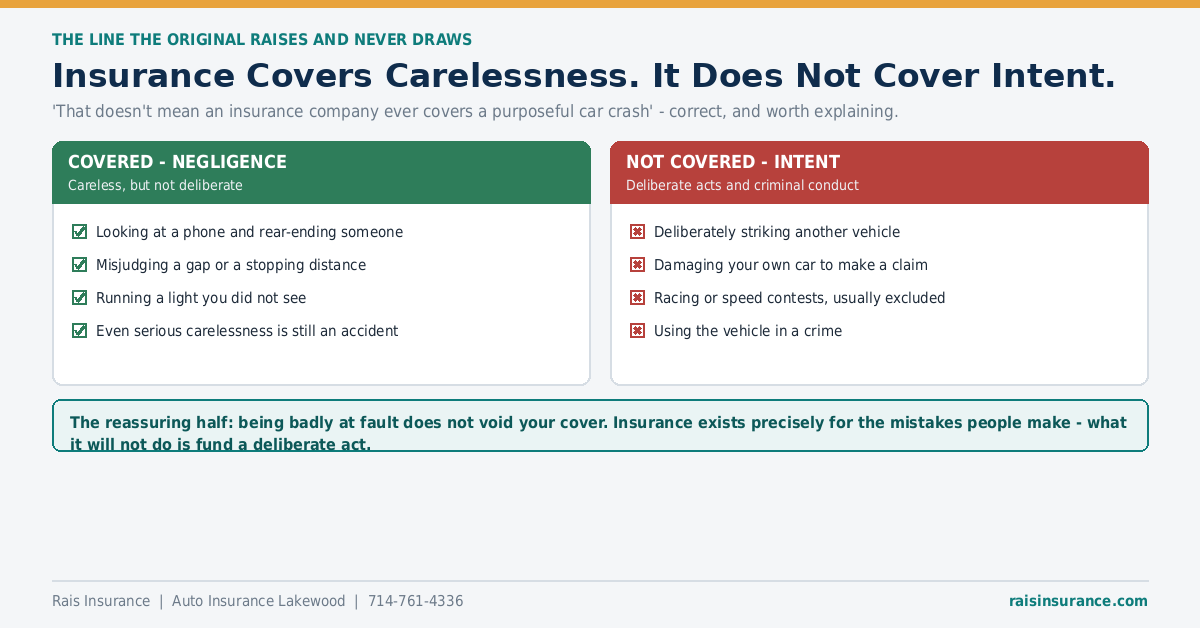
The reassuring half first, because people worry about it: being badly at fault does not void your car insurance. Insurance responds to negligence, and negligence includes serious carelessness:
- Looking at a phone and running into the car ahead – the original’s own example, and it is covered.
- Misjudging a gap or a stopping distance.
- Running a light you did not see.
All of those are accidents in the sense the policy means. There are consequences – an at-fault claim affects your record and your renewal, and any citation is a separate legal matter – but the coverage itself responds.
What insurance will not fund is a deliberate act: striking another vehicle on purpose, damaging your own car to make a claim, or using a vehicle in a crime. That is one of the few genuinely universal exclusions in auto insurance, and the original is right to name it.
Five other ways a claim can fail
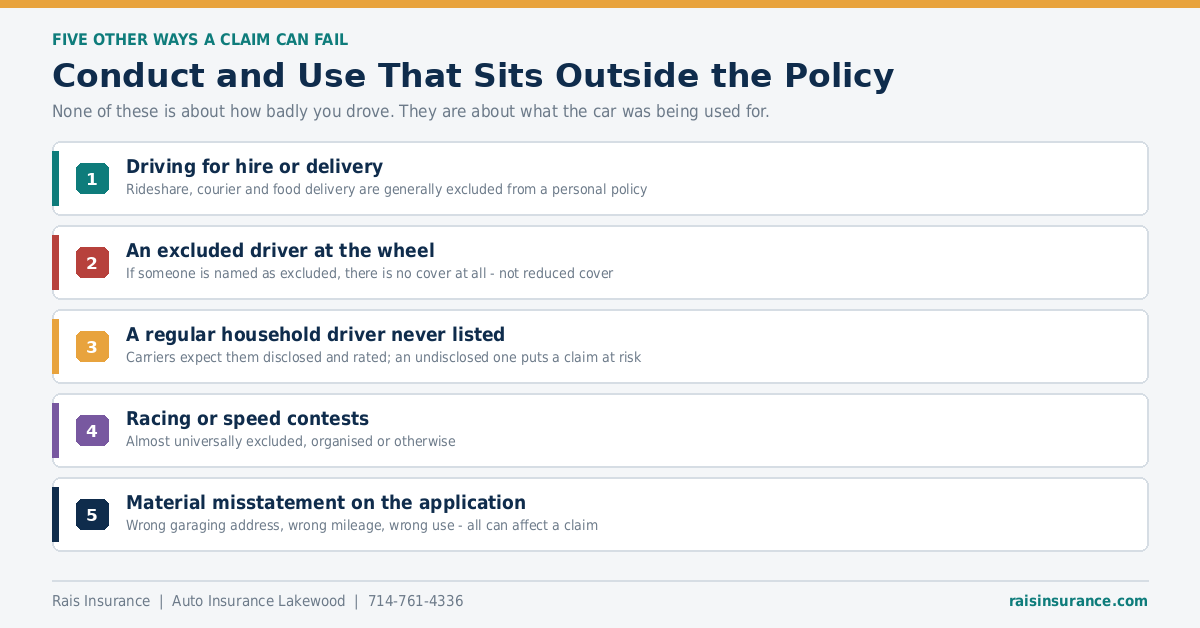
None of these car insurance exclusions is about how badly you drove. They are about what the car was being used for, or who was driving it:
- Driving for hire or delivery. Rideshare, courier and food delivery work are generally excluded from a personal policy. Some carriers offer an endorsement, and it is worth arranging before you start rather than after a claim.
- An excluded driver at the wheel. If someone is named as excluded, there is no cover at all – not reduced cover.
- A regular household driver who was never listed. Carriers expect them disclosed and rated: see who is covered to drive your car.
- Racing or speed contests, almost universally excluded whether organised or not.
- A material misstatement on the application – wrong garaging address, wrong annual mileage, wrong use of the vehicle.
For what a policy never covers regardless of conduct – wear, maintenance and mechanical breakdown – see what auto insurance does not cover.
One Correction on How Fault Works
The original says an accident is covered by “the person whomever carries the most fault”. California does not award fault to one driver – it apportions it as a percentage, under a rule called pure comparative fault. 70/30 and 60/40 are far more common outcomes than 100/0, and each side pays its share.
How that percentage is actually arrived at – the evidence, the adjusters, and what you can do at the scene – is set out on our how fault is actually decided page.
What Actually Covers Your Own Vehicle
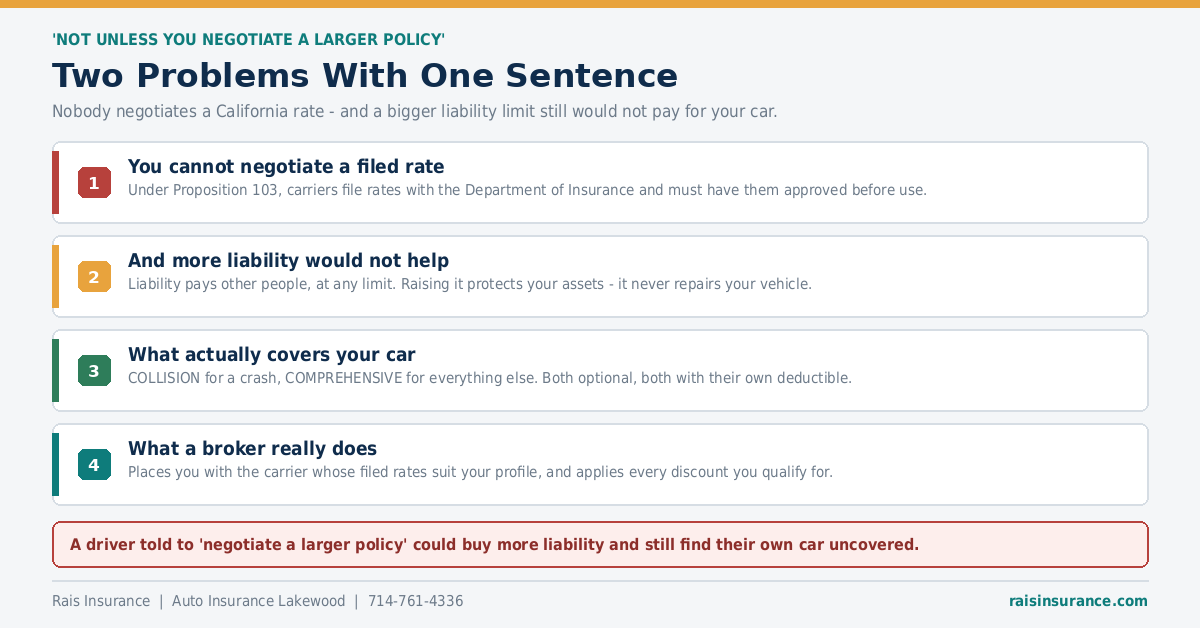
The original gets the core point right – your liability pays the other party’s damages, not yours. But it then says “not unless you negotiate a larger policy”, and that needs correcting twice over:
- Nobody negotiates a California rate. Carriers file their rates with the Department of Insurance and must have them approved before use, so no agent can price below a carrier’s filed rate for your profile.
- And a larger liability limit still would not repair your car. Liability pays other people at any limit. Raising it protects your assets from a judgment – it never pays for your own vehicle.
The auto insurance that does cover your own car is collision for a crash and comprehensive for almost everything else. Both are optional, and each carries its own deductible.
How the deductible really works
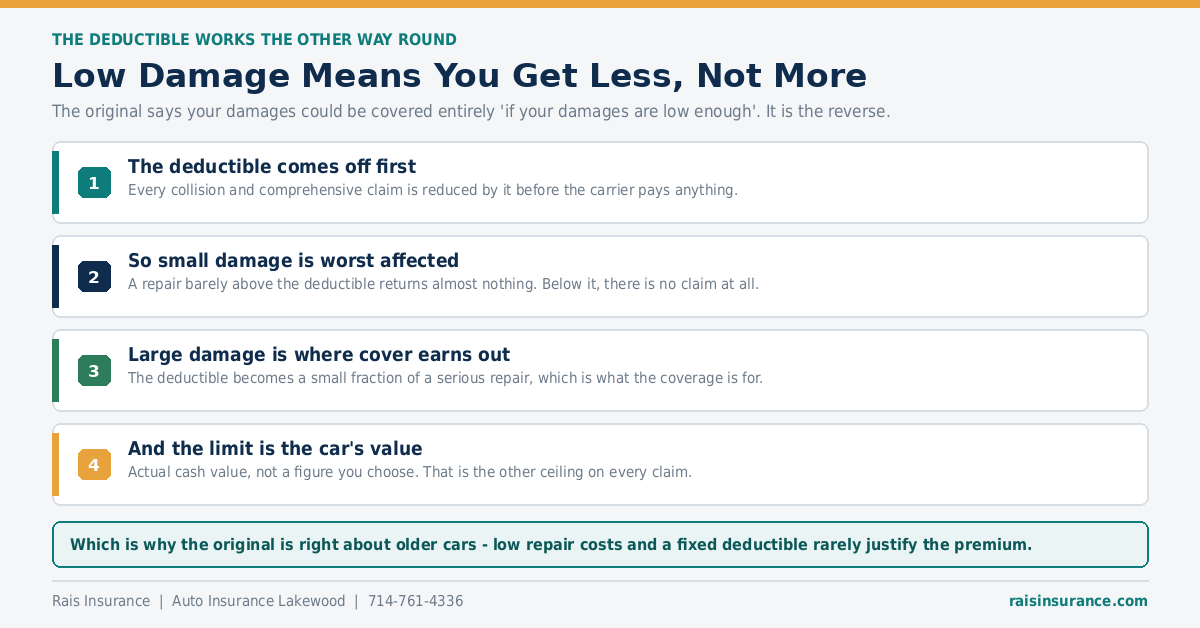
The original suggests your damages could be covered entirely “if your damages are low enough”. It works the other way round:
- The deductible comes off first, before the carrier pays anything at all.
- So small damage is worst affected. A repair barely above your deductible returns almost nothing, and one below it is not a claim at all.
- Large damage is where the cover earns out, because the deductible becomes a small fraction of a serious repair.
- And the ceiling is the car’s actual cash value, not a figure you choose.
Which is exactly why the original is right about older cars: collision is typically not worth it on an older vehicle with low repair costs, and it earns its premium on a newer or more expensive model. That is one of the better-reasoned passages in this set – see when collision and comprehensive stop earning their premium.
Comprehensive, and the Coverage That Is Missing
The original describes comprehensive accurately: your car is not only at risk from the road, and theft, disaster-related damage and vandalism all sit outside a collision claim. It is also right that the more valuable the car, the more it matters – because the payout is capped at the vehicle’s value either way.
One coverage belongs on this list and is absent: uninsured and underinsured motorist. It is optional in California, a carrier must obtain your decline in writing, and it responds when the at-fault driver has no insurance or not enough of it. In a fault-based state, that is the one situation nothing else on the policy answers.
Worth naming the two required halves too, since the page refers to liability generally: bodily injury liability and property damage liability are both mandatory in California. The current minimum limits are on our auto insurance in California page.
Driving in Lakewood
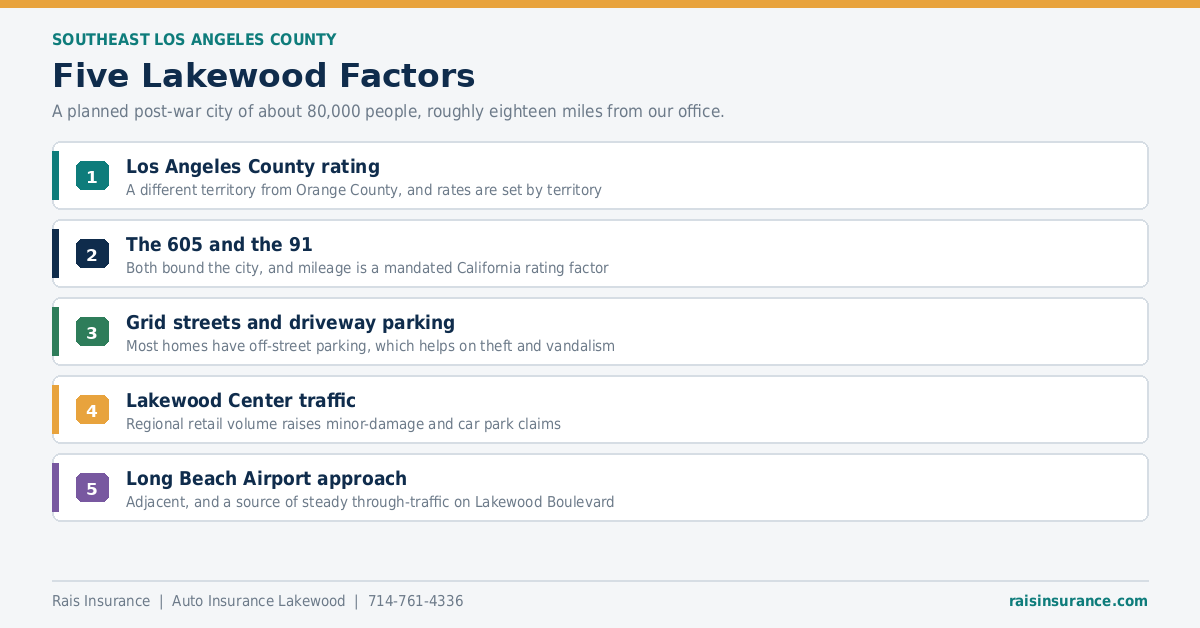
Five things that shape car insurance Lakewood rates specifically, on top of the auto insurance Lakewood basics above:
- Los Angeles County rating. A different territory from Orange County, and California rates by garaging territory.
- The 605 and the 91, both bounding the city, and annual mileage is one of the three factors state law requires to weigh most heavily.
- Grid streets and driveway parking. Most homes here have off-street parking, which helps on theft, vandalism and glass claims – all comprehensive.
- Lakewood Center traffic, which brings regional retail volume and the minor-damage claims that go with busy car parks.
- Long Beach Airport nearby, a steady source of through-traffic on Lakewood Boulevard.
Getting the Combination Right
Whatever kind of car insurance you are looking for, the useful work is deciding each part deliberately – your liability limits, whether you carry collision and comprehensive on this particular car, your deductible, and whether you have declined uninsured motorist without meaning to.
As an independent broker we place business across a panel of carriers rather than selling one company’s products, so one set of details gets quoted several times – see the insurance companies we represent. We are not an insurance company; the carrier issues the policy and pays the claim, and there is no fee to you for the comparison.
Auto Insurance in Lakewood – Frequently Asked Questions
Q1. Will my insurance pay if the crash was my fault?
Yes – that is precisely what liability coverage is for. Insurance responds to negligence, which includes serious carelessness: looking at a phone, misjudging a gap, running a light you did not see. Being badly at fault does not void your cover. What insurance will not fund is a deliberate act.
Q2. Does insurance cover an accident caused by texting?
Yes. Distraction is negligence rather than intent, so the claim is covered in the ordinary way. There are consequences – an at-fault claim affects your record and your renewal, and any citation is a separate legal matter – but the coverage itself responds.
Q3. Does insurance cover intentional damage?
No. Deliberately striking another vehicle, damaging your own car to make a claim, or using a vehicle in a crime all fall outside the policy. The original version of this page is right about this and it is worth stating plainly – it is one of the few genuinely universal exclusions in auto insurance.
Q4. Can my claim be denied for reasons other than how I drove?
Yes, and they are worth knowing. Driving for hire or delivery is generally excluded from a personal policy. An excluded driver at the wheel means no cover at all. A regular household driver who was never listed can put a claim at risk. Racing is almost universally excluded. And a material misstatement on the application – wrong garaging address, wrong mileage, wrong use – can affect a claim.
Q5. How does a deductible actually work?
It comes off before the carrier pays anything, which means small claims are the ones it hurts. A repair barely above your deductible returns almost nothing, and one below it is not a claim at all. On a serious repair the deductible becomes a small fraction of the total, which is what the coverage is really for.
Q6. Can I negotiate a lower rate or a bigger policy?
Not the rate. California carriers file their rates with the Department of Insurance and must have them approved before use, so nobody can price below a carrier’s filed rate for your profile. You can certainly buy higher limits and more coverages – but note that a larger liability limit still pays other people, never your own vehicle.
Q7. What covers my own car?
Collision, for damage from hitting something regardless of fault, and comprehensive for almost everything else – theft, fire, vandalism, weather, falling objects and animal strikes. Both are optional and each carries its own deductible. No amount of liability coverage will repair your vehicle.
Q8. Is collision worth it on an older car?
Often not, and the original version of this page reasons about this correctly. The payout is capped at the vehicle’s actual cash value less your deductible, so as the car’s value falls the coverage buys you progressively less. Comprehensive usually keeps earning its premium for longer, because it is cheaper and theft and fire do not care about the car’s age.
Q9. Do I need uninsured motorist coverage?
It is optional in California and a carrier must obtain your decline in writing. It responds when the at-fault driver has no insurance or not enough of it – the one situation that a fault-based system cannot resolve on its own, and the coverage missing from the original version of this page.
Q10. How do I get a Lakewood auto insurance quote?
Call Rais Insurance on 714-761-4336 or email rai@raisinsurance.com. Our office is in Anaheim, about eighteen miles away. We are an independent broker, so one set of details is quoted across several carriers, and there is no fee to you for the comparison.
Get a Car Insurance Quote in Lakewood
contact Rais Insurance on 714-761-4336 or email rai@raisinsurance.com.
Have your car insurance declarations page to hand. And if anyone in the household drives for a delivery or rideshare platform, mention it at the start – a personal policy generally excludes it, and that is much better resolved now than at claim time.
