

Auto Insurance Riverside California
It is a good day. Light traffic, decent weather, an ordinary commute – and then another vehicle comes out of nowhere and hits your car. That opening from the original version of this page is the right place to start, because it is the most common serious claim there is, and most drivers have never checked what their policy would actually do about it.
So this car insurance guide answers its own scenario first. Auto insurance Riverside drivers carry should be judged on what happens on that morning – not on what a policy is called.
Somebody Hits You – What Actually Responds
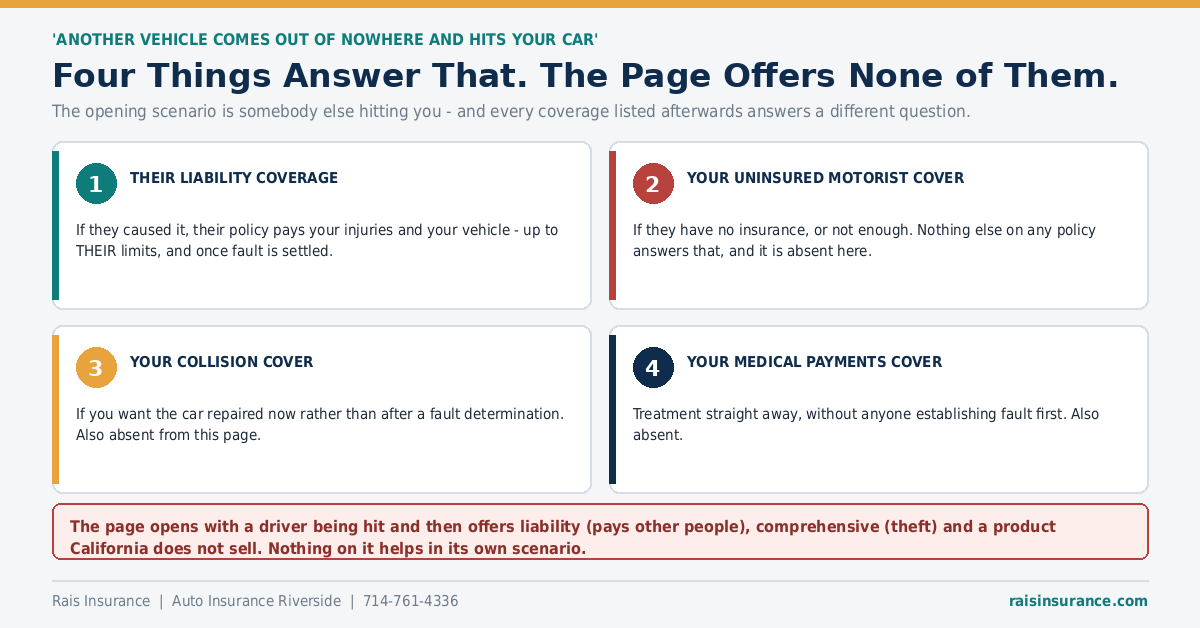
Four car insurance coverages can respond, and which of them applies depends partly on the other driver and partly on what you bought:
- Their liability coverage, if they were at fault. It pays your injuries and your vehicle – up to their limits, and once fault has been established. That process is set out on our how fault is actually decided page.
- Your uninsured and underinsured motorist cover, if they had no insurance or not enough of it. Nothing else on any policy answers that situation.
- Your collision cover, if you want the car repaired now rather than after a fault determination. Your deductible applies, and it may be reimbursed later if your carrier recovers.
- Your medical payments cover, which pays for treatment straight away without anyone establishing fault first.
Notice that three of those four are optional auto insurance coverages you choose to carry – and that the second one is the only thing standing between you and paying for somebody else’s mistake yourself.
Personal Injury Protection Is Not Sold Here
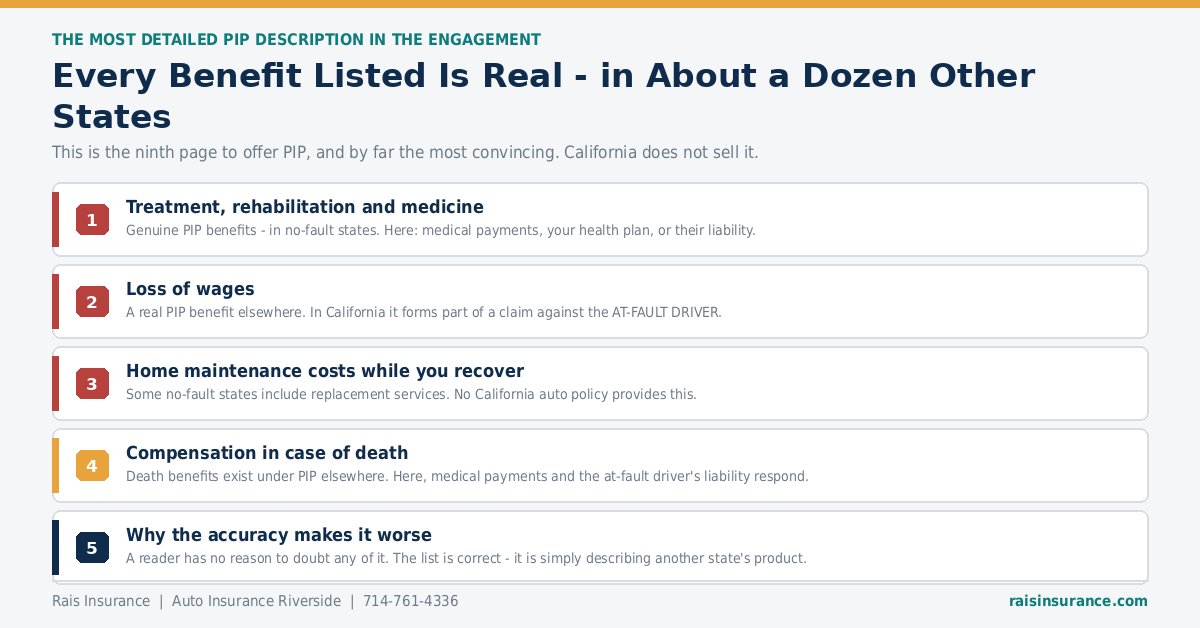
The original version of this page describes PIP in unusual detail – treatment, rehabilitation, medicine, loss of wages, home maintenance while you recover, and a death benefit. Every one of those is a genuine PIP benefit, in about a dozen states that run no-fault systems.
California is not one of them. It is a fault-based state: the driver responsible for a collision is responsible for its cost, and their liability coverage answers the claim. PIP is the coverage that makes a no-fault system work, and neither is available here. See California is an at-fault state.
The accuracy is what makes this worth flagging rather than glossing. A reader has no reason to doubt a description that is correct in every particular – it simply belongs to another state’s product.
What about lost wages?
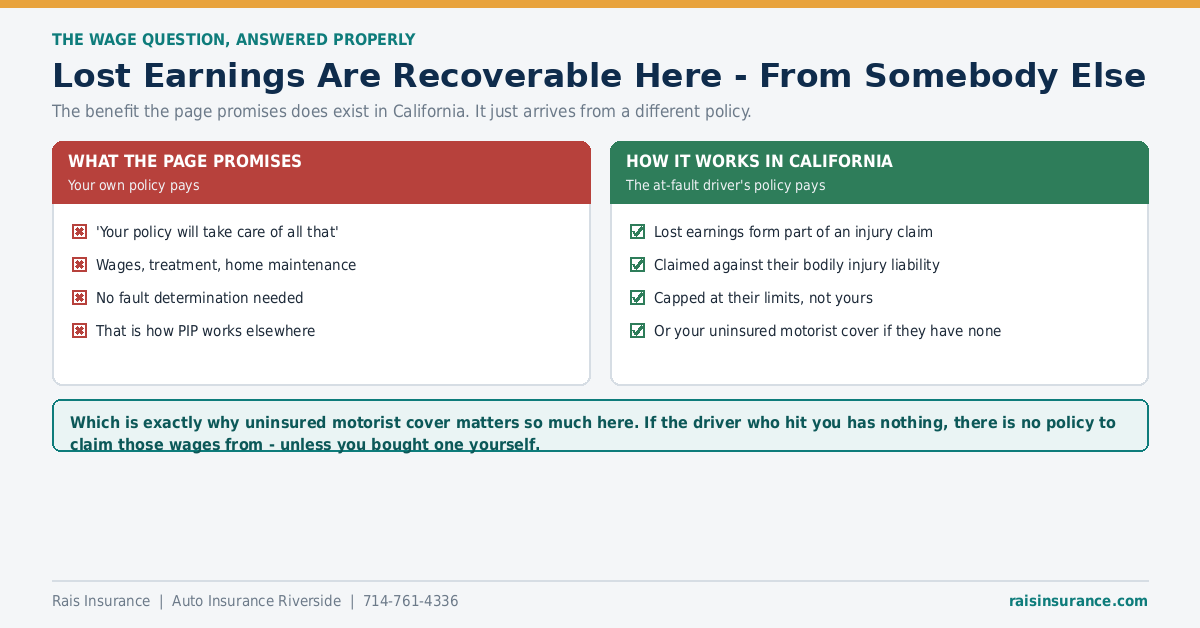
This part of the promise does exist in California. It just arrives from somewhere else:
- Lost earnings form part of an injury claim against the at-fault driver’s bodily injury liability.
- Which means they are capped at that driver’s limits, not yours.
- And if they had no insurance, there is no policy to claim from – unless you carry uninsured motorist cover yourself.
- Medical costs come from medical payments cover, your health plan, or the same liability claim.
- A death benefit is available through medical payments and through the at-fault driver’s bodily injury liability.
The one benefit with no California equivalent is home maintenance help while you recover – some no-fault states include replacement services in their PIP cover, and no personal auto policy here provides it.
Liability – and Where It Stops
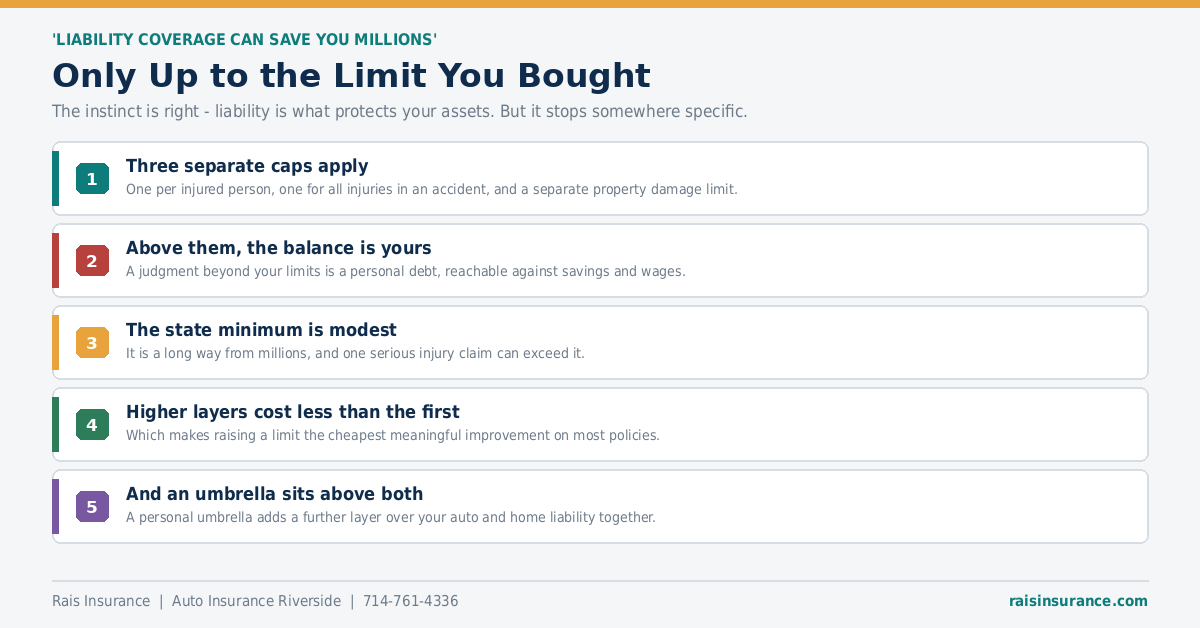
The original says liability coverage “can save you millions in damages or injuries”. The instinct is right – liability is the coverage that protects your assets rather than your car – but it stops somewhere specific:
- Three separate caps apply: one per injured person, one for all injuries in a single accident, and a separate property damage limit. See how liability limits actually work.
- Above them, the balance is yours – a judgment beyond your limits is a personal debt, reachable against savings and wages.
- The state minimum is a long way from millions, and one serious injury claim can exceed it.
- Higher layers cost far less than the first, which makes raising a limit the cheapest meaningful improvement on most policies.
- A personal umbrella policy adds a further layer above your auto and home liability together, which is where the word ‘millions’ genuinely applies.
Comprehensive – Wider Than Theft
The original is right that theft is a real exposure and right that you cannot always choose a good parking space. Comprehensive does cover it – and rather more besides: fire, vandalism, weather, flood, falling objects and animal strikes, all of which damage a vehicle without a collision being involved. See what comprehensive coverage actually covers.
One coverage is absent from the page entirely: collision, which is what repairs your own vehicle after a crash regardless of fault. On a page that opens with a collision, that is the gap worth closing first. The full auto insurance list is on our auto insurance in California page.
Driving in Riverside
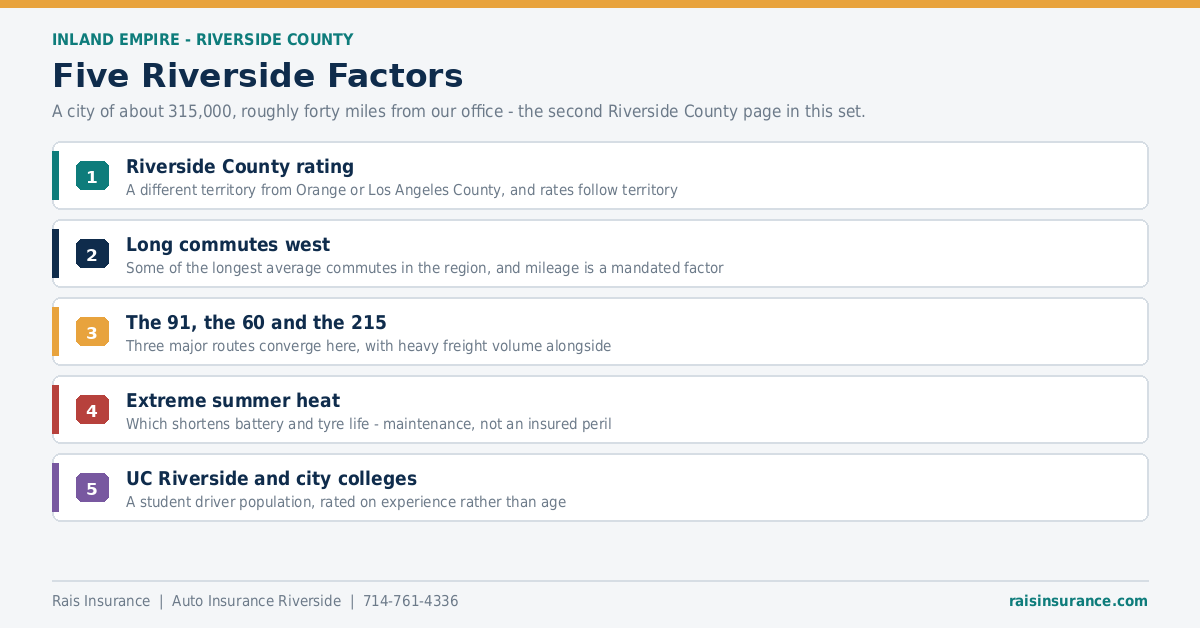
Five things that shape car insurance Riverside rates specifically, on top of the auto insurance Riverside basics above:
- Riverside County rating. A different territory from Orange or Los Angeles County, and California rates by garaging territory rather than city name.
- Long commutes west, among the longest average commutes in the region – and annual mileage is one of the three factors state law requires to weigh most heavily.
- The 91, the 60 and the 215, three major routes converging with heavy freight volume alongside commuter traffic.
- Extreme summer heat, which shortens battery and tyre life. Worth knowing that this is maintenance rather than an insured peril – no policy covers wear.
- UC Riverside and the city colleges, and a student driver population rated on experience rather than age.
Covering Your Bases
The original’s framing is a good one – preparation matters, and the point of a policy is that it is already in place when the unexpected arrives. What that means practically is knowing which parts of the car insurance you hold, rather than what the policy is called.
As an independent broker we place business across a panel of carriers rather than selling one company’s products, so one set of details gets quoted several times – see the insurance companies we represent. We are not an insurance company; the carrier issues the policy and pays the claim, and there is no fee to you for the comparison. Our office is in Anaheim, about forty miles west, so Riverside is served by phone and email.
Auto Insurance in Riverside – Frequently Asked Questions
Q1. Somebody hit my car – what responds?
Up to four things, doing different jobs. Their bodily injury and property damage liability, if they were at fault and once that is settled. Your own uninsured or underinsured motorist cover if they had no insurance or not enough. Your own collision cover if you want the car repaired now rather than after a fault determination. And your medical payments cover, which pays for treatment straight away without anyone establishing fault.
Q2. Does California have personal injury protection?
No. PIP is the coverage that makes a no-fault system work, and California is a fault-based state – the driver responsible for a collision is responsible for the cost. The original version of this page describes PIP in detail, and every benefit it lists is real in about a dozen other states. None of it is available here.
Q3. Who pays my lost wages after an accident?
The at-fault driver, through their bodily injury liability coverage – lost earnings form part of an injury claim against them rather than a benefit of your own policy. If they had no insurance, your own uninsured motorist cover is what fills that gap. It is one of the clearest reasons to carry it.
Q4. Does auto insurance cover home maintenance while I recover?
Not in California. Some no-fault states include replacement services in their PIP cover, and that is what the original version of this page is describing. No California personal auto policy provides it – which makes it worth knowing before you assume you are covered.
Q5. What if the driver who hit me has no insurance?
That is precisely what uninsured motorist cover is for – your own policy responds instead of theirs. Underinsured motorist handles the related case where they have some cover but not enough for your loss. Both are optional in California and a carrier must obtain your decline in writing, so it is checkable on your declarations page.
Q6. How much can liability coverage actually save me?
Up to the limit you bought, and no further. Three separate caps apply – one per injured person, one for all injuries in an accident, and a separate property damage limit. Above those, the balance of a judgment is a personal debt. Higher layers price well below the first, and a personal umbrella policy adds a further layer over your auto and home liability together.
Q7. What does comprehensive cover besides theft?
Fire, vandalism, weather, flood, falling objects and animal strikes – anything that damages the vehicle without a collision. The original names theft, which is correct but narrower than the coverage actually is. It is optional and carries its own deductible.
Q8. Should I claim on my own collision if it was not my fault?
Sometimes. It is usually faster than waiting for the other insurer to accept liability, and your deductible may be reimbursed if your carrier recovers from theirs. The trade-off is that it appears as a claim on your record, so it is worth discussing before deciding.
Q9. Why is car insurance expensive in Riverside?
Several things at once. Riverside County is its own rating territory, average commutes here are among the longest in the region, and annual mileage is one of the three factors California law requires carriers to weigh most heavily. The 91, 60 and 215 also carry heavy freight volume alongside commuter traffic.
Q10. How do I get a Riverside auto insurance quote?
Call Rais Insurance on 714-761-4336 or email rai@raisinsurance.com. Our office is in Anaheim, about forty miles west, so Riverside is served by phone and email. We are an independent broker, so one set of details is quoted across several carriers, and there is no fee to you for the comparison.
Get a Car Insurance Quote in Riverside
contact Rais Insurance on 714-761-4336 or email rai@raisinsurance.com to schedule a consultation.
One line to check on your car insurance declarations page before you call: whether you carry uninsured motorist cover. It is the only thing that answers the scenario this page opens with when the other driver turns out to have nothing – and it is declined far more often than people realise, usually without their noticing.
