

General Liability Insurance Turlock
The commercial general liability coverage list on this page is unusually accurate, so rather than correct it this page does something more useful: it takes each item and adds the limit that decides whether it applies. And it goes properly into the one coverage on the list that almost nobody explains – contractual liability, which is what happens to your insurance the moment you sign an agreement.
Contractual Liability – the Coverage Almost Nobody Explains
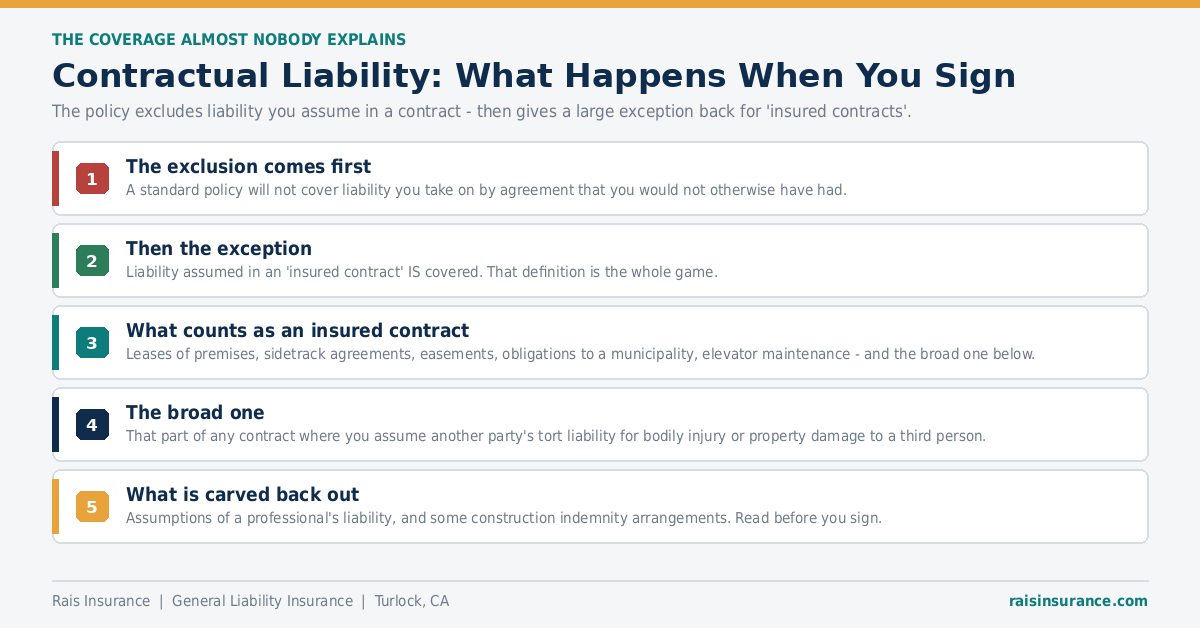
The original list ends with contractual liability, naming leases and maintenance contracts. That is correct, and it is the single most consequential item on the page – because signing a contract can create liability you would never otherwise have had, and whether your policy backs it turns on a definition most business owners have never read.
The structure is unusual and worth following in order:
- The exclusion comes first. A standard policy will not cover liability you assume by agreement that you would not otherwise have borne. Read alone, that sounds as though contracts leave you exposed.
- Then a large exception. Liability assumed in what the policy calls an “insured contract” *is* covered. That definition is the whole game.
- What counts as an insured contract. A specific list: leases of premises, sidetrack agreements, easement or licence agreements, obligations to indemnify a municipality where required by ordinance, elevator maintenance agreements – and the broad one below.
- The broad one. That part of any other contract where you assume another party’s tort liability for bodily injury or property damage to a third person. Most commercial indemnity clauses live here.
- What is carved back out. Assumptions of a professional’s liability, and certain construction indemnity arrangements. Those you have taken on personally.
The clause in every commercial agreement
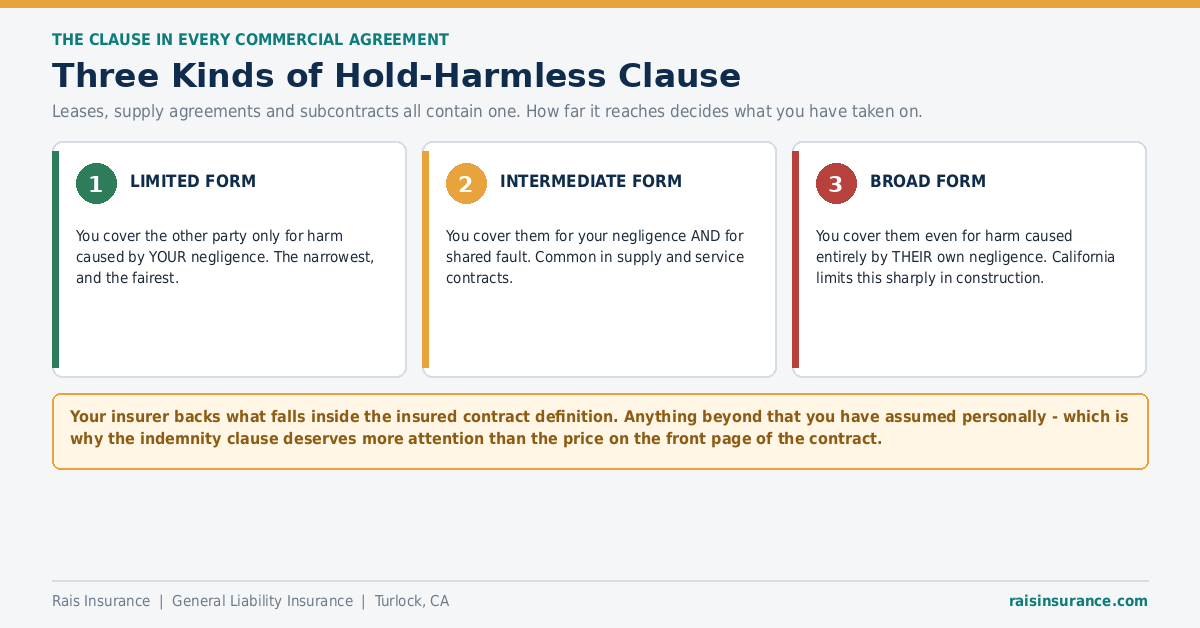
Leases, supply agreements, haulage contracts and subcontracts all contain a hold-harmless or indemnity clause. They come in three forms, and which one you signed decides how much you have taken on:
- Limited form. You cover the other party only for harm caused by your negligence. The narrowest and the fairest.
- Intermediate form. You cover them for your negligence and for situations of shared fault. Common in supply and service agreements.
- Broad form. You cover them even for harm caused entirely by their own negligence. California restricts this sharply in construction contracts, and it is worth resisting elsewhere.
The practical consequence: your insurer backs what falls inside the insured contract definition, and anything beyond that you have assumed personally. Which is why the indemnity clause deserves more attention than the price on the front page. On the documents a client or general contractor will ask for alongside it, see what a licensed California contractor has to carry and who will ask you for a certificate, and at what limits.
The Eight Coverages, Verified
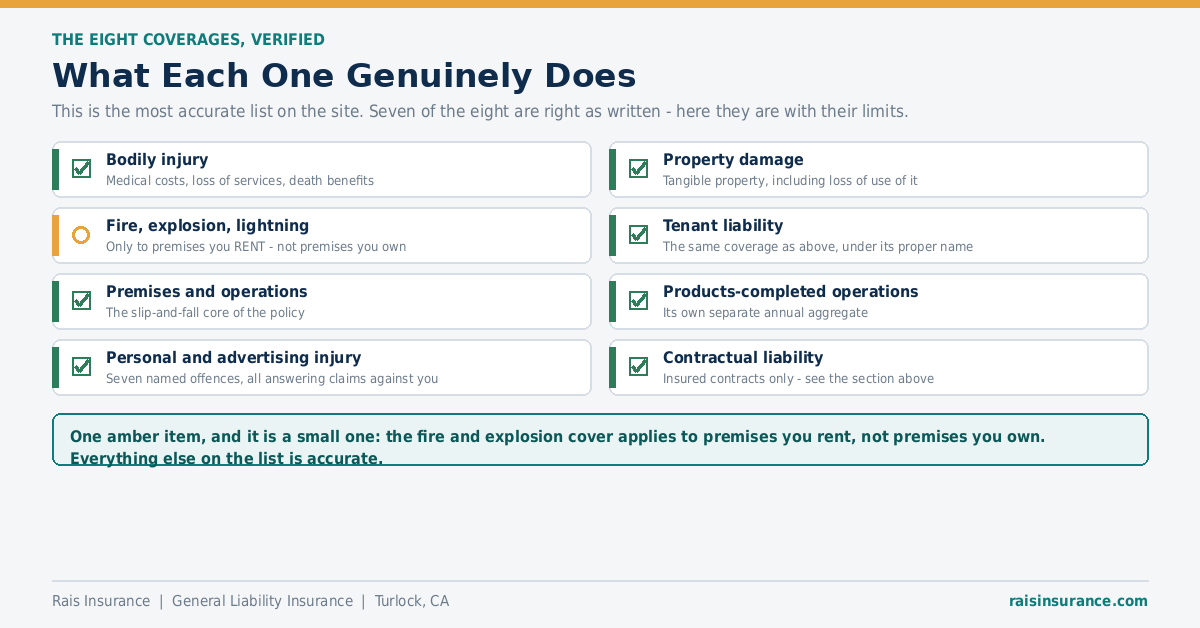
Taking the original list in order, with the limit that decides each one:
- Bodily injury on your premises – correct, and general liability insurance genuinely covers loss of services, medical expenses and death benefits here. It applies to people who are not your employees; employee injuries are workers’ compensation.
- Property damage – correct, including damage to tangible property that leaves it unusable. That is loss of use, a real and often overlooked part of the cover.
- Fire, explosion or lightning damage – correct with one important qualification. This applies to premises you rent, not premises you own, and it sits under its own separate sub-limit. Damage to a building you own is commercial property insurance. See damage to premises rented to you.
- Tenant liability – correct, and it is the same coverage as the item above under its proper name.
- Premises and operations liability – correct. The slip-and-fall core of the policy, and the most common claim any business faces.
- Products and completed operations – correct. Note it carries its own separate annual aggregate, so exhausting the general aggregate does not exhaust this one.
- Personal and advertising injury – correct, and the list given is genuinely close to the seven named offences. All of them answer claims made against you.
- Contractual liability – correct, subject to the insured contract definition set out above.
Seven of eight accurate as written, and the eighth needed only a qualification. That is the strongest general liability coverage list on the site. For how the aggregates work in full, see Coverage A, B and C and how the limits work.
One word worth changing
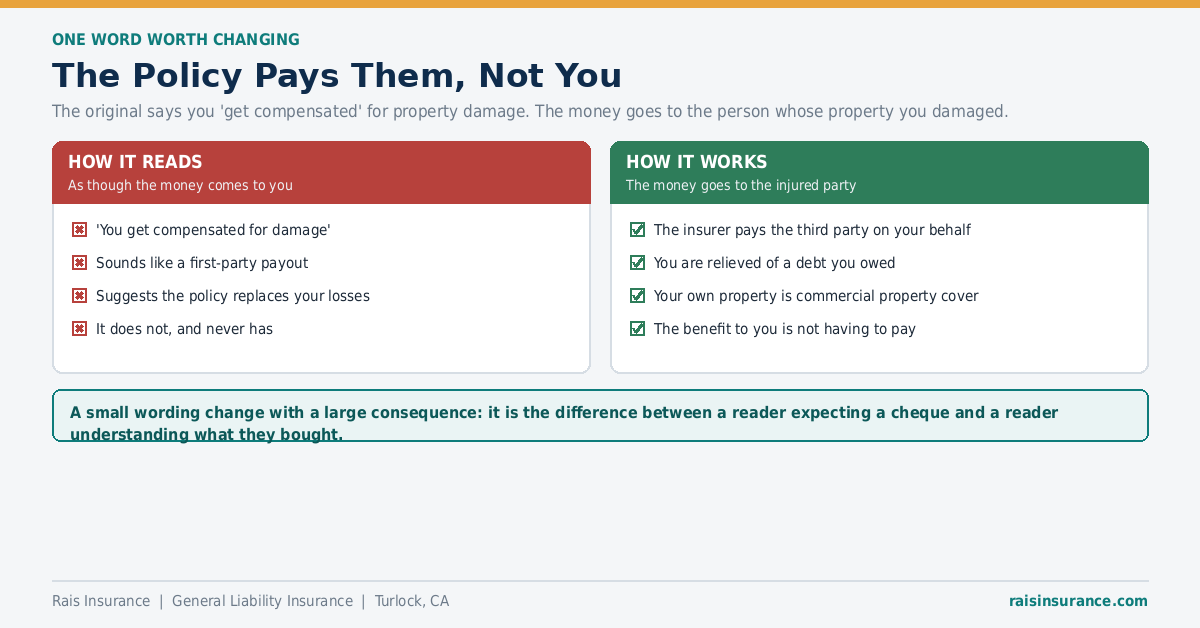
The property damage line says you “get compensated” for the damage. In practice the money goes to the person whose property you damaged – the insurer pays them on your behalf. You are relieved of a debt rather than paid a sum.
It matters because it sets the right expectation. General liability never compensates you for your own losses: your building, stock and equipment are commercial property, and lost trading is business income cover. The benefit of a liability policy is not receiving money – it is not having to pay it out. See first-party cover versus third-party cover.
What It Protects, and What It Does Not
The original says the policy protects your business assets and its reputation. The first half is right. The second is worth adjusting: insurance pays damages and funds your defence. It does not manage press, handle customer communication or remove an incident from the record.
What it does do is resolve a claim without a prolonged public fight, which is frequently the best reputational outcome available. The financial job is valuable on its own terms – it is simply the financial job.
One other small clarification. The opening refers to “erroneous or negligent acts”. Negligent acts are squarely within general liability. Erroneous acts – a mistake in professional advice, a design that failed, a specification that did not work – fall under the professional services exclusion and belong to errors and omissions cover instead.
An Agricultural and Food Processing Economy
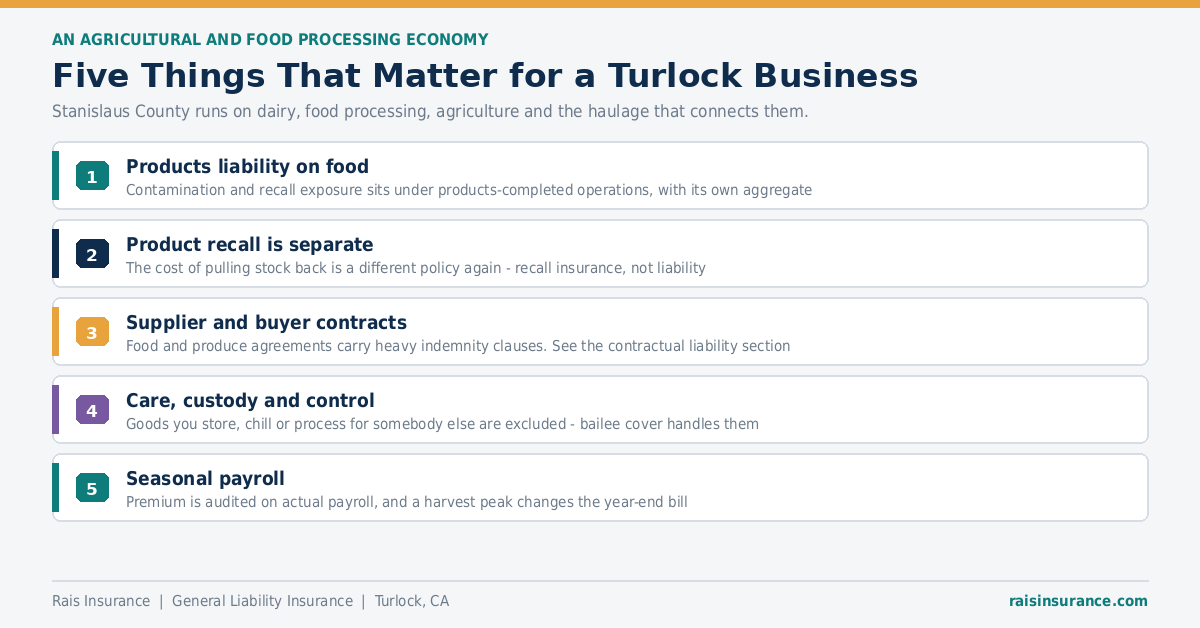
Turlock sits in the middle of one of the most productive agricultural regions in the country, with dairy, food processing and the haulage that connects them making up a large share of the local business base. Five things matter more here than in a general commercial market:
- Products liability on food. Contamination and illness claims sit under products and completed operations, with that separate aggregate. For a processor this is usually the most important limit on the schedule.
- Product recall is a different policy. If a product causes harm, liability responds. The cost of pulling stock back – notification, transport, disposal, lost value – is product recall insurance, bought separately. The distinction matters more in food than in almost any other sector.
- Supplier and buyer contracts. Produce and processing agreements carry heavy indemnity clauses, which is why the contractual liability section above leads this page rather than closing it.
- Care, custody and control. Goods you store, chill or process for somebody else are excluded from liability cover. Bailee cover or warehouse legal liability handles them – see what general liability does not cover.
- Seasonal payroll. Premium is provisional and audited on actual payroll, so a harvest or processing peak changes the year-end bill. Estimating low defers a cost rather than saving one.
What It Costs
There is no flat rate. Premium is built from your classification code, gross receipts or payroll, the limits you select, your claims history and how much work you subcontract out. Agricultural and food processing classes rate very differently from general commercial, so classification accuracy is worth checking at renewal – see what actually sets your premium, and the year-end audit.
What Rais Insurance Can Do for You
We work with clients from the beginning to build cover that addresses what the business actually does, and we would rather save you money by removing something you do not need than by cutting a limit you do. For a Turlock business the most useful thing we can look at is usually not the quote – it is the indemnity clause in whatever contract you are about to sign.
One note on geography: our office is in Anaheim, so Turlock is served remotely rather than from a local branch. For commercial insurance that changes very little in practice, but it is better said upfront than discovered later. We place the business liability insurance Turlock operations actually need, writing across Turlock, Modesto, Ceres, Hughson and Denair, and across California generally.
General Liability Insurance Turlock – Frequently Asked Questions
Q1. Does general liability cover liability I take on in a contract?
Partly, and the structure is unusual. The policy first excludes liability you assume by agreement that you would not otherwise have had – then gives a large exception back for liability assumed in what it calls an insured contract. Whether your indemnity clause falls inside that definition decides whether your insurer stands behind it or whether you have taken it on personally.
Q2. What is an insured contract?
A defined term covering a specific list: leases of premises, sidetrack agreements, easement or licence agreements, obligations to indemnify a municipality where required by ordinance, elevator maintenance agreements, and – the broad one – that part of any other contract where you assume another party’s tort liability for bodily injury or property damage to a third person. Assumptions of a professional’s liability are carved back out.
Q3. What is a hold-harmless clause?
The part of a contract where one party agrees to absorb the other’s liability. They come in three forms. Limited form covers the other party only for harm caused by your negligence. Intermediate form adds shared fault. Broad form covers them even for harm caused entirely by their own negligence – and California restricts that sharply in construction contracts. Which form you signed decides your exposure.
Q4. Does general liability cover fire damage to my own building?
No. The fire, explosion and lightning cover in a liability policy applies to premises you RENT – it is often called fire legal liability or damage to premises rented to you, and it sits under its own separate sub-limit. Damage to a building you own is commercial property insurance. The distinction catches people out because both sentences mention fire.
Q5. What does ‘loss of use’ mean in property damage cover?
It means the policy responds not only to physical damage to tangible property but also to the owner being unable to use it – including, in some circumstances, property that was not physically damaged at all. For a business that halts somebody else’s operations, that can be the larger part of the claim, and the original page names it correctly.
Q6. Does general liability cover a product recall?
No. If a product you made or sold causes injury or property damage, products-completed operations responds to that claim. But the cost of pulling stock back off shelves – notification, transport, disposal, lost value – is product recall insurance, which is a separate policy. In food processing that distinction matters more than almost anywhere else.
Q7. What is the products-completed operations aggregate?
A separate annual limit for claims arising after your product has left you or your work has been finished. It sits alongside the general aggregate rather than inside it, so exhausting one does not exhaust the other. For a Turlock manufacturer or food processor it is often the more important of the two, and it is worth checking on your declarations page by name.
Q8. Does general liability cover goods I store or process for someone else?
No. Property belonging to another party that is in your care, custody or control is excluded – a named exclusion, not an oversight. Cold storage, processing and warehousing operations need bailee cover or warehouse legal liability instead. This is one of the most consequential gaps in an agricultural supply chain.
Q9. Who does the policy actually pay?
The injured third party, on your behalf. General liability does not compensate you for your own losses – it relieves you of a debt you owed to somebody else. Your own building, stock and equipment are commercial property; your lost trading is business income cover. The benefit of a liability policy is not receiving money, it is not having to pay it out.
Q10. How much does general liability insurance cost in Turlock?
There is no flat rate. Premium is built from your classification code, gross receipts or payroll, the limits you buy, your claims history and how much work you subcontract. Stanislaus County’s agricultural and food processing base rates very differently from general commercial, and seasonal payroll peaks show up at the year-end audit rather than at quoting.
Get a General Liability Insurance Quote in Turlock
contact Rais Insurance and we will build the cover around your operation rather than around a template. Call 714-761-4336, email rai@raisinsurance.com, or write to 2612 W. Lincoln Avenue, Suite 103, Anaheim, CA 92801.
If you have a contract in front of you, send the indemnity clause with your enquiry. It is usually the single most informative document about what your business has actually taken on.
