

General Liability Insurance San Clemente
So this page starts by sorting out what belongs where. Ask what does general liability insurance cover and the honest answer begins with what it does not. General liability insurance in San Clemente is a specific and genuinely valuable policy, narrower than it is usually described. Below: the four things commonly listed alongside it that actually need different policies, the single rule that sorts every product in insurance, and what this one really does.
Four Different Policies, One Heading
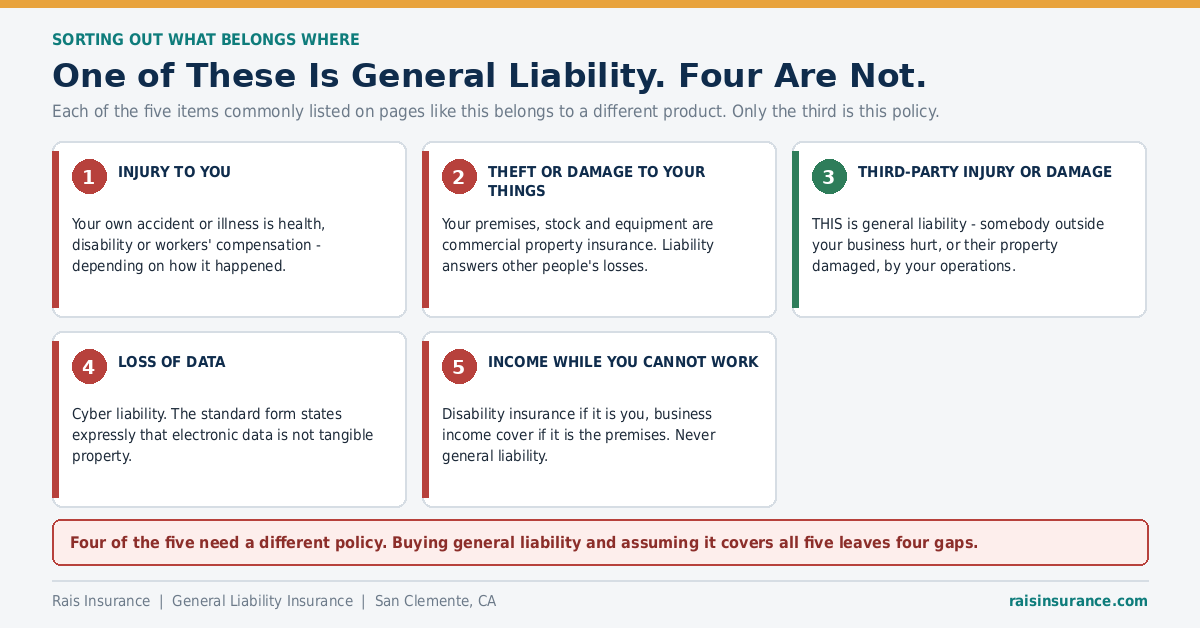
Pages on this subject often present a list like the one below as though every item sat inside one policy. Only one of them does. Here is each, with the policy that genuinely answers it:
- Injury or illness to you. Your own accident is health insurance; an illness caused by working conditions is workers’ compensation if you are an employee; and being unable to work is disability insurance. None of the three is general liability.
- Theft or damage to your property, assets or premises. That is commercial property insurance. Liability answers other people’s losses, not yours.
- Third-party injury or property damage. This one is the policy – somebody outside your business hurt, or their property damaged, by your premises, operations or products.
- Loss or corruption of data. Cyber liability. The standard form states expressly that electronic data is not tangible property, so it falls outside.
- Income while you cannot earn. Disability insurance if it is you personally; business income cover inside a property policy if it is the premises. Never this policy.
Four of the five need a different product. That is not a criticism of the policy – it is simply what it is, and buying it while assuming it covers all five leaves four gaps. Which of them you actually need is set out on our which policies your business actually needs page.
The Rule That Sorts Every Policy
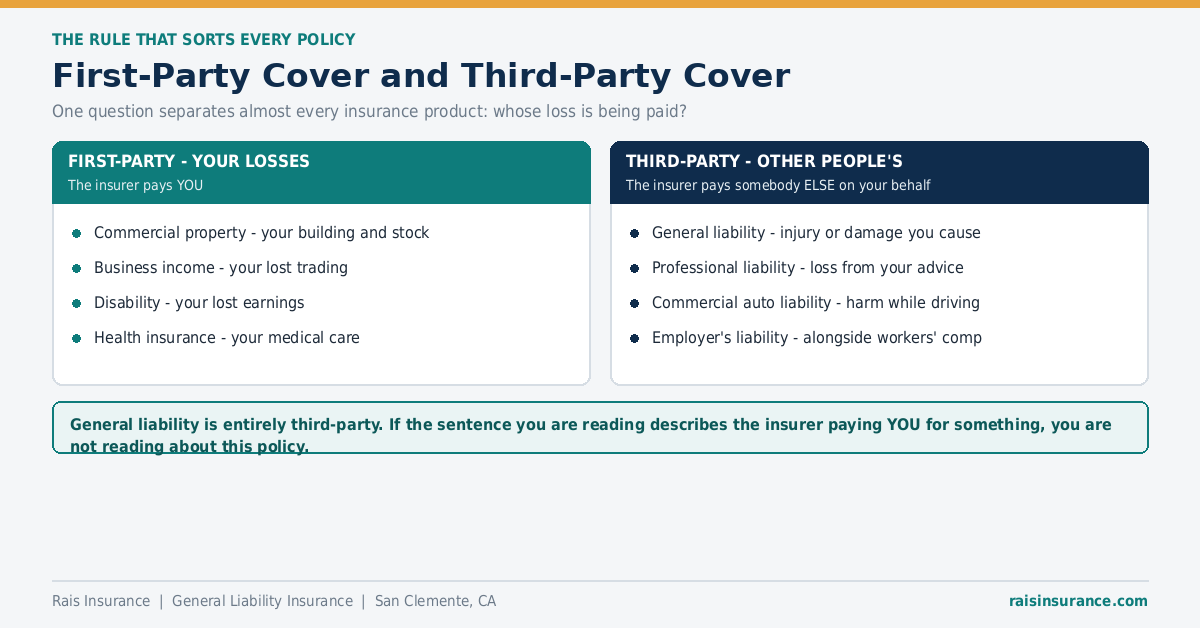
There is one question that separates almost every insurance product, and it is worth carrying around: whose loss is being paid?
First-party cover pays you. Commercial property replaces your building and stock. Business income replaces your trading while you cannot operate. Disability replaces your earnings. Health insurance pays for your treatment. In each case the money comes to you.
Third-party cover pays somebody else on your behalf, when you are responsible for their loss. This policy, professional liability, commercial auto liability and employer’s liability all work this way. The money never reaches you at all – it goes to the person you harmed, and the value to you is that you did not have to find it.
This cover is entirely third-party. So the practical test when reading any description of it: if a sentence says the insurer will pay *you* for something, you are not reading about this policy.
Looking After Employees Is a Different Policy
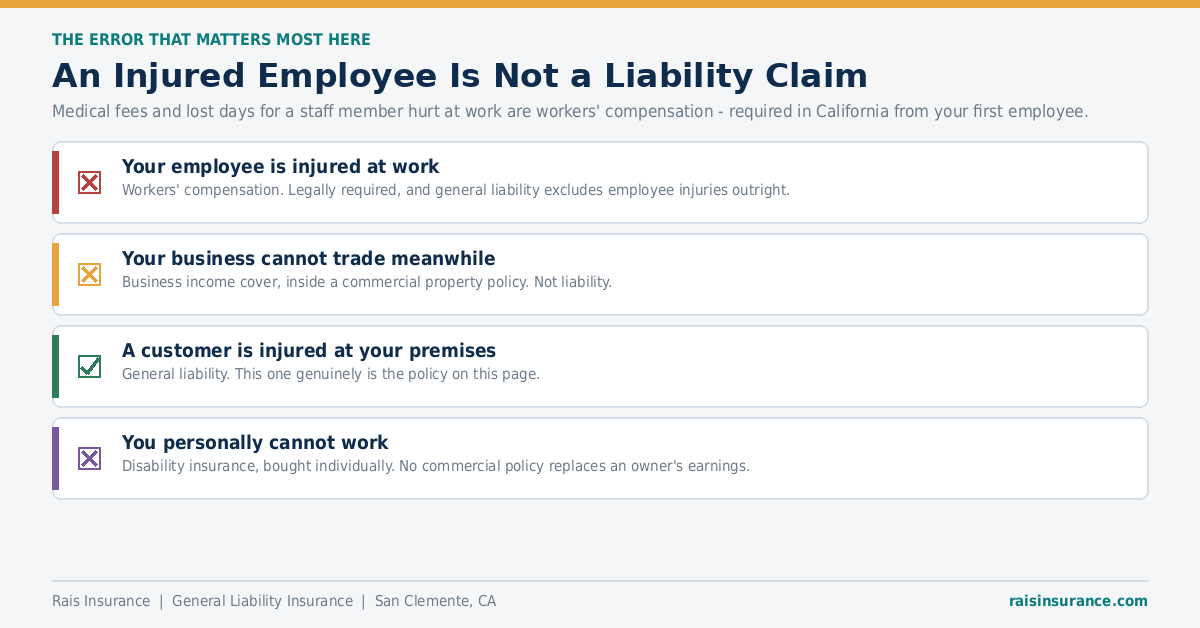
The instinct here is exactly right. Taking care of the people who work for you is prudent, and a business owner who thinks about medical fees and lost days when an employee is hurt is thinking about the correct problem. It is simply the wrong policy.
An employee injured at work is a workers’ compensation claim. California requires that cover from your first employee, with no revenue threshold, and the policy specifically excludes injuries to your own employees – the exclusion exists precisely because a separate compulsory system handles them. Operating without workers’ compensation while having employees is a criminal offence in California, so this is not a gap to leave open. See workers’ compensation and what California requires of employers.
The related items separate out the same way. Lost days of operation while your premises are unusable are business income cover, inside a property policy. And if it is you personally who cannot work, no commercial policy replaces an owner’s earnings – that is individual disability insurance.
Data and Intellectual Property
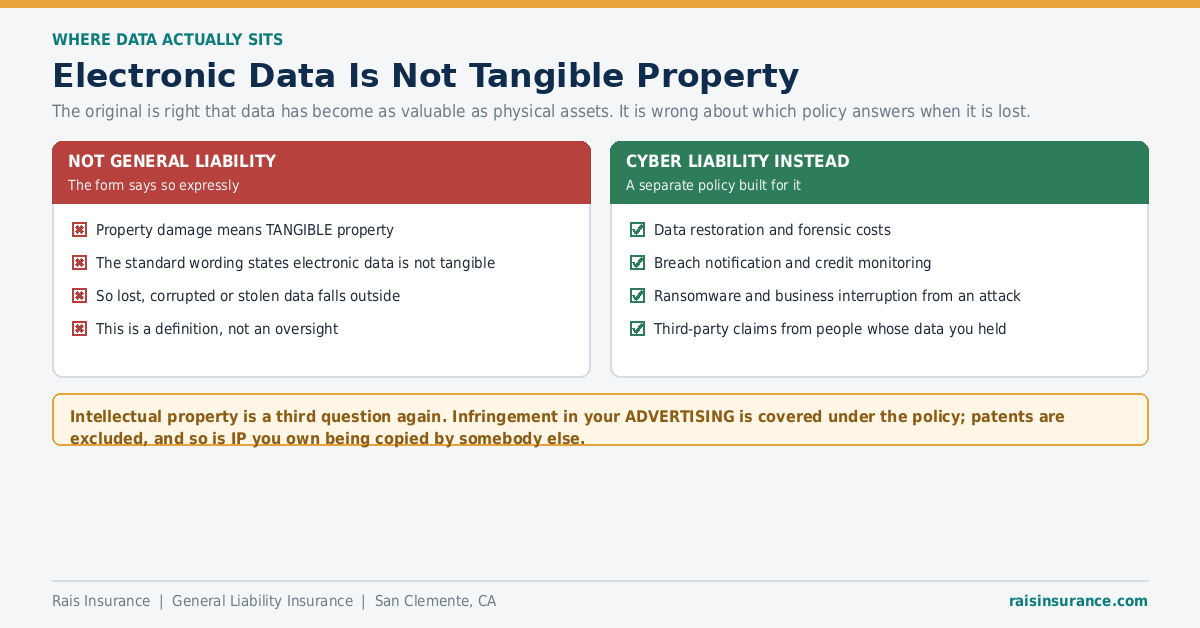
The observation is a good one and it is getting truer every year: data assets have become as valuable as physical ones, and losing them can genuinely end a business. The policy answer is just a different one.
Electronic data is not tangible property. The standard form defines property damage as physical injury to tangible property and then says so expressly. Lost, corrupted or stolen data therefore falls outside the policy – not by oversight, but by definition. What answers it is cyber liability: data restoration and forensics, breach notification, ransomware response, and third-party claims from people whose data you held.
Intellectual property is a third question again. Infringing a copyright, trade dress or slogan in your advertising is covered, under personal and advertising injury. Patent infringement is excluded. And it answers claims brought *against* you – it will not fund a claim you bring against somebody who copied your work, which is usually what a business owner has in mind when they raise it.
So What Does This Policy Actually Do?
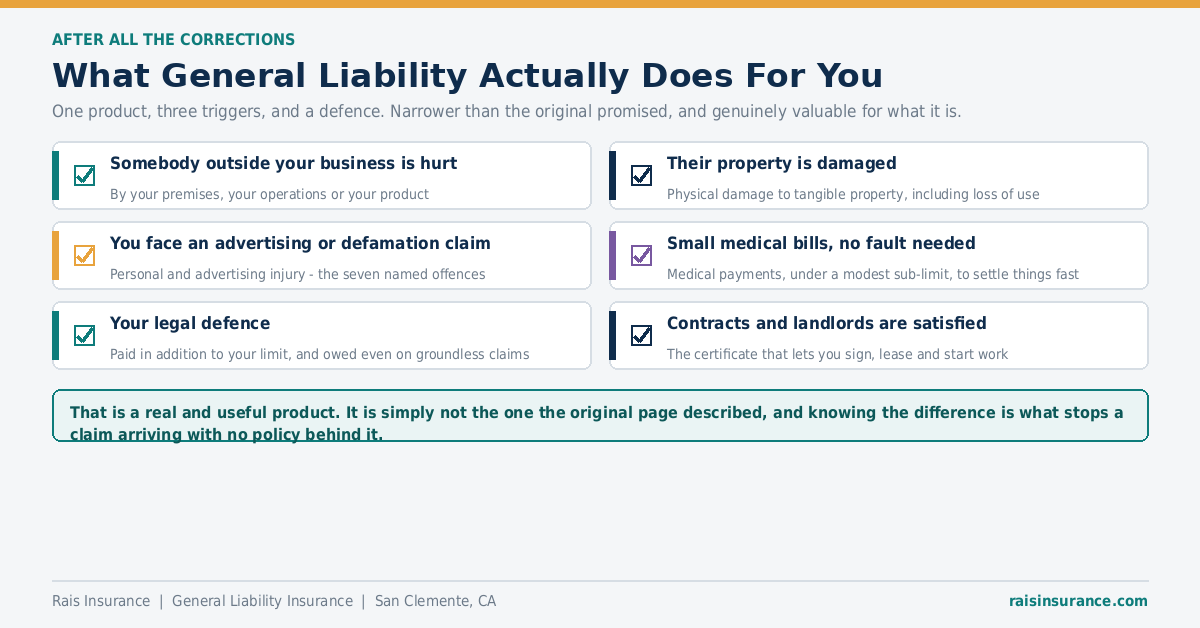
After all of that, it is worth stating positively, because what remains is a real and useful product:
- Bodily injury to somebody outside your business – caused by your premises, your operations or something you sold.
- Physical damage to their tangible property, including loss of use of it.
- Personal and advertising injury – libel, slander, invasion of privacy, false arrest, and advertising offences. The seven named offences are set out on our Coverage A, B and C and the seven named offences page.
- Medical payments – small bills for an injured visitor, paid without anyone having to establish fault, under a modest sub-limit.
- Your legal defence – paid in addition to your limit rather than out of it, and owed even on claims that turn out to be groundless.
- The certificate that landlords, clients and general contractors require before you can sign, lease or start work.
That is narrower than the original description of it, and commercial general liability remains one of the two or three policies almost every business genuinely needs. Business liability insurance is worth buying accurately rather than optimistically.
If You Are Not Running a Business
One clarification, since the original raised securing your personal financial position. This is a commercial policy. If your concern is personal rather than commercial, the relevant products are the liability section of your homeowners or renters policy, a personal umbrella sitting above it, disability insurance for your earnings, and health cover.
That is a legitimate conversation and we are happy to have it – it is simply a different one. The line between the two, and the gap that opens for anyone running a business from home, is covered on our personal liability and the gap for home businesses page.
What It Costs
There is no flat rate. Premium is built from your classification code, your gross receipts or payroll, the limits you buy, your claims history and how much work you subcontract out. San Clemente’s business base skews toward small professional practices, hospitality and trades, and those three price very differently from one another. More on the mechanics in what actually sets your premium.
Support When You Need It Most
At Rais Insurance we are here to help when it matters, and the most useful thing we do is not the quote – it is working out which of the products above your situation actually calls for. As the sections above show, that is mostly a question of knowing where each policy stops.
If you already hold cover and want to check it yourself first, how to read your own policy sets out how a policy is structured and which section answers which question.
We place business insurance San Clemente firms rely on, serving San Clemente, Dana Point and Capistrano Beach from our Anaheim office and writing across California.
General Liability Insurance San Clemente – Frequently Asked Questions
Q1. Does general liability insurance cover my own injuries?
No. This is third-party cover – it answers harm your business causes to somebody else. Your own injury goes to health insurance, or to disability insurance if it stops you working. If you have employees and one of them is hurt, that is workers’ compensation, which California requires from your first employee. None of those three is general liability.
Q2. Does general liability replace my income if I cannot work?
No, and this is a common misunderstanding worth clearing up. Nothing in this policy pays you. If you personally cannot work, that is disability insurance, bought individually. If your premises are damaged and the business cannot trade, that is business income cover inside a commercial property policy. Both are first-party products; general liability is entirely third-party.
Q3. What is the difference between first-party and third-party insurance?
First-party cover pays you for your own losses – commercial property, business income, disability, health. Third-party cover pays somebody else on your behalf when you are responsible for their loss – general liability, professional liability, commercial auto liability. It is the single most useful distinction in insurance, and it sorts almost every product in one question: whose loss is being paid?
Q4. Does general liability cover theft or damage to my own property?
No. Your building, stock, equipment and premises are commercial property insurance. General liability answers damage you cause to other people’s property, not damage to your own. The two are frequently bundled together in a business owner’s policy, which is probably why they get confused – but they are separate coverages doing opposite jobs.
Q5. Does general liability cover lost or corrupted data?
Generally no. The standard form defines property damage as physical injury to tangible property and states expressly that electronic data is not tangible property. Lost, corrupted or stolen data is a cyber liability question – data restoration, breach notification, ransomware, and claims from people whose data you held. That is a separate policy and an increasingly necessary one.
Q6. What about intellectual property – is that covered?
Partly, and narrowly. The policy covers infringement of copyright, trade dress or slogan in your ADVERTISEMENT, under personal and advertising injury. Patent infringement is excluded. And it answers claims brought against you – it does not fund a claim you bring against somebody who copied your work, which is what most business owners actually have in mind when they ask.
Q7. If an employee is injured at work, does general liability pay their medical bills?
No. Employee injuries are workers’ compensation, which is legally required in California from your first employee and which general liability specifically excludes. The exclusion is deliberate – it exists because a separate compulsory system handles employee injuries. Operating without workers’ compensation while having employees is a criminal offence in California.
Q8. So what does general liability actually cover?
Three things and a defence. Bodily injury to somebody outside your business. Physical damage to their tangible property. Personal and advertising injury, meaning libel, slander, privacy and advertising offences. Plus the cost of defending you, which under a standard form sits in addition to your limit. It also produces the certificate landlords and clients require before you can start work.
Q9. Do I need general liability if I am not a business?
No. This is a commercial policy. If you are looking to protect your personal financial position, the relevant products are the liability section of your homeowners or renters policy, a personal umbrella above it, disability insurance for your earnings, and health cover. A broker can walk you through those, but they are a different conversation from this one.
Q10. How much does general liability insurance cost in San Clemente?
There is no flat rate. Premium is built from your classification code, gross receipts or payroll, the limits you buy, your claims history and how much work you subcontract. San Clemente’s business base skews toward small professional, hospitality and trade operations, which price very differently from one another. A broker can put the same details to several carriers and show you the spread.
Get a General Liability Insurance Quote in San Clemente
Contact us today and we will go through what your business actually faces before quoting anything. contact Rais Insurance on 714-761-4336, email rai@raisinsurance.com, or visit 2612 W. Lincoln Avenue, Suite 103, Anaheim, CA 92801.
Bring your current declarations page if you have one. The first useful check is simply which policies you are actually holding – a good number of businesses discover they have two of the five and assumed they had all of them.
