

General liability insurance Santa Fe Springs
What follows is each part of the general liability insurance cover with its actual boundaries attached – including the one definition that decides most claims and turns out to be far less certain than it sounds.
Property Damage and Bodily Injury – and What Bodily Injury Means
This coverage protects you against legal liability for property damage or bodily injury caused to others out of non-professional conduct during your business operations. That word is doing important work: the standard form carries a professional services exclusion, so claims about your expertise rather than your operations fall elsewhere.
The definition, and where it gets uncertain
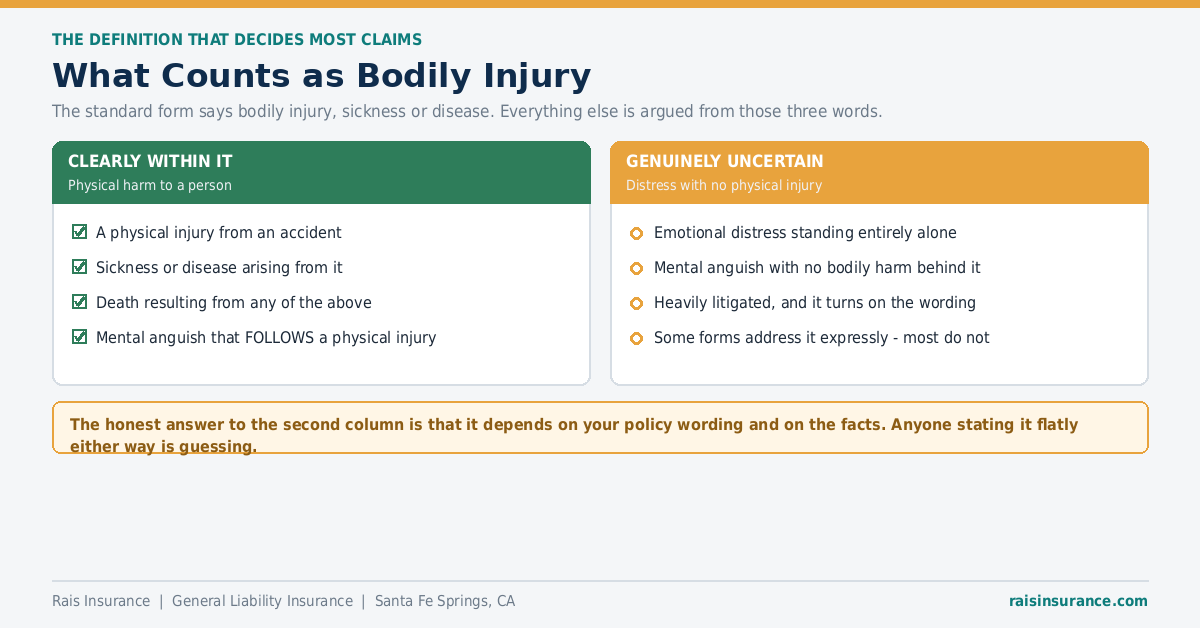
The standard policy defines bodily injury as bodily injury, sickness or disease sustained by a person, including death resulting from any of those. It is a short definition doing an enormous amount of work, because nearly every general liability claim turns on whether what happened fits inside it.
The original states that emotional distress and mental injuries are treated as bodily injury even when there is no physical sign of bodily harm. That is worth correcting carefully, because the honest answer is more useful than either flat position:
- Mental anguish that follows a physical injury is generally treated as part of that injury. That much is settled and uncontroversial.
- Emotional distress standing entirely alone, with no physical harm behind it, is genuinely contested. Some wordings address it expressly; most do not, and it has produced a great deal of litigation.
- Which side your general liability policy falls on depends on your wording and your facts. Anyone stating it flatly either way – including a page like this one – is guessing.
That is not a technicality. It is the difference between assuming a claim is covered and checking. For what a claim actually costs once it is covered, see what a claim actually costs you.
Advertising and Personal Injury – the Seven Named Offences
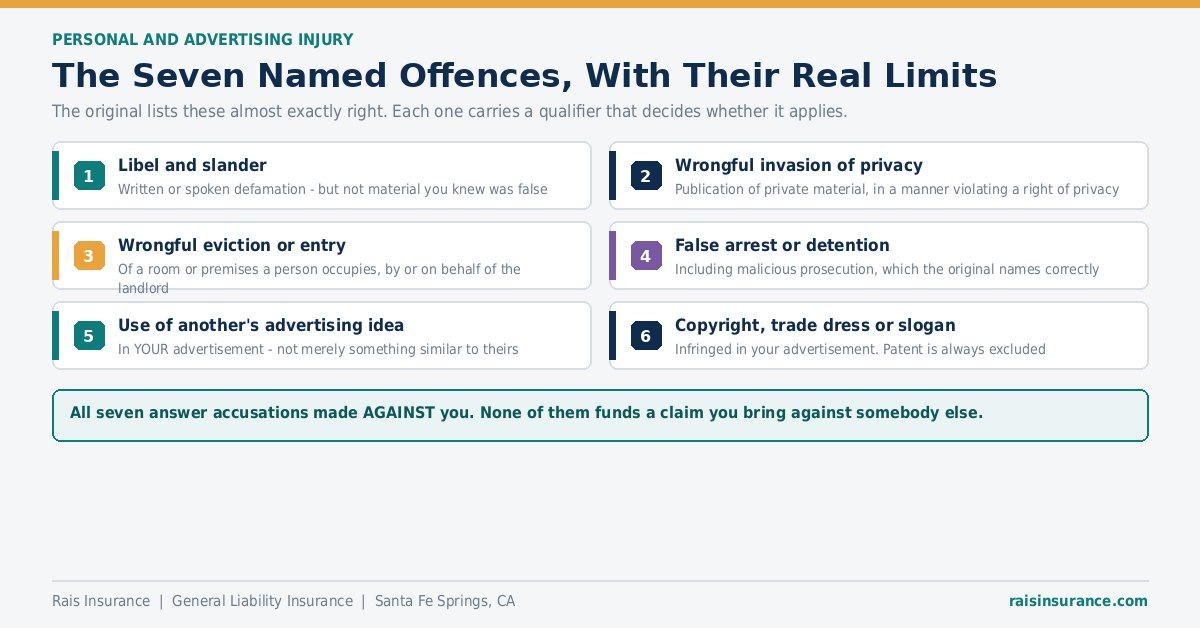
The original’s list here is close to exactly right, which is unusual and worth saying. General liability covers a closed set of seven named offences, and each carries a qualifier that decides whether it applies:
- Libel and slander – oral or written publication of material that defames a person or organisation. Material you published knowing it to be false is excluded.
- Wrongful invasion of privacy – publication of material that violates a person’s right of privacy.
- Wrongful eviction or entry – of a room or premises a person occupies, committed by or on behalf of its owner or landlord.
- False arrest, detention or imprisonment, and malicious prosecution – the original names both correctly, and malicious prosecution in particular is one almost nobody lists.
- Use of another’s advertising idea in your advertisement – note the wording. It is not enough that your idea resembles somebody else’s; the offence is using theirs.
- Infringement of copyright, trade dress or slogan in your advertisement – patent infringement is always excluded, and infringement in your product rather than your advertising is a different question.
All seven answer accusations made against you. None of them funds a claim you bring against somebody else – which catches out businesses whose real concern is a competitor copying them. The full structure is on our Coverage A, B and C and how the limits work page.
Medical Payments – the One Coverage That Works Without a Claim
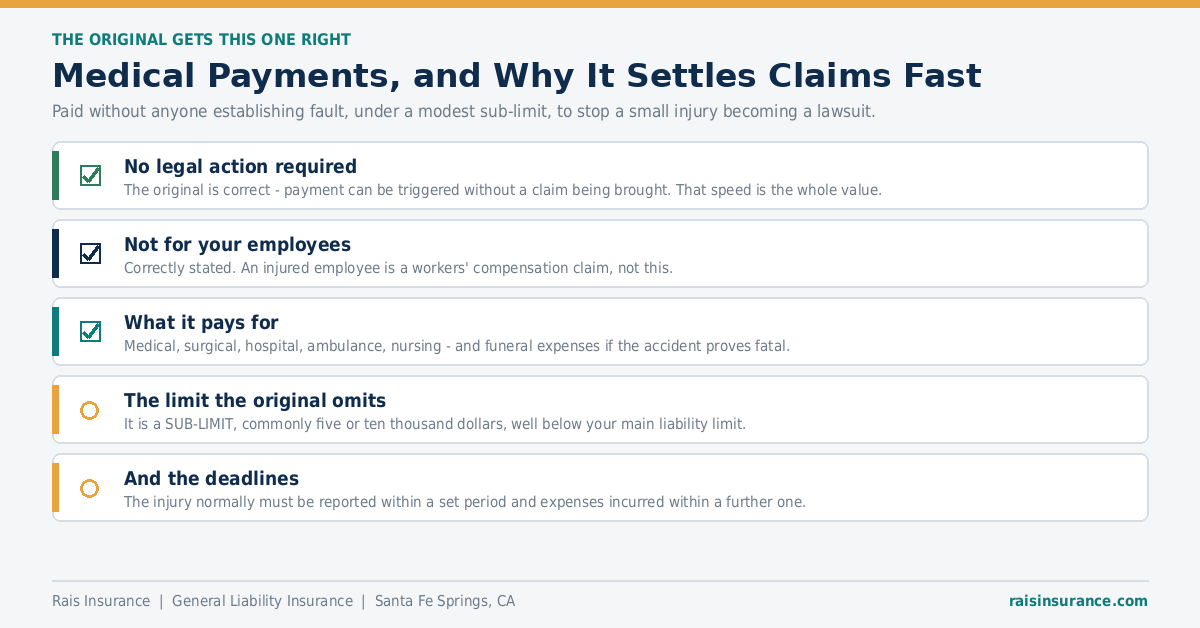
This is the section the original handles best, and the substance is right. Medical payments covers treatment for someone who is not your employee injured in an accident on your premises. It pays reasonable and necessary medical, surgical, hospital, ambulance and nursing expenses – and funeral expenses if the accident proves fatal.
The important part is also correct: payment can be triggered without legal action being brought. Nobody has to establish that you were at fault. That is what lets smaller medical claims be settled quickly and without litigation, and it is often what stops a minor injury becoming a bodily injury lawsuit under the main coverage.
Two things the original leaves out, and both matter. Medical payments is a sub-limit – commonly five or ten thousand dollars, well below your main liability limit. And it carries deadlines: the injury normally has to be reported within a set period and expenses incurred within a further one. See premises liability and what goes wrong at your unit.
Additional Coverages – and What We Can Actually Advise On
Depending on what your business does, you may need coverages that sit outside a general liability insurance policy entirely – workers’ compensation, commercial auto, professional liability, cyber, cargo. Which of them apply is worth a conversation, and it is the conversation most worth having. See which policies your business actually needs.
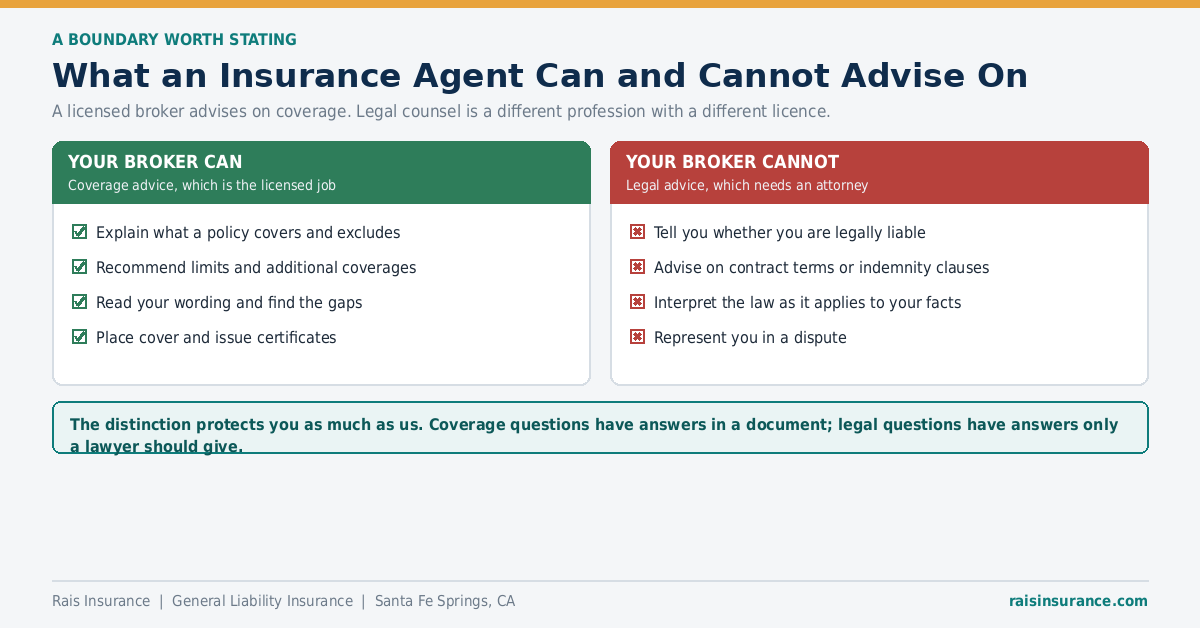
One clarification on what that conversation is. The original offers legal counsel on these coverages, and that is not something an insurance agent provides. The distinction is worth stating plainly because it protects you as much as us:
A licensed broker advises on coverage – what a policy covers and excludes, which limits to carry, where the gaps in your programme sit, and how to read your own wording. That is the licensed job and we are happy to do all of it.
An attorney advises on law – whether you are legally liable, what an indemnity clause in a contract commits you to, how a statute applies to your particular facts, and how to handle a dispute. Coverage questions have answers in a document. Legal questions do not, and they should come from someone licensed to give them.
An Industrial City, Insured Differently
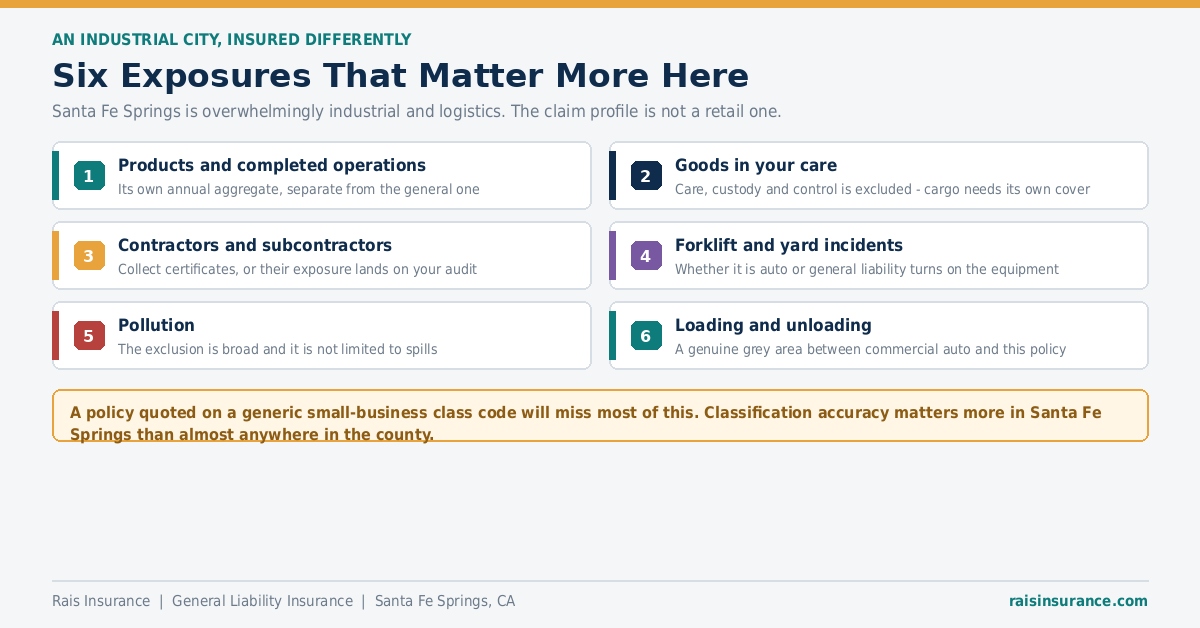
Santa Fe Springs is one of the most heavily industrial cities in Los Angeles County – warehousing, distribution, light manufacturing and freight, with a very small residential population relative to its business base. The claim profile here is not a retail one, and six exposures matter more than they would elsewhere:
- Products and completed operations. Its own annual aggregate, separate from the general aggregate, covering claims that arise after your product or work has left you. For a manufacturer or distributor this is often the more important of the two limits.
- Goods in your care. Cargo and customer property you hold, move or store is excluded under care, custody and control. Warehousing and freight operations need warehouse legal liability, motor truck cargo or bailee cover instead.
- Contractors and subcontractors. Collect certificates from every one. An uninsured subcontractor’s exposure lands back on you, and at your year-end audit their work is typically added to your own.
- Forklift and yard equipment. Most mobile equipment operating on your premises stays inside general liability rather than commercial auto – but it turns on the equipment and the use.
- Pollution. The standard exclusion is broad, and it is not limited to major spills. Environmental cover is bought separately.
- Loading and unloading. A recognised grey area between this policy and commercial auto. If you run both, it is worth raising specifically rather than assuming.
A general liability policy quoted on a generic small-business classification will miss most of that. See what general liability does not cover for the wider exclusions picture.
What It Costs
There is no flat rate, and any figure quoted without knowing your operations is guesswork. Premium is built from your classification code, your gross receipts or payroll, the limits you select, your claims history and how much work you subcontract out.
Classification accuracy matters more in Santa Fe Springs than in most markets, because the rate difference between adjacent industrial codes is substantial and businesses here drift between them as their work changes. Check the code on your declarations page at renewal – see what actually sets your premium, and the year-end audit. On how much cover to carry, how much cover a business should carry.
Where to Get Your Cover
Rais Insurance places business liability insurance for Santa Fe Springs operations of every size, and we build the cover around what your operation actually does rather than around a template. As a family business we would rather hold a long relationship than close a fast sale, and in practice that means telling you where a policy stops as readily as where it starts.
We serve Santa Fe Springs and the surrounding southeast Los Angeles County industrial corridor from our Anaheim office, and we write across California.
General Liability Insurance Santa Fe Springs – Frequently Asked Questions
Q1. Does general liability cover emotional distress?
It depends, and anyone answering flatly either way is guessing. The standard form defines bodily injury as bodily injury, sickness or disease. Mental anguish that follows a physical injury is generally treated as part of that injury. Emotional distress standing entirely alone, with no physical harm behind it, is genuinely contested – some policy wordings address it expressly and most do not, and it has produced a great deal of litigation.
Q2. What is the definition of bodily injury in a general liability policy?
Bodily injury, sickness or disease sustained by a person, including death resulting from any of those at any time. It is a short definition doing an enormous amount of work, because almost every injury claim turns on whether what happened fits inside it. Purely economic loss does not, and neither does damage to property – that is the separate property damage trigger.
Q3. What are the seven named offences under personal and advertising injury?
False arrest, detention or imprisonment; malicious prosecution; wrongful eviction from or entry into a room or premises a person occupies; oral or written publication that slanders or libels; publication violating a right of privacy; use of another’s advertising idea in your advertisement; and infringement of copyright, trade dress or slogan in your advertisement. All seven answer accusations against you.
Q4. Does the policy cover copyright infringement?
Within limits. It covers infringement of copyright, trade dress or slogan committed in your ADVERTISEMENT. Patent infringement is always excluded, infringement in your product itself is a different matter, and material you published knowing it to be false is excluded. It also answers claims brought against you – it will not fund a claim you bring against somebody who copied your work.
Q5. Does medical payments coverage require a lawsuit?
No, and that is precisely its value. Payment can be made without anyone bringing a claim or establishing fault, which lets a small injury be settled quickly and without litigation. It covers reasonable medical, surgical, hospital, ambulance and nursing expenses, and funeral expenses if the accident proves fatal. It applies to people who are not your employees.
Q6. How much does medical payments coverage pay?
It is a sub-limit, commonly five or ten thousand dollars, sitting well below your main liability limit. It also carries deadlines – the injury normally has to be reported within a set period and expenses incurred within a further one. Beyond that sub-limit an injured person would have to bring a bodily injury claim under the main coverage, where fault does have to be established.
Q7. Can my insurance agent give me legal advice?
No, and it matters that we are clear about it. A licensed broker advises on coverage – what a policy covers and excludes, which limits to carry, where the gaps in your programme are. Whether you are legally liable, what an indemnity clause in a contract means, or how the law applies to your particular facts are questions for an attorney. Coverage questions have answers in a document; legal questions do not.
Q8. What is the products and completed operations aggregate?
A separate annual limit covering claims that arise after your product has left you or your work has been completed. It sits alongside the general aggregate rather than inside it, so exhausting one does not exhaust the other. For a manufacturer or distributor in Santa Fe Springs it is often the more important of the two, and it is worth checking on your declarations page specifically.
Q9. Does general liability cover a forklift accident?
Usually yes, because most forklifts and yard equipment fall outside the auto definition and stay within general liability. It turns on the equipment and how it is used – mobile equipment operating on your premises is treated differently from a vehicle on a public road. Loading and unloading is a recognised grey area between this policy and commercial auto, which is worth raising specifically if you run both.
Q10. How much does general liability insurance cost in Santa Fe Springs?
There is no flat rate. Premium is built from your classification code, gross receipts or payroll, the limits you buy, your claims history and how much work you subcontract. Santa Fe Springs is overwhelmingly industrial and logistics, so classification accuracy matters more here than in a retail market – the rate difference between adjacent industrial codes is substantial.
Get a General Liability Insurance Quote in Santa Fe Springs
Get in touch and we will work through what your business actually faces before quoting anything. contact Rais Insurance on 714-761-4336, email rai@raisinsurance.com, or visit 2612 W. Lincoln Avenue, Suite 103, Anaheim, CA 92801.
If you hold or move goods belonging to anybody else, mention it first. That single fact changes which policies you need more than anything else on your declarations page.
