

General Liability Insurance Pico Rivera
That is what a general liability insurance policy exists to answer, and it is what this page sets out. Below: how much of a claim is genuinely yours when more than one party is at fault, what a bodily injury claim is made of, how damaged property gets valued, and why a claim you eventually win still costs money to win. For your own position, a licensed agent at Rais Insurance can go through it with you.
Bodily Injury Liability – and How Much of It Is Yours
Bodily injury liability is the first of the two things a general liability policy is built around, and it arises when somebody is harmed and your business caused it or contributed to it. That much is straightforward. The part worth correcting is what follows.
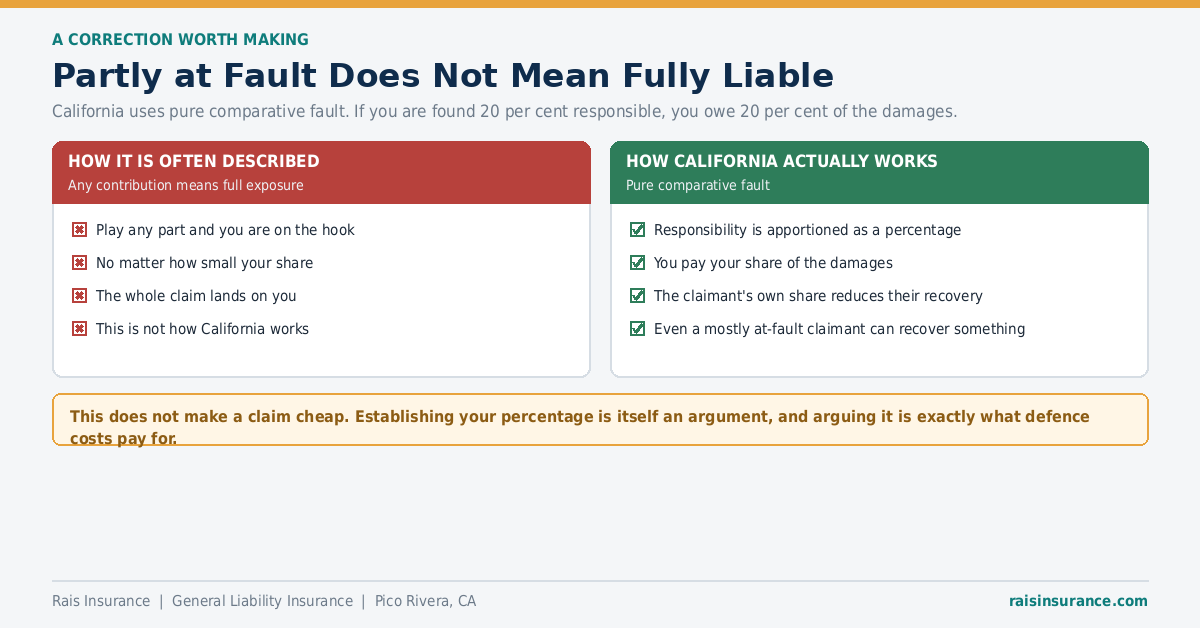
It is sometimes said that playing any part in an injury, however small, puts you on the hook for the whole claim — and it is the single biggest misunderstanding a general liability policyholder carries. California does not work that way. The state uses pure comparative fault, which means responsibility is apportioned as a percentage and each party pays their share. Found twenty per cent responsible and you are liable for twenty per cent of the damages, not all of them.
The same principle runs the other way. A claimant’s own share of the fault reduces what they recover – and California is one of a small number of states where there is no cut-off point, so a claimant found mostly responsible can still recover something. It is a genuinely different system from the all-or-nothing version most people assume.
None of which makes a claim cheap. Establishing your actual percentage is itself an argument, and arguing it is exactly what defence costs pay for – which is the subject of the third section below.
What the claim is actually made of
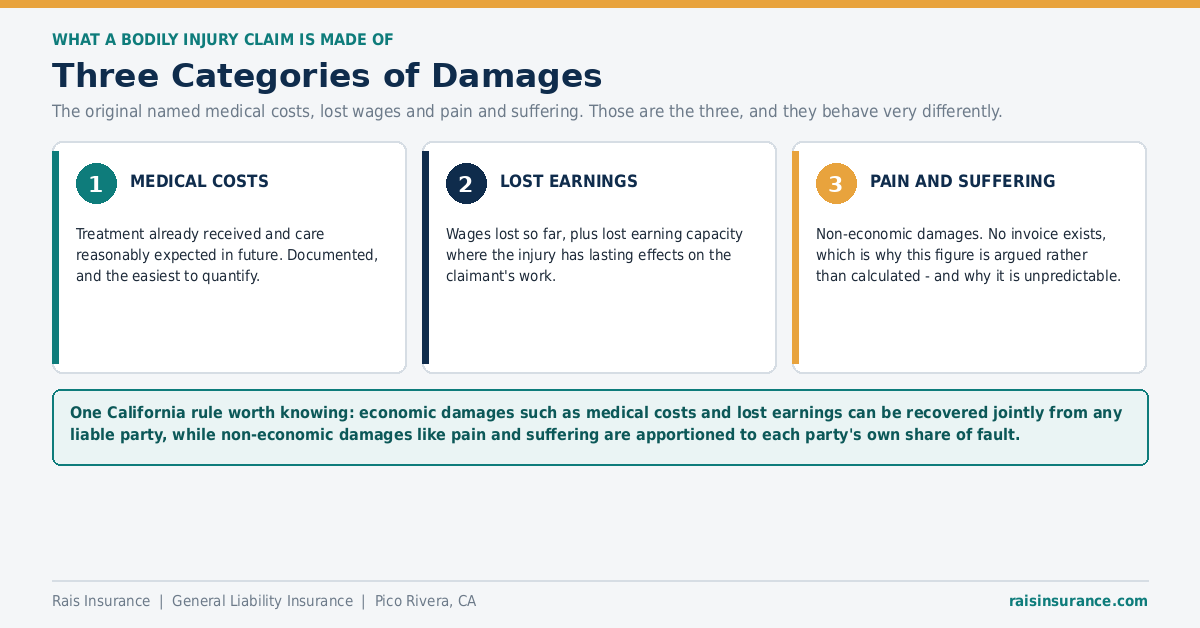
The original named medical payments, lost wages and pain and suffering. Those are the three categories, and they behave very differently from one another:
- Medical costs. Treatment already received and care reasonably expected in future. Documented, invoiced, and the easiest of the three to quantify.
- Lost earnings. Wages lost so far, plus lost earning capacity where the injury has lasting effects on what the claimant can do. Still evidence-based, but more arguable than medical bills.
- Pain and suffering. Non-economic damages, and there is no invoice behind them. This figure is argued rather than calculated, which is the single biggest reason claim values are hard to predict. Anyone offering you a formula is describing a rule of thumb, not a rule.
One California distinction worth carrying: economic damages such as medical costs and lost earnings can generally be recovered in full from any liable party, while non-economic damages like pain and suffering are apportioned to each party’s own share of fault. That split matters whenever more than one business is involved in the same incident.
Property Damage Liability – and How the Figure Is Set
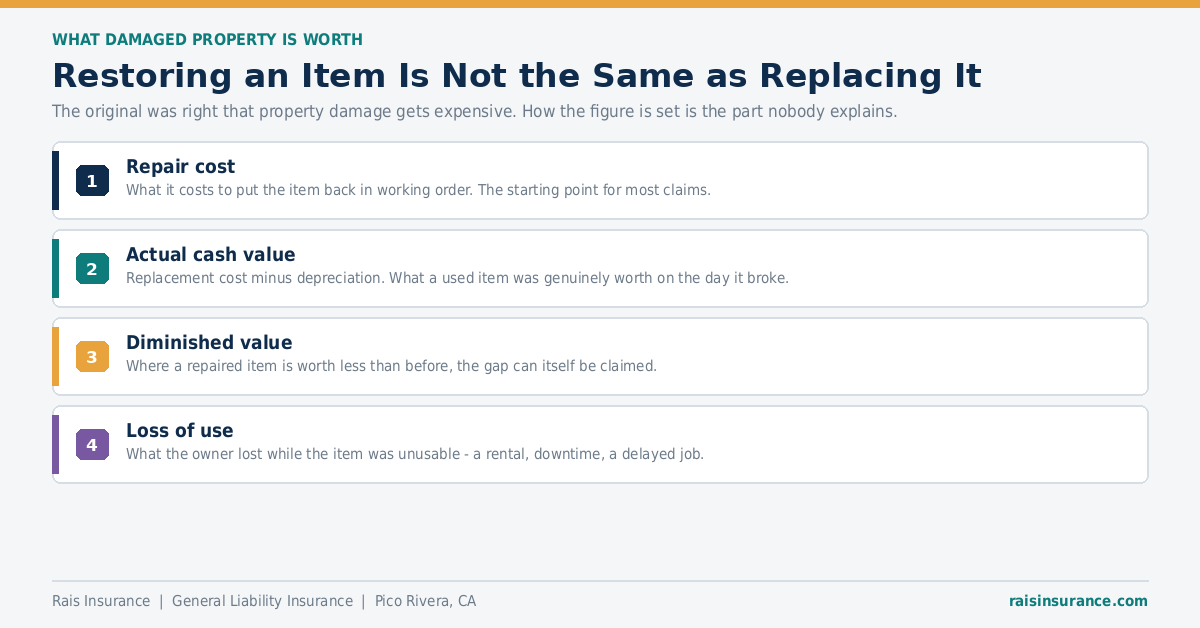
Property damage liability is the second, and it comes down to a simple idea: if something is broken, destroyed or otherwise ruined and your business was behind it, you are expected to put it right. The original was correct that this gets expensive quickly. What it did not say is how the figure is arrived at, and there are four routes:
- Repair cost. What it takes to put the item back in working order. The starting point for most claims, and often the whole answer for a straightforward one.
- Actual cash value. Replacement cost minus depreciation – what a used item was genuinely worth on the day it broke, rather than what a new one costs.
- Diminished value. Where a repaired item is worth less than it was before the damage, that gap can itself be claimed. Common with vehicles, and often overlooked.
- Loss of use. What the owner lost while the item was unusable: a rental, downtime on a job, a delayed delivery. Genuine damages, and frequently the part nobody budgeted for.
The practical point for anyone holding general liability insurance is that a damaged item rarely costs one number. It costs the repair plus whatever the owner lost while waiting for it.
Legal Fees – Being Right Is Not the Same as Being Free
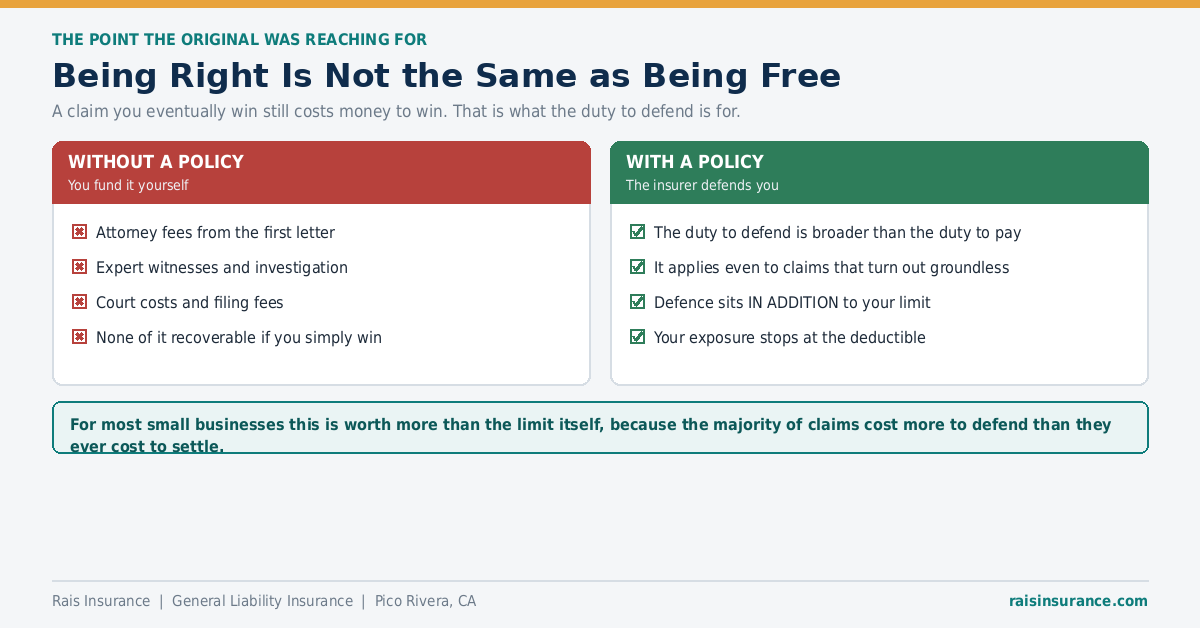
The original makes a point most businesses only learn the hard way: even if you are not found liable and should never have been on the hook, going to court or hiring an attorney costs money – and without cover, that money is yours.
This is what the duty to defend exists for, and it is worth understanding precisely because it is broader than people expect. The insurer’s duty to defend is wider than its duty to pay. If a claim is of a kind the policy could cover, the insurer defends it – including claims that turn out to be entirely groundless. You do not have to lose for the defence to be provided.
Two things follow. Under a standard general liability form, defence costs sit in addition to your limit rather than eroding it, so legal fees do not eat the money available to settle. And for most small businesses that feature is worth more than the limit itself, because the majority of claims cost more to defend than they ever cost to resolve.
More on this in the duty to defend and how a false claim is handled, and on the other costs paid outside the limit in what the insurer pays on top of your limit.
Where the Risk Actually Sits for a Business
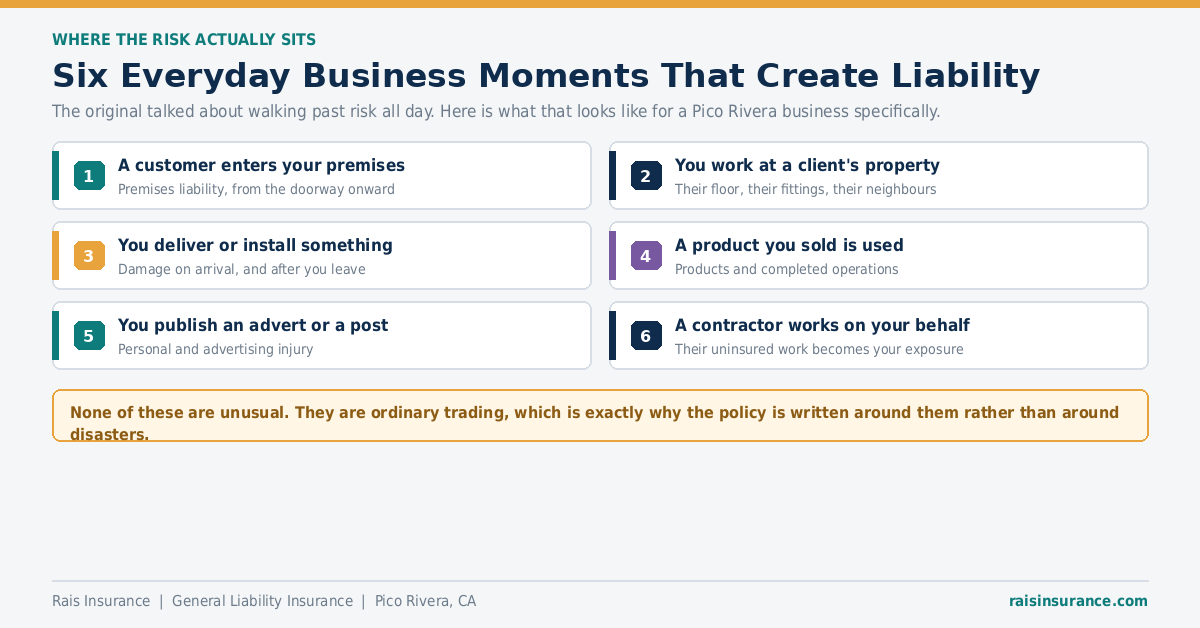
The original’s framing – that people walk past more exposure than they realise – is right, and it is worth making concrete. For a Pico Rivera business, six ordinary moments create most of it:
- A customer enters your premises. Premises liability starts at the doorway and runs to the back of the property.
- You work at a client’s property. Their floor, their fittings, sometimes their neighbours. You control less than you do at home.
- You deliver or install something. Damage on arrival, and damage that shows up after you have left.
- A product you sold is used. Products and completed operations, which carries its own annual aggregate.
- You publish an advert or a post. Personal and advertising injury – copyright, trade dress, defamation.
- A contractor works on your behalf. If they cannot produce their own general liability certificate, their exposure lands back on you – and on your premium at audit too.
None of those are unusual. They are ordinary trading, which is precisely why general liability insurance is written around them rather than around disasters. Which policies you need alongside this one is covered on our which policies your business actually needs page.
One Clarification: This Is a Business Policy
Worth stating plainly, because the risks described above sound like everyday life and in one sense they are. General liability is a commercial policy. Business liability insurance answers injury or damage arising out of your business operations, premises or products.
Accidents in your private life – a guest injured at your home, damage to a neighbour’s property – are personal liability, and that sits inside a homeowners or renters policy instead. Both matter, and a general liability policy will not reach across into the other. If you run a business from a Pico Rivera home there is a real gap between the two, because the homeowners policy excludes business liability and you may not have bought a commercial one yet. See personal liability, home businesses and the gaps between.
What It Costs
There is no flat rate for general liability insurance. Premium is built from your classification code, your gross receipts or payroll, the limits you buy, your claims history over three to five years, and how much work you subcontract out. Two Pico Rivera businesses on the same street can pay very differently for identical limits.
On how much cover to carry in the first place, see how much cover a business should carry. On what drives the number, what actually sets your premium.
Talking It Through with Rais Insurance
As you weigh up the possibilities above, a licensed agent at Rais Insurance can work through your own position and put together the general liability insurance Pico Rivera businesses actually need rather than a template. That conversation is more useful before a claim than after one – and if one does arrive, what to do in the first 48 hours after an incident matters more than most owners expect.
We serve Pico Rivera, Montebello and South El Monte from our Anaheim office, and we write across California.
General Liability Insurance Pico Rivera – Frequently Asked Questions
Q1. If I am only partly at fault, do I pay the whole claim?
No. California uses pure comparative fault, so responsibility is apportioned as a percentage and each party pays their share. If you are found twenty per cent responsible, you are liable for twenty per cent of the damages. The claimant’s own share reduces what they recover too. This is worth knowing because liability is often described as all-or-nothing, and in California it is not.
Q2. What is pure comparative fault?
It means fault is divided by percentage with no cut-off point. Some states bar a claimant who is more than half responsible from recovering anything; California does not. A claimant found seventy per cent at fault can still recover thirty per cent of their damages. For a business owner the practical consequence is that establishing your actual share matters enormously, and arguing it is exactly what defence costs pay for.
Q3. What is a bodily injury claim actually made of?
Three categories. Medical costs, covering treatment already received and care reasonably expected in future. Lost earnings, covering wages lost so far plus lost earning capacity where the injury has lasting effects. And pain and suffering, which is non-economic and has no invoice behind it. The first two are documented and quantifiable; the third is argued, which is why claim values are hard to predict.
Q4. How is pain and suffering calculated?
It is not calculated so much as negotiated. There is no invoice for non-economic damages, so the figure comes from argument, precedent and the parties’ assessment of what a jury might award. Anyone offering you a formula is describing a rule of thumb rather than a rule. It is also the category where the gap between a defended and an undefended claim is widest.
Q5. What is the difference between economic and non-economic damages in California?
Economic damages are the documented ones – medical costs, lost earnings, repair bills. Non-economic damages are pain and suffering and similar. The distinction matters because California treats them differently when more than one party is liable: economic damages can generally be recovered in full from any liable party, while non-economic damages are apportioned to each party’s own share of fault.
Q6. How is damaged property valued in a claim?
Usually starting from repair cost, but that is not the whole picture. Actual cash value – replacement cost less depreciation – reflects what a used item was genuinely worth on the day. Diminished value can be claimed where a repaired item is worth less than it was before. And loss of use covers what the owner lost while the item was unusable, such as a rental or business downtime.
Q7. Does my insurance pay legal fees even if I win?
Yes, and this is one of the most valuable features of a liability policy. The insurer’s duty to defend is broader than its duty to pay, so it applies to claims that turn out to be groundless as well as to ones that succeed. Under a standard general liability form those defence costs sit in addition to your limit rather than eroding it, which for most small businesses is worth more than the limit itself.
Q8. What kinds of everyday business activity create liability?
Ordinary ones. A customer entering your premises, work performed at a client’s property, deliveries and installations, a product being used after you sold it, an advertisement or social post, and work carried out by contractors on your behalf. The last of those catches people out most often, because an uninsured contractor’s exposure lands back on you.
Q9. How much does general liability insurance cost in Pico Rivera?
There is no flat rate. Premium is built from your classification code, gross receipts or payroll, the limits you buy, your claims history and how much work you subcontract. Two businesses on the same street can pay very differently for identical limits, because the exposures are not comparable. A broker can put the same information to several carriers and show you the spread.
Q10. Is this policy for my business or for me personally?
General liability is a commercial policy covering injury or damage arising from your business. Accidents in your private life – a guest hurt at your home, damage to a neighbour’s property – are personal liability, which sits inside a homeowners or renters policy. Both matter, and if you run a business from home there is a gap between them worth closing.
Get a General Liability Insurance Quote in Pico Rivera
contact Rais Insurance to talk through what your business actually faces. Call 714-761-4336, email rai@raisinsurance.com, or visit 2612 W. Lincoln Avenue, Suite 103, Anaheim, CA 92801.
If you already hold a policy, bring the declarations page. The two lines worth checking first are your limit and whether defence costs sit inside it or outside it.
