

General Liability Insurance Mission Viejo
Below: what the insurer pays in addition to your limit rather than out of it, how the alcohol exclusion really works, whether your employees are genuinely covered, and who has the right to settle a claim over your objection. To check your own requirements against any of it, one of our agents at Rais Insurance can go through your schedule with you.
What a General Liability Policy Typically Covers
Ask what does general liability insurance cover and the honest answer starts here. Running a business exposes you to risk, and a commercial general liability policy protects the business, and your employees acting on its behalf, against claims for property damage or bodily injury brought by others. It responds to accidents on your premises, harm arising from your products, incidents during normal business operations, and claims connected to your advertising.
Where it pays, it meets the settlement or the judgment up to your limit, and it covers the cost of defending you. How much cover you should be carrying in the first place is a separate question – see how much cover a business actually needs.
What the Insurer Pays On Top of Your Limit
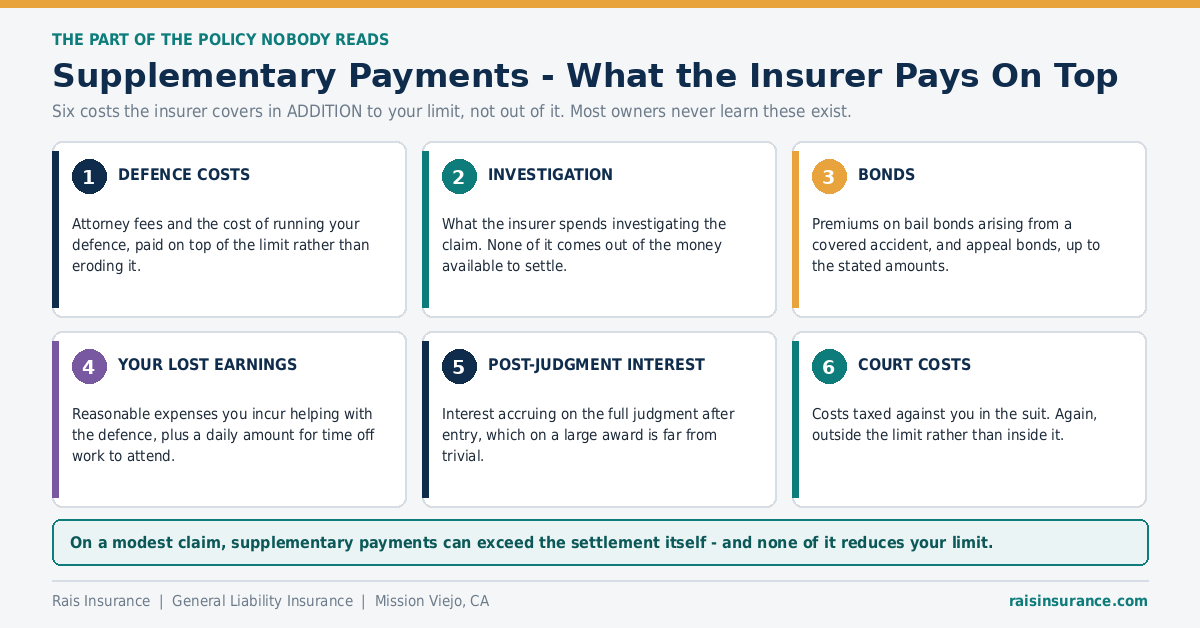
The original version of this page listed attorney expenses, the insurer’s investigation, the settlement or judgment, and any bonds that may be posted. That list is accurate, and it is pointing at something with a name almost nobody uses: supplementary payments. This is one of the most valuable sections of a general liability policy and one of the least read.
These costs are paid in addition to your limit rather than deducted from it, which means they do not reduce the money available to settle the claim:
- Defence costs. Attorney fees and the cost of running your defence. On a standard form this sits outside the limit, and for most small businesses it is worth more than the limit itself.
- Investigation. What the insurer spends looking into a claim it may have to pay. None of it comes out of your money.
- Bonds. The premium on bail bonds arising out of a covered accident, and on appeal bonds, up to the amounts stated in the policy. Note the wording: the insurer pays the bond premium, it does not furnish the bond.
- Your reasonable expenses. What it costs you to help with the defence, including a daily amount for earnings lost while attending hearings or trial at the insurer’s request.
- Post-judgment interest. Interest accruing on the full judgment after it is entered. On a large award, over a long appeal, this is not a trivial figure.
- Court costs. Costs taxed against you in the suit, again outside the limit.
The practical point: on a modest claim, supplementary payments can exceed the settlement itself. When you compare two quotes, whether defence costs sit inside or outside the limit matters more than a difference of a few dollars in premium.
Alcohol: The Exclusion Most Owners Never Check
This needs correcting carefully, because the answer is genuinely split and the previous version of this page came down on the wrong side of it.
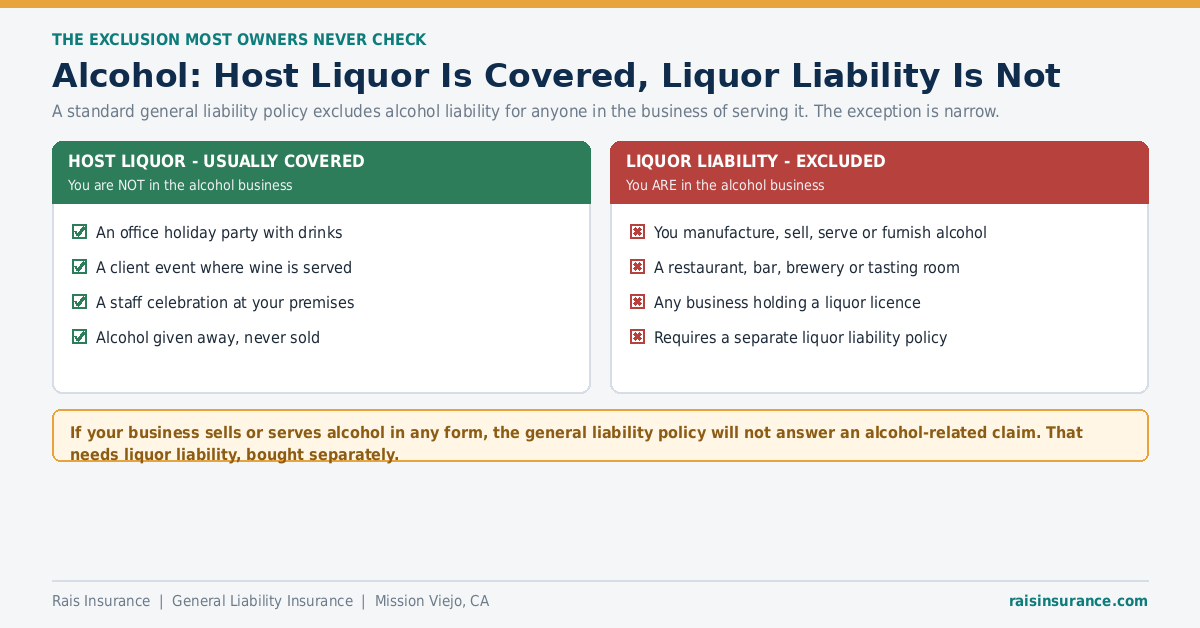
A standard general liability insurance policy contains a liquor liability exclusion. It removes cover for any business that manufactures, sells, serves or furnishes alcohol, or that holds a liquor licence. If that describes your Mission Viejo business – a restaurant, a bar, a brewery, a tasting room – the general liability policy will not answer an alcohol-related claim. That requires a separate liquor liability policy.
The exception, and it is a real one, is host liquor liability. If you are not in the alcohol business but alcohol is served at something you host – an office holiday party, a client event, a staff celebration – a standard policy generally does respond. The line is whether serving alcohol is part of your business or incidental to it.
So the honest version of the original claim is this: cover for alcohol-related incidents involving your employees exists if you are not in the alcohol trade, and does not if you are. Given how much of south Orange County’s business base is hospitality, that is worth checking on your own schedule today rather than after an incident. The full set of related carve-outs is on our Costa Mesa page – the liquor, professional services and care-custody-control exclusions.
Known Risks and Unknown Risks Are Not the Same Thing
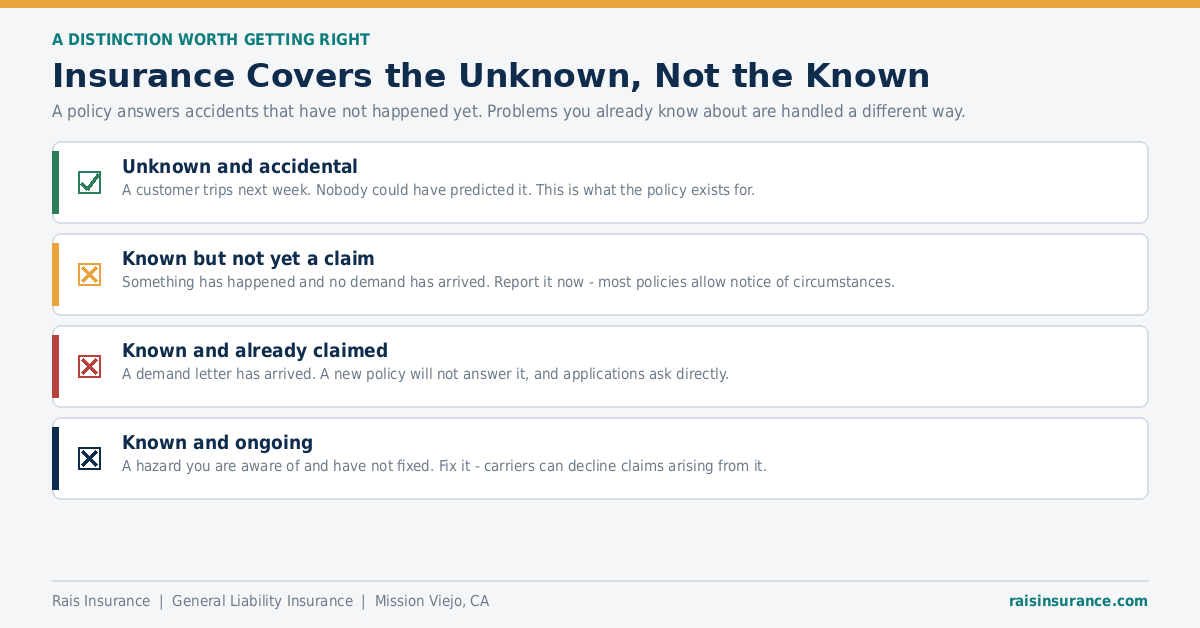
It is often said that liability cover keeps a business safe from both known and unknown risks. The unknown half is exactly right. The known half needs unpacking, because insurance works on uncertainty and a risk that has already materialised is treated differently.
- Unknown and accidental. A customer trips next week and nobody could have predicted it. This is precisely what the policy exists for.
- Known, but not yet a claim. Something has happened and no demand has arrived. Report it to your carrier now – most policies accept notice of circumstances, and doing so protects your position. See what to do in the first 48 hours after an incident.
- Known and already claimed. A demand letter has arrived. A policy bought now will not answer it, and applications ask about this directly.
- Known and ongoing. A hazard you are aware of and have not addressed. Fix it, because a carrier can decline claims arising from a condition you knew about and left in place.
None of that weakens the policy. It just means the protection is bought in advance of the problem rather than in response to it – see the four edges of any policy, and why cover cannot be bought after the fact.
Does the Policy Really Protect Your Employees?
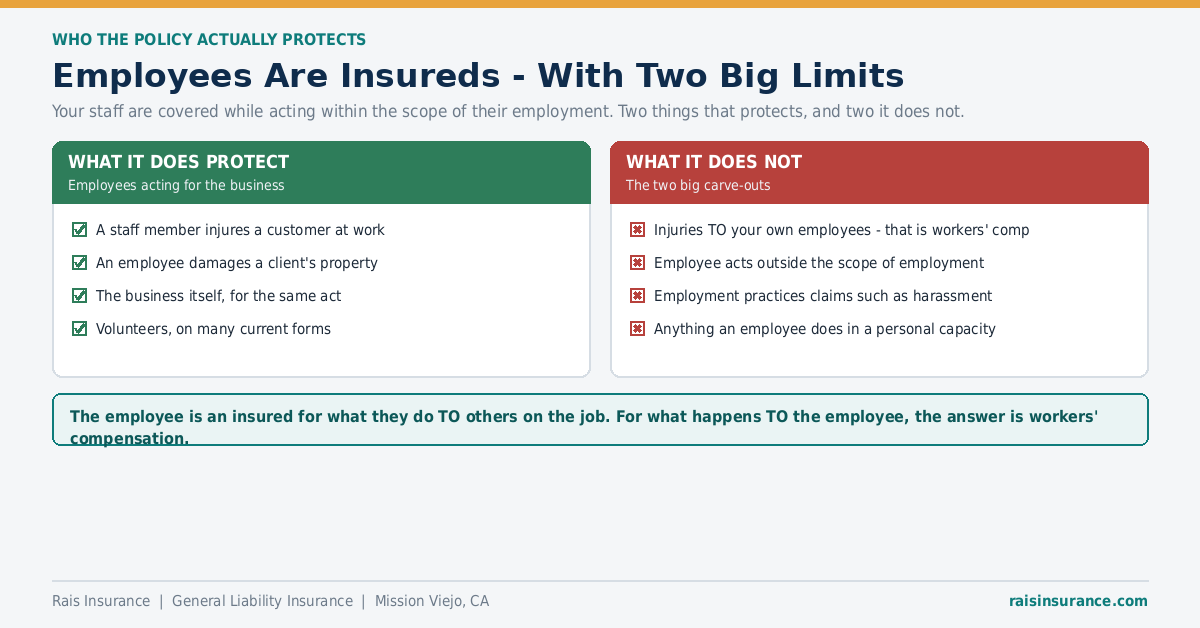
Yes, and the detail is worth having, because the answer is not unqualified. Your employees are insureds under the policy while acting within the scope of their employment. If a staff member injures a customer or damages a client’s property while working, both they and the business are covered. Many current forms extend the same status to volunteers.
Two carve-outs matter, and both are large:
- Injuries to your own employees are not covered here. That is workers’ compensation, and in California it is required from your first employee. See general liability paired with workers’ compensation.
- Employment practices claims are not covered either. Harassment, discrimination and wrongful termination allegations need employment practices liability insurance, a separate policy entirely.
The rule of thumb: the policy covers what your employee does to somebody else on the job. For what happens to the employee, the answer is workers’ compensation. If your team includes subcontractors as well as staff, what a licensed California contractor has to carry covers the certificate side of that.
Advertising, Copyright and What That Actually Means
Cover for advertising injury is real, and the original was right to flag copyright as part of it. The scope is narrower than it sounds, so it is worth stating precisely: the policy answers claims that you used another party’s advertising idea in your advertisement, or infringed a copyright, trade dress or slogan in your advertisement.
Three qualifications follow from that wording. It applies to your advertising, not to your products. Patent infringement is excluded. And it answers claims made against you – it does not fund a claim you bring against somebody who copied your work.
Settlements, Judgments, and Who Actually Decides
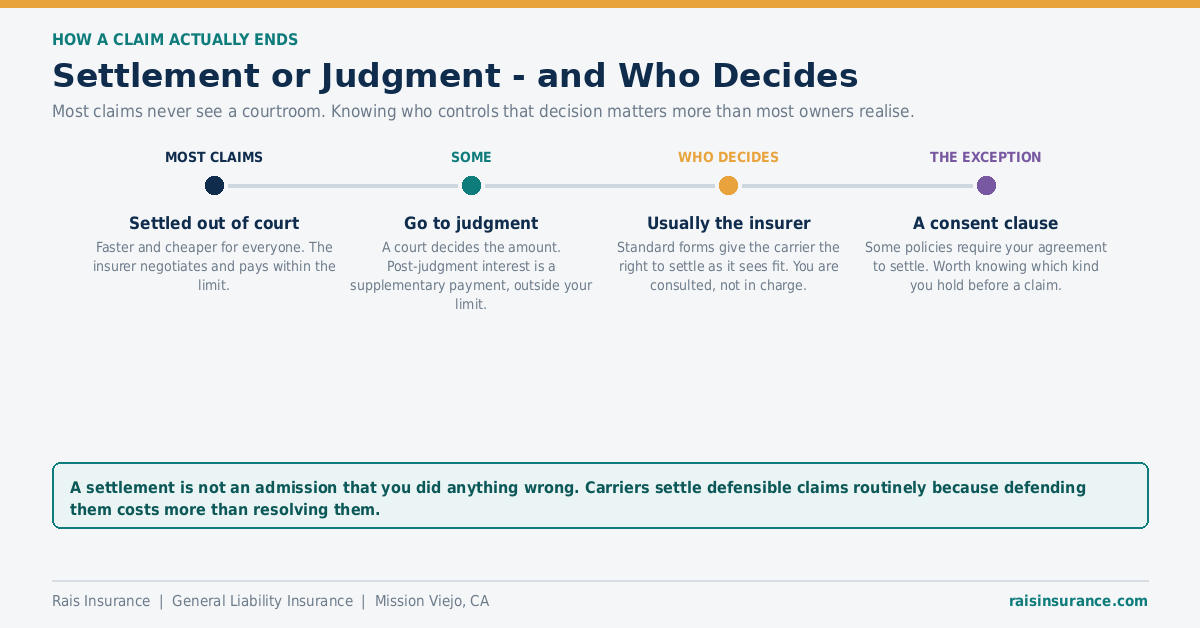
Most liability claims never reach a courtroom. They are settled, because resolving a matter early usually costs less than taking it to judgment even when the defence is strong.
Here is the part that surprises most business owners: under most standard general liability forms, the insurer has the right to settle a claim as it sees fit. You will normally be consulted, but the decision is generally the carrier’s rather than yours. Some policies carry a consent-to-settle clause requiring your agreement, and if your reputation in a community the size of Mission Viejo matters commercially, that is a feature worth asking about before you buy rather than during a claim.
One reassurance attached to that: a settlement is not an admission that you did anything wrong. Carriers settle defensible claims routinely as a commercial calculation, and settlement agreements normally say so explicitly.
Why Choose Rais Insurance
Rais Insurance places general liability insurance in Mission Viejo for businesses of every size, and we treat business liability insurance as something built around the situation and industry in front of us rather than around a template. We are a family-owned and operated firm, we work quickly, and we would rather hold a long relationship with a client than close a fast sale.
In practice that means telling you where a policy stops as clearly as where it starts. If your business serves alcohol, we will say so before you buy rather than after a claim. If your defence costs sit inside your limit, we will show you what that means in a real scenario. What drives the price itself is covered on our La Habra page – what actually sets your premium.
We serve Mission Viejo, Rancho Santa Margarita, San Juan Capistrano and Ladera Ranch from our Anaheim office, and we write across California.
General Liability Insurance Mission Viejo – Frequently Asked Questions
Q1. Does general liability insurance cover alcohol-related incidents?
It depends entirely on whether you are in the business of serving alcohol. A standard policy includes host liquor liability, which covers a business that is not in the alcohol trade but occasionally serves it – an office party, a client event. If your business manufactures, sells, serves or furnishes alcohol, the liquor liability exclusion applies and you need a separate liquor liability policy. That distinction catches out restaurants and bars regularly.
Q2. What are supplementary payments on a general liability policy?
They are costs the insurer pays in addition to your limit rather than out of it: defence and attorney costs, the insurer’s own investigation expenses, premiums on bail and appeal bonds arising from a covered accident, your reasonable expenses in helping with the defence including a daily amount for time off work, post-judgment interest, and court costs taxed against you. On a modest claim these can exceed the settlement itself.
Q3. Are my employees covered by my general liability policy?
Yes, as insureds, while acting within the scope of their employment – so if a staff member injures a customer or damages a client’s property, both they and the business are covered. Two important carve-outs: injuries TO your own employees go to workers’ compensation, not here, and employment practices claims such as harassment or wrongful termination need employment practices liability instead.
Q4. Does the policy cover known risks as well as unknown ones?
Insurance answers accidents that have not happened yet. A risk you already know has materialised is handled differently: if something has occurred but no demand has arrived, report it to your carrier now, since most policies accept notice of circumstances. If a demand letter has already arrived, a new policy will not answer it. And a hazard you know about and have not fixed is worth fixing, because carriers can decline claims arising from it.
Q5. Can my insurer settle a claim without my agreement?
Under most standard general liability forms, yes. The carrier has the right to investigate and settle any claim as it considers appropriate. You will normally be consulted, but the decision is generally theirs. Some policies contain a consent-to-settle clause requiring your agreement, and if reputation matters to your business that is a feature worth asking about before you buy rather than during a claim.
Q6. If my insurer settles, does that mean I did something wrong?
No. Carriers settle defensible claims routinely, because taking a matter through to judgment often costs more than resolving it early even when the defence is strong. A settlement is a commercial decision about cost and risk, not an admission of liability, and settlement agreements usually say so explicitly.
Q7. Does the policy pay for the investigation and the bonds too?
Yes, and both sit under supplementary payments rather than coming out of your limit. The insurer covers the cost of investigating a claim it may have to pay, and it covers the premium on bail bonds arising out of a covered accident and on appeal bonds, up to the amounts stated in the policy. It pays the bond premium – it does not furnish the bond itself.
Q8. Does general liability cover advertising and copyright issues?
It covers personal and advertising injury, which includes using another party’s advertising idea in your advertisement and infringing a copyright, trade dress or slogan in your advertisement. Note the limits of that: it applies to your advertising rather than to your products, patent infringement is excluded, and it answers claims made against you rather than funding a claim you bring.
Q9. How much does general liability insurance cost in Mission Viejo?
There is no flat rate. Premium is built from your classification code, your gross receipts or payroll, the limits you select, your claims history and how much work you subcontract. A professional office and a restaurant on the same street pay very differently for identical limits, because the exposures are not comparable. A broker can put the same information to several carriers and show you the spread.
Q10. What should I ask before buying a liability policy?
Four questions cover most of it. Do defence costs sit inside or outside the limit? Which exclusions actually apply to what I do – alcohol, professional services, care of others’ property? Can the insurer settle without my consent? And is the limit high enough for the contracts I have already signed? A broker who answers those specifically is worth more than one who quotes fastest.
Get a Free General Liability Quote in Mission Viejo
Get a free quote today and put the Rais Insurance confidence behind your business. contact Rais Insurance on 714-761-4336, email rai@raisinsurance.com, or visit 2612 W. Lincoln Avenue, Suite 103, Anaheim, CA 92801.
If you already hold a policy, bring the declarations page. Two things are worth checking in the first five minutes: whether defence costs sit inside or outside your limit, and whether the liquor exclusion applies to what you actually do.
