

Auto Insurance Brea California
What is less widely known is that California decides some of that for the carrier. State law fixes which factors must weigh most, and forbids three that are standard almost everywhere else. That makes auto insurance Brea drivers buy behave differently from a quote in most other states, and it changes which levers are worth pulling.
What California Law Says Must Come First
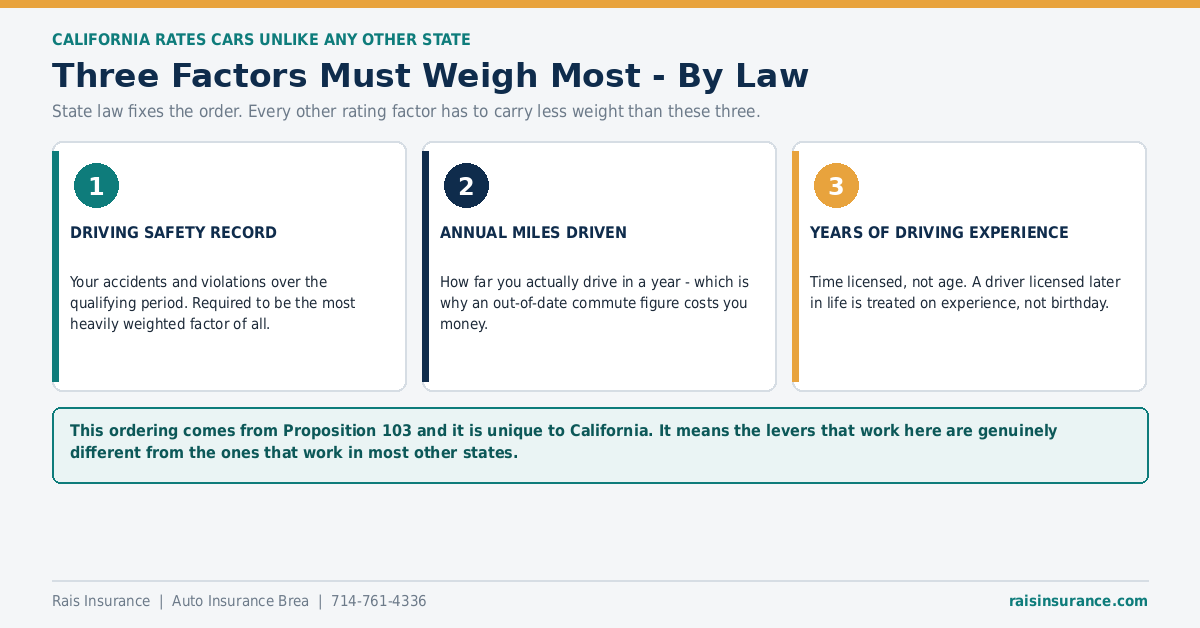
Three factors are required to carry the most weight in your car insurance rate, and every other factor has to weigh less than these:
- Your driving safety record. Accidents and violations over the qualifying period. Required to be the single most heavily weighted factor.
- Your annual miles driven. How far you actually drive in a year – which is why an out-of-date commute figure is genuinely expensive.
- Your years of driving experience. Time licensed, not age. A driver licensed later in life is rated on experience rather than birthday.
That ordering comes from Proposition 103, and it is unique to California. It also means the state’s Department of Insurance reviews and approves rate changes before carriers can use them – which is why rates here move differently from other markets.
And Three Things That Cannot Be Used at All
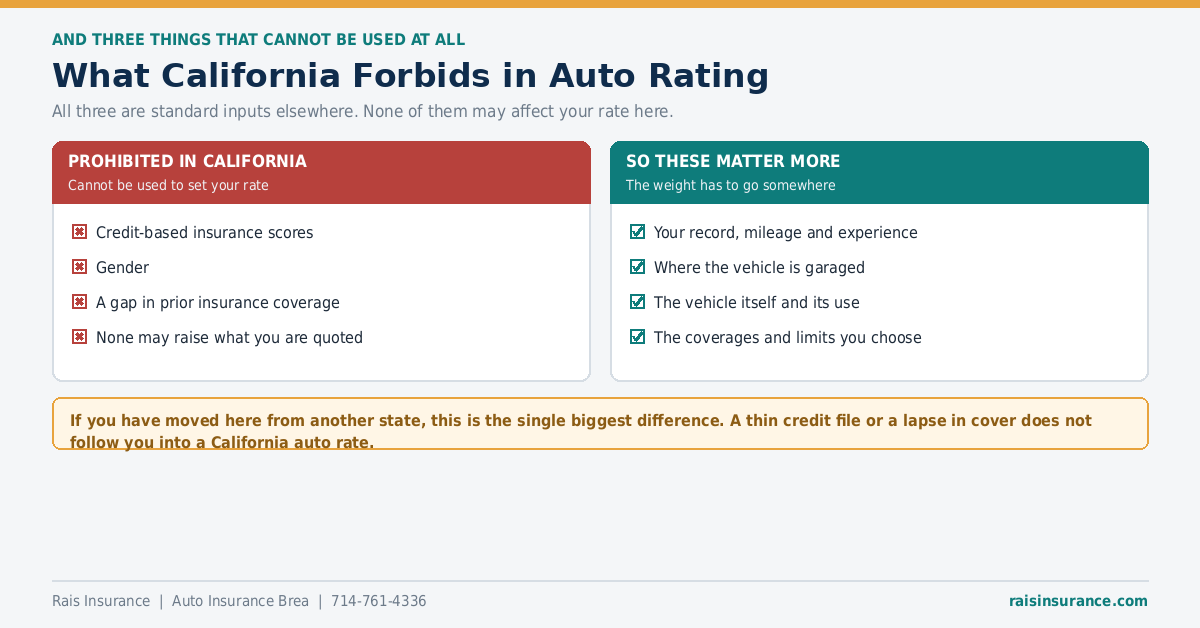
California prohibits three inputs that most states allow and many carriers weigh heavily:
- Credit-based insurance scores. A thin or poor credit file cannot raise a California auto rate.
- Gender. Removed as a permitted rating factor.
- A gap in prior coverage. Being uninsured previously carries its own penalties under state law, but it cannot be used to load your rate here.
If you have moved to Brea from another state, this is the single biggest difference and it is worth knowing before you accept that a rate cannot be improved. The weight has to fall somewhere – so it lands on your record, your mileage, your experience, the vehicle, where it is garaged, and the coverages you select.
What You Can Actually Change
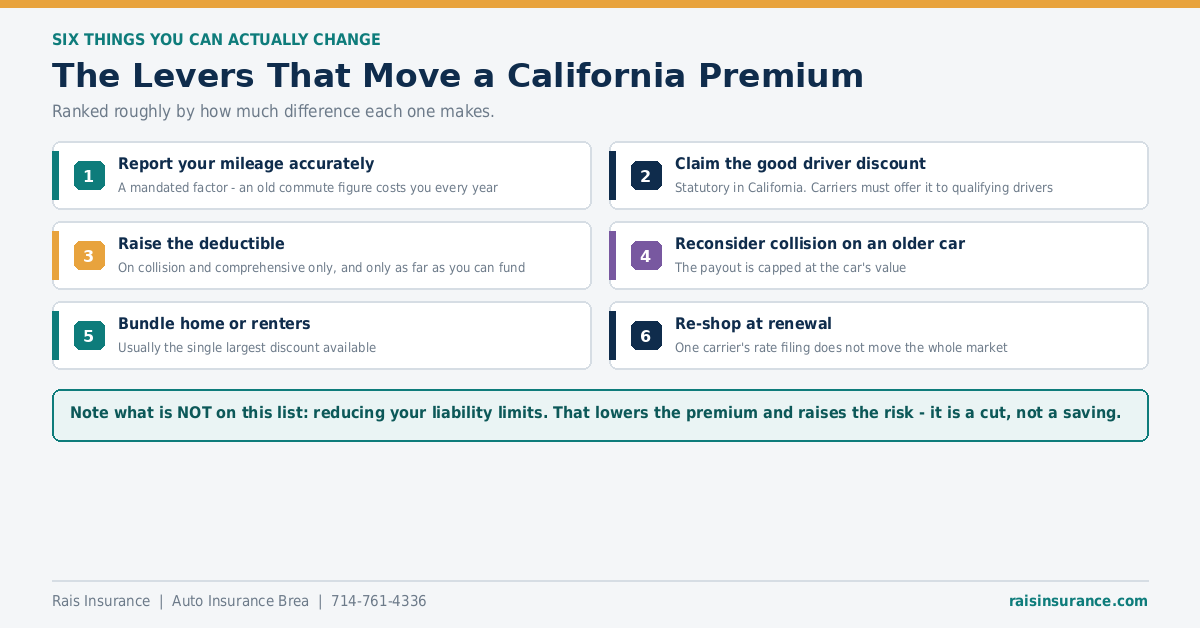
Six levers on your car insurance premium, roughly in order of how much difference they make:
- Report your mileage accurately. A mandated factor. If you reported a long commute years ago and now work closer to home or partly remotely, you are paying on miles you no longer drive.
- Claim the good driver discount. Statutory in California – carriers must offer it to qualifying drivers. Worth confirming you are receiving it rather than assuming.
- Raise the deductible, on collision and comprehensive only, and only as far as you could genuinely pay from savings.
- Reconsider collision on an older vehicle, where the payout is capped at the car’s value – see when collision and comprehensive stop earning their premium.
- Bundle with home insurance in California or renters cover. Usually the single largest discount available.
- Re-shop at renewal. One carrier’s rate filing does not move the whole market – see how to compare quotes across carriers.
Note what is not on that list: reducing your liability limits. That lowers the premium and raises the risk, which makes it a cut rather than a saving. How the limits work is set out on our how liability limits actually work page.
The Coverage List, Corrected
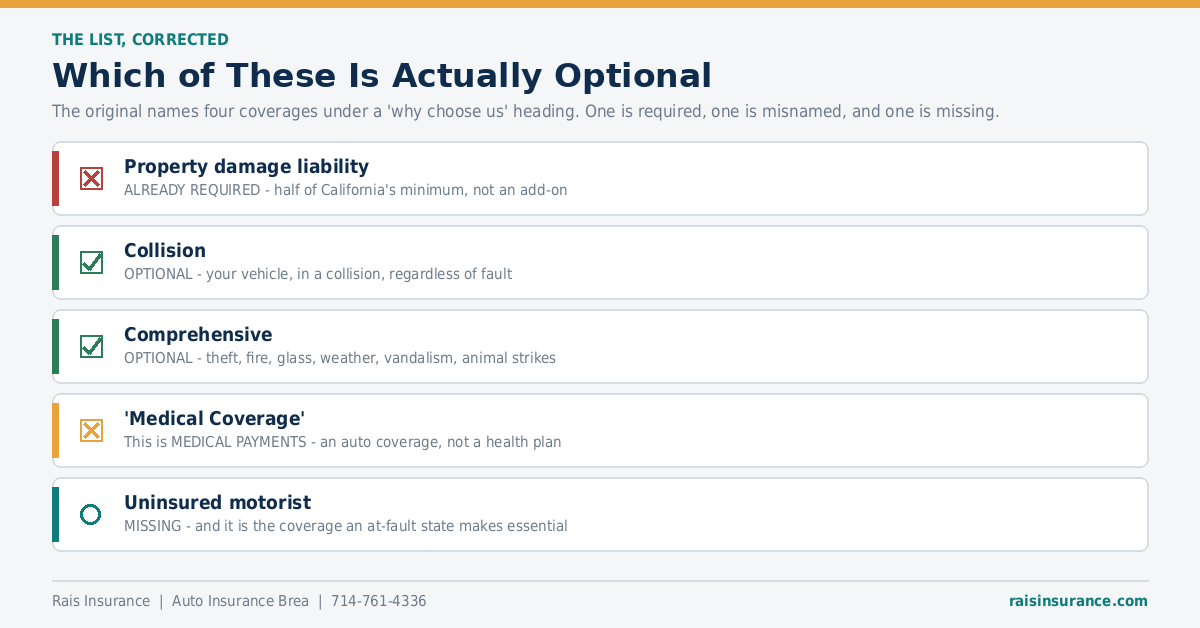
The original version of this page listed four auto insurance coverages. Sorted properly:
- Property damage liability – already required. It is half of California’s minimum, alongside bodily injury liability, so it is not an optional extra you add on top.
- Collision – optional. Your vehicle, in a collision, regardless of fault.
- Comprehensive – optional. Theft, fire, vandalism, falling objects, weather, glass and animal strikes.
- Medical payments – the original calls this “Medical Coverage”. It is an auto coverage that pays medical costs for you and your passengers without establishing fault. It is not a health plan.
- Uninsured motorist – missing from the original entirely, and it is the coverage an at-fault state makes essential. Optional here, and a carrier must obtain your decline in writing.
The original is right that California holds drivers individually responsible when they are at fault – that is what an at-fault state means, and it is why liability is the only coverage the law requires. It follows that what you recover after an accident depends on the other driver’s limits, which is exactly the gap uninsured motorist cover fills. The full coverage list sits on our auto insurance in California page.
Do You Need More Than the Minimum?
The original asks this and answers it well: some drivers feel financially safe on minimum cover, and while the premium is lower, sticking to bare liability can hurt badly when the worst happens. That is right, and worth making concrete.
Minimum auto insurance protects other people from you, up to a capped amount. It does nothing for your own vehicle, nothing for your own injuries, and nothing if the driver who hits you has no insurance. And once your limits are exhausted, the remainder of a claim is a personal debt.
The practical point is that higher limits cost far less than the first layer did, because serious claims are rare relative to ordinary ones. Most drivers carrying the minimum are doing so because nobody showed them the price of the alternative.
What Shapes a Rate in Brea
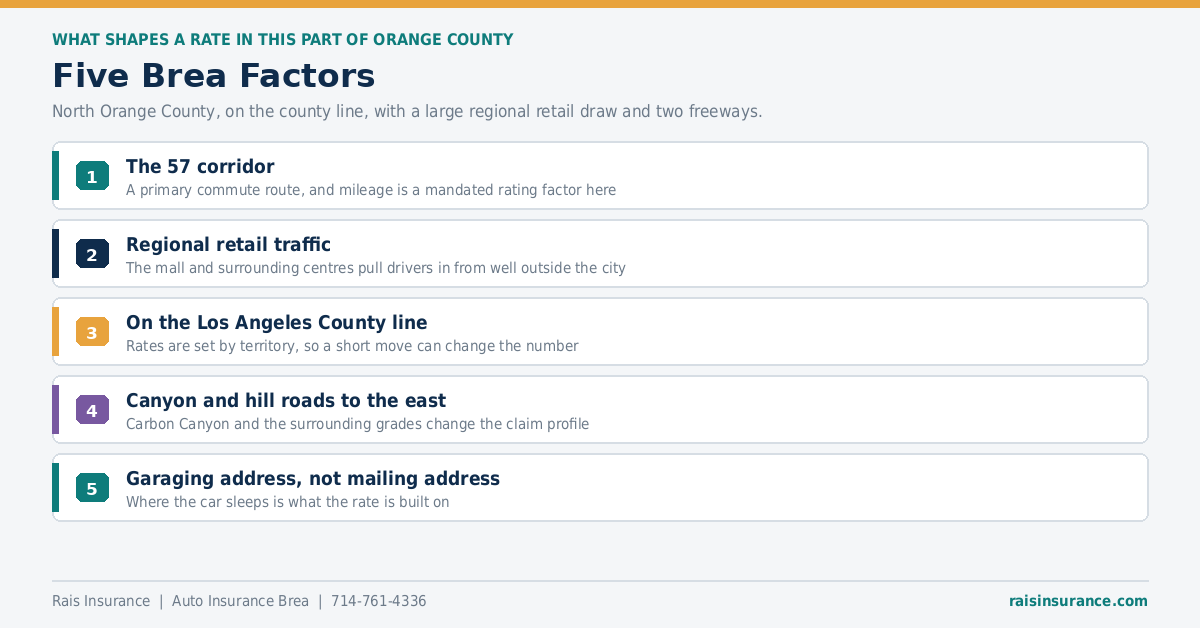
Five local factors shaping car insurance Brea rates, on top of everything above:
- The 57 corridor. A primary commute route through north Orange County, and annual mileage is one of the mandated factors.
- Regional retail traffic. The mall and surrounding centres draw drivers from well outside the city, which shows up in claim frequency.
- The Los Angeles County line. Rates are set by garaging territory, so a short move across the boundary can change the number materially.
- Canyon and hill roads to the east. Carbon Canyon and the surrounding grades produce a different claim profile from flat suburban driving.
- Garaging address, not mailing address. Where the vehicle actually sleeps is what the rate is built on, and an out-of-date address can cause problems at claim time.
Why Work With Rais Insurance
We are an independent broker, not an insurance company – the carrier issues the policy and pays the claim, and we place the business across a panel rather than selling one company’s products. One set of details from you gets quoted across several carriers, and there is no fee to you for the comparison: the carrier that writes the policy pays the broker. See the insurance companies we represent.
That matters more than usual here, because carriers weigh territory and vehicle differently from one another – and Brea sits on a county line where those differences show up.
We place auto insurance Brea households rely on, working across Southern and Northern California from our office in Anaheim, about fifteen minutes down the 57. For what a policy will never cover at all, see what auto insurance does not cover.
Auto Insurance in Brea – Frequently Asked Questions
Q1. What determines my car insurance rate in California?
California law fixes the top of the list. Your driving safety record, your annual miles driven and your years of driving experience must weigh most heavily, in that order, and every other factor has to carry less weight than those three. After them come the vehicle itself, where it is garaged, how it is used, and the coverages and limits you choose.
Q2. Does my credit score affect my car insurance in California?
No. California prohibits the use of credit-based insurance scores in auto rating, which makes it unusual – most states permit it and many carriers weigh it heavily. If you have moved here from elsewhere and were quoted poorly on credit, that factor simply does not apply to a California auto policy.
Q3. Can insurers use gender to rate car insurance here?
No. Gender is prohibited as an auto rating factor in California. Along with credit scores and prior-coverage gaps, it is one of three inputs that are standard elsewhere and unavailable here – which means the weight has to fall on your record, your mileage and your experience instead.
Q4. Will a gap in coverage raise my rate?
Not in California, where penalising a lapse in prior insurance is prohibited as a rating factor. That said, driving uninsured carries its own penalties under state law, and a gap can complicate placement with some carriers for other reasons – so it is still worth avoiding, just not for the rating reason people expect.
Q5. What is the California good driver discount?
A discount state law requires carriers to offer to drivers who meet the statutory good driver definition – broadly, a clean enough record over the qualifying period. It is worth confirming you are actually receiving it rather than assuming, because it is one of the larger single reductions available and it is not always applied automatically.
Q6. Does annual mileage really change my premium?
Yes, and more than in most states – it is one of the three factors California requires to weigh most heavily. That makes an out-of-date figure genuinely expensive: if you reported a long commute years ago and now work closer to home or partly remotely, you may be paying on mileage you no longer drive.
Q7. Why does my neighbour pay less than I do?
Usually the record, the mileage or the vehicle – but territory matters too. Rates are set by garaging territory rather than by city, and Brea sits close to the Los Angeles County line, so addresses a short distance apart can rate differently. The address on the policy should be where the car actually sleeps.
Q8. Is property damage liability optional?
No. Property damage liability is one of the two coverages California requires, alongside bodily injury liability. Any policy that meets the state minimum already includes it – so it is not something you add on top. What is optional is collision, comprehensive, medical payments and uninsured motorist cover.
Q9. Do I need uninsured motorist coverage?
It is optional in California, and a carrier must offer it and obtain your decline in writing. Whether you need it follows from the at-fault system: what you recover after an accident depends on the other driver’s limits, so a driver with no coverage leaves you nothing to claim against. Your own uninsured motorist cover is what fills that gap.
Q10. How do I get a Brea auto insurance quote?
Call Rais Insurance on 714-761-4336, email rai@raisinsurance.com, or visit 2612 W. Lincoln Avenue, Suite 103, Anaheim, CA 92801 – about fifteen minutes down the 57. We are an independent broker, so one set of details is quoted across several carriers, and there is no fee to you for the comparison.
Get a Car Insurance Quote in Brea
For car insurance Brea quotes, contact Rais Insurance on 714-761-4336, email rai@raisinsurance.com, or visit 2612 W. Lincoln Avenue, Suite 103, Anaheim, CA 92801.
Two things worth checking before you call: your current annual mileage figure, and whether the garaging address on the policy is still where the car sleeps. Both are mandated or near-mandated factors, and both go stale quietly.
