

Guide on Compare Insurance Rates in California
There is also something specific to this state that most rate-comparison advice skips entirely. California regulates how auto insurance California carriers are allowed to calculate your rate, more tightly than almost anywhere else in the country. Three factors have to come first by law, two common ones cannot be used at all, and one discount is compulsory. Knowing that changes what you look for.
How California Actually Sets Your Rate
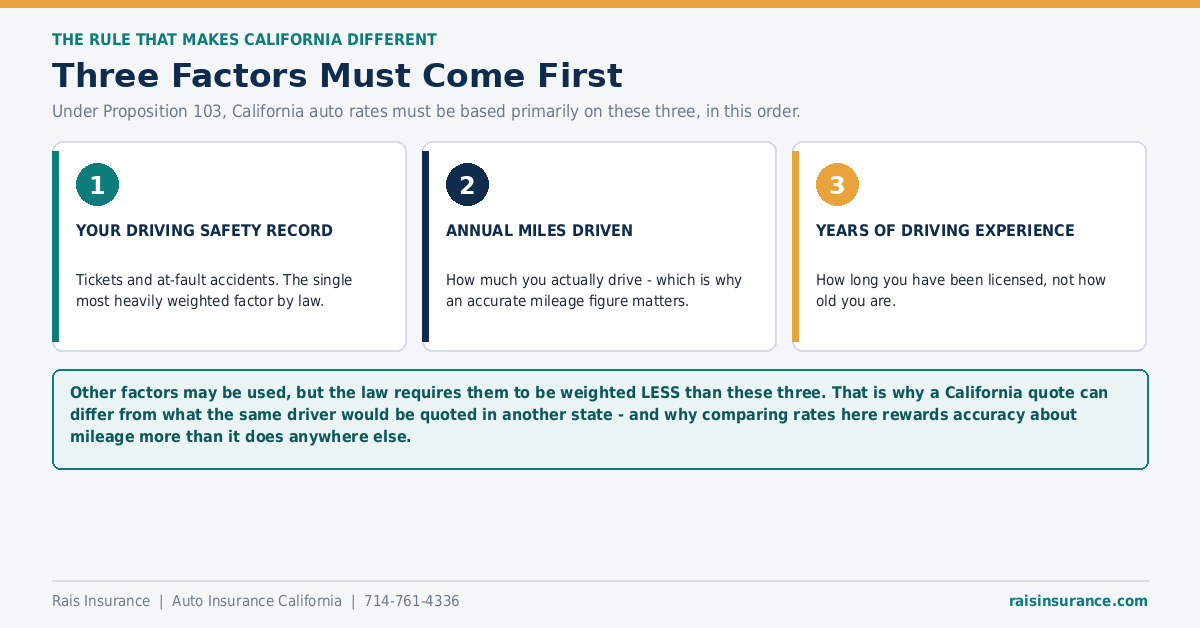
Under Proposition 103, private passenger auto rates in California must be based primarily on three factors, weighted in this order:
- Your driving safety record. Tickets and at-fault accidents. By law this is the most heavily weighted input.
- Your annual mileage. How much you actually drive – which is why giving an accurate figure matters more here than in most states, and why genuinely low-mileage drivers should always get fresh quotes.
- Your years of driving experience. How long you have held a licence, which is not quite the same as your age.
Other factors can be used, but the regulations require them to carry less weight than those three. It is also worth knowing that California operates a prior-approval system: insurers cannot simply change rates: increases have to be filed with and approved by the Insurance Commissioner. That is part of why California auto insurance rates move on a different rhythm from other states.
What cannot be used
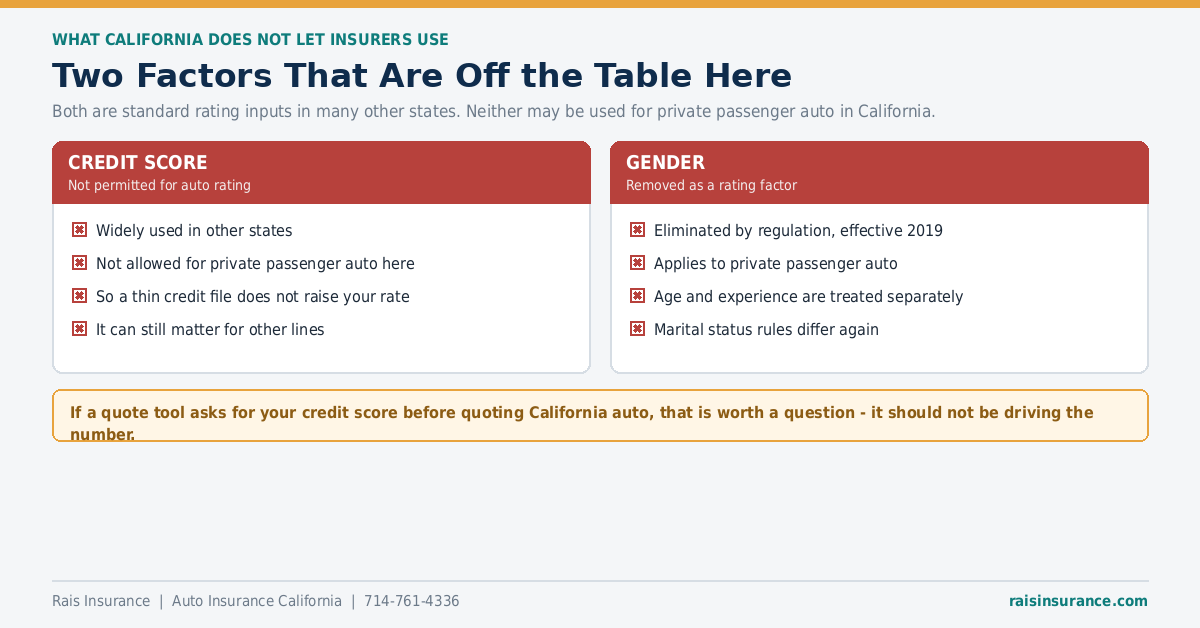
Two inputs that are standard elsewhere are off the table here:
- Credit score. California does not permit credit-based insurance scores in private passenger auto rating. In many states a thin or damaged credit file raises your premium substantially. Here it should not be part of the calculation at all.
- Gender. Removed as a rating factor for private passenger auto by regulation, effective 2019.
That is worth carrying into a comparison. If an online tool asks for your credit score before quoting California auto cover, it is fair to ask what it is being used for.
Coverage – and the Older Car Question
Different insurers offer different coverage, and changing a policy variable changes the quoted rate – so comparing like with like is the whole exercise. Adjust the limit or the deductible on one quote and not the other, and the car insurance quotes in front of you are no longer comparable.
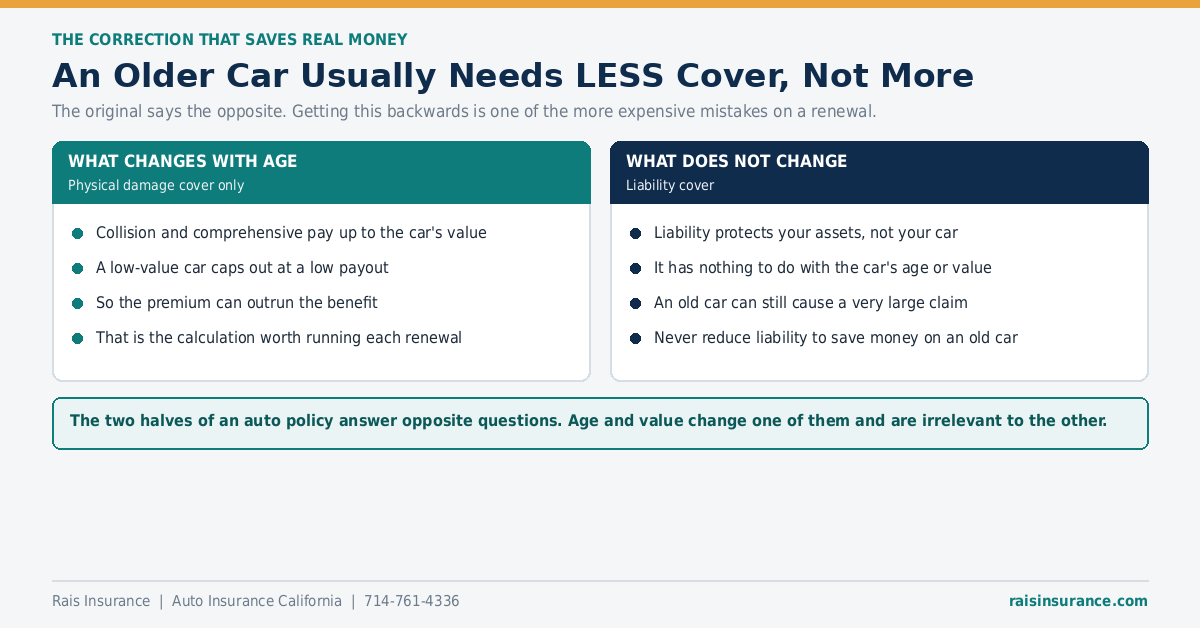
One correction worth making, because getting it backwards costs real money. The original version of this guide suggested that older cars may need more cover. In practice the opposite is usually true, and the reason is worth understanding:
- Collision and comprehensive pay up to the car’s actual cash value. On a low-value vehicle the payout is capped low while the premium is not, so each renewal is worth a quick calculation: what would this car actually pay out, and how does that compare with what I am paying to insure it?
- Liability is a completely different question. It protects your assets rather than your car, and it has nothing to do with the vehicle’s age or value. An old car can cause a very large claim. Reducing liability limits to save money on an old vehicle is the one change not to make.
A genuinely valuable older vehicle is a separate case again, and often better served by an agreed-value policy – see classic car insurance.
The Scorecard, Filled In
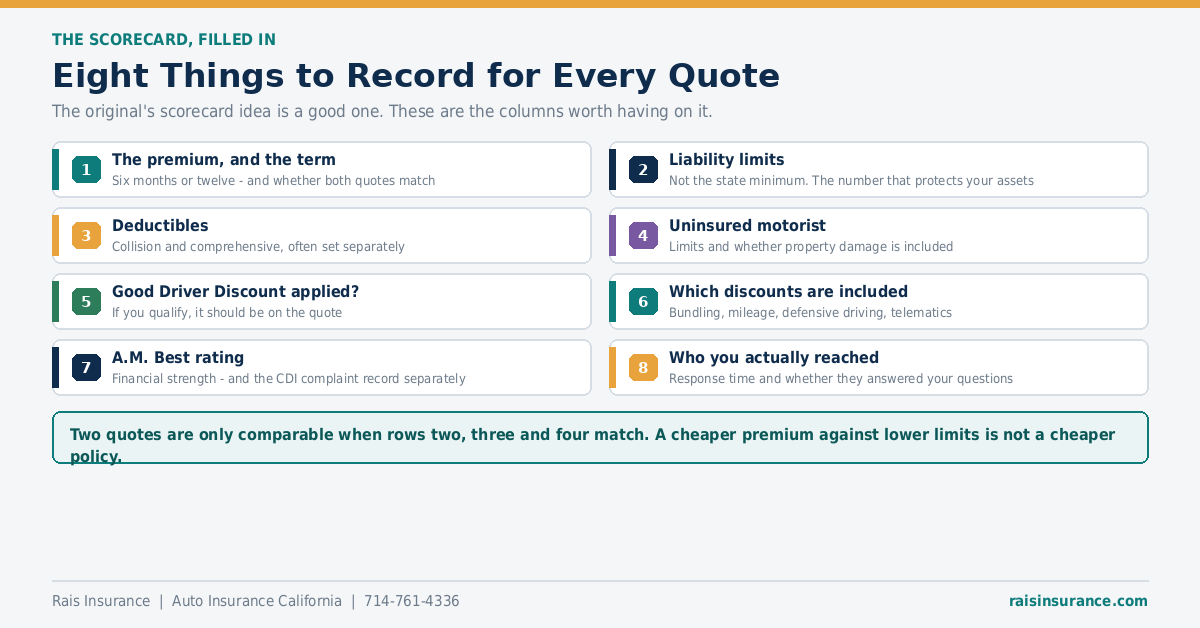
Keeping a scorecard while you shop is a good idea and the original guide is right to suggest one. These are the columns worth having on it:
- The premium, and the policy term. Six months or twelve. Check this first, because a cheaper number may simply cover half the time.
- Liability limits. Not the state minimum – the number that would actually protect your assets in a serious claim.
- Deductibles. Your collision deductible and your comprehensive deductible are often set separately, so check both.
- Uninsured and underinsured motorist. Limits, and whether property damage is included. Frequently the line that differs between two otherwise identical quotes.
- Whether the Good Driver Discount is applied. If you qualify, it should be on the quote.
- Which other discounts are included. Bundling, mileage, defensive driving, telematics.
- The carrier’s A.M. Best rating, plus its complaint record with the California Department of Insurance – two different questions.
- Who you actually spoke to. Response time, and whether your questions were answered clearly. The original is right that this matters, and it is the column people forget to write down.
Two quotes are only comparable when the limits, deductibles and term match. A cheaper premium against lower limits is not a cheaper policy – it is a smaller policy.
Financial Strength and Claims Record
Checking a carrier’s profile and financial position before you buy is sound advice, and there are two specific places to look rather than a general web search.
A.M. Best publishes financial strength ratings for most carriers writing in the United States – that tells you whether a company can pay claims. The California Department of Insurance publishes complaint data by carrier – that tells you something about how claims actually run. A company can be strong on the first measure and unremarkable on the second, which is why both are worth a look.
Policy Term, and Switching Mid-Year
Auto policy lengths vary more than most other lines, so the term matters when you are contrasting carriers. A twelve-month policy holds your rate for longer – which helps if rates are rising and works against you if they fall, or if your own record is about to improve. A six-month term reprices sooner in both directions.
On switching: you are free to change carrier mid-term, and you receive a refund of the unused premium, normally calculated pro rata. Two practical points – check whether your current carrier applies a cancellation fee, and make sure the new policy is bound before the old one ends. A gap in coverage, even a short one, can affect what you are quoted afterwards.
The events genuinely worth re-quoting for are the ones that change a mandatory rating factor: a violation dropping off your record, a significant change in annual mileage, moving, adding or removing a driver, or a change of vehicle.
Discounts – Including One That Is Not Optional
Almost every carrier offers discounts, and many are not advertised – so asking directly is more effective than reading the website. The most important one in this state is not a marketing offer at all.
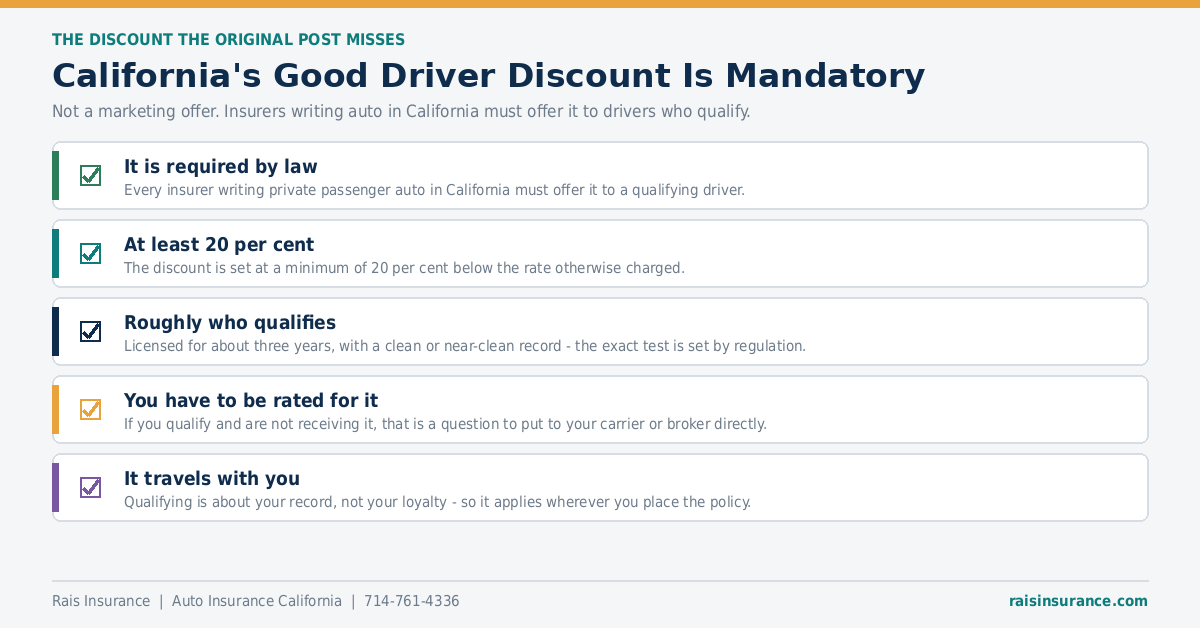
California’s Good Driver Discount is required by law. Insurers writing private passenger auto here must offer it to a qualifying driver, and it is set at a minimum of 20 per cent below the rate otherwise charged. Broadly, it applies to drivers licensed for around three years with a clean or near-clean record, though the precise test is set by regulation. If you believe you qualify and it is not on your quote, that is a question to put directly rather than something to negotiate.
Beyond that, the ones worth asking about by name:
- Bundling – home insurance in California or renters insurance alongside your auto policy.
- Low annual mileage, which carries more weight here than elsewhere because mileage is a mandatory rating factor.
- Telematics or pay-per-mile programmes, which suit low-mileage drivers particularly well.
- Defensive driving course completion, good student, multi-vehicle, senior, and paid-in-full or paperless billing.
Putting It Together
So: compare coverage rather than price alone, keep a scorecard, check financial strength and claims record separately, mind the policy term, and ask about every discount including the one that is compulsory. Done properly that is an hour’s work, and it frequently changes which quote is actually cheapest — which is how people find genuinely cheap car insurance California carriers will still honour at claim time.
The shortcut is to have one set of details quoted by several carriers on the same basis, which is what a broker does. For auto insurance in California, call 714-761-4336.
Our other services: life insurance in California, home insurance in California, renters insurance and classic car insurance.
Comparing Insurance Rates in California – Frequently Asked Questions
Q1. How are car insurance rates calculated in California?
Differently from most states. Under Proposition 103, California requires private passenger auto rates to be based primarily on three factors, weighted in this order: your driving safety record, your annual mileage, and your years of driving experience. Other factors may be used, but the law requires them to carry less weight than those three.
Q2. Does my credit score affect my car insurance rate in California?
No. California does not permit credit-based insurance scores to be used in rating private passenger auto insurance, which is a meaningful difference from most other states. If a comparison tool asks for your credit score before quoting California auto cover, it is worth asking what it is being used for.
Q3. Is gender used to set auto rates in California?
No. Gender was eliminated as a rating factor for private passenger auto in California by regulation, effective in 2019. Age and years of driving experience are treated as separate questions, and experience is one of the three mandatory factors.
Q4. What is the Good Driver Discount and do I qualify?
It is a discount California law requires insurers to offer, set at a minimum of 20 per cent below the rate otherwise charged. Broadly it applies to drivers who have been licensed for around three years with a clean or near-clean record, though the precise eligibility test is set by regulation. If you believe you qualify and it is not showing on your quote, ask directly – it is not something you have to negotiate for.
Q5. Should I drop collision and comprehensive on an older car?
It is worth calculating each renewal. Collision and comprehensive pay up to the car’s actual cash value, so on a low-value vehicle the payout is capped low while the premium is not. When the annual cost approaches a meaningful share of what the car would pay out, dropping them can make sense. Liability is a completely different question and should not be reduced – it protects your assets, not your car.
Q6. Does an older car need more insurance?
No, and the opposite is closer to the truth. Age reduces what physical damage cover is worth to you, because the payout is limited by the car’s value. It changes nothing about your liability needs, which depend on what you could be sued for rather than what you drive.
Q7. Can I switch insurers in the middle of a policy term?
Yes. You can cancel mid-term and receive a refund of the unused premium, usually calculated pro rata. It is worth checking whether your carrier applies any cancellation fee, and worth making sure the new policy is bound before the old one ends so there is no gap – a lapse in coverage can affect what you are quoted later.
Q8. Is a six-month or twelve-month policy better?
Neither is inherently better, but they are not comparable side by side. A twelve-month term locks your rate for longer, which helps if rates are rising and hurts if they are falling or if your record is about to improve. A six-month term reprices sooner in both directions. When comparing quotes, check the term first – a cheaper number may simply cover half the time.
Q9. What discounts should I be asking about?
Beyond the mandatory Good Driver Discount: bundling home or renters with auto, low annual mileage, defensive driving course completion, telematics or pay-per-mile programmes, good student, multi-vehicle, and paid-in-full or paperless billing. Many are not advertised, so asking directly is usually more effective than reading the website.
Q10. How do I compare quotes properly?
Make sure the liability limits, deductibles and policy term match before you look at price – a cheaper premium against lower limits is not a cheaper policy. A broker can put one set of details to several carriers and return quotes built the same way. Call Rais Insurance on 714-761-4336 or email rai@raisinsurance.com.
Get Quotes Compared on the Same Basis
contact Rais Insurance on 714-761-4336, email rai@raisinsurance.com, or visit 2612 W. Lincoln Avenue, Suite 103, Anaheim, CA 92801.
Have your current declarations page to hand. Your liability limits, your deductibles and your annual mileage are the three lines that decide most of what a fresh quote will say.