

Hotel Insurance Coverage & Quotes in California
The right hotel insurance programme addresses all of those at once, and good hotel liability insurance is only one part of it. This hotel insurance coverage guide sets out the ten policies a California hotel typically needs, which one is legally required, and the four gaps that most often turn up when we review an existing programme.
What California Actually Requires of an Employer
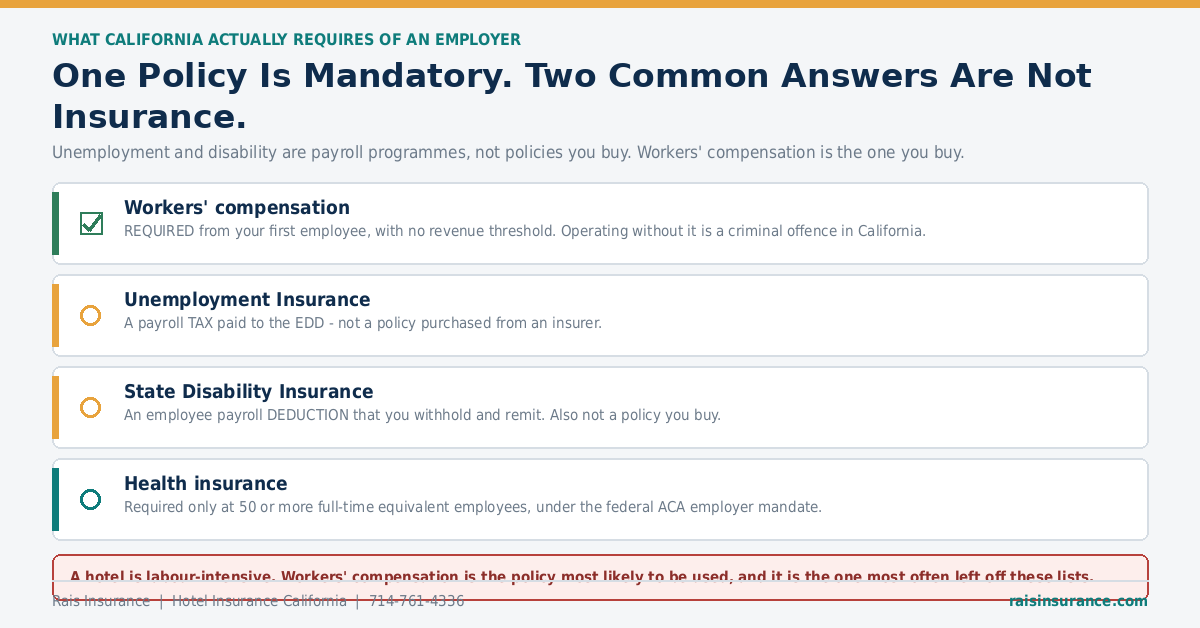
It is worth being precise here, because this is commonly explained in a way that misses the one policy that matters.
- Workers’ compensation is required – from your first employee, with no revenue threshold. Operating without it while having employees is a criminal offence in California. For a hotel, which is labour-intensive and has real injury exposure in housekeeping, kitchens and maintenance, this is also the policy most likely to be used. See workers’ compensation and what California requires of employers.
- Unemployment insurance is a payroll tax, not a policy you buy. Employers pay it to the Employment Development Department; there is no insurer and no quote.
- State disability insurance is an employee deduction that you withhold and remit on their behalf. Again, not a policy purchased by the business.
- Health insurance becomes a requirement at 50 or more full-time equivalent employees, under the federal ACA employer mandate. Below that threshold it is optional, though frequently offered.
So of the things usually listed as legally required, two are payroll administration rather than insurance – and the one that genuinely is required is the one most often left off the list.
The Programme a Hotel Actually Carries
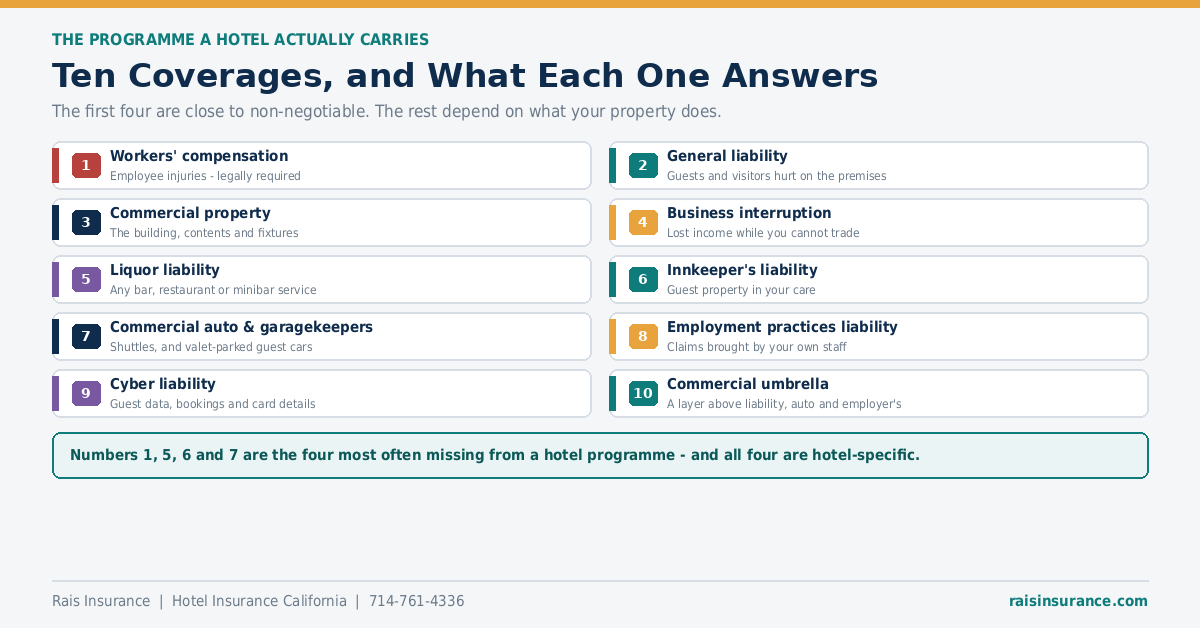
The original framing on this page was right in outline: a hotel policy answers liability on one side and property on the other, and a hotel represents a large capital investment that needs protecting. Filled in properly, a complete hotel insurance programme looks like this:
- Workers’ compensation – employee injuries. Required, as above.
- General liability – the core of hotel liability insurance: guests and visitors injured on the premises, and your legal defence.
- Commercial property – the building, fixtures, furniture and contents. See commercial building and property insurance in Anaheim.
- Business interruption – lost room revenue and continuing expenses while covered damage stops you trading. The original refers to this as financial loss from a loss in business; the product has a name and it is worth asking for by it.
- Liquor liability – any bar, restaurant, banquet or minibar service. Covered in detail below.
- Innkeeper’s liability – guest property in your care. Also below.
- Commercial auto and garagekeepers – shuttles you operate, and guest vehicles your valet staff handle.
- Employment practices liability – claims brought by your own staff about how they were treated.
- Cyber liability – guest data, booking systems and card details.
- Commercial umbrella – a further layer above general liability, auto and employer’s liability at once. The original calls this umbrella coverage and is right that it is what stands between a catastrophic claim and the business. See how much cover a business should carry.
Liquor liability – the exclusion that catches hotels
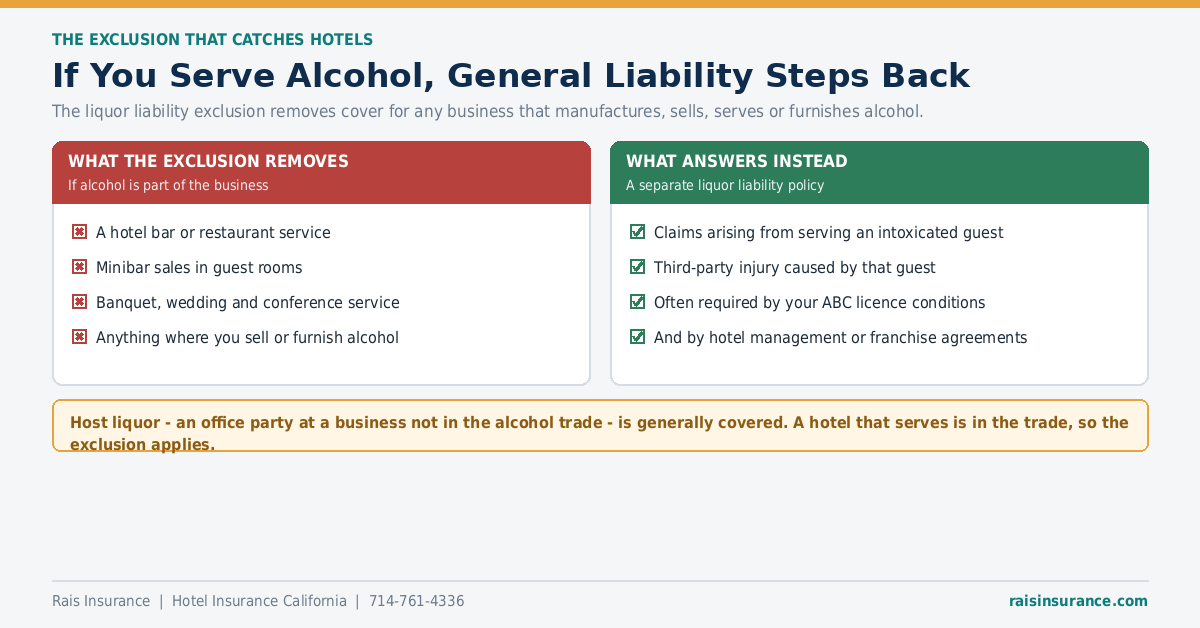
This is the single biggest gap we find on hotel insurance programmes, and it is not obvious from reading a general liability policy casually. The standard form carries a liquor liability exclusion that removes cover for any business which manufactures, sells, serves or furnishes alcohol.
A hotel with a bar, a restaurant, banquet service or even minibar sales is in that category. So a claim arising from serving an intoxicated guest – including injury that guest then causes to somebody else – falls outside general liability entirely and needs a separate liquor liability policy. It is also frequently required by ABC licence conditions and by franchise or management agreements. The distinction from host liquor cover is set out on our host liquor versus liquor liability page.
Innkeeper’s liability – guest property in your care
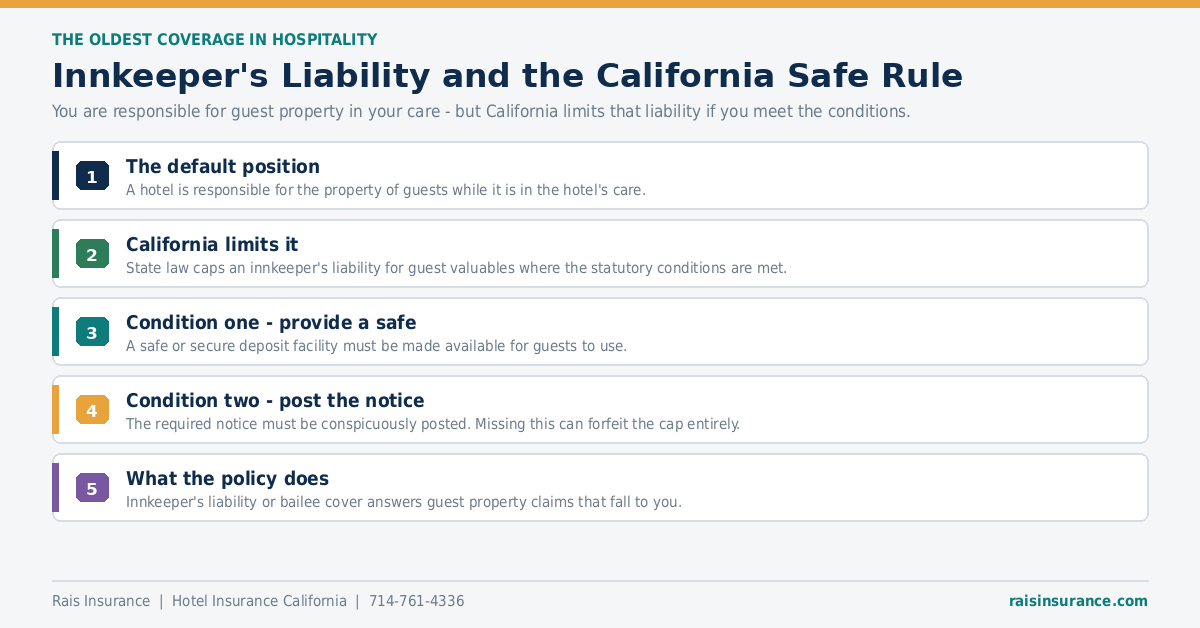
A hotel is responsible for guests’ property while it is in the hotel’s care, which is the oldest coverage question in hospitality. It matters that general liability excludes property in your care, custody or control – so this needs its own answer.
California law limits an innkeeper’s liability for guest valuables where certain statutory conditions are met – broadly, that a safe or secure deposit facility is made available and that the required notice is conspicuously posted. That second condition is worth taking seriously, because failing to post the notice can forfeit the protection entirely. Innkeeper’s liability or bailee cover then answers the claims that do fall to you.
Coverage Options Worth Adding
Beyond the core hotel insurance programme, several options are worth considering depending on what your property does. The original page names four of these, and all four are legitimate:
- Guest relocation cover – the cost of moving guests elsewhere, and the related losses, after a covered event makes rooms unusable. A genuinely hotel-specific coverage and a good one to know about.
- Event cancellation cover – where an event is cancelled because of power failure, property damage or equipment failure, this compensates the costs involved and the revenue lost. Valuable for any property with meaningful banquet or conference business.
- Foodborne illness liability – claims from guests who become ill. Treatment varies between forms, so it is worth confirming whether yours includes it, endorses it, or applies a separate sub-limit.
- Cyber liability – the original describes this accurately. A breach can expose guest names, addresses and card details, bringing notification costs, regulatory exposure and claims from affected guests. General liability will not respond, because the standard form states that electronic data is not tangible property – see what general liability does not cover.
- Assault and battery cover – frequently sub-limited or excluded outright in hospitality policies. Worth checking as its own line rather than assuming it sits inside general liability.
One correction on the original list. Goods in transit and livestock cover is not a hotel exposure – that wording belongs to agricultural haulage rather than hospitality. If your property does move goods regularly, the relevant products are motor truck cargo or bailee cover, and we can look at those. But no hotel needs livestock transit insurance.
Hotels in Anaheim and the Orange County Resort Corridor
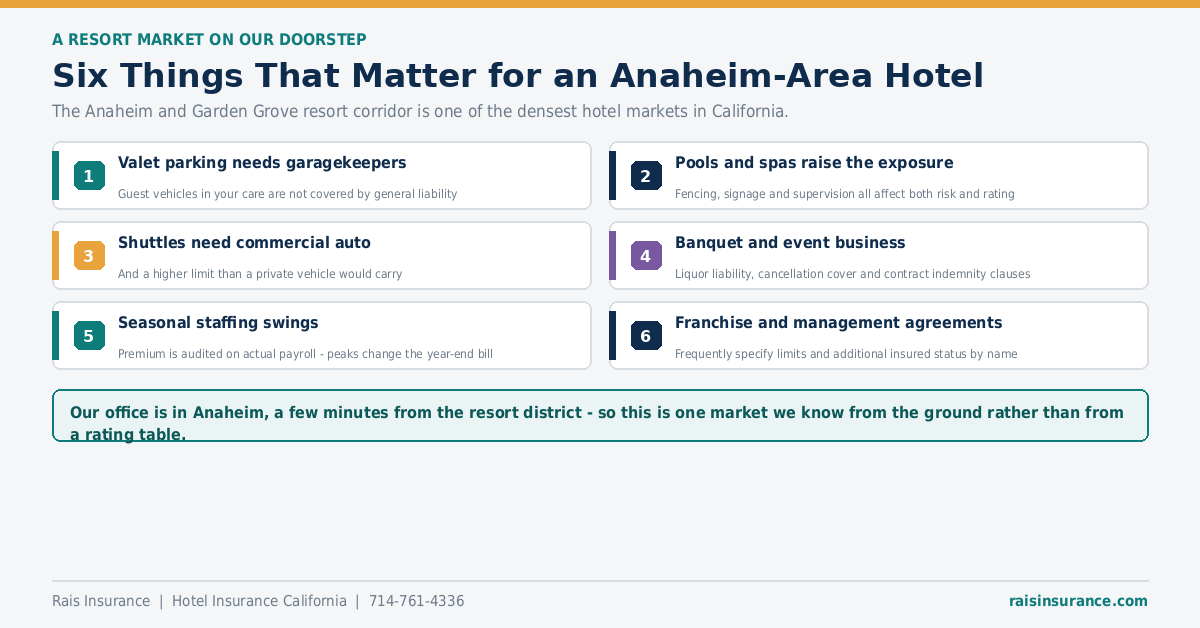
Our office is in Anaheim, a few minutes from one of the densest hotel markets in California. Six things come up repeatedly on properties in this corridor:
- Valet parking needs garagekeepers cover. Guest vehicles in your care are excluded from general liability and are not your commercial auto liability either.
- Pools and spas raise the exposure materially. Fencing, signage, depth markings and supervision all affect both the risk and the rate.
- Shuttle services need commercial auto at a higher limit than a private vehicle would carry, and drivers need to be scheduled properly.
- Banquet and event business brings liquor liability, cancellation cover and contract indemnity clauses all at once.
- Seasonal staffing swings matter because premium is audited on actual payroll – a peak season changes the year-end bill. See what actually sets your premium, and the year-end audit.
- Franchise and management agreements frequently specify required limits and additional insured status by name. Those clauses are worth reading before renewal rather than after.
What Hotel Insurance Costs
Hotel insurance is priced on the property, so there is no flat rate and any figure quoted without knowing yours is guesswork. Premium is built from your classification, room count, revenue, payroll, claims history, the limits you select, and specific exposures – a pool, a bar, valet parking, a shuttle, a commercial kitchen.
The practical value of a broker here is that hospitality is a specialist class. Putting one set of details to several carriers who actually write hotels produces a wider spread than filling in the same form on comparison sites, and it surfaces the coverage differences rather than just the prices.
Every Hotel Is Different
The hotel industry is dynamic, and every property has its own requirements – a forty-room motel off the freeway and a full-service resort with three restaurants and a conference floor need genuinely different programmes. What they share is the hotel insurance structure above; what differs is which options apply and at what limits.
Rais Insurance places hotel insurance California operators rely on, and hospitality insurance more broadly, and we would rather spend the first conversation working out what your property actually faces than quoting something generic. See also business insurance in California.
Hotel Insurance – Frequently Asked Questions
Q1. What insurance is legally required for a California hotel?
Workers’ compensation, from your first employee, with no revenue threshold – and operating without it while having employees is a criminal offence in California. Unemployment insurance and state disability are often described as required insurance, but they are payroll programmes rather than policies you buy: UI is an employer tax paid to the EDD, and SDI is an employee deduction you withhold and remit.
Q2. Does general liability cover alcohol service at a hotel bar?
No. The standard liquor liability exclusion removes cover for any business that manufactures, sells, serves or furnishes alcohol – which includes a hotel bar, restaurant service, banquet service and minibar sales. You need a separate liquor liability policy. Host liquor cover, which applies to a business not in the alcohol trade, does not help a hotel that serves.
Q3. What is innkeeper’s liability?
It is the hotel’s responsibility for guest property while that property is in the hotel’s care – the oldest coverage in hospitality. California law limits an innkeeper’s liability for guest valuables where the statutory conditions are met, which generally means providing a safe or secure deposit facility and conspicuously posting the required notice. Failing to post it can forfeit the protection.
Q4. Do I need garagekeepers coverage for valet parking?
If you park guests’ vehicles, yes. General liability excludes property in your care, custody or control, and commercial auto liability covers your own vehicles rather than guests’. Garagekeepers legal liability is the cover that answers damage to a guest’s car while your staff are handling or storing it – a genuine gap on a lot of hotel programmes.
Q5. What does hotel business interruption cover?
Lost room revenue and continuing expenses while covered damage stops you trading, running for what the policy calls the period of restoration. It is triggered by direct physical damage from a covered peril – no damage means no cover. Extra expense, which pays the cost of keeping partially open, is usually sold alongside it and is often the more useful half for a hotel.
Q6. Is guest injury covered by general liability?
Yes – a guest or visitor injured on your premises is exactly what the general liability section answers, along with your legal defence. Pools, spas, stairs and wet floors are the most common sources. Note that assault and battery is frequently sub-limited or excluded in hospitality policies, so that is worth checking as its own line rather than assuming.
Q7. What about claims brought by my own staff?
Injuries go to workers’ compensation. Claims about how somebody was treated – discrimination, harassment, wrongful termination, wage and hour allegations – are employment practices liability, which is a separate policy. In a labour-intensive industry with high turnover, this is one of the more likely claims a hotel will face, and general liability does not answer it.
Q8. Does hotel insurance cover foodborne illness?
Where a hotel serves food, foodborne illness liability responds to claims from guests who become ill. It is worth confirming how your policy handles it, because treatment varies between forms – some include it within products-completed operations, others require a specific endorsement, and some carriers apply a separate sub-limit.
Q9. Do I need cyber liability for a hotel?
Realistically yes. Hotels hold names, addresses, card details and booking histories, which makes them a long-standing target. Cyber liability covers breach notification, forensic investigation, credit monitoring, ransomware response and third-party claims from affected guests. General liability will not respond, because the standard form states that electronic data is not tangible property.
Q10. How much does hotel insurance cost in California?
There is no flat rate. Premium is built from your classification, room count, revenue, payroll, claims history, the limits you buy, and specific exposures like a pool, a bar, valet parking or a shuttle. The most useful thing a broker can do is put one set of details to several hospitality carriers and show you the spread. Call 714-761-4336.
Get Hotel Insurance Quotes in California
contact Rais Insurance on 714-761-4336, email rai@raisinsurance.com, or visit 2612 W. Lincoln Avenue, Suite 103, Anaheim, CA 92801.
Four things speed up a useful quote: your room count, whether you serve alcohol, whether you offer valet parking, and your payroll figure. Those four between them determine most of the programme.
