

How to Compare Home Insurance Quotes in California
The complication is that quotes are rarely comparable. Two prices for the same address are usually two different products – different rebuild limits, different settlement bases, different exclusions. This guide covers the factors worth weighing, and the ones that decide whether a cheap quote is a bargain or a gap.
What a California Home Policy Does Not Cover
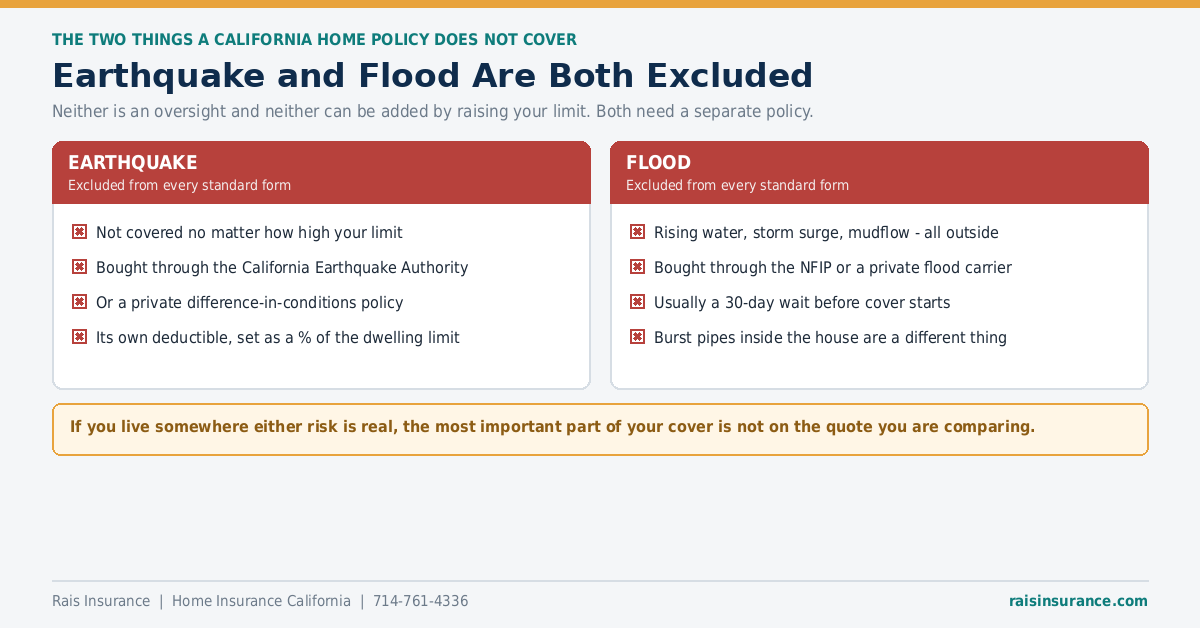
Start here, because it is the part no quote comparison shows you. Two major risks are excluded from every standard home insurance California policy sold, and neither can be added by raising your limit:
- Earthquake. Excluded from every standard form, no matter how high your dwelling limit. Cover is bought separately – most commonly through the California Earthquake Authority, sold alongside your policy by participating carriers, or through a private difference-in-conditions policy. It carries its own deductible, normally set as a percentage of the dwelling limit rather than a flat sum.
- Flood. Rising water, storm surge and mudflow are all outside a standard policy. Cover comes from the National Flood Insurance Program or a private flood carrier, and there is usually a thirty-day waiting period before it begins – so buying after a forecast does not work. A burst pipe inside the house is a different matter and generally is covered. See flood insurance in California.
This matters for the example the original version of this post used. Living somewhere with real seismic exposure does not mean your homeowners policy will respond to earthquake damage – it means you need a second policy. If you are looking at home insurance in Cypress or anywhere else in the region, that is the question to ask before comparing prices, because the most important part of your cover is not on the quote in front of you.
The Setting That Changes the Price Most
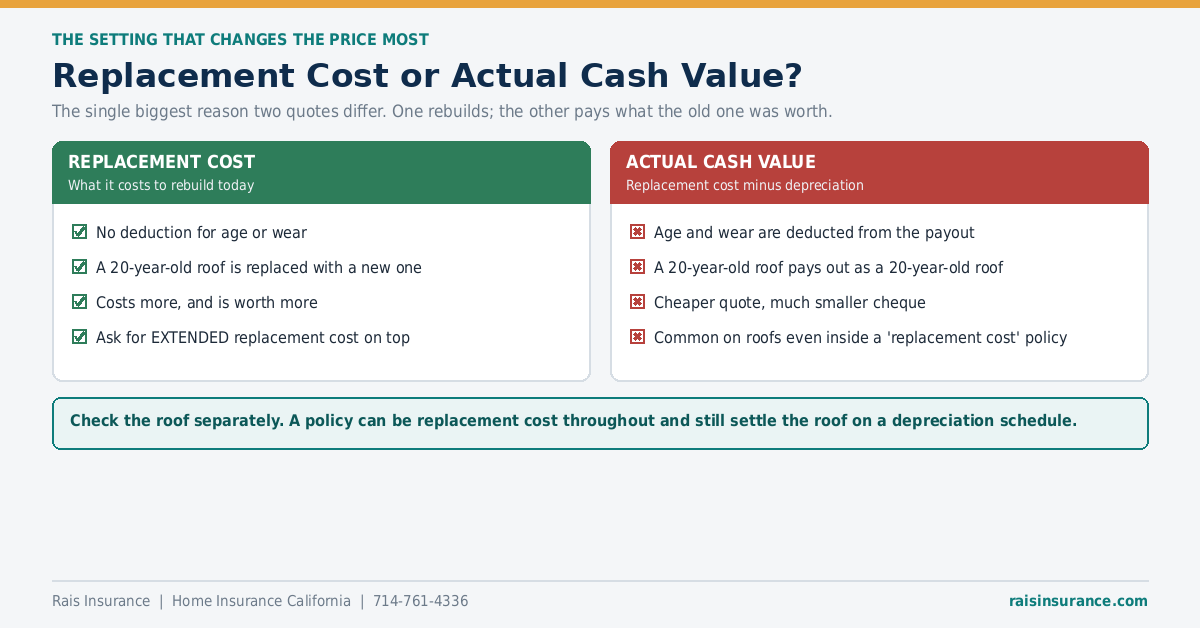
If two quotes differ significantly on price, this is usually why. Replacement cost pays what it costs to rebuild or replace today, with no deduction for age or wear. Actual cash value deducts depreciation first – so a twenty-year-old roof pays out as a twenty-year-old roof.
One thing worth checking specifically: a policy can be replacement cost throughout and still settle the roof on a depreciation schedule. On an older roof that difference runs to tens of thousands of dollars, and it appears nowhere on a price comparison.
The endorsement to ask for by name is extended replacement cost – a further percentage above your dwelling limit, often 25 or 50 per cent, if rebuild costs overrun. It matters most after a widespread event, when demand for labour and materials rises across a whole area at once. A great many homeowners have never been offered it.
What You Are Actually Comparing
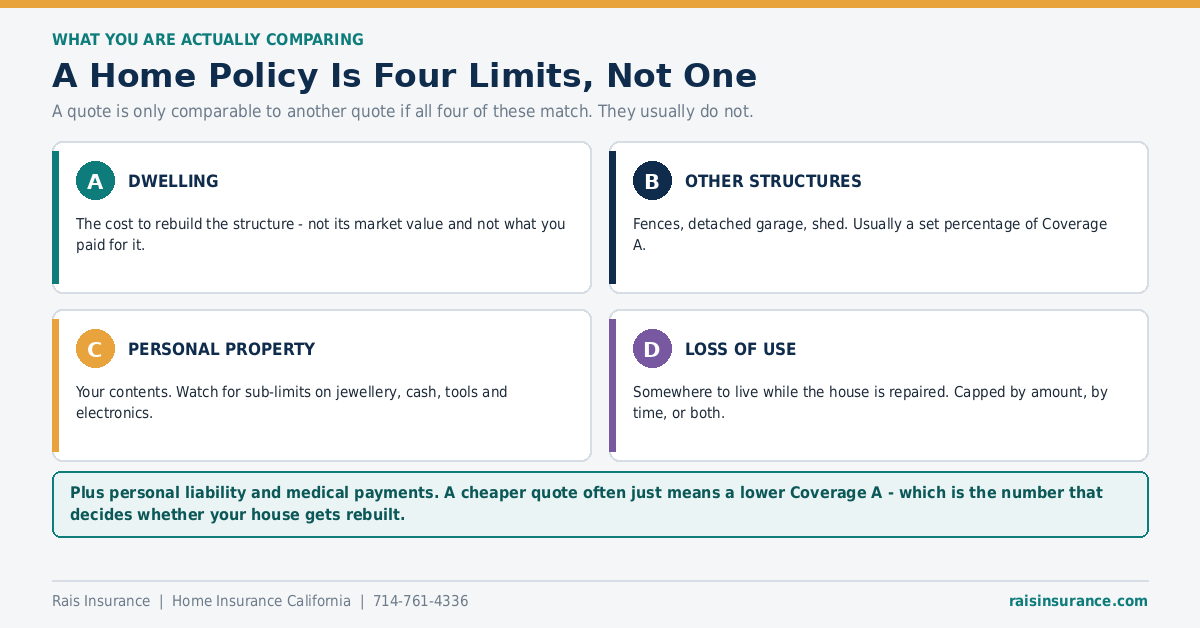
A homeowners insurance policy is not one number. It is four separate limits, and a quote is only comparable to another if all four match:
- Coverage A – Dwelling. The cost to rebuild the structure. Not the market value and not what you paid, both of which include land. This is the number that decides whether your house gets rebuilt, and a cheaper quote very often just means a lower Coverage A.
- Coverage B – Other structures. Fences, detached garage, shed. Usually a set percentage of Coverage A rather than a figure you choose.
- Coverage C – Personal property. Your contents – and this is where sub-limits live. Jewellery, cash, tools, firearms and electronics frequently have their own caps well below the headline number.
- Coverage D – Loss of use. Somewhere to live while the house is repaired. Capped by amount, by time, or both, and worth reading in full if your area has slow rebuild timelines.
Plus personal liability and medical payments, which are the sections that answer somebody else’s injury or damage rather than your own. Together these six numbers are what you should be comparing – not the single figure at the bottom of the page.
The Carrier’s Financial Rating
Checking ratings and reviews before you buy is genuinely worth the time. A.M. Best is the standard reference and rates most carriers writing homeowners insurance in the United States, assessing financial strength and the ability to meet claims obligations.
Worth adding a second source: the California Department of Insurance publishes complaint data by carrier. Financial strength and claims service are not the same thing, and a company can be sound on paper while being slow in practice.
The Claims Process
This is a fair point and an important one – after a loss you want a prompt, responsible response, and a dispute with your own insurer is the last thing anybody wants to be managing while their house is uninhabitable.
One correction on how it was originally put. A good insurer does not “provide you enough coverage to repair the damages” as a matter of goodwill – what you are paid is determined by the limits, the settlement basis and the terms you bought. That is precisely why the sections above matter more than the carrier’s reputation does. Reputation decides how smoothly a claim runs. The policy decides how much it pays.
Deductible
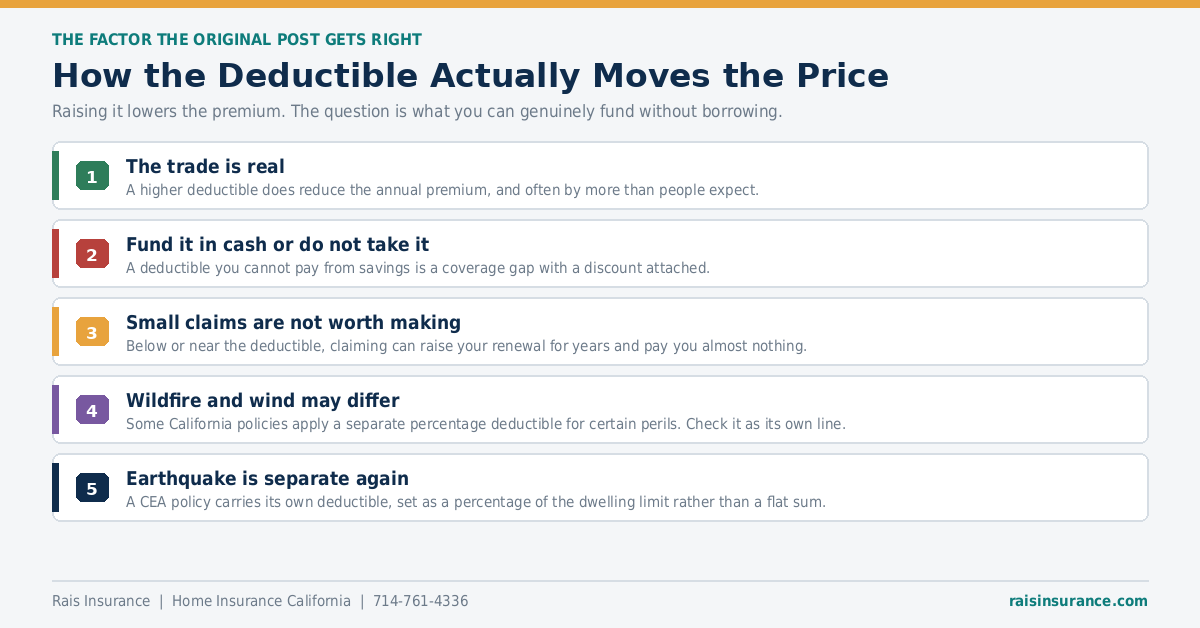
The deductible you choose does move the annual premium, and often by more than people expect. Raising it is one of the more effective ways to reduce what you pay.
The constraint is straightforward: only raise it as far as you can genuinely fund from savings without borrowing. A deductible you cannot pay is a coverage gap with a discount attached. If a few thousand dollars would be difficult to find at short notice, keeping it lower is the right call even though the premium is higher.
Two additions. Small claims near the deductible are usually not worth making – they pay out little and can affect your renewal for years. And some California policies apply a separate percentage deductible for certain perils rather than a flat sum, which is worth checking as its own line rather than assuming one number applies to everything.
Price, and Why Online Calculators Only Get You Partway
Online quote tools are a reasonable starting point. They ask for your location, the age and size of the house, your chosen deductible and similar details, and they return an indicative figure quickly.
What they cannot do is tell you whether two results describe the same policy. A calculator will happily return a lower number because it assumed a lower Coverage A, an ACV settlement basis, or no extended replacement cost – none of which is displayed prominently. Treat the output as a range rather than a comparison.
Eight Questions to Ask of Every Quote
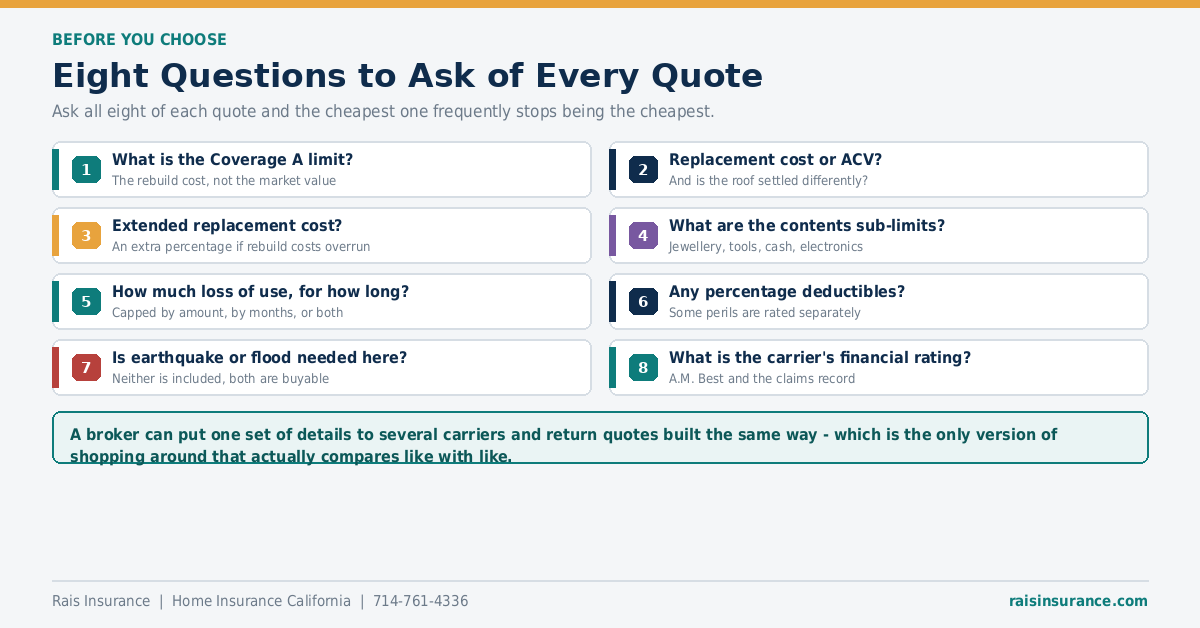
- What is the Coverage A limit, and how was it calculated? Rebuild cost, not market value.
- Replacement cost or actual cash value? And is the roof settled differently from the rest?
- Is extended replacement cost included? If not, what would it add?
- What are the personal property sub-limits? Jewellery, tools, cash, electronics.
- How much loss of use, and for how long? Capped by amount, by months, or both.
- Are there any percentage deductibles? Some perils may be rated separately.
- Is earthquake or flood cover needed at this address? Neither is included; both are buyable.
- What is the carrier’s A.M. Best rating and complaint record? Two different questions.
Ask all eight of every quote and the cheapest one frequently stops being the cheapest. That is the version of shopping around that actually protects you.
Getting Quotes That Compare Like With Like
So yes – be wise, shop around, assess several quotations rather than accepting the first. The refinement worth adding is that the comparison only means something if the policies are built the same way.
That is the practical argument for using a broker rather than a comparison site: one set of details goes to several carriers, and the quotes come back on the same basis. If you would like that done for your property, see our home insurance California page or call 714-761-4336.
Our other services: auto insurance, classic car insurance, renters insurance and business insurance.
Home Insurance Quotes – Frequently Asked Questions
Q1. Does home insurance cover earthquake damage in California?
No. Earthquake is excluded from every standard homeowners policy in California, and no amount of dwelling limit changes that. Cover is bought separately – most commonly through the California Earthquake Authority, sold alongside your existing policy by participating carriers, or through a private difference-in-conditions policy. It carries its own deductible, usually set as a percentage of the dwelling limit rather than a flat sum.
Q2. Does home insurance cover flood?
No. Flood – rising water, storm surge, mudflow – is excluded from standard homeowners policies. It is bought separately through the National Flood Insurance Program or a private flood carrier, and there is normally a thirty-day waiting period before cover begins, so buying after a forecast does not work. A burst pipe inside the house is a different matter and is generally covered by the home policy.
Q3. What is the difference between replacement cost and actual cash value?
Replacement cost pays what it costs to rebuild or replace today, with no deduction for age or wear. Actual cash value deducts depreciation, so a twenty-year-old roof pays out as a twenty-year-old roof. It is the single biggest reason two quotes differ in price, and the cheaper one is frequently cheaper because it settles on ACV.
Q4. Can a replacement cost policy still depreciate my roof?
Yes, and it is worth checking specifically. Some policies are replacement cost throughout but apply a separate roof settlement schedule that depreciates by age and material. On an older roof that difference can be tens of thousands of dollars, and it does not appear anywhere on the price comparison.
Q5. What is Coverage A and how much should it be?
Coverage A is the dwelling limit – what it would cost to rebuild the structure. It is not the market value of your home and not what you paid for it, both of which include land. It should reflect current local construction costs, which have moved considerably. A quote that looks cheap is very often a quote with a lower Coverage A.
Q6. What is extended replacement cost?
An endorsement that adds a further percentage above your dwelling limit – often 25 or 50 per cent – if rebuild costs overrun the estimate. It matters most after a widespread event, when demand for labour and materials pushes costs up across a whole area. Many homeowners have never been offered it, and it is worth asking for by name.
Q7. Does a higher deductible really lower my premium?
Yes, and often by more than people expect – this part of the original advice is sound. The constraint is what you can genuinely pay from savings without borrowing. A deductible you cannot fund is a coverage gap with a discount attached. Note also that some California policies apply a separate percentage deductible for certain perils, which is worth checking as its own line.
Q8. Should I make a small claim?
Usually not, if it is close to your deductible. A claim near the deductible pays out little and can affect your renewal premium and your claims record for years, which is precisely why carrying a deductible you can afford makes sense – it stops you making claims that cost more than they return.
Q9. How do I know if a carrier is financially sound?
A.M. Best is the standard reference and rates most carriers writing homeowners cover in the United States. The California Department of Insurance also publishes complaint data, which is a useful second check because financial strength and claims service are not the same thing. A broker who places business with a carrier regularly will also have a practical sense of how claims actually run.
Q10. What is the fastest way to compare quotes properly?
Give one set of details to a broker and ask for quotes built the same way – same Coverage A basis, same settlement basis, same deductible, same endorsements. That is the only version of shopping around that compares like with like. Call Rais Insurance on 714-761-4336 or email rai@raisinsurance.com.
Get a Home Insurance Quote in California
To have several carriers quoted on the same basis, contact Rais Insurance on 714-761-4336, email rai@raisinsurance.com, or visit 2612 W. Lincoln Avenue, Suite 103, Anaheim, CA 92801.
If you already hold a policy, have the declarations page to hand. Coverage A and the settlement basis are the two lines worth checking first – between them they decide almost everything else.