

Commercial building insurance Garden Grove
Protect Your Commercial Property With Commercial Property Insurance Garden Grove
Losing property to theft, fire, weather or a simple accident can damage any small business, whatever the industry. Commercial insurance policies are a crucial tool for business owners protecting their commercial property and equipment, and a commercial property policy is the one that reimburses you for damaged or lost tools, equipment, inventory and much more.
This page concentrates on the part of that list most policies handle worst: the stock you sell. Garden Grove has one of the densest concentrations of restaurants, grocers, food producers and retailers in Orange County, and stock is the item most often underinsured, most often undervalued at claim time, and – if it is chilled or frozen – most often not covered at all in the way owners assume.
Rais Insurance places commercial building insurance in Garden Grove for businesses that hold inventory. Below: how stock is actually valued when you claim, why spoilage is not a standard coverage, what equipment breakdown does that a property policy does not, and the six-item checklist we run over every food and retail schedule we review.
Who Needs Commercial Property Insurance in Garden Grove?
The commercial property insurance model applies to businesses that lease or own office space, manufacture products, manage inventory, lease equipment, or maintain the property of others. In Garden Grove that covers most of Harbor Boulevard and most of the Garden Grove Boulevard corridor – restaurants, markets, bakeries, distributors, light manufacturers, salons, clinics and workshops.
Whether you own your unit or lease it changes what you insure, not whether you need to. Our page on whether you own the building or rent it works through the owner, landlord and tenant split in full.
What a Commercial Property Policy Covers
A commercial building and property insurance policy can cover most of the business assets at your premises. For example:
- Your office space, unit or building
- Equipment used in your business, such as PCs, kitchen equipment and specialist machinery
- Food and perishable items that your business sells – as property, though see the spoilage section below
- Supplies and office furniture such as desks, chairs and appliances
- Stock, inventory, raw materials and packaging
One correction to a line that appears on a lot of insurance pages, including this one: commercial property insurance does not include cargo or inland marine. Inland marine is a separate line of insurance, not a coverage inside a property policy. A commercial property policy is written around a fixed described location – anything that moves, or sits away from that location, needs the separate line. See property that moves or sits away from your premises.
Stock and Inventory: Insuring What You Actually Sell
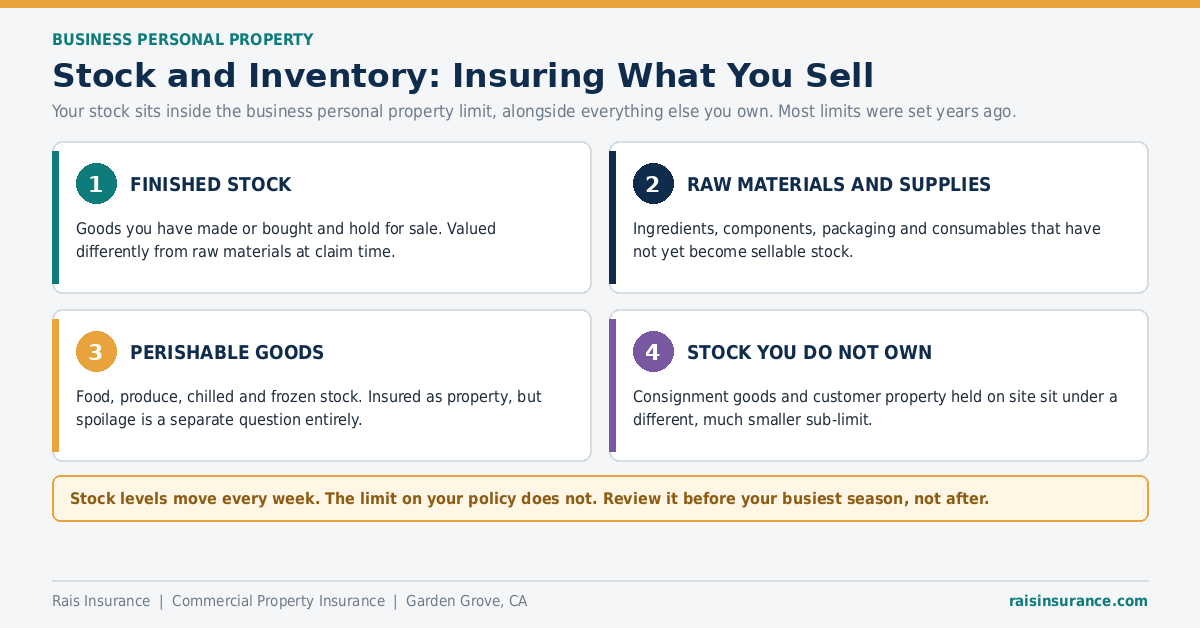
Your stock does not have a policy of its own. It sits inside the business personal property limit alongside your furniture, your equipment and your supplies – which means a single figure has to cover all of it. That figure is usually set once, at the first renewal, and then left alone while the business grows.
Four kinds of stock behave differently and are worth separating in your own head before you look at the limit:
- Finished stock – goods you have made or bought and hold for sale. Valued differently at claim time from everything else on this list.
- Raw materials and supplies – ingredients, components, packaging and consumables that have not yet become sellable stock.
- Perishable goods – food, produce, chilled and frozen stock. Insured as property, but spoilage is an entirely separate question.
- Stock you do not own – consignment goods and property of others in your care sit under a much smaller sub-limit than your own property.
Stock levels move every week. The limit on your policy does not. The single most useful thing most Garden Grove business owners could do this year is check the business personal property figure against what is actually on the shelves in their busiest month.
Spoilage: The Gap Under Every Refrigerator in Garden Grove
This is the most important section on the page, and it corrects an assumption almost every food business makes.
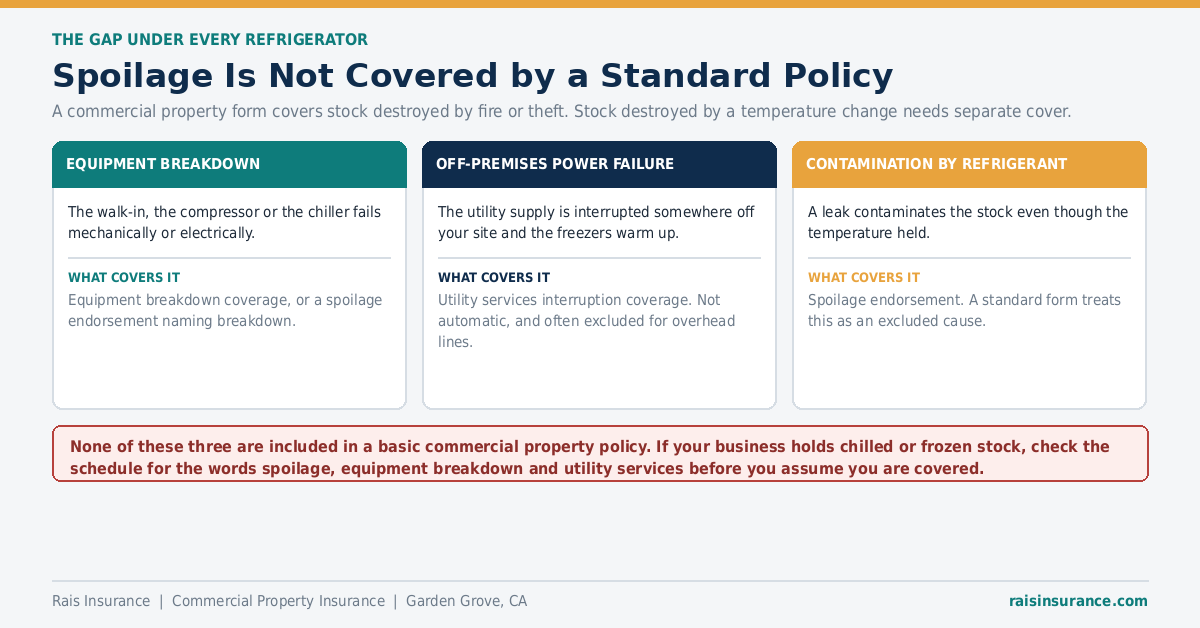
A commercial property policy covers stock destroyed by an insured cause of loss – fire, theft, vandalism, a burst pipe. Stock destroyed by a temperature change is a different thing, and a standard commercial property form does not cover it. Three separate triggers, three separate answers:
- The equipment fails. The walk-in, the compressor or the chiller breaks down mechanically or electrically. Answered by equipment breakdown coverage, or by a spoilage endorsement that names breakdown as a covered cause.
- The power fails off-premises. The utility supply is interrupted somewhere away from your site and the freezers warm up. Answered by utility services interruption coverage – not automatic, and frequently written to exclude overhead transmission lines.
- Refrigerant contaminates the stock. A leak spoils the goods even though the temperature held. Answered by a spoilage endorsement. A standard form treats this as an excluded cause.
None of the three are included in a basic commercial property policy. If your business holds chilled or frozen stock, open the schedule and look for the words spoilage, equipment breakdown and utility services before you assume you are covered. If they are not there, you are not.
Equipment Breakdown: Why the Freezer Failing Is Not a Property Claim
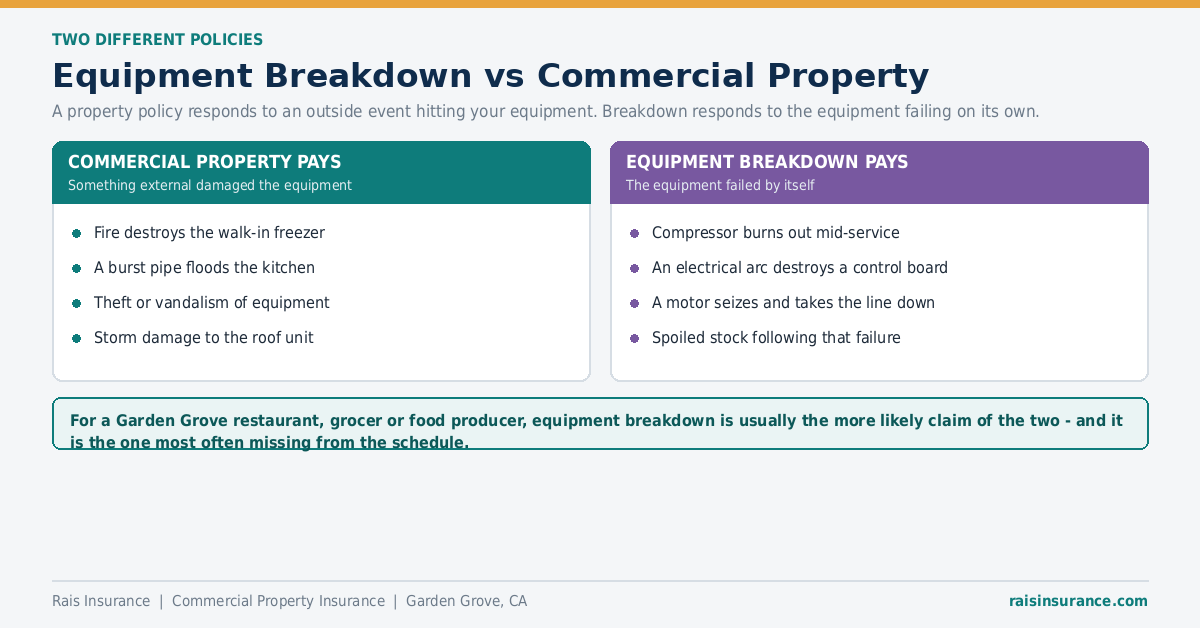
The distinction is about cause, not about the equipment. A commercial property policy responds when something external damages your equipment – a fire, a flood from a burst pipe, theft, storm damage to a roof unit. Equipment breakdown responds when the equipment fails on its own – a compressor burns out mid-service, an electrical arc destroys a control board, a motor seizes and takes the production line down with it.
For a Garden Grove restaurant, market or food producer, internal failure is usually the more likely of the two, and it is the coverage most often missing from the schedule. It also matters that the spoiled stock following a breakdown is normally paid under the breakdown coverage rather than the property one – which is precisely why a business with no breakdown coverage finds itself with no spoilage recovery either.
Lost trading income while you are shut for repairs is a third, separate coverage again – see business income and coverage extensions.
How a Stock Claim Is Actually Valued
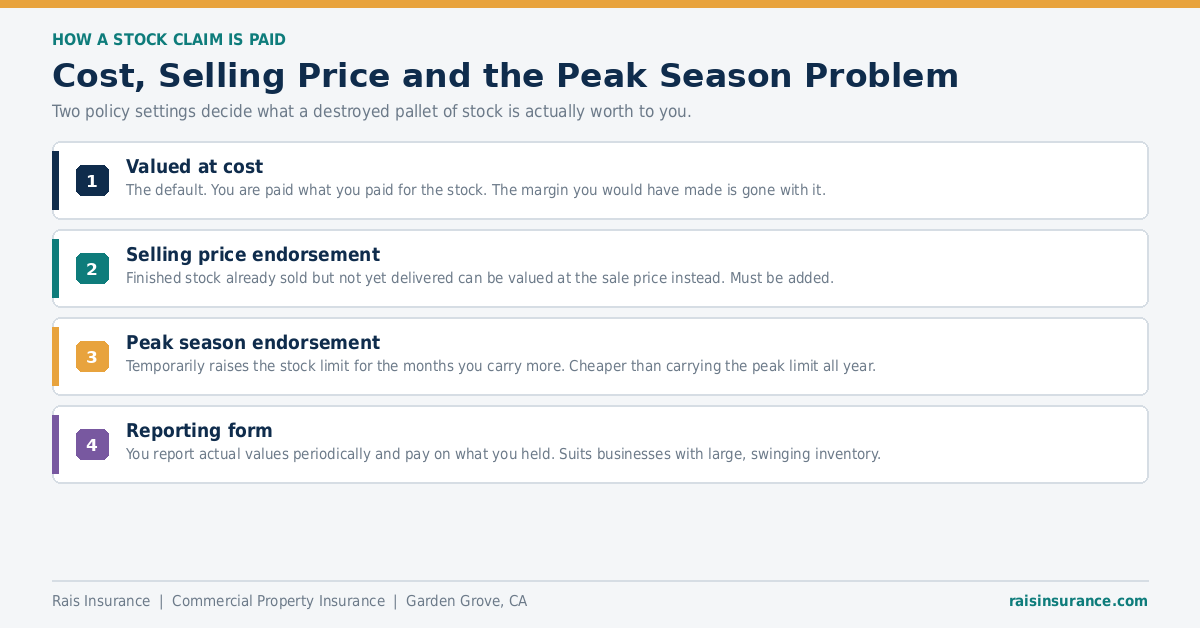
Assume a pallet of your finished stock is destroyed. What you are paid depends on two settings most owners have never been asked about:
- Valued at cost. The default. You are paid what you paid for the stock, so the margin you would have made on the sale is gone with it.
- Selling price endorsement. Finished stock that is already sold but not yet delivered can be valued at the sale price instead. It has to be added. If your stock carries meaningful margin, this endorsement is usually worth more than it costs.
- Peak season endorsement. Temporarily raises the stock limit for the months you carry more, which is cheaper than carrying the peak figure all year round.
- Reporting form. You report actual values periodically and pay based on what you held. Suits businesses with large, swinging inventories rather than predictable seasonal peaks.
The first of those four is what you have unless somebody changed it. The other three are conversations worth having before your busiest quarter, not during it.
The Coverage Stack for a Garden Grove Business That Holds Stock
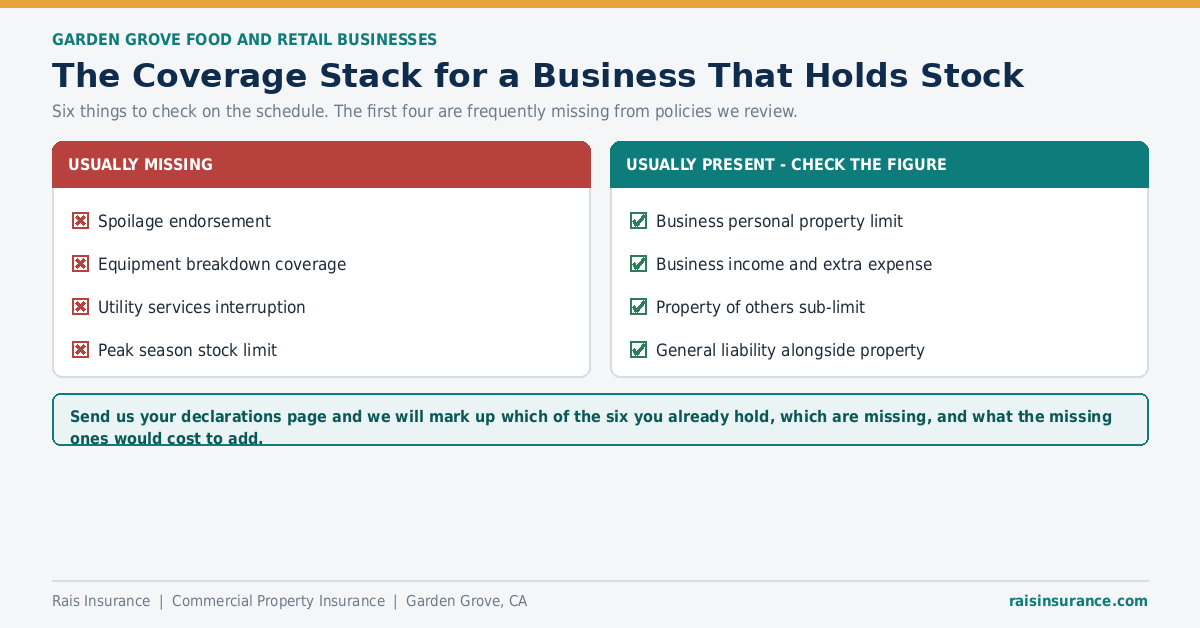
Six items. In the schedules we review, the first four are missing far more often than they are present:
- Spoilage endorsement – usually missing
- Equipment breakdown coverage – usually missing
- Utility services interruption – usually missing
- Peak season stock limit – usually missing
- Business personal property limit – usually present, but check the figure against current stock
- Business income and extra expense – usually present, but check the indemnity period
Send us your declarations page and we will mark up which of the six you already hold, which are missing, and what the missing ones would cost to add. That review is free and takes about fifteen minutes.
Home-Based Businesses in Garden Grove
You may still need commercial property insurance even if your business operates from your home. The reason is usually stated too bluntly, so to be precise: a homeowners policy does not exclude business property outright, but it caps it at a very small on-premises limit – often only a few thousand dollars – and it can exclude business activity entirely once the operation passes a certain scale.
If you hold stock, equipment or customer property at home, that cap is the problem. A business owner’s policy or a standalone commercial property policy is the correct answer, and for a small operation it usually costs less than people expect.
What Commercial Property Insurance Does Not Cover
A commercial property policy covers a great deal, but not everything you own and not every kind of loss:
- Claims brought against you – a customer injured on your premises is a general liability insurance claim.
- Vehicles – commercial auto, always a separate policy.
- Property in transit or off-site – inland marine, as above.
- Employee theft – crime coverage, not property.
- Earthquake and flood – excluded statewide in California and placed separately. See exclusions and how your building is valued.
How to Choose the Best Commercial Building and Property Insurance in Garden Grove
Working with a broker to assess your business risk and build an insurance package that makes sense for the operation is the key to finding the right commercial insurance policy. At Rais Insurance we offer quality insurance services, competitive rates and straightforward consultation, and our commercial insurance agents can assist you in making the best decisions on coverage and rates in Garden Grove.
Some carriers write commercial property and general liability together under a single business owner’s policy for small businesses, which is usually more cost-effective than buying them separately. Beyond those two we place the wider commercial insurance products we place – umbrella, executive liability, workers’ compensation, professional liability and crime.
Buying business property insurance well comes down to a short list of questions when you hold stock: is the business personal property limit current, is spoilage named, is equipment breakdown on the schedule, and is the stock valued at cost or at selling price. Four answers usually settle whether a policy is fit for purpose.
We serve Garden Grove and write commercial property insurance across California from our Anaheim office, ten minutes up Harbor Boulevard.
Commercial Building Insurance Garden Grove – Frequently Asked Questions
Q1. Does commercial property insurance cover food spoilage?
Not as standard. A commercial property policy covers stock destroyed by an insured cause of loss such as fire or theft. Stock ruined by a temperature change is a different thing, and it needs a spoilage endorsement, equipment breakdown coverage, or utility services interruption coverage depending on what caused the temperature to move. If your Garden Grove business holds chilled or frozen stock, check the schedule for those words specifically.
Q2. What is equipment breakdown insurance and do I need it?
Equipment breakdown responds when equipment fails on its own – a compressor burns out, an electrical arc destroys a control board, a motor seizes. A commercial property policy responds when something external damages the equipment, such as fire or a burst pipe. For a restaurant, grocer or food producer, internal failure is usually the more likely claim, and the spoiled stock that follows is normally covered under the breakdown coverage rather than the property one.
Q3. How is my inventory valued if it is destroyed?
By default, at what you paid for it. That means the margin you would have made on the sale is not recovered. A selling price endorsement changes the valuation for finished stock that is already sold but not yet delivered, so it is paid at the sale price instead. If your stock carries meaningful margin, that endorsement is usually worth more than the premium it costs.
Q4. My stock level changes a lot through the year. How do I insure that?
Two options. A peak season endorsement temporarily raises the business personal property limit for the months you carry more stock, which is cheaper than carrying the peak figure all year. A reporting form goes further – you report actual values periodically and pay based on what you held. Reporting forms suit businesses with large, swinging inventories; peak season endorsements suit predictable seasonal peaks.
Q5. What happens if the power fails and my freezers warm up?
It depends where the failure happened. Damage to your own equipment on your premises can fall under equipment breakdown. An interruption in the utility supply off your site is a different trigger and needs utility services interruption coverage, which is not automatic and is frequently written to exclude overhead transmission lines. Both gaps are worth closing before a summer outage rather than after one.
Q6. Do I need commercial property insurance if I run my business from home in Garden Grove?
Almost certainly. A homeowners policy does not simply exclude business property, but it caps it at a very small on-premises limit – often a few thousand dollars – and it can exclude business activity entirely once the operation passes a certain scale. If you hold stock, equipment or customer property at home, a business owner’s policy or a standalone commercial property policy is the correct answer.
Q7. Does commercial property insurance cover stock I hold for someone else?
Partly, and under a much smaller limit than your own. Consignment goods and customer property in your care, custody or control are covered as personal property of others while at the described premises, typically at a modest sub-limit. If holding third-party stock is a routine part of what you do, that sub-limit needs increasing or the exposure moving onto a bailee form.
Q8. Is inland marine part of commercial property insurance?
No. Inland marine is a separate line of insurance, not a coverage inside a commercial property policy. It handles property that moves or sits away from the described premises – tools, contractors’ equipment, goods in transit, property at a job site. A commercial property policy is written around a fixed location, which is why anything mobile needs the separate line.
Q9. Can I buy commercial property and general liability together?
Yes, and for most small Garden Grove businesses it is cheaper than buying them separately. A business owner’s policy bundles both, usually with business income included. Larger or mixed-hazard operations that a BOP will not accept move to a commercial package policy, where you select which lines go in. Either way one carrier writing both means fewer arguments at claim time.
Q10. How much does commercial property insurance cost in Garden Grove?
There is no flat rate. The premium is built from the value of the building and its contents, what the business does inside, the fire and security protection on site, and the exposures around the address. A food business carries a different rate from an office in the same building because of the cooking and refrigeration hazard. Send a broker your current declarations page for a real figure.
Get a Commercial Property Insurance Quote in Garden Grove
Request a commercial insurance quote online or give our agents a call to discuss your requirements. contact Rais Insurance on 714-761-4336, email rai@raisinsurance.com, or visit 2612 W. Lincoln Avenue, Suite 103, Anaheim, CA 92801.
Bring your declarations page and a rough figure for what your stock is worth in your busiest month. Those two things answer most of this page in one conversation.
