

Commercial Property Insurance Stanton, California
Protect your commercial building, furniture, tools, inventory, and business personal property with commercial property insurance Stanton. If something happens to your premises or your physical assets, the business cannot function without the right coverage behind it. And if your tools and equipment leave the building during a normal working week, one policy is not enough — which is what most of this page is about.
What Commercial Property Insurance Covers
Commercial property insurance covers the risks associated with loss of property — commercial buildings, the equipment needed to run the business, furniture, inventory, fixtures, supplies, business documents, and more. A policyholder can be compensated for loss or damage caused by events such as fire, theft, burst pipes and other hazards covered by the policy, though what is covered varies with the form you buy and the limits you choose.
The Three Commercial Property Policy Forms
Commercial property policies come in three forms, and the difference is simply how much they cover:
- Basic form — the narrowest. The insurer pays only for causes specifically listed in the policy, such as fire, lightning, windstorm, hail, smoke, explosion, vandalism, vehicle or aircraft impact, riot, sprinkler leakage and volcanic action.
- Broad form — everything in the basic form, plus a further set of named causes: falling objects, the weight of snow, ice or sleet, water damage from plumbing or appliances, and collapse.
- Special form — the widest. It covers all causes of loss except those the policy expressly excludes, which is why it is sometimes called open-perils or all-risk.
One point worth being clear about, because it matters at claim time: theft is not one of the causes added by the broad form. Theft cover comes with the special form, subject to its exclusions, or through a separate crime endorsement. If theft is a real exposure for your business, that decides which form you should be buying.
Our Buena Park commercial building insurance page compares the three forms in detail, including how the choice affects premium.
Property That Stays Put vs. Property That Moves
Commercial property insurance covers assets at a specific location. Inland marine insurance is designed to cover assets that move from one location to another on a regular basis. That one sentence is the most important thing on this page, and it is the gap most Stanton businesses do not know they have.
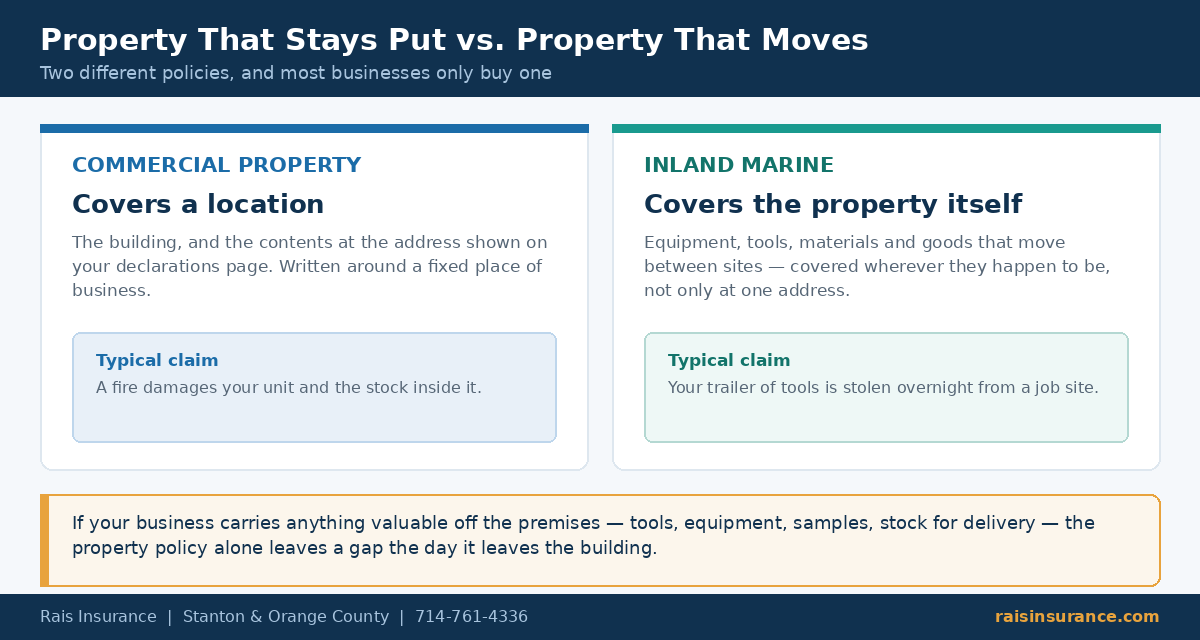
If you frequently move expensive items — tools, equipment, materials — between sites, you will need inland marine cover. The name is historical: marine insurers extended ocean cargo cover onto dry land and the label stayed. It has nothing to do with boats, and it is the reason a great many businesses find out too late that their property policy stopped at the door.
What Inland Marine Insurance Actually Covers
It is not one policy but a family of forms. You buy the ones that match how your business actually works:
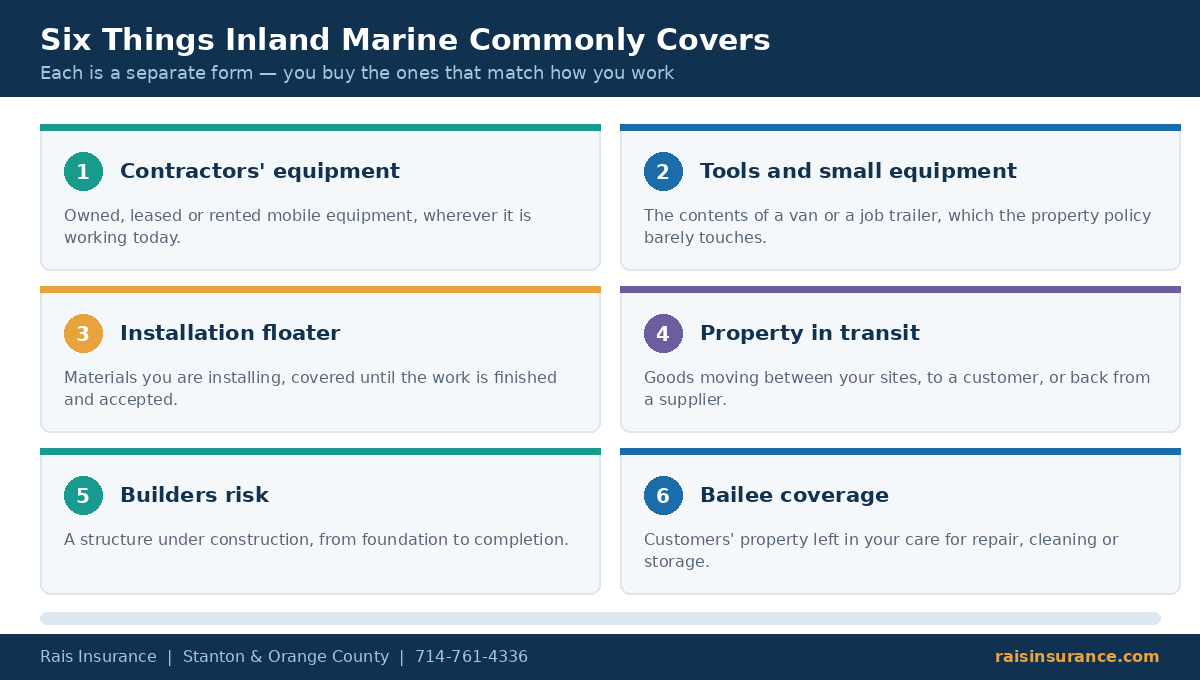
- Contractors’ equipment floater — owned, leased or rented mobile equipment, covered wherever it is working today rather than at one address.
- Tools and small equipment — the contents of a van or a job trailer, which a property policy barely touches.
- Installation floater — materials you are installing at a customer’s site, covered until the work is finished and accepted.
- Property in transit — goods moving between your locations, out to a customer, or back from a supplier. Motor truck cargo if you haul for others.
- Builders risk — a structure under construction or renovation, along with materials on site, until it can be insured as a completed building.
- Bailee coverage — customers’ property left in your care for repair, cleaning, alteration or storage.
Why Your Property Policy Stops at the Door
Most commercial property policies do include something for property away from the insured location. The problem is the size of it.
Property at your insured address is covered to your full contents limit. Property temporarily off premises is usually covered only to a small extension. Property in transit is often a smaller sublimit again, or excluded outright. And equipment sitting at a job site for weeks frequently falls outside the extension altogether.
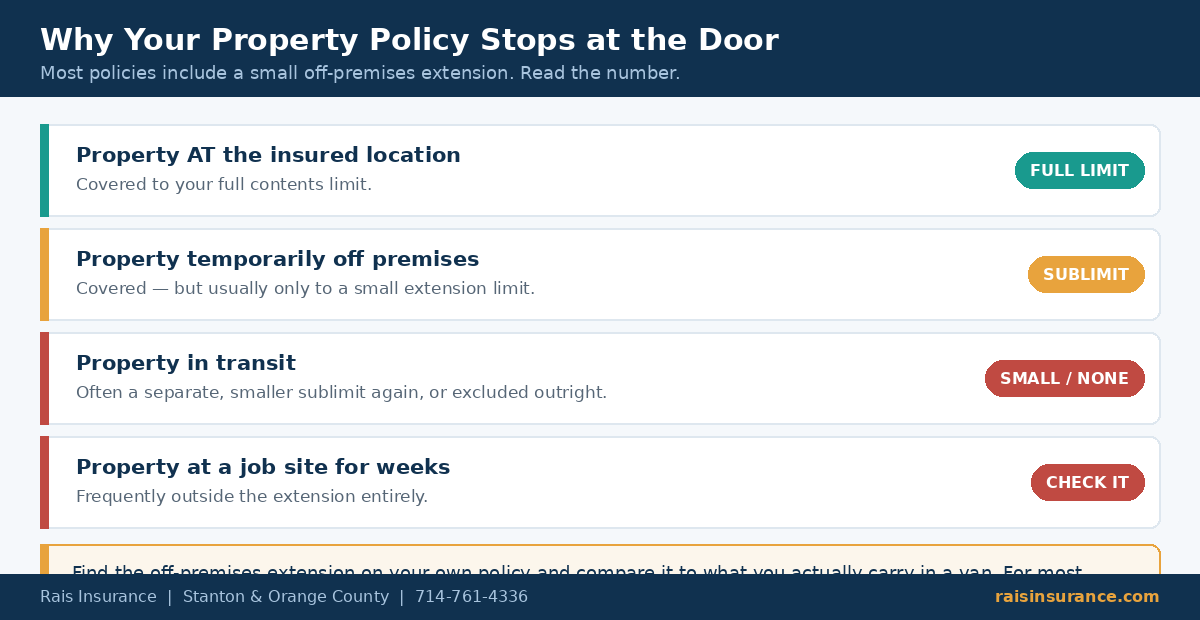
There is a simple test. Find the off-premises extension on your declarations page, then add up what is in the van on a normal Tuesday. For most trades businesses the gap is obvious the moment they look, and it is usually a few hundred dollars a year to close.
Scheduled or Blanket: How Your Equipment Gets Listed
Once you have decided to insure equipment, there are two ways to do it, and the choice decides what a claim actually pays.
Scheduled coverage lists each item with a stated value. It suits high-value machinery and leaves no argument about what is insured — but anything you forget to add is uninsured, so new purchases have to be reported.
Blanket coverage sets one limit across a class of items with a per-item sublimit. It suits large quantities of smaller tools and covers new purchases automatically — but the total limit has to reflect everything you own, and the per-item sublimit needs checking against your most expensive piece.
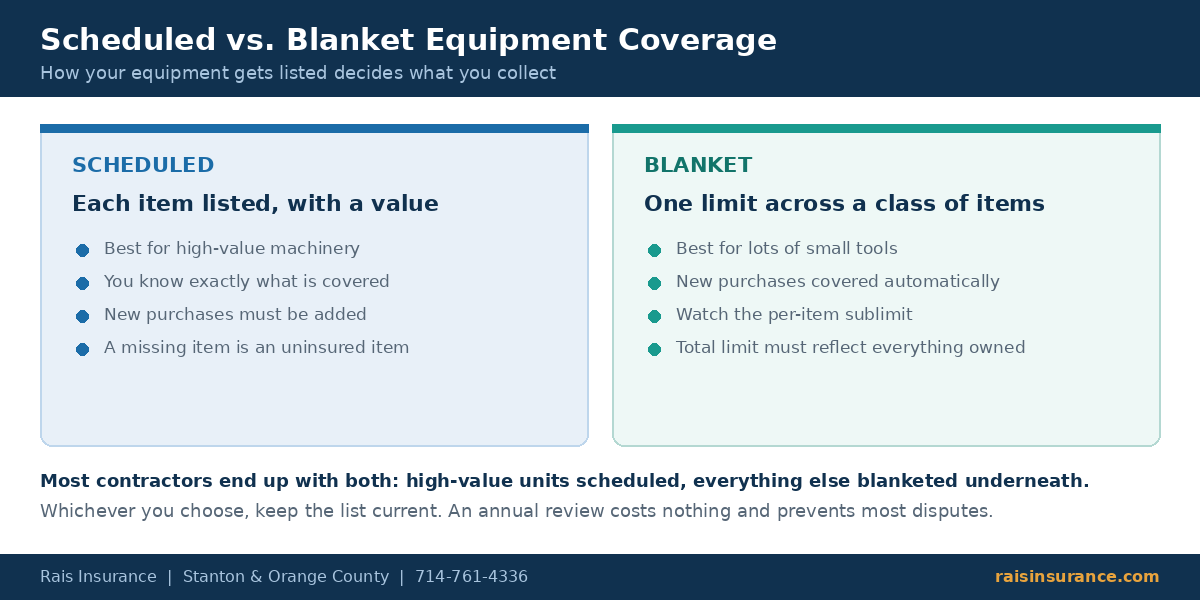
Whichever you choose, the list needs to stay current. An annual review costs nothing and prevents most of the disputes we see.
If You Lease Your Building to Tenants
As a landlord you may want a policy built around the particular risks that come with rental property rather than a standard commercial form. That means the structure, loss of rents, and your liability as an owner — a different shape of program from the one an owner-occupier needs. Our Anaheim commercial building insurance page sets out the owner, landlord and tenant positions side by side.
How to Choose the Right Commercial Property Insurance Stanton
Our commercial insurance packages are tailored to your specific business needs, and our products are designed to protect your assets — the building, the inventory, the equipment, and the vehicles.
We go the extra mile to work out how a business might be exposed to loss, and then put the means in place to reduce those exposures. We do more than sell commercial insurance. We review a client’s exposures and build a plan to help them avoid a financial disaster.
In practice that means asking what leaves the building, what sits on a job site overnight, and what belongs to somebody else — three questions a policy comparison rarely covers and a claim always does.
Serving Stanton and Orange County
We write commercial property and inland marine insurance for businesses in Stanton and the neighboring cities of Westminster, Los Alamitos, Midway City and Seal Beach, from our office in Anaheim about six miles away. We write commercial property insurance across Orange County, and Stanton is close enough that we can walk the premises and look in the van before we quote it.
We also write general liability insurance and commercial auto insurance, so a contractor’s whole program can sit on one renewal calendar.
Get a Commercial Property Insurance Quote
To quote it properly we need the property address, square footage, construction type, year built, and — the part most quotes miss — a list of the equipment that travels. Send both and we will price the property policy and the floater together rather than leaving you to discover the gap between them.
Call 714-761-4336 or email rai@raisinsurance.com.
Commercial Property and Inland Marine FAQs
Q1. What is inland marine insurance?
It covers property that moves rather than property that sits at one address — tools, equipment, materials in transit, and goods held for customers. The name is historical: marine insurers extended ocean cargo cover onto land, and the label stuck. It has nothing to do with boats, and most businesses that need it have never heard of it.
Q2. Does commercial property insurance cover equipment away from my building?
Only up to a small extension limit, if at all. A commercial property policy is written around the address on your declarations page. Most forms include a modest allowance for property temporarily off premises and a smaller one for property in transit. Compare that figure to what you actually carry in a van.
Q3. What is a contractors’ equipment floater?
An inland marine form covering mobile equipment you own, lease, or rent, wherever it happens to be working. It follows the machine rather than the location, which is why it responds to a theft from a job site or damage in transit between sites — situations a property policy is not built for.
Q4. Are tools stolen from my truck covered?
Under a commercial property policy, usually not beyond a small sublimit, and sometimes not at all. Under a tools and equipment floater, yes, subject to your limit and any requirement about how the vehicle is secured. This is the single most common uninsured loss among trades businesses.
Q5. What is an installation floater?
Coverage for materials and equipment you are installing at a customer’s site, from the point they leave your premises until the work is finished and accepted. Without it there is a window where the materials are neither covered by your property policy nor yet the customer’s responsibility.
Q6. Is property in transit covered?
Not by default, and rarely to a meaningful limit. A property policy may include a small transit extension; anything of real value moving between sites, to a customer, or back from a supplier needs a transit form or a motor truck cargo policy if you haul for others.
Q7. What is the difference between scheduled and blanket equipment coverage?
Scheduled coverage lists each item with a stated value, which suits high-value machinery and leaves no doubt about what is insured. Blanket coverage sets one limit across a class of items, with a per-item sublimit, which suits large quantities of smaller tools. Most contractors end up using both.
Q8. Do I need builders risk insurance?
If you are constructing, renovating, or adding to a structure, yes. Builders risk covers the work in progress along with materials on site, and it fills the period before a completed building can be insured under an ordinary property policy. Lenders and property owners usually require it.
Q9. Does inland marine cover customers’ property in my care?
That is bailee coverage, and it is a specific form rather than something included automatically. If customers leave property with you for repair, cleaning, alteration, or storage, your commercial property policy generally does not treat it as yours to insure — bailee cover closes that gap.
Q10. Does it cover equipment I rent or lease rather than own?
It can, but only if the policy is set up for it. Rental and lease agreements routinely make you responsible for damage to the equipment and sometimes for the rental company’s lost income while it is repaired. Tell us what you rent regularly and we will make sure the form matches the contracts you sign.
