

Commercial building insurance Orange
Protect Your Commercial Property With Commercial Property Insurance Orange
Commercial property insurance protects the physical side of your business – the building, the equipment you operate with, your inventory, fencing, landscaping, outdoor signage and much more. Among the perils a commercial property policy typically covers are fire, theft, vandalism and windstorm. Service businesses, manufacturers and retailers across Orange, CA all rely on it for the same reason: it is the only policy that repairs or replaces the things your business physically owns.
There is one question this page answers that most commercial property pages skip entirely, and it decides whether your policy actually works: who insures what? The answer is different if you own and occupy the building, own it and lease it out, or rent your space – and it is your lease, not your policy, that settles it.
Rais Insurance places commercial building insurance in Orange for owner-occupiers, commercial landlords and tenants throughout Orange County. Below: the responsibility split, the five lease clauses that dictate what you have to buy, the build-out gap that catches almost every tenant, and whether your coverage belongs in one policy or several.
Who Insures What: Owner, Landlord and Tenant
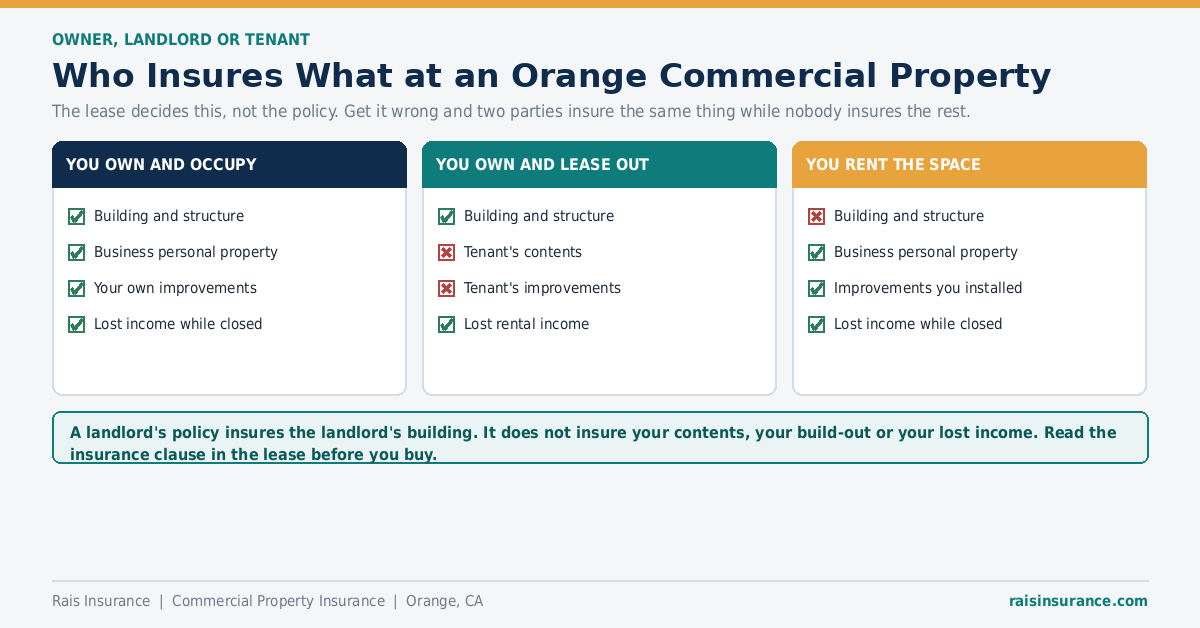
Our insurance agents are experienced in protecting your physical assets, whether you own the property or rent it. That distinction is not a detail – it changes which policy you need and which limits matter.
If you own and occupy the building
You insure everything: the structure, your business personal property, any improvements you have made, and the income you would lose while the building is unusable. This is the simplest position and the easiest one to underinsure, because the building limit and the contents limit both need reviewing every year and usually only one of them gets attention.
If you own the building and lease it out
You insure the structure and your lost rental income – not your tenants’ contents and not their improvements. Your loss of rents coverage is the item landlords most often skip, and it is the one that hurts: after a serious fire the building is repaired by the property limit, but the twelve months of missing rent is a separate coverage that either exists or does not.
If you rent your space
You insure your business personal property, the improvements and betterments you installed, and your own lost income. You do not insure the structure. The mistake here is the reverse of the landlord’s: tenants assume the landlord’s policy has them covered, and it does not – a landlord’s policy insures the landlord’s building.
Get this split wrong and the usual result is not a small gap. It is two parties insuring the same wall while nobody insures the build-out, the stock or the lost income.
The Five Lease Clauses That Decide Your Insurance
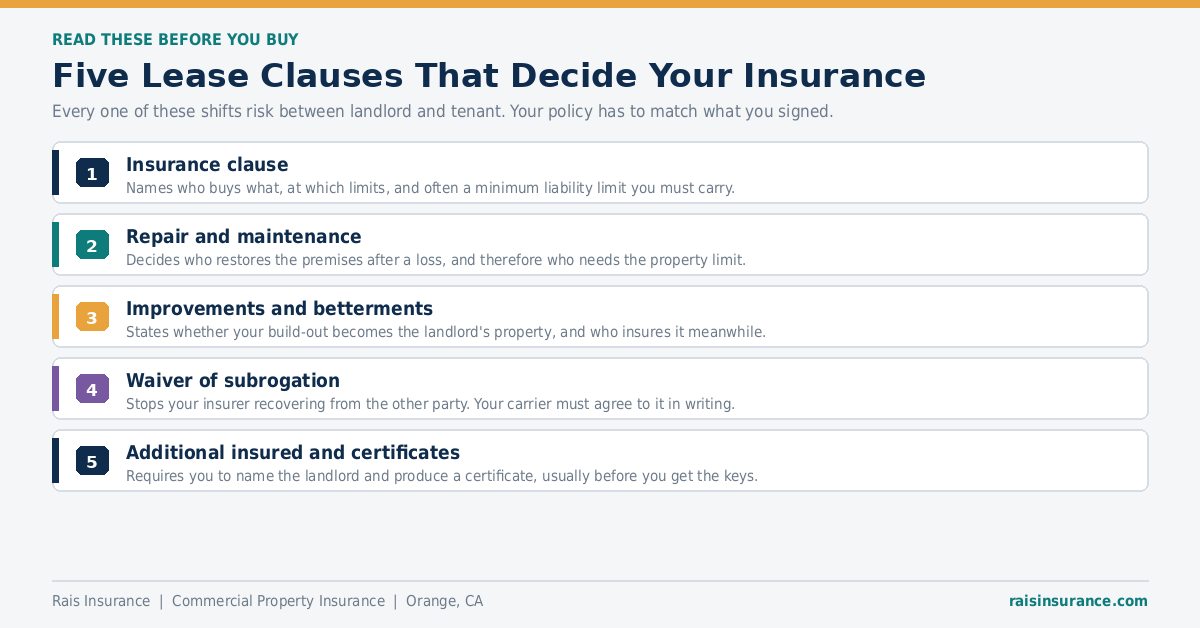
If you lease commercial space in Orange – or lease it out – your insurance obligations are written into the lease, not chosen freely. These five clauses do the work:
- Insurance clause. Names who buys which policies, at what limits, and frequently sets a minimum general liability limit you must carry. Read it before you shop, not after.
- Repair and maintenance. Decides who is obliged to restore the premises after a loss – and therefore who genuinely needs the property limit to be adequate.
- Improvements and betterments. States whether the build-out becomes the landlord’s property once installed, and who is responsible for insuring it in the meantime. These two answers are frequently different, which is where the gap opens.
- Waiver of subrogation. Each party gives up the right to have its insurer recover from the other. Your carrier has to agree to it in writing, normally by endorsement. Signing one your insurer has not accepted can jeopardise your own coverage.
- Additional insured and certificates. Requires you to add the landlord to your liability policy and produce a certificate of insurance, usually before you are handed the keys.
None of these are exotic. All five appear in a standard Orange County commercial lease, and all five are far easier to deal with before signature than after a claim.
Improvements and Betterments: The Gap Tenants Fall Into
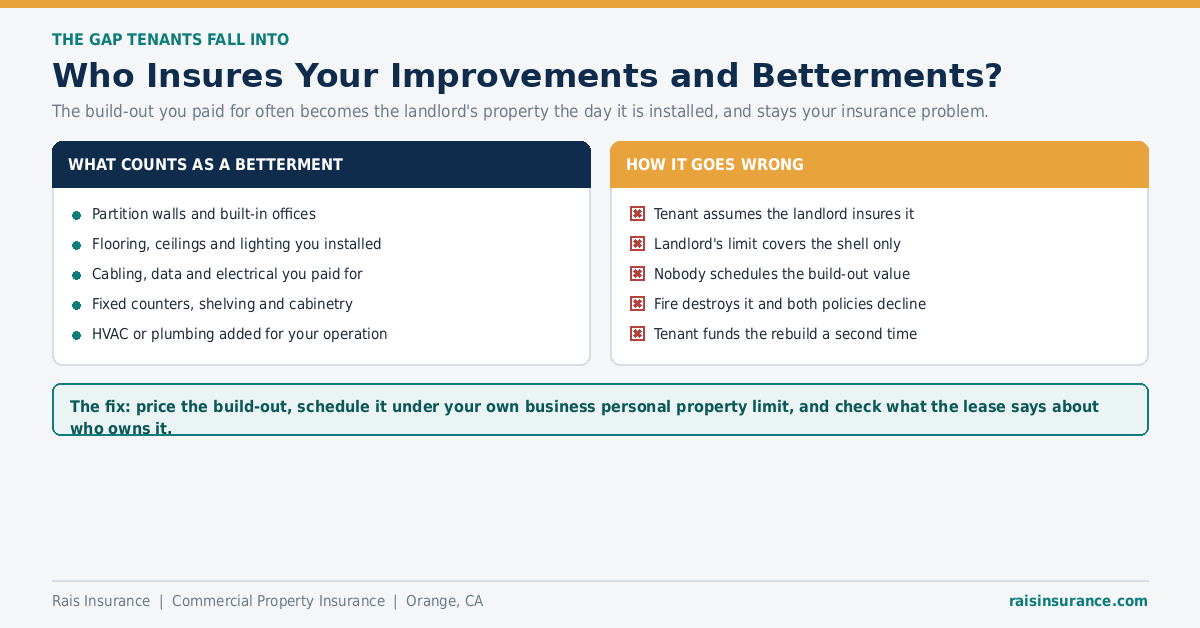
If you fitted out your unit – partition walls, flooring, lighting, cabling, fixed counters, an HVAC unit added for your operation – that work is called improvements and betterments, and it is the single most commonly uninsured item at a leased commercial property.
The trap is structural rather than careless. Most leases say the improvements become the landlord’s property the moment they are installed, so the tenant reasonably assumes the landlord insures them. But the landlord’s building limit was set for the shell, and the landlord has no way of knowing what you spent. A fire destroys the fit-out, both policies point at each other, and the tenant funds the rebuild a second time out of cash.
The fix takes one conversation: price the build-out, schedule that figure under your own business personal property limit, and confirm what the lease actually says about ownership. If you are the landlord, the mirror-image action is to make sure your limit was never set on the assumption that tenant fit-out is included.
One Policy or Several? BOP, Package and Monoline Compared
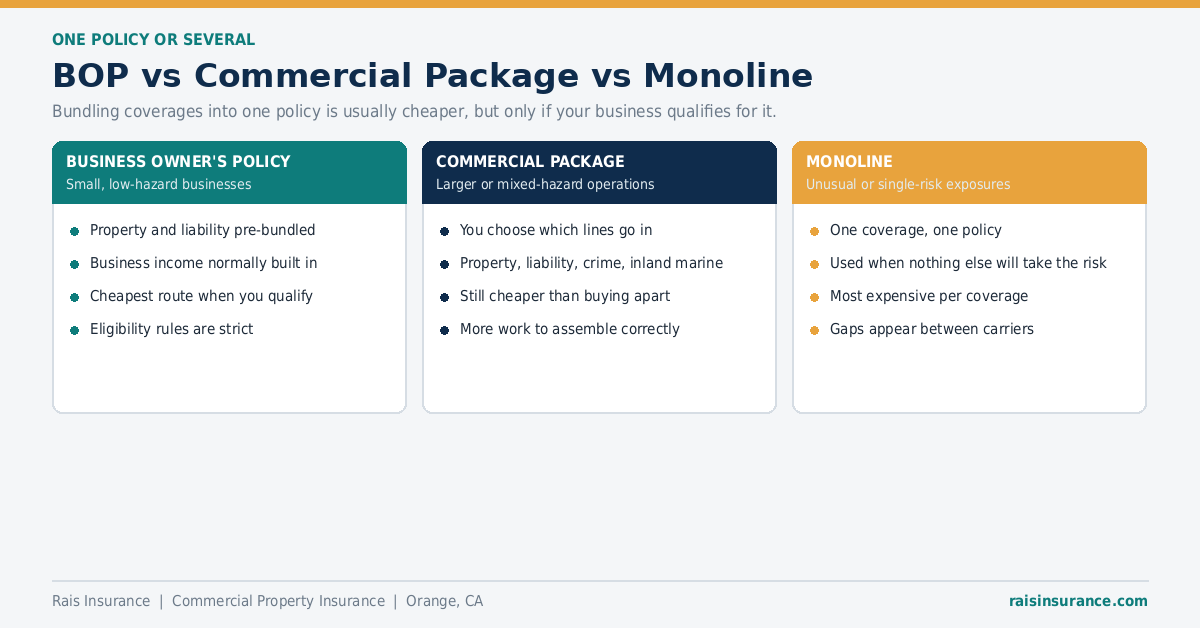
A significant benefit of commercial building and property insurance is that it can provide multiple coverages in one policy, saving you the cost of acquiring several separate ones. There are three ways to buy, and which one you qualify for moves the price more than shopping around does.
| How you buy it | Who it suits | What to know |
|---|---|---|
| Business owner’s policy (BOP) | Small, low-hazard businesses – offices, most retail, many service firms | Property and general liability come pre-bundled, with business income normally built in. Cheapest route to both coverages when you qualify, but eligibility rules on size, occupancy and hazard are strict. |
| Commercial package policy | Larger operations, or mixed hazards a BOP will not accept | You select which lines go in – property, general liability, crime, equipment and stock that moves between sites, and others. More work to assemble, still materially cheaper than buying each separately. |
| Monoline policies | Unusual or single-risk exposures | One coverage per policy. Sometimes the only market that will take the risk, but the most expensive per coverage – and gaps appear in the seams between carriers. |
The reason bundling is cheaper is not a discount gimmick. One carrier writing several lines has a fuller picture of the risk and fewer arguments to have with another insurer at claim time. Which policy form sits underneath still matters too – see all-risk and peril-specific policy forms.
The Four Coverages Inside a Commercial Property Policy
A typical commercial property insurance policy is built from these parts. Terms differ between insurers, so read your own schedule rather than a summary:
- Commercial buildings coverage. Replacement coverage for the structure itself. Whether that means replacement cost or actual cash value is the most consequential choice on the whole policy.
- Business income coverage. Replaces lost profit and continuing fixed expenses while you cannot trade, and can extend to losses caused when a civil authority restricts access to your premises or neighbourhood after a disaster.
- Business personal property coverage. Your contents at a described location. Each location carries its own limit, so a second site is not automatically covered by the first one’s figure.
- Electronic data processing coverage. Broadens what applies to computer systems, media and data – see the correction immediately below.
Full detail on business income and electronic data processing coverage sits on our Cypress page rather than being repeated here.
One correction worth making: your computers are covered
It is sometimes said that computer equipment is not covered by commercial property policies. That is not right. Computers are business personal property and a standard commercial property form insures them for the causes of loss you bought. What a basic form handles poorly is the way computers actually fail – electrical disturbance, power surge, mechanical breakdown – and it does not properly address the data and media themselves. That is what electronic data processing coverage adds.
It is also worth being precise about one thing that is frequently listed under EDP: virus attacks are not an EDP peril. Malware, ransomware, breach response and data restoration after an attack belong to a cyber liability policy. Buying EDP and believing you have bought cyber cover is a costly assumption.
What Commercial Property Insurance Does Not Do
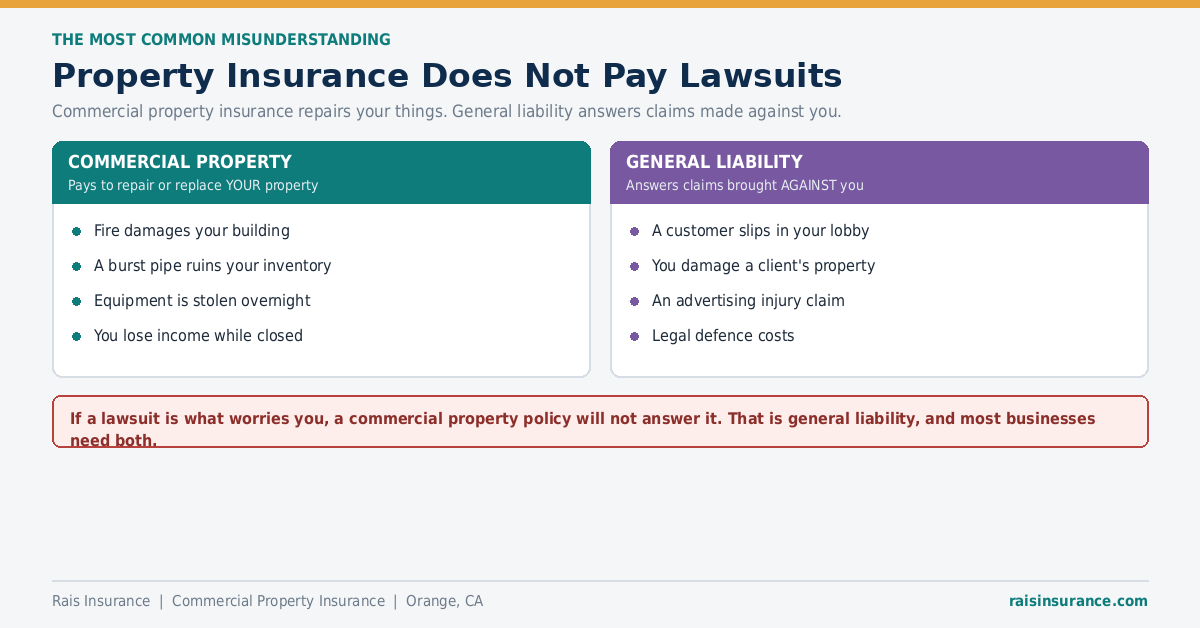
Commercial property insurance guards the physical assets of your business. It does not answer claims brought against you. If a customer is injured in your lobby, if you damage a client’s property, or if you face an advertising injury allegation, that is general liability insurance – and it is the policy that also funds your legal defence. Most Orange businesses need both, which is exactly why the BOP and package routes above exist.
Three further gaps sit outside every standard commercial property policy in California:
- Earthquake – excluded statewide, added back by endorsement or a difference in conditions policy.
- Flood – excluded, and placed separately through the NFIP or the private market. See flood insurance in California.
- Wear, tear and gradual deterioration – a policy pays for sudden accidental damage, never for deferred maintenance.
A note on wording: phrases such as natural disasters or natural calamities are not coverage terms, and in California they quietly conceal the two largest exclusions on the list. For the full picture on exclusions and how your building is valued, see our Anaheim page.
How to Choose the Best Commercial Property Insurance in Orange
Rais Insurance is dedicated to helping your business grow and prosper. Our team carefully considers your unique business needs and tailors coverage accordingly, whether you own the property or rent it, so that you can choose the right commercial property insurance for the risks your business actually carries.
Buying business property insurance well is less about the carrier than about four decisions. Start from the lease, because it tells us which of the three positions you are in. Price the build-out separately, because nobody else will. Decide between a BOP, a package and monoline on eligibility rather than on habit. And confirm the building limit against a current valuation instead of last year’s renewal figure.
Premium itself is a separate subject – if that is your question, our Santa Ana page covers how your premium is rated and what documents decide a claim in full.
We serve Orange, Villa Park, Yorba Linda and Orange Park Acres from our Anaheim office, and we write commercial property insurance across California.
Commercial Building Insurance Orange – Frequently Asked Questions
Q1. Do I need commercial property insurance if I rent my space in Orange?
Yes. You do not need to own a building to have insurable property. As a tenant you own your equipment, inventory, furniture and records, and your lease will almost always make you responsible for the improvements and betterments you installed. The landlord’s policy insures the landlord’s building. It does not insure your contents, your build-out or your lost income.
Q2. Who insures tenant improvements and betterments?
Usually the tenant, even though the lease often makes the improvements the landlord’s property once installed. That combination is exactly why the item gets missed: the tenant assumes the landlord covers it because the landlord owns it, and the landlord’s limit is set for the shell only. Price your build-out and schedule it under your own business personal property limit.
Q3. Does commercial property insurance cover lawsuits?
No. Commercial property insurance pays to repair or replace your own property and to replace income lost while you cannot trade. A claim brought against you by someone else – a customer injured on your premises, damage you caused to a client’s property, an advertising injury allegation – is general liability, together with the legal defence costs. Most businesses need both policies.
Q4. What is a business owner’s policy and should I buy one?
A business owner’s policy, or BOP, bundles commercial property and general liability into a single policy, usually with business income included. For a small, low-hazard business it is normally the cheapest route to both coverages. Eligibility rules are strict on size, occupancy and hazard, so a larger or mixed operation typically moves to a commercial package policy instead.
Q5. What is the difference between a BOP and a commercial package policy?
A BOP is pre-bundled: the carrier decides what goes in and you qualify or you do not. A commercial package policy is assembled, so you choose which lines to include – property, general liability, crime, inland marine, and others. The package costs more to put together but fits businesses a BOP will not accept, and it is still cheaper than buying each coverage as a standalone monoline policy.
Q6. What is a waiver of subrogation in a commercial lease?
It is a clause in which each party gives up the right to have its insurer recover a loss from the other party. If your lease contains one, your insurer must agree to it in writing, usually by endorsement. Signing a waiver your carrier has not accepted can put your own coverage at risk, so send the lease to your broker before you sign it.
Q7. Why does my landlord want to be named as an additional insured?
Because it gives the landlord the protection of your liability policy for claims arising out of your occupancy, rather than relying on your promise to indemnify. Most commercial leases in Orange County require it, along with a certificate of insurance produced before you take possession. Both are routine and your broker can issue them quickly.
Q8. Does commercial property insurance cover earthquakes and floods in Orange, CA?
No. Earthquake and flood are excluded from standard commercial property policies throughout California. Earthquake is added back by endorsement or through a difference in conditions policy, and flood is placed separately through the NFIP or a private flood market. Be careful with the phrase natural disasters in any policy summary – it is not a coverage term and it hides these two exclusions.
Q9. Are my computers covered by a commercial property policy?
Yes, computers are business personal property and a standard commercial property form covers them for the causes of loss you bought. What a basic form does not do well is cover the broader causes computers actually fail from, such as electrical disturbance and mechanical breakdown, or cover the data and media themselves. That is what an electronic data processing coverage adds – not virus attacks, which belong to a cyber policy.
Q10. How much does commercial property insurance cost in Orange, CA?
There is no flat rate. The premium is built from the replacement value of the building and contents, the construction type, what the business does inside, the fire and security protection on site, and the exposures around the address. Whether you bundle also moves the number materially. The quickest route to a real figure is to send a broker your current declarations page and your lease.
Get a Commercial Property Insurance Quote in Orange, CA
So what are you waiting for? contact Rais Insurance right now and get the right commercial building and property insurance from one of our experienced agents serving Orange, CA. Call 714-761-4336, email rai@raisinsurance.com, or visit 2612 W. Lincoln Avenue, Suite 103, Anaheim, CA 92801.
Bring two documents: your current declarations page and your lease. Between them they answer almost every question above, and they usually reveal within ten minutes whether you are underinsured, double-insured, or both.
