

What Does Home Insurance Cover in California?
The perils that actually threaten a California home are not the ones usually listed. Two of the biggest are excluded from every standard policy, one of the most commonly cited does not happen here at all, and the part of the policy that protects a family’s finances most is the part people think about least. This page covers all three.
Which Perils Actually Threaten a California Home
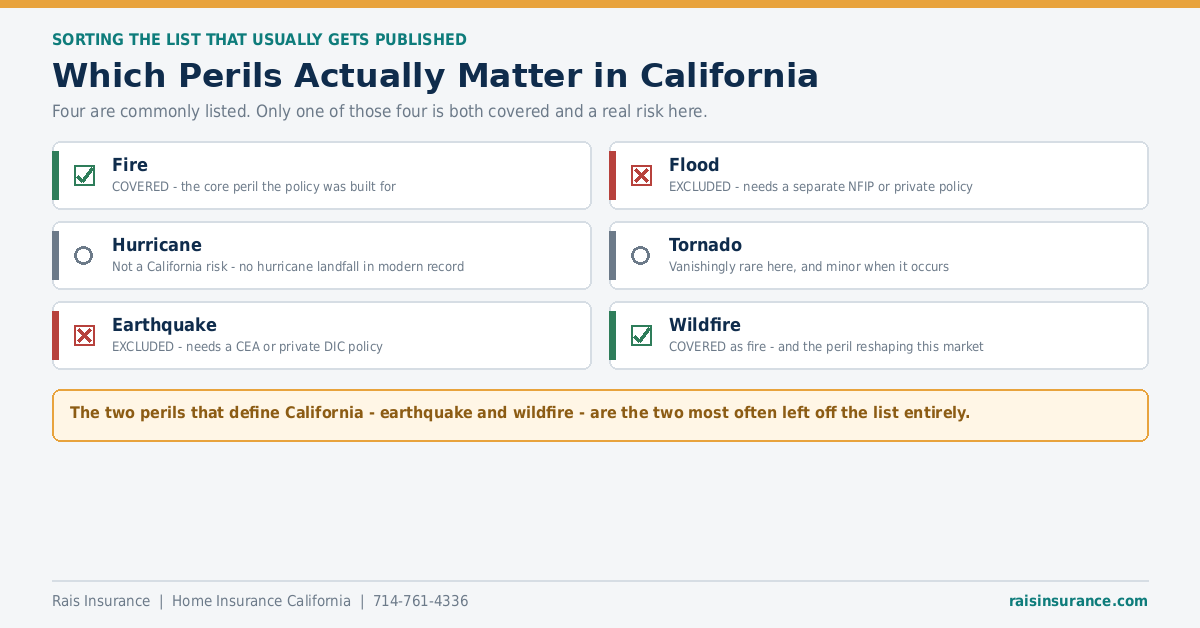
The standard list of calamities you will see in most writing on this subject is fire, hurricane, tornado and flood. Sorted for this state, that list is mostly wrong:
- Fire – covered. The core peril homeowners insurance was built around, and still the most consequential for most households.
- Flood – excluded. Rising water, storm surge and mudflow are outside every standard policy. Cover comes from the National Flood Insurance Program or a private carrier, usually with a thirty-day waiting period – see flood insurance in California.
- Hurricane – not a California risk. No hurricane has made landfall in California in the modern record. Where wind damage does happen, windstorm is already a named peril.
- Tornado – vanishingly rare here, and minor when it occurs.
- Earthquake – excluded, and almost never on these lists despite being the risk everyone in California knows about. It needs a separate California Earthquake Authority policy or a private difference-in-conditions policy, with its own percentage deductible.
- Wildfire – covered as fire, and the peril genuinely reshaping this market.
So of the four perils usually named, one is covered and relevant, one is excluded, and two do not meaningfully occur here – while the two that define California insurance are missing from the list entirely.
Wildfire – covered, but check the limit
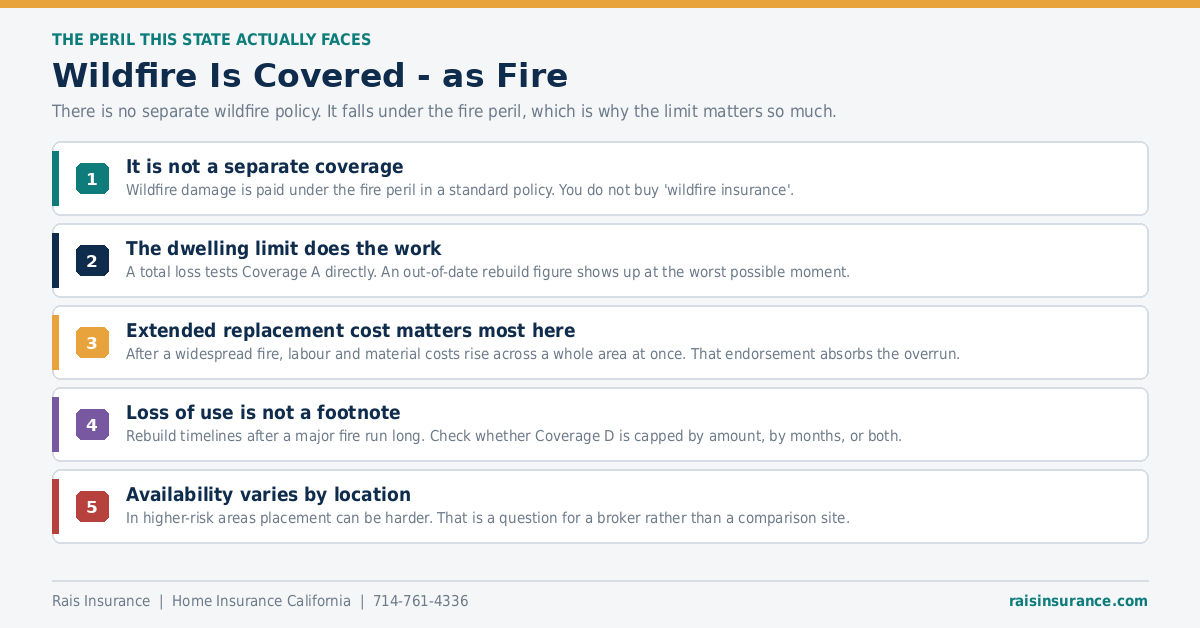
There is no separate wildfire policy to buy. Wildfire damage is paid under the fire peril in a standard homeowners policy, which is good news – and it puts all the weight on one number.
A wildfire loss is frequently a total loss, so it tests Coverage A, your dwelling limit, directly. If that figure reflects what it cost to rebuild several years ago rather than today, the shortfall appears at the worst possible moment. Two things are worth asking for by name: extended replacement cost, which adds a further percentage above the limit when rebuild costs overrun across a whole area at once, and a realistic loss of use limit, since rebuild timelines after a major fire run long.
The Part That Protects the Family, Not Just the House
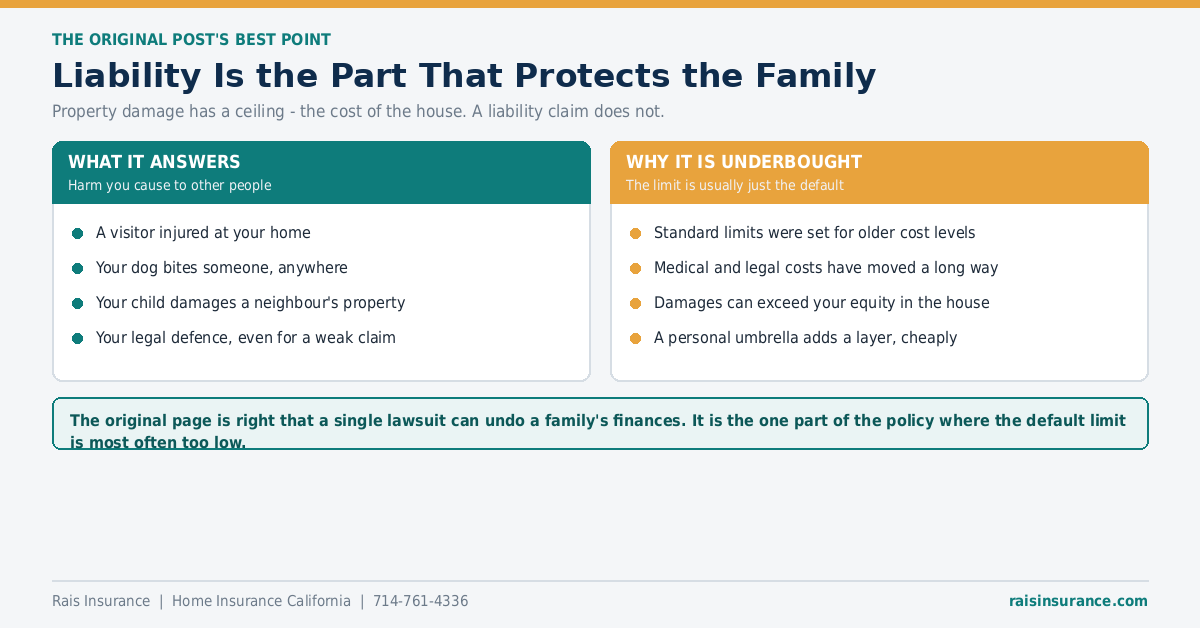
The original version of this post made one point better than most published writing on the subject: the most important thing a home policy protects against is liability, because a single lawsuit can undo a family’s financial position in a way that damage to the building rarely does. That is exactly right, and it deserves more than a sentence.
The reason is a matter of ceilings. Property damage has one – however bad the loss, it is bounded by the cost of rebuilding your house and replacing its contents. A liability claim has no such ceiling. It is bounded by what a court decides, which can exceed your equity in the property – and no amount of homeowners insurance on the building addresses that.
The liability section answers a visitor injured at your home, a dog bite – anywhere, and California applies strict liability to dog owners – damage a member of your household causes to somebody else’s property, and your legal defence even when the claim is weak.
Which makes it the part of the policy most often underbought. Standard limits were set against older medical and legal cost levels, and most people never change them from the default. A personal umbrella policy adds a further layer above both your home and auto liability, usually for a modest annual premium – it is one of the better-value purchases in personal insurance.
Judging an Insurer Before You Need Them
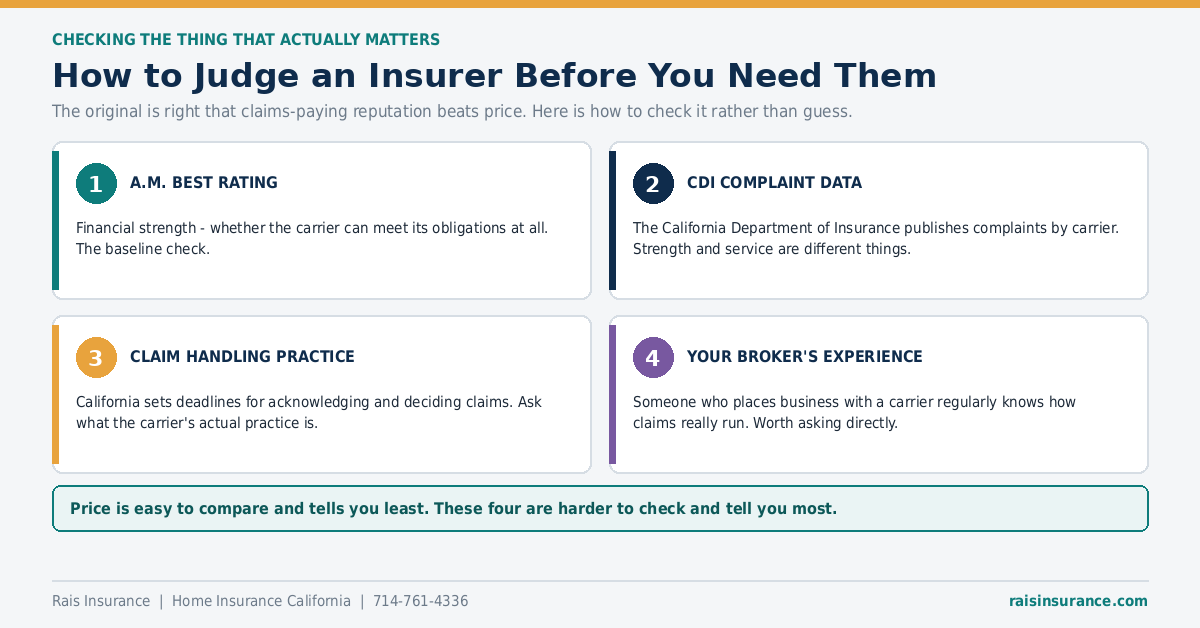
Comparing three or four quotes before deciding is sound advice, and so is the point that you should not decide on premium alone – what matters more is whether the carrier pays claims without a fight. The question is how to check that rather than guess at it:
- A.M. Best rating – financial strength, meaning whether the carrier can meet its obligations at all. The baseline check.
- California Department of Insurance complaint data – published by carrier, and a different question entirely. A company can be financially sound and still slow to settle.
- Claim handling practice – California sets deadlines for acknowledging and deciding claims. Asking what a carrier’s actual practice is tells you more than its advertising.
- Your broker’s experience – someone placing business with a carrier regularly knows how claims really run. That is worth asking for directly, and it is information a comparison site cannot give you.
Price is the easiest thing to compare and the least informative. On what actually makes two quotes different, see how to compare home insurance quotes properly.
Cutting Cost Without Cutting Cover
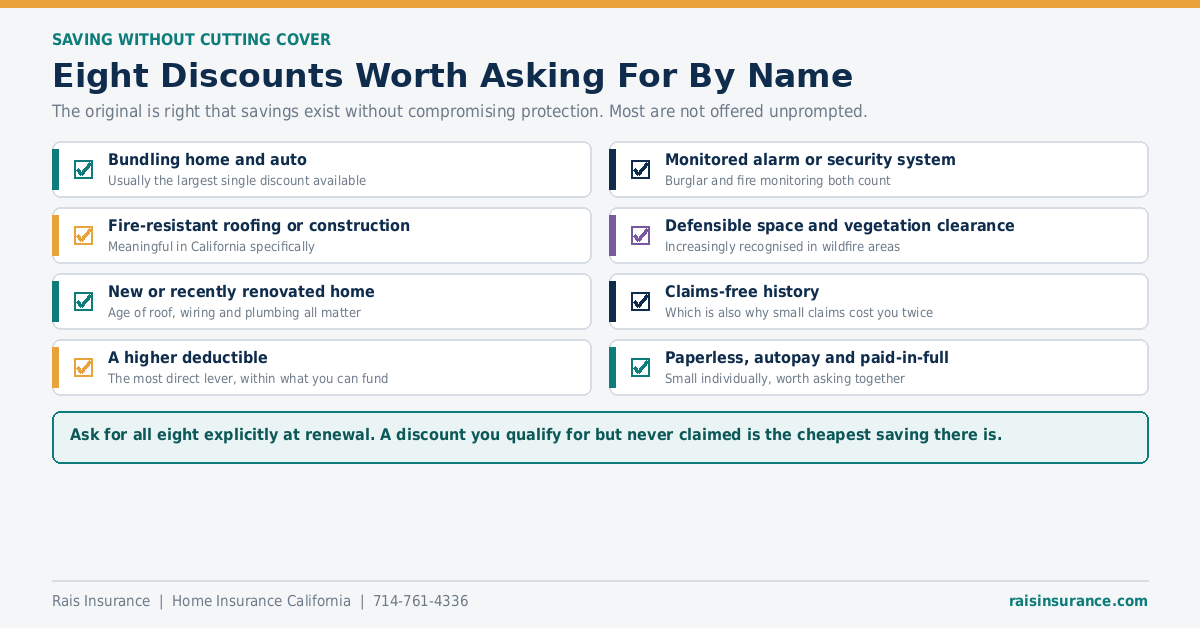
There are genuine savings available that do not reduce your protection at all – and most of them are not offered unless you ask. Eight worth raising by name at your next renewal:
- Bundling home and auto with one carrier – usually the largest single discount available.
- A monitored alarm system – burglar and fire monitoring both typically count.
- Fire-resistant roofing or construction – meaningful in California specifically.
- Defensible space and vegetation clearance – increasingly recognised in wildfire-exposed areas.
- A newer or recently renovated home – the age of the roof, wiring and plumbing all matter.
- A claims-free history – which is also why making a small claim can cost you twice.
- A higher deductible – the most direct lever, within what you could genuinely pay from savings.
- Administrative savings – paperless billing, autopay and paying in full. Small individually, worth asking about together.
What does *not* count as smart cost-cutting is reducing your dwelling limit or moving to an actual cash value settlement to make a quote look cheaper. That is not a discount – it is a smaller policy.
Home Insurance in Orange County and Across California
Rais Insurance places home insurance California households rely on, from our office in Anaheim. If you are comparing home insurance Orange County options locally, our home insurance in Orange and home insurance in Garden Grove pages cover those markets specifically.
One practical note on this state: what a carrier will write, and at what price, varies more by exact location than most people expect – brush proximity, roof material and construction type all matter. That is precisely the situation where a broker putting one set of details to several carriers beats filling in the same form repeatedly.
Choosing Wisely
A home policy is there for stability and protection, and choosing well is mostly a matter of knowing what you are actually buying. Get the dwelling limit right, understand that earthquake and flood need separate policies, do not leave the liability limit at the default, and check the carrier as carefully as the price.
If you would like that done for your property rather than working through it yourself, see home insurance in California or call 714-761-4336.
Our other services: auto insurance, renters insurance and business insurance.
Home Insurance Coverage – Frequently Asked Questions
Q1. What perils does a California home insurance policy cover?
A standard homeowners insurance policy covers fire – including wildfire – along with lightning, windstorm, hail, explosion, theft, vandalism, falling objects, and sudden water damage from burst pipes. It also covers your personal liability and your contents. The two significant California risks it does NOT cover are earthquake and flood, both of which need separate policies.
Q2. Is wildfire covered by homeowners insurance?
Yes. Wildfire damage is paid under the fire peril in a standard policy – there is no separate wildfire policy to buy. What matters is whether your dwelling limit reflects current rebuild costs, because a wildfire loss is often a total loss and tests that limit directly. Extended replacement cost is worth asking about specifically.
Q3. Does home insurance cover flood damage?
No. Flood – rising water, storm surge, mudflow – is excluded from every standard homeowners policy. Cover comes from the National Flood Insurance Program or a private flood carrier, and there is normally a thirty-day waiting period. A burst pipe inside the house is a different thing and is generally covered by the home policy.
Q4. Does home insurance cover earthquake damage in California?
No. Earthquake is excluded from every standard California homeowners policy, and no amount of dwelling limit changes that. Cover is bought separately, most commonly through the California Earthquake Authority alongside your existing policy, or through a private difference-in-conditions policy. It carries its own deductible, usually a percentage of the dwelling limit.
Q5. Do I need hurricane or tornado cover in California?
No. California does not experience hurricane landfall, and tornadoes here are rare and generally minor. Where windstorm damage does occur it is already covered as a named peril in a standard policy. Articles listing hurricane and tornado as key home insurance perils are usually written for other parts of the country.
Q6. How much personal liability coverage should I carry?
More than the default, in most cases. Standard limits were set against older medical and legal cost levels, and a serious injury claim can exceed them without much difficulty – potentially beyond your equity in the house. A personal umbrella policy adds a further layer above both your home and auto liability, usually for a modest annual premium.
Q7. Does home insurance cover dog bites?
Generally yes, under the liability section, and it applies whether the bite happens at your home or elsewhere. California applies strict liability for dog bites, meaning the owner can be responsible even without prior knowledge of aggression. Some carriers restrict or exclude certain breeds, so it is worth checking your own wording rather than assuming.
Q8. How do I check whether an insurer pays claims properly?
Two sources beyond the quote. A.M. Best rates financial strength – whether the carrier can meet obligations at all. And the California Department of Insurance publishes complaint data by carrier, which is a different question: a company can be financially sound and still slow to settle. A broker who places business with a carrier regularly will also have a practical view.
Q9. What home insurance discounts are available in California?
Bundling home and auto is usually the largest. Beyond that: monitored alarm systems, fire-resistant roofing or construction, defensible space and vegetation clearance, a newer or renovated home, a claims-free history, a higher deductible, and administrative savings like paperless billing and paying in full. Most are not offered unless you ask.
Q10. Should I choose a policy on price?
Not on price alone. A cheaper quote very often reflects a lower dwelling limit or an actual cash value settlement basis rather than genuine savings, and neither difference is displayed prominently. Compare the coverage first and the price second – our guide to comparing home insurance quotes covers what to hold constant across quotes.
Get a Home Insurance Quote in California
contact Rais Insurance on 714-761-4336, email rai@raisinsurance.com, or visit 2612 W. Lincoln Avenue, Suite 103, Anaheim, CA 92801.
If you already hold a policy, have the declarations page to hand. Three lines are worth checking: your dwelling limit, your personal liability limit, and whether you carry earthquake cover at all.