

General Liability Insurance Tustin
The claims that actually happen in Tustin have a pattern to them, and it is worth naming: most of them involve a neighbour. A tree comes down on the wrong side of a fence. A fire pit throws a spark. Work in one garden damages something in the next. This page covers who pays in each of those situations under California law, which liability insurance policy responds, and how the answer changes if the same thing happens in the course of a business.
Four Things That Actually Happen in Tustin
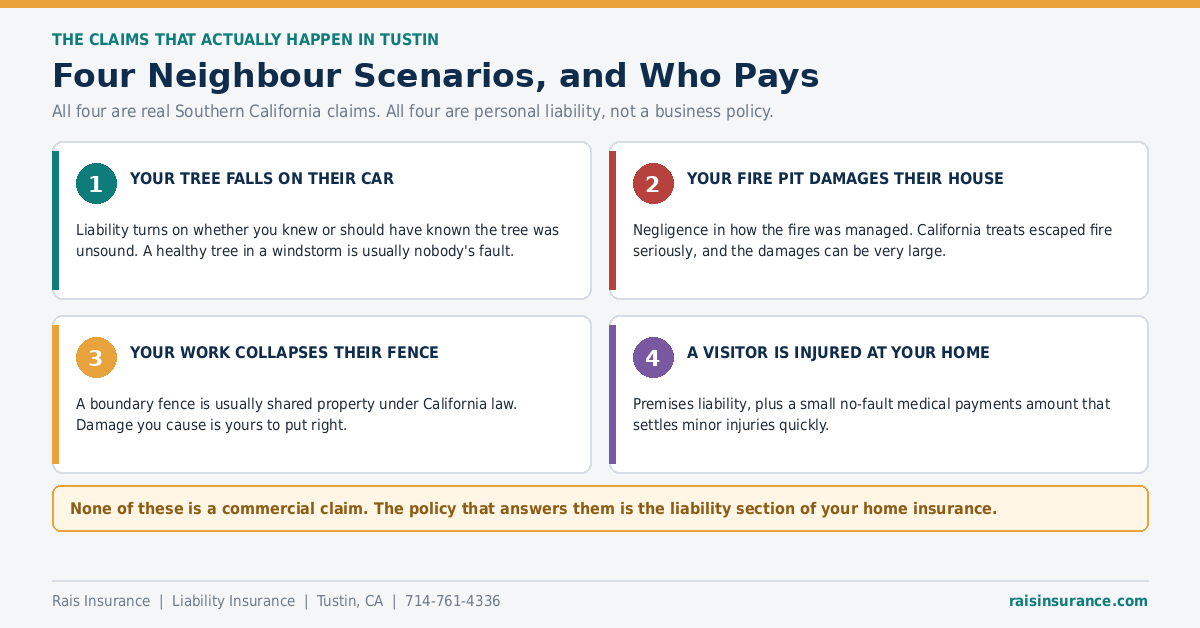
Each of these is a genuine Southern California liability insurance claim, and each has a different answer:
- Your tree falls on a neighbour’s car. Liability turns on whether you knew, or reasonably should have known, that the tree was unsound. A healthy tree in an unusual windstorm is usually nobody’s fault.
- Your fire pit or barbecue damages their property. Negligence in how the fire was managed. California treats escaped fire seriously and the damages can run very high.
- Work in your garden collapses a boundary fence. A shared fence has its own rules in California – but damage you cause is yours alone to put right.
- A visitor is injured at your home. Premises liability, plus a small no-fault medical payments amount that can settle a minor injury before it becomes a claim.
None of the four is a commercial claim. The liability insurance that answers all of them is the liability section of your homeowners or renters policy – which is a different product from the commercial cover this part of our site otherwise deals with, and worth being clear about before you buy anything.
Trees – the most common dispute of all
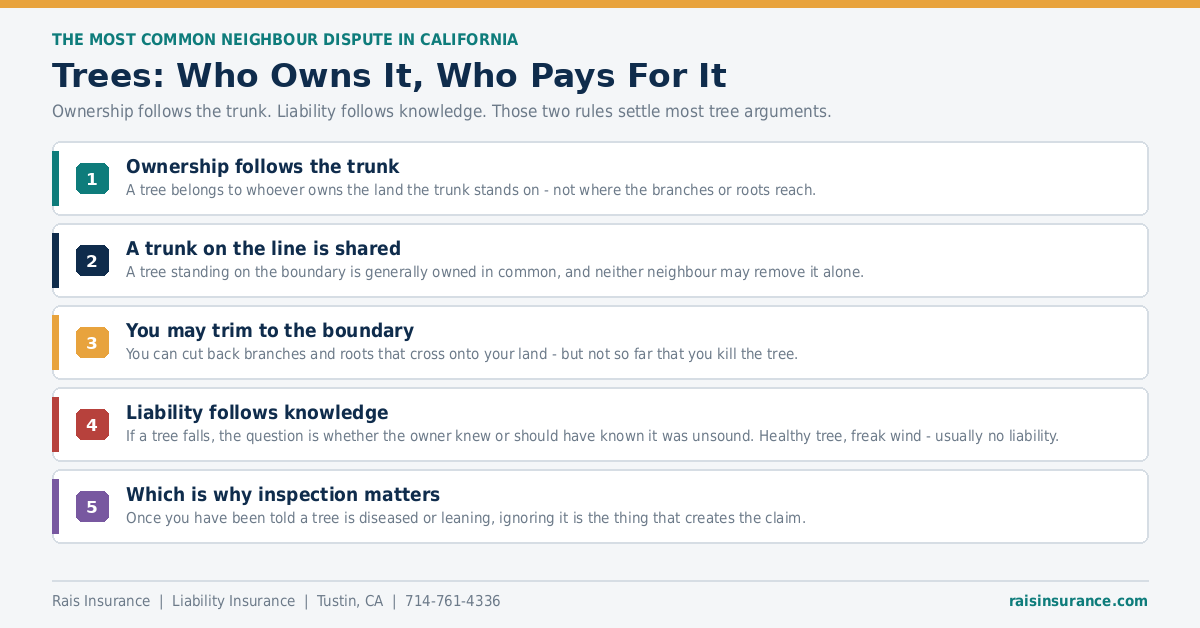
Two rules settle most tree arguments in California, and they are worth knowing before an argument starts:
- Ownership follows the trunk. A tree belongs to whoever owns the land the trunk stands on – not where the branches hang or the roots run. A trunk sitting on the boundary itself is generally owned in common, and neither neighbour may remove it alone.
- Liability follows knowledge. If a tree falls, the question is not who owned it but whether the owner knew or should have known it was unsound. Diseased, dead, leaning, previously damaged – once you have been told, ignoring it is what creates the claim.
- You may trim to the boundary. Branches and roots crossing onto your land can be cut back at your own expense. The limit is that you must not cut so severely that you damage or kill the tree, which can make you liable to its owner instead.
Fences – shared unless proven otherwise
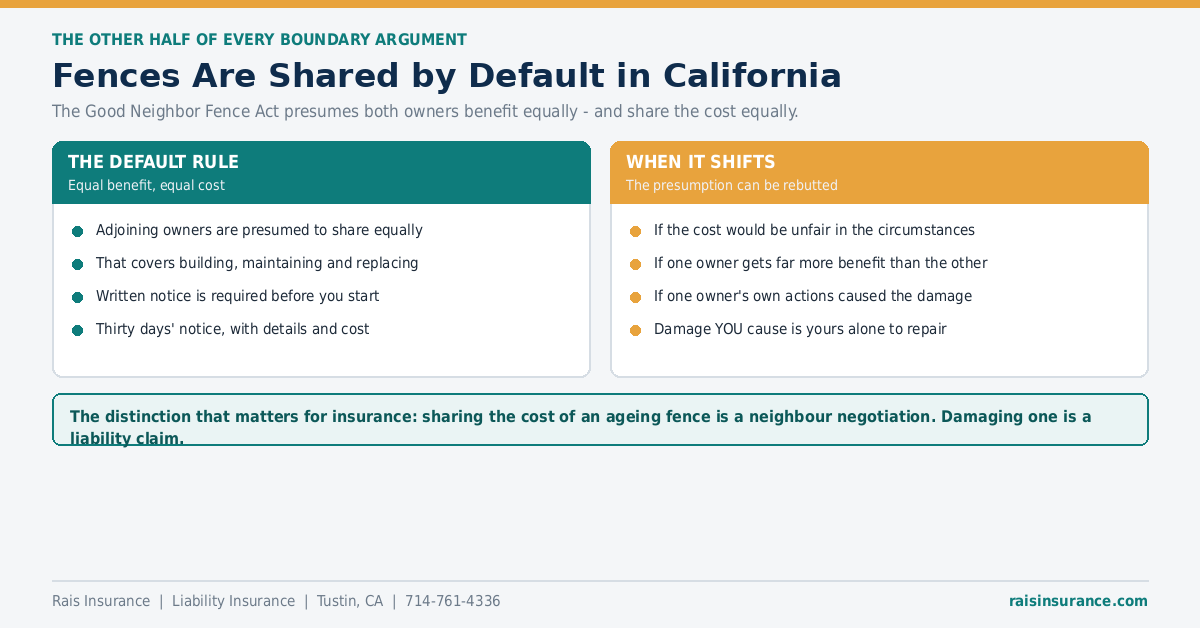
California’s Good Neighbor Fence Act presumes that adjoining owners benefit equally from a boundary fence and share its cost equally – building, maintaining and replacing. Thirty days’ written notice setting out the problem, the proposed work and the estimated cost is required before you start.
That presumption can be rebutted where equal sharing would be unfair – if one owner takes far more benefit than the other, or where the circumstances make an even split unreasonable. And there is one clear exception: damage you cause yourself is yours alone. Sharing the cost of an ageing fence is a neighbour negotiation; damaging one is a liability claim.
The Same Accident, Two Different Policies
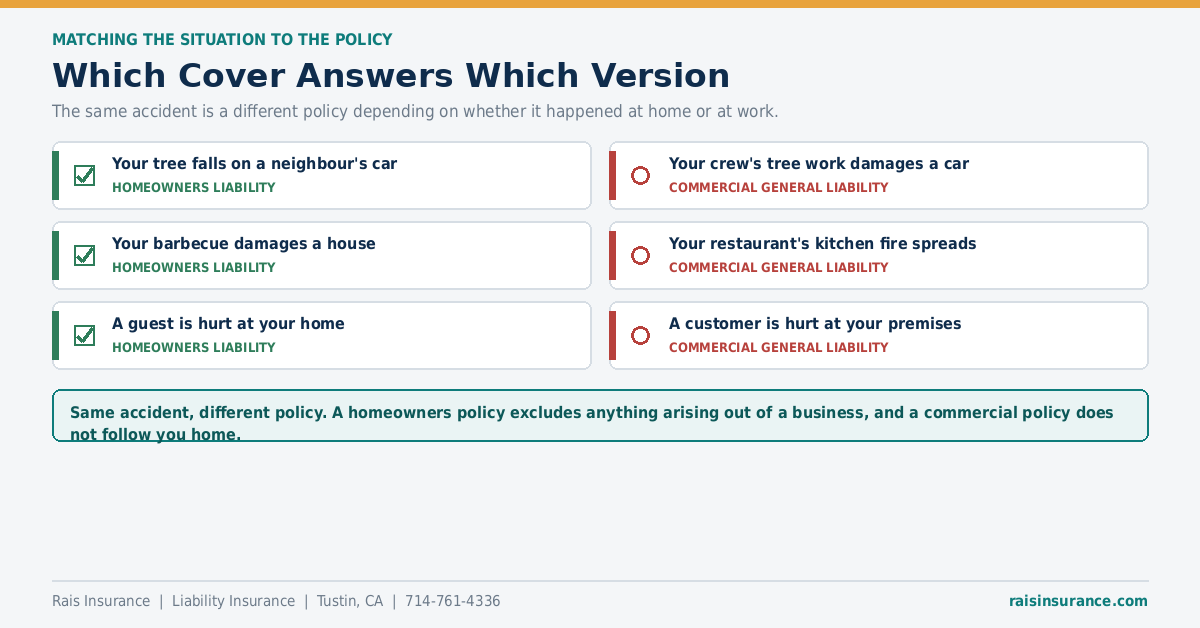
This distinction decides which liability insurance you should be asking about, and it catches people out constantly. Your tree falling on a neighbour’s car is homeowners liability. Your crew’s tree work damaging a customer’s car is commercial general liability. Same accident, different policy.
The reason is that a homeowners policy excludes liability arising out of a business, and that exclusion is broad. It does not matter that the work happened at a house, or that the business is small, or that it is something you only do occasionally. If the activity is commercial, the home policy steps back.
It runs the other way too: a commercial policy does not follow you home. A business owner in Tustin generally needs both personal cover and business liability insurance, and the gap between them is where a surprising number of claims land – see personal liability, home businesses and the gaps between.
If your question is the commercial one – what a Tustin business needs and how general liability insurance Tustin operators rely on fits alongside the other policies – that is set out in full on our which policies your business actually needs page for Orange County.
Medical Bills Resulting from Liability
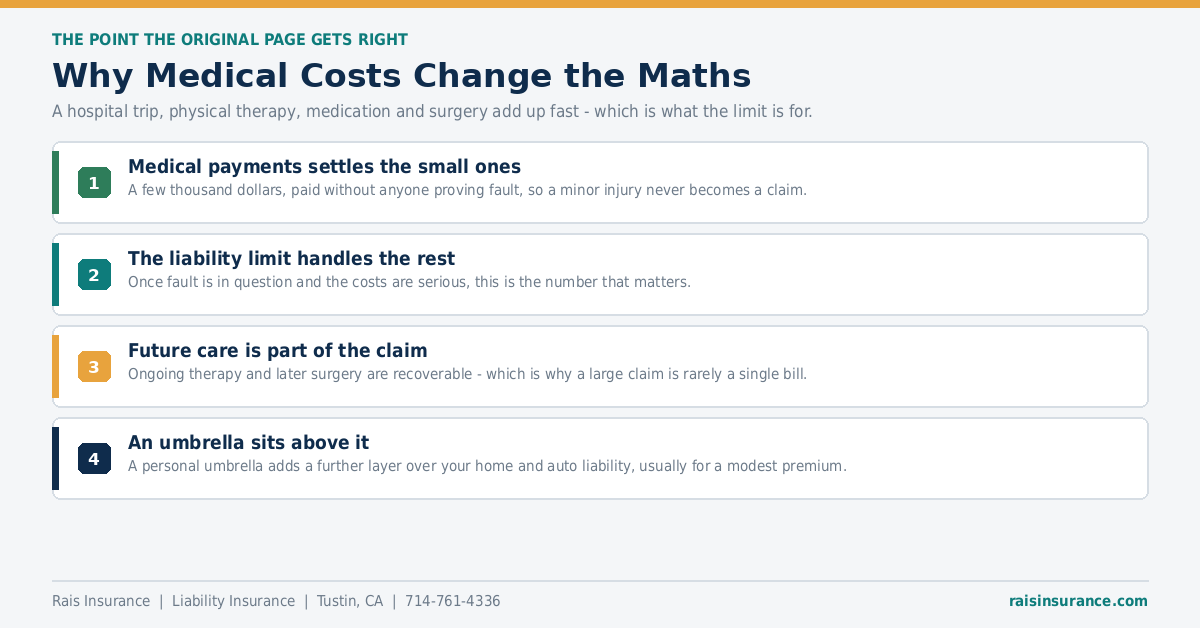
Some people are comfortable carrying this risk themselves, and for small amounts that is a reasonable position. The arithmetic changes when you picture the actual sequence: a hospital trip, then physical therapy, then medication, then possibly surgery months later. The original cost is rarely the final one.
Four things determine whether your liability insurance is equal to that:
- Medical payments settles the small ones. A few thousand dollars, paid without anyone establishing fault, so a minor injury is resolved before it becomes a dispute – see medical payments and why it settles claims fast.
- The liability limit handles the rest. Once fault is genuinely in question and the costs are serious, this is the number that matters.
- Future care counts. Ongoing therapy and later surgery are recoverable as part of the claim, which is why a large claim is almost never a single bill – see what a claim actually costs you.
- An umbrella sits above it. A personal umbrella policy adds a further layer over both your home and auto liability, usually for a modest premium. On why higher layers cost less than people expect, see how much cover to carry, and why the second million costs less.
And the point the original page makes well is worth keeping: the value is not only being covered for the damage you can foresee. It is being covered for the incidents you have not thought about – which, by definition, is most of them. That is also what the duty to defend exists for; see the duty to defend and how a false claim is handled.
What It Costs
Liability insurance is genuinely one of the better-value things you can buy. On a homeowners policy the liability insurance section is a small part of the premium, and raising the limit typically costs far less than the first dollar of cover did. A personal umbrella is usually cheaper again per dollar of protection.
What it actually costs you depends on your limits, your claims history, your property and what else you have with the same carrier. Rather than quote a figure that will not hold, we would rather look at your current declarations page and tell you whether the limit on it is realistic for Orange County medical and legal costs.
Talk to a Licensed Agent in Tustin
Rais Insurance places liability insurance Orange County residents and business owners rely on, writing across Tustin, North Tustin, Cowan Heights and the wider county. Business liability insurance and personal cover are both placed from the same office. The most useful conversation usually starts with two questions: what your current liability limit is, and whether anything you do at home is commercial.
Those two answers decide which liability insurance policies we should be looking at, and quite often they reveal that a homeowner has been relying on a policy that would decline the claim they are most worried about.
Liability Insurance Tustin – Frequently Asked Questions
Q1. My tree fell on my neighbour’s car. Am I liable?
It depends on what you knew. California liability for a falling tree turns on whether the owner knew or reasonably should have known the tree was unsound – diseased, dead, leaning or damaged. A healthy tree brought down by an unusual windstorm is generally nobody’s fault, and the neighbour’s own insurance would handle it. A tree you had been warned about is a different matter entirely.
Q2. Who owns a tree that sits on the property line?
Ownership follows the trunk, not the branches or the roots. A tree whose trunk stands entirely on your land is yours, even if half the canopy hangs over next door. A trunk standing on the boundary itself is generally owned in common by both neighbours, and neither one may remove it without the other’s agreement.
Q3. Can I cut branches that hang over my property?
Generally yes, up to the boundary line. You may trim branches and roots that encroach onto your land at your own expense. The limit is that you must not cut so severely that you damage the tree’s health or kill it – doing so can make you liable to the owner, and California treats damage to trees seriously.
Q4. Who pays for a fence between two properties?
Under California’s Good Neighbor Fence Act, adjoining owners are presumed to share equally in the cost of building, maintaining and replacing a boundary fence, because both are presumed to benefit equally. Thirty days’ written notice with the details and estimated cost is required before starting. The presumption can be rebutted if equal sharing would be unfair in the circumstances.
Q5. What if I damage my neighbour’s fence?
That is a different question from sharing the cost of an ageing fence. Damage you cause – by your work, your vehicle, your tree – is yours to put right, and it is a liability claim rather than a shared-cost negotiation. The liability section of your homeowners policy is what responds.
Q6. Am I liable if a fire from my barbecue or fire pit spreads?
You can be, if the fire escaped because of your negligence in how it was managed. California takes escaped fire seriously and the damages can be very large, which is one of the strongest arguments for carrying a higher liability limit than the minimum. Simply having a fire is not negligence; leaving it unattended or lighting it in high wind may well be.
Q7. Does my homeowners policy cover damage I cause to a neighbour?
Yes, that is precisely what the liability section is for. It answers bodily injury and property damage you or your household cause to other people, pays their damages up to your limit, and funds your legal defence. It also carries a small medical payments amount that can settle a minor injury without anyone establishing fault.
Q8. Does homeowners liability cover anything to do with my business?
No. A homeowners policy excludes liability arising out of a business, and that exclusion is broad. If any of these scenarios happens in the course of work – your crew’s tree trimming damages a car, a kitchen fire spreads from your restaurant, a customer is injured at your premises – the policy that responds is commercial general liability, which is an entirely separate purchase.
Q9. How much personal liability coverage should I carry?
More than the default, in most cases. Standard homeowners limits were set for a different era of medical and legal costs, and a serious injury claim can exceed them without much difficulty. A personal umbrella policy adds a further layer above both your home and auto liability, and it is usually one of the least expensive pieces of cover you can buy for the protection it provides.
Q10. How do I get a quote in Tustin?
Call Rais Insurance on 714-761-4336, email rai@raisinsurance.com, or visit 2612 W. Lincoln Avenue, Suite 103, Anaheim, CA 92801. It helps to know your current liability limit and whether any part of what you do at home is commercial – those two answers usually decide which policies we should be looking at.
Get a Liability Insurance Quote in Tustin
Call 714-761-4336 to speak to a licensed agent, email rai@raisinsurance.com, or contact Rais Insurance online. You can also visit us at 2612 W. Lincoln Avenue, Suite 103, Anaheim, CA 92801.
Have your declarations page to hand if you can. The liability limit is one line on it, and it is the line worth checking before anything happens rather than after.
