

General Liability Insurance Norwalk
The idea behind liability insurance is genuinely old. Long before modern insurers, individuals and businesses facing a shared danger would pool money into a mutual fund and draw on it when one of them suffered a loss. Homeowners in a part of California exposed to earthquakes could band together, pay into the fund, and protect themselves collectively against something none of them could carry alone.
Today insurers do that work at scale, so a Norwalk business owner can transfer the risk with a policy rather than a committee. What has not changed is that the protection is defined – and the most useful thing this page can tell you is which insurance California actually requires by law, and which is required by everyone else instead. Those are two different lists, and the difference matters.
Is General Liability Insurance Legally Required?
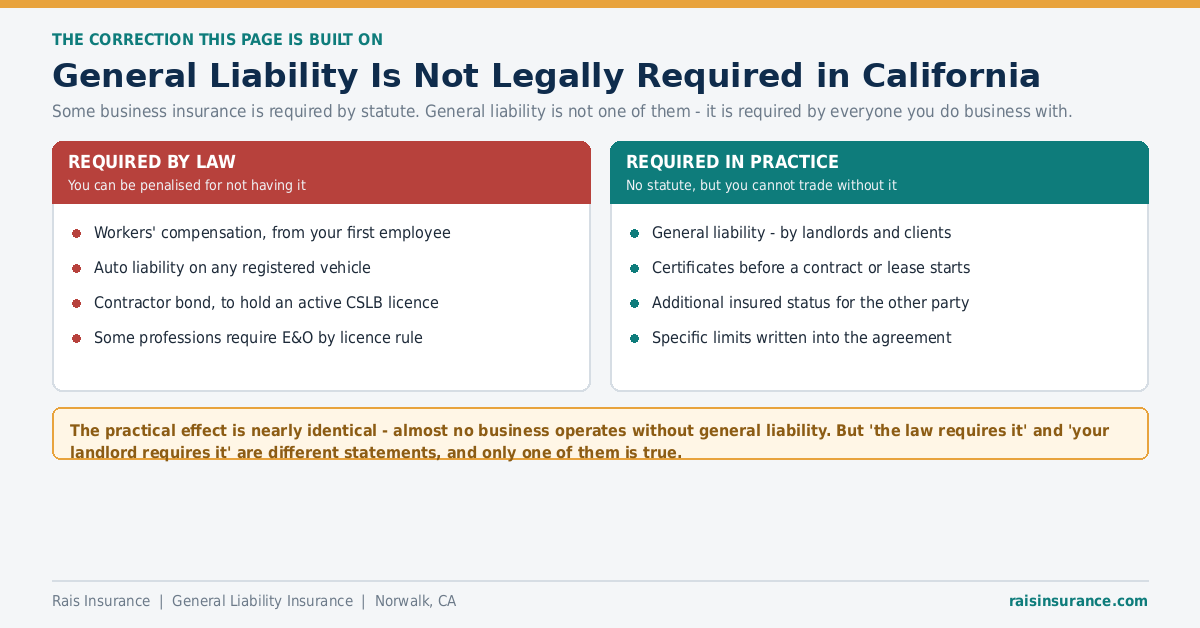
No. There is no California statute requiring a business to carry general liability insurance. This is worth stating plainly, because it is commonly said otherwise – including in the earlier version of this page, which described liability insurance as mandatory for businesses, property owners and drivers alike. Only one of those three is accurate.
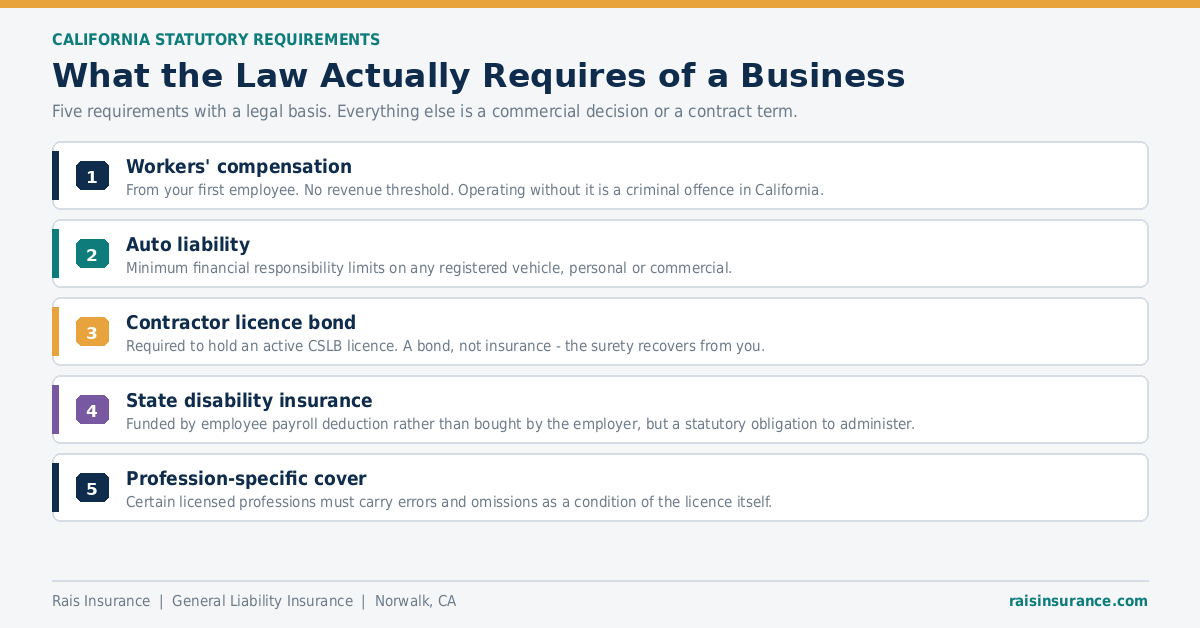
What is legally required is a different list, and it is a real one:
- Workers’ compensation, from your first employee. No revenue threshold, no grace period, and operating without it while having employees is a criminal offence in California. See workers’ compensation and what California requires of employers.
- Auto liability, on any registered vehicle. This is the requirement people are usually thinking of when they say liability insurance is mandatory – and it is a different policy entirely.
- A contractor licence bond, to hold an active CSLB licence. Note that a bond is not insurance: the surety pays your customer and then recovers from you. See what a licensed California contractor has to carry.
- Errors and omissions, for certain licensed professions where the licence itself carries the condition.
General liability sits outside that list. What makes it near-universal is not statute but everybody else: your landlord will not hand over keys without a certificate, a general contractor will not let you on site, and commercial clients write it into the contract at limits they specify. The practical effect is close to a legal requirement, but nobody fines you for not having it. A claim simply arrives and there is nothing behind it. On who asks and at what level, see who will ask you for a certificate, and at what limits.
What Commercial General Liability Insurance Does
Commercial general liability is the form most Norwalk businesses buy, and it exists to let an owner meet a legal challenge when something goes wrong and somebody outside the business is hurt or their property is damaged. From damage caused by your work to bodily injury connected to a product or service you provide, the policy funds the damages you become legally obligated to pay – and, importantly, the cost of defending you.
It applies whether the business is small or large. What changes with size is the limit you need rather than whether the policy is relevant. Business liability insurance is sized to the operation, not to the letterhead.
Accidental Negligence, and Where That Stops
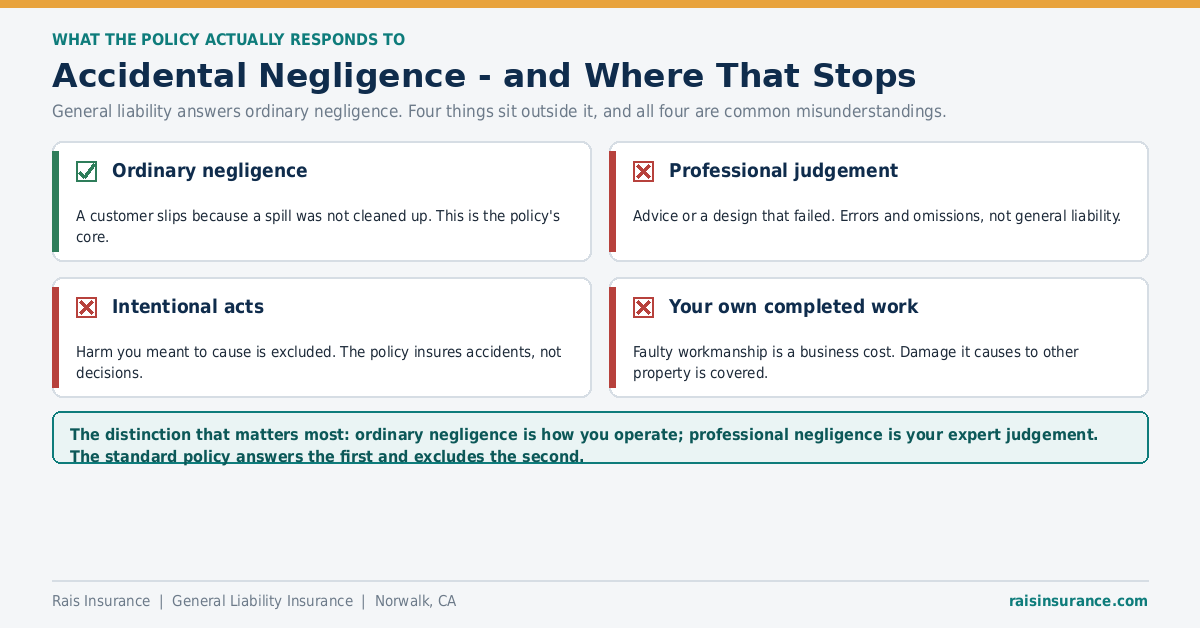
The original framing was right about this: general liability is about the aftermath of accidental negligence. It is worth drawing the boundary precisely, because three things sit outside it and all three catch people out.
- Ordinary negligence is covered. A spill nobody cleaned up, a delivery that damaged a client’s floor, a fitting that failed. This is the core of the policy.
- Professional judgement is not. Advice that turned out wrong, a design that failed, a service that underperformed. The standard form carries a professional services exclusion, and those claims belong to errors and omissions.
- Intentional acts are not. Expected or intended injury is excluded, because the policy insures accidents rather than decisions. The exclusion is about intending the harm, not intending the act, and reasonable force used to protect people or property is treated differently.
- Damage to your own completed work is not. Faulty workmanship is treated as a business cost. Damage that work causes to other property generally is covered – if a plumbing error floods a finished floor, the floor is a claim while the pipework usually is not.
The longer list is on our Escondido page: the full list of what general liability does not cover.
Why Two Norwalk Businesses Pay Different Premiums
The original made a fair point that higher-risk businesses pay more than lower-risk ones. Here is what actually sits behind that judgement, because it is more specific than a general sense of danger:
- Public contact. How many people who are not employees come onto your premises. Premises exposure scales with strangers on site.
- Physical work. Heights, heat, heavy equipment, vehicles – anything that can go wrong quickly and badly.
- Off-site work. Work performed at somebody else’s property multiplies the exposure, because you no longer control the environment.
- Products. Anything you make, sell or install can cause harm after it has left you, which is a separate aggregate on the policy.
- Claims history. Usually three to five years, and it includes claims reported and closed without payment.
- Classification code. The single biggest factor, and the only one on this list that is administrative rather than a fact about your business.
That last one deserves attention. Businesses drift – a firm that started as one thing and now mostly does another is frequently still rated on the original code. Check the code and its description on your declarations page at renewal, because the correction usually runs in your favour and nobody makes it for you. More on this in what actually sets your premium, and the year-end audit.
Homeowner Liability Is a Different Policy
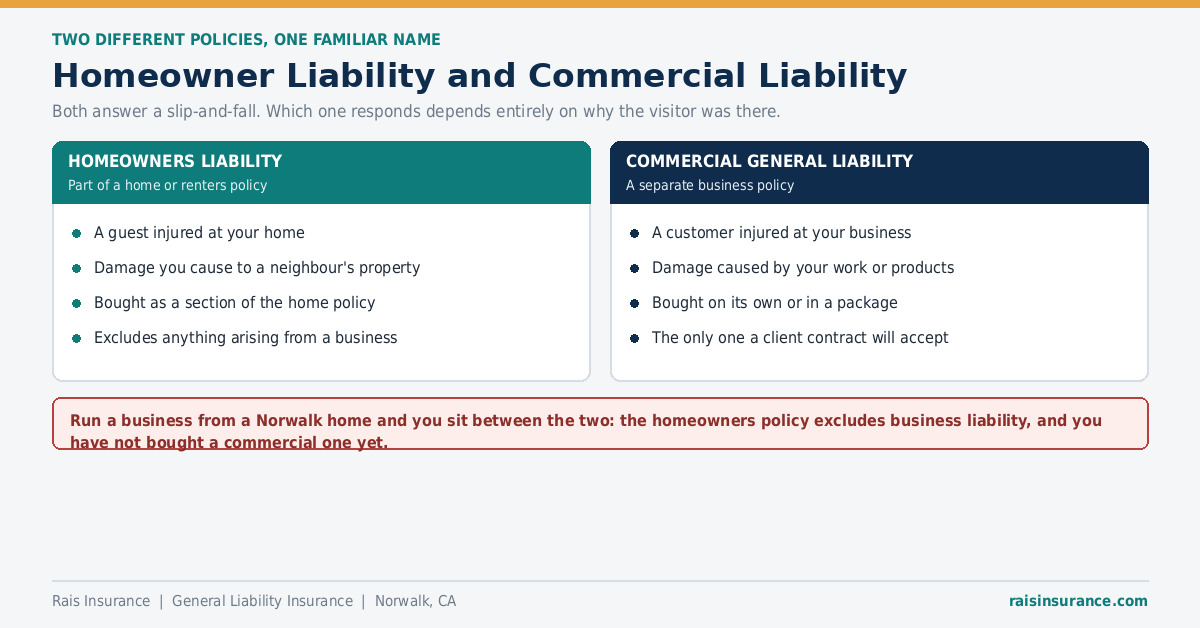
The earlier version of this page also covered homeowner liability – a slip-and-fall, or something more serious, where a visitor is injured on private property. That is a real coverage and the description was sound. It is a different policy, though, and the distinction is worth keeping clean.
Homeowner liability is a section of your home or renters policy. It answers accidents arising from your private life: a guest injured at your home, damage you cause to a neighbour’s property. Commercial general liability is a separate business policy answering injury or damage arising from your business. Both would respond to a slip-and-fall, and which one applies depends entirely on why the visitor was there.
The gap between them catches out home-based businesses, and Norwalk has a lot of them. A homeowners policy excludes liability arising out of a business, so if clients visit, if you hold stock, or if a contract asks for proof of cover, the home policy will not answer. See personal liability, home businesses and the gaps between.
One Note on the Earthquake Example
The mutual-fund illustration above uses earthquake as the shared peril, which is historically apt and worth one clarification for anyone reading it as coverage advice: earthquake is excluded from standard property policies throughout California and has to be added by endorsement or bought as a separate policy. The same is true of flood. Neither is a general liability question at all, but if the example prompted the thought, see earthquake and flood cover in California.
Working Out What You Need with Rais Insurance
Whatever kind of liability cover you need, we can help you work it out. For most Norwalk businesses the sequence is short: establish what the law requires of you, then what your contracts require, then whether the limits you hold satisfy the stricter of the two. That order matters, because the second list is almost always longer than the first.
Three questions usually settle it. Do you have employees? Do people who are not employees come onto your premises or do you work at theirs? And has anyone – a landlord, a client, a general contractor – specified a limit in writing? Those three answers establish which policies you need before anybody quotes a price.
We serve Norwalk, Santa Fe Springs and Downey from our Anaheim office, and we write across California.
General Liability Insurance Norwalk – Frequently Asked Questions
Q1. Is general liability insurance required by law in California?
No. There is no California statute requiring a business to carry general liability insurance. What is legally required is different: workers’ compensation from your first employee, auto liability on any registered vehicle, a contractor bond to hold an active CSLB licence, and errors and omissions for certain licensed professions. General liability is required by landlords, clients and general contractors instead – which in practice means you cannot trade without it, but the reason matters.
Q2. What business insurance does California actually require?
Workers’ compensation is the big one, mandatory from your first employee with no revenue threshold, and operating without it while having employees is a criminal offence. Auto liability applies to any registered vehicle. Contractors need a CSLB bond to keep a licence active. Some licensed professions must carry errors and omissions as a licence condition. State disability insurance is funded by employee payroll deduction but is an employer obligation to administer.
Q3. If it is not required by law, do I still need general liability?
In nearly every case, yes. A landlord will not hand over keys without a certificate, a general contractor will not let you on site, and commercial clients write it into the contract at limits they specify. The practical effect is close to a legal requirement. The difference is that nobody fines you for not having it – a claim simply arrives and there is no policy behind it.
Q4. What kind of negligence does general liability cover?
Ordinary negligence arising from how you operate – a spill nobody cleaned up, a delivery that damaged a client’s floor, a product that failed. Three things sit outside it. Professional judgement, meaning advice or a design that failed, belongs to errors and omissions. Intentional acts are excluded, because the policy insures accidents rather than decisions. And damage to your own completed work is generally excluded, though damage that work causes to other property is covered.
Q5. Why is my general liability premium higher than a similar business?
Six things drive it: how much contact you have with the public, how physical the work is, how much of it happens at somebody else’s property, whether you make or sell products, your claims history over three to five years, and your classification code. The last one is administrative rather than a fact about your business, and it is the one most often recorded wrongly – a misclassified business can pay a multiple of the correct rate for years.
Q6. Does my homeowners policy cover my business?
No. A homeowners policy excludes liability arising out of a business, and caps business property at a very small on-premises limit. If you run a business from a Norwalk home you sit between the two policies: the home policy excludes the business exposure and you have not bought a commercial one yet. A business owner’s policy bundling liability with a small property limit is normally the straightforward fix.
Q7. What is the difference between homeowner liability and commercial liability?
Both answer a slip-and-fall, and which one responds depends on why the visitor was there. Homeowner liability is a section of your home or renters policy covering accidents in your private life. Commercial general liability is a separate business policy covering injury or damage arising from your business. A client contract will only ever accept the commercial one.
Q8. Does general liability cover something I did on purpose?
No. Expected or intended injury is excluded from the standard policy. The distinction is between an accident and a decision – insurance transfers the risk of things going wrong, not the consequences of choosing to cause harm. Note that this is about intent to cause the harm, not intent to do the act, and reasonable force used to protect people or property is treated differently.
Q9. How much does general liability insurance cost in Norwalk?
There is no flat rate. Premium is built from your classification code, gross receipts or payroll, the limits you buy, your claims history and how much work you subcontract. Two Norwalk businesses on the same street buying identical limits can pay very different amounts because the exposures are not comparable. A broker can put the same information to several carriers and show you the spread.
Q10. How do I know if my classification code is right?
Look at the code and its description on your declarations page and ask whether it genuinely describes what your business does day to day. Businesses drift – a firm that started as one thing and now mostly does another is frequently still rated on the original. It is worth checking at every renewal, because the correction usually runs in your favour and nobody makes it for you.
Get a General Liability Insurance Quote in Norwalk
contact Rais Insurance and we will work out what you are actually required to carry before quoting anything. Call 714-761-4336, email rai@raisinsurance.com, or visit 2612 W. Lincoln Avenue, Suite 103, Anaheim, CA 92801.
Bring your declarations page and any contract or lease that specifies insurance. The first thing worth checking is whether your classification code still describes what your business actually does.
