

General Liability Insurance San Jose
The premium is small next to the cost of defending a case, and that argument for general liability insurance is sound. But buying on that argument alone is how businesses end up holding a policy that does not answer the claim they were most likely to face. Below: what the policy pays, the four things California law puts outside any insurance contract, what a business owner’s policy really is, and the gap that matters most to a Santa Clara County business.
What the Policy Actually Pays For
A commercial general liability policy protects your business assets by meeting obligations you become legally liable for when somebody outside the business is hurt or their property is damaged. That includes medical costs for an injured visitor, the cost of your legal defence, and a settlement or award if a claim succeeds against you.
One correction on that, because it recurs across this site and it matters: an injured employee is not covered here. Employee injuries are workers’ compensation, which California requires from your first employee and which general liability specifically excludes. The people this policy covers are the ones who are not on your payroll – customers, visitors, delivery drivers. See workers’ compensation and what California requires of employers.
The tenant point is right and worth keeping. If you rent your premises, there is cover for damage you cause to them – but it sits under its own separate sub-limit, well below your main liability limit, and fire damage is the clearest case on the standard form. Check that line on your own schedule: see damage to premises rented to you.
What No Policy Can Legally Pay For in California
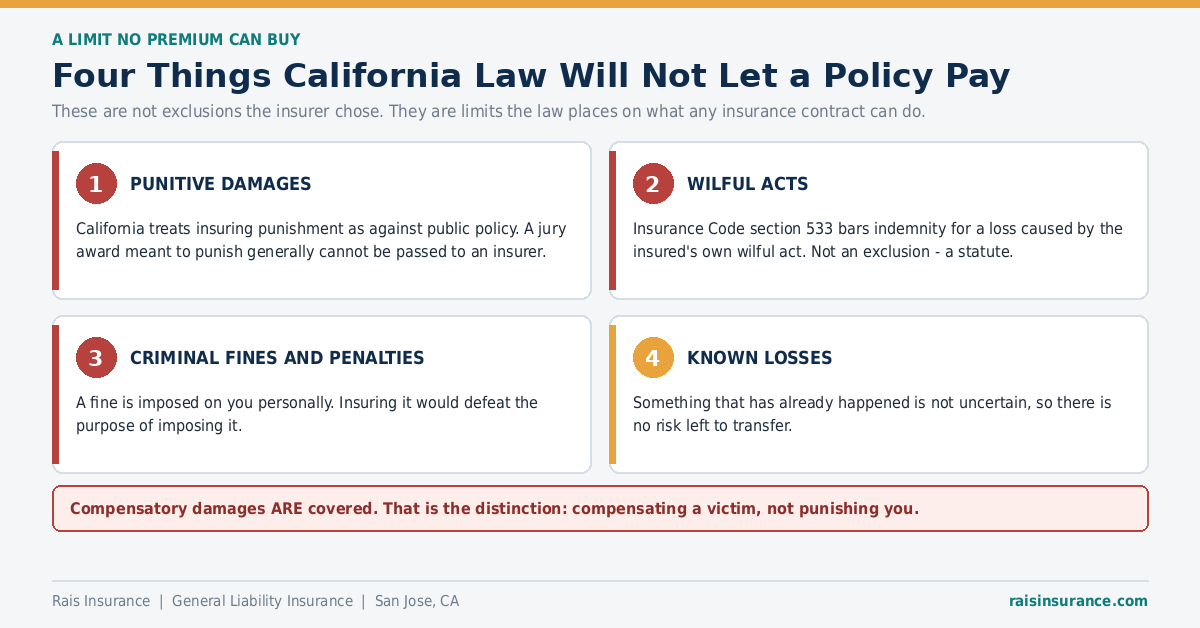
This is the section the original was closest to and furthest from at the same time, and it is the most useful thing on this page. Some limits on cover are not exclusions an insurer chose – they are limits the law places on what any insurance contract can do. No premium removes them.
Compensatory damages and punitive damages
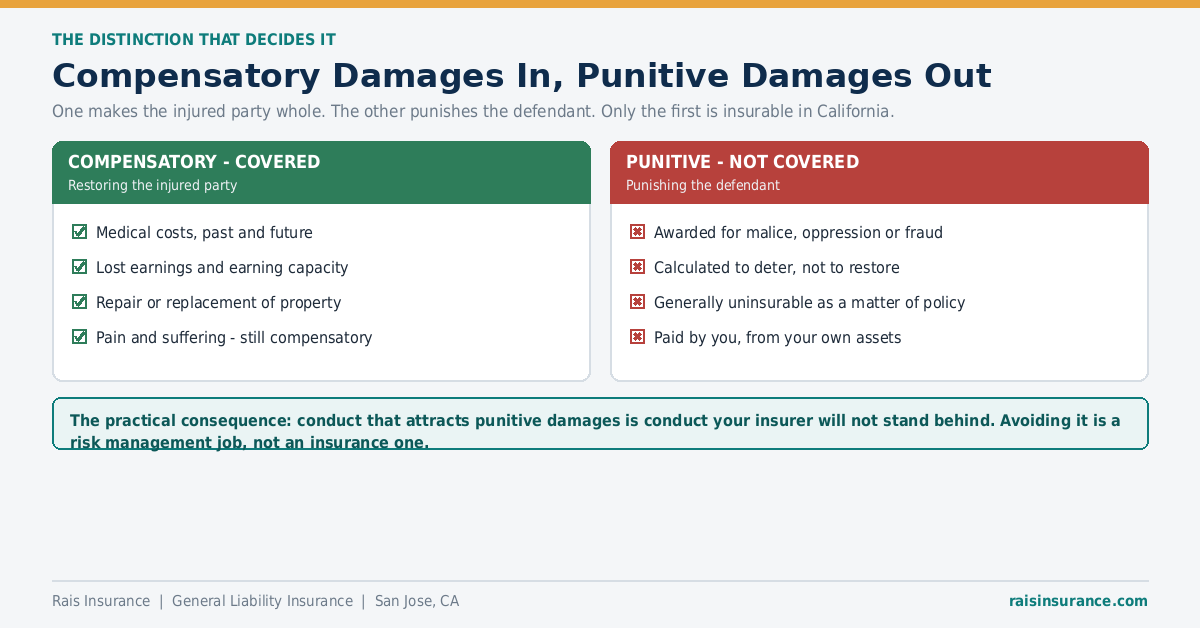
Compensatory damages are covered. These restore the injured party: medical costs past and future, lost earnings and earning capacity, repair or replacement of property, and pain and suffering. All of it is compensatory, because all of it is aimed at making somebody whole.
Punitive damages generally are not. A punitive award is made where conduct is found to involve malice, oppression or fraud, and its purpose is to punish and deter rather than to restore. California treats insuring a punishment as contrary to public policy, so that portion of an award is normally not recoverable from an insurer. It comes out of your own assets.
That distinction is worth understanding rather than memorising: conduct serious enough to attract punitive damages is conduct your insurer will not stand behind. Preventing it is a risk management job, not an insurance one.
Three more things outside any policy
- Wilful acts. California Insurance Code section 533 bars indemnity for a loss caused by the insured’s own wilful act. That is a statute, not a policy exclusion, and it applies whatever your wording says.
- Criminal fines and penalties. A fine is imposed on you deliberately. Allowing it to be insured would defeat the point of imposing it.
- Losses that have already happened. Insurance transfers uncertainty. Once an event has occurred there is no uncertainty left to transfer, which is why cover has to be in place beforehand.
For the exclusions the policy itself chooses, as opposed to the ones the law imposes, see what general liability does not cover.
Determining Your Coverage Requirements
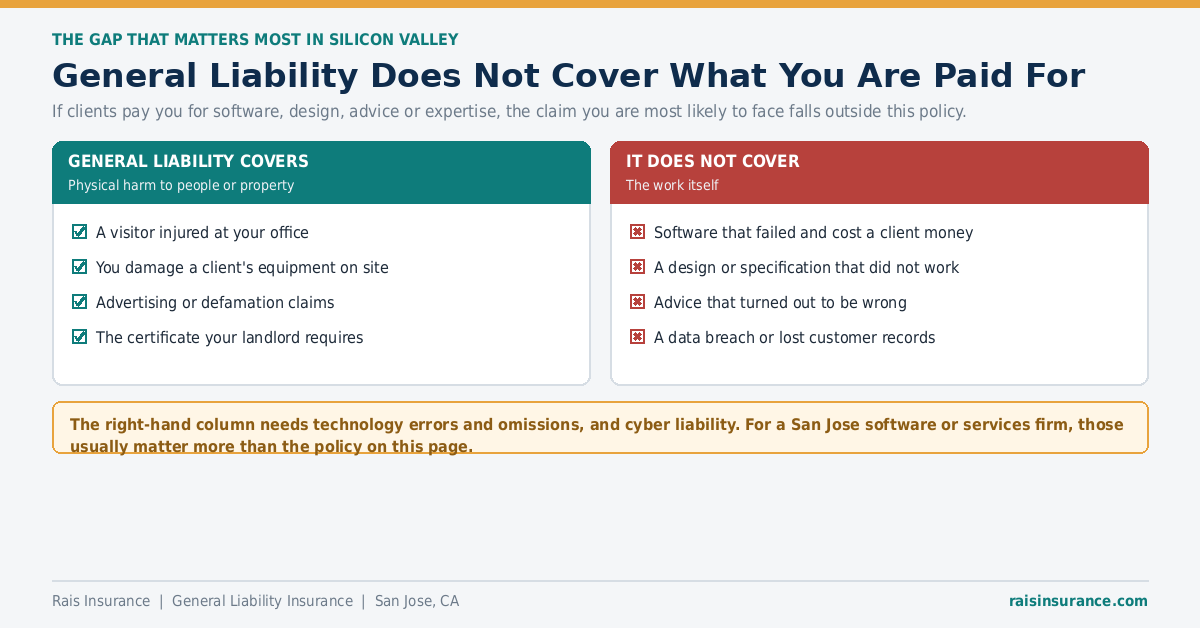
The original names three factors, and all three are right: the type of business you run, the risks associated with running it, and your location. Three more decide what you actually have to buy:
- Type of business. In practice this means your classification code, which is the single biggest driver of the rate.
- Perceived risk. Public contact, how physical the work is, how much happens at somebody else’s property, and whether you sell a physical product.
- Location. The venue you would be sued in, the local litigation environment, and what contracts in your market typically demand.
- What your contracts require. Frequently a higher limit than you would have chosen. A limit you have not bought is a limit you cannot certify – see how much cover a business should carry.
- Claims history. Usually three to five years, and it includes claims reported and closed without payment.
- Whether clients pay you for expertise. If they do, a different policy matters more than this one, for the reason set out below.
The Business Owner’s Policy – and Who Actually Qualifies
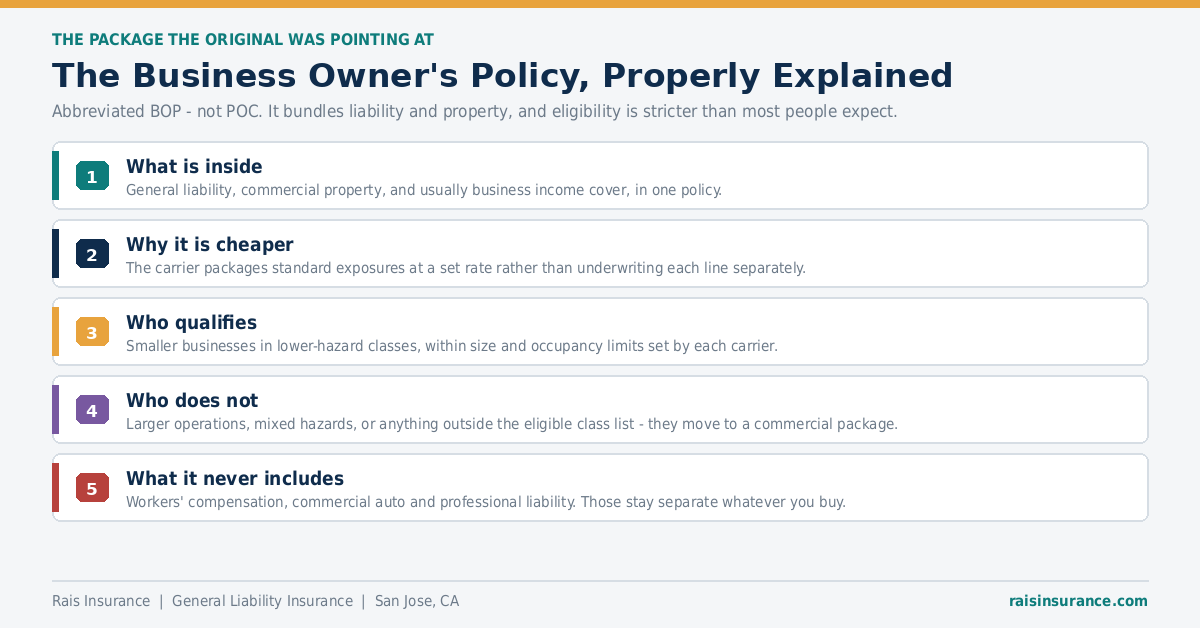
The original is right that a lower-risk business should look at packaging liability with property, and right that it usually comes at a better rate. The abbreviation is BOP – business owner’s policy.
What is inside: general liability, commercial property, and usually business income cover, written together. It prices below buying those lines separately because the carrier packages standard exposures at a set rate rather than underwriting each one individually.
The part worth knowing before you ask for a quote is eligibility. Carriers set limits on business size, occupancy and the classification codes they will accept, and those limits are stricter than most people expect. A business outside them moves to a commercial package policy instead, where you choose which lines go in. Asking early saves a wasted conversation.
And what a BOP never includes: workers’ compensation, commercial auto and professional liability. Those stay separate whatever package you buy. On how the whole set fits together, see which policies your business actually needs.
The Gap That Matters Most in Silicon Valley
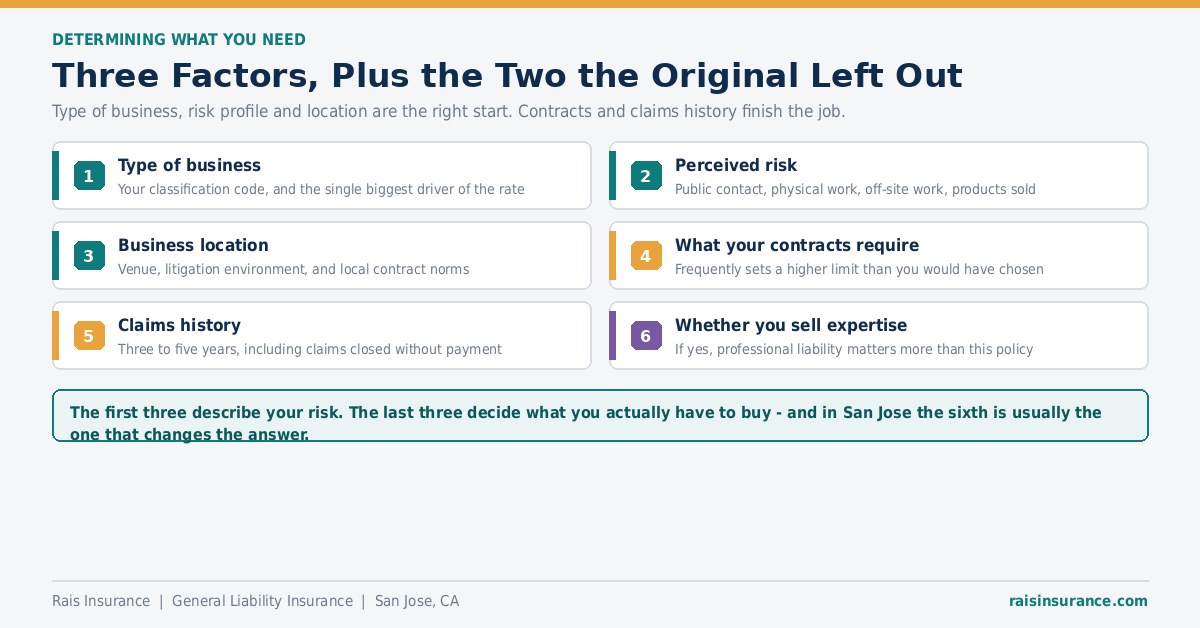
San Jose’s business base is unlike anywhere else this agency writes. Software, hardware, design, engineering consultancy, professional services – and for all of them, the claim most likely to arrive is one general liability does not answer.
The standard form carries a professional services exclusion. So the policy covers a visitor injured at your office, damage you cause to a client’s equipment on site, an advertising or defamation claim, and the certificate your landlord wants before handing over keys. It does not cover software that failed and cost a client money, a design or specification that did not work, advice that turned out wrong, or a data breach.
That second list needs technology errors and omissions and cyber liability. For a San Jose software or services firm those are usually the more important purchases, and general liability is the one bought because a landlord or a client asked for the certificate. Both are worth having, and business liability insurance still earns its place — the mistake is thinking it does the other policy’s job.
Working with Rais Insurance in Northern California
Rais Insurance has placed cover for businesses across Southern and Northern California since 1982, from small companies through to larger operations, and we build the policy around the business rather than the other way round.
One thing worth being straightforward about: our office is in Anaheim, so we serve San Jose remotely rather than from a local branch. In practice that changes very little for commercial insurance – quoting, binding, certificates and claims are all handled the same way – and it is worth knowing before you call rather than after.
We place the business insurance San Jose companies of every size need, writing across San Jose, Santa Clara, Sunnyvale, Milpitas and Campbell. If you would like to check your existing wording first, how to read your own policy sets out how a policy is structured.
What It Costs
There is no flat rate. Premium is built from your classification code, gross receipts or payroll, the limits you select, your claims history and how much work you subcontract out. Santa Clara County skews heavily toward technology and professional services, which price very differently from the trades and hospitality businesses more common elsewhere in the state. More on the mechanics in what actually sets your premium.
General Liability Insurance San Jose – Frequently Asked Questions
Q1. Are punitive damages covered by general liability insurance in California?
Generally no. California treats insuring punishment as contrary to public policy, so a punitive award – made to punish a defendant rather than to compensate a victim – is normally not recoverable from an insurer. Compensatory damages, which restore the injured party, are covered. The distinction matters because it is one of the few limits on cover that no amount of premium can remove.
Q2. What is the difference between compensatory and punitive damages?
Compensatory damages make the injured party whole – medical costs, lost earnings, repair or replacement of property, and pain and suffering. Punitive damages are awarded on top of those, where conduct is found to involve malice, oppression or fraud, and they exist to punish and deter rather than to restore. That purpose is why they sit outside what a liability policy can pay in California.
Q3. What else is uninsurable as a matter of law?
California Insurance Code section 533 bars indemnity for a loss caused by the insured’s own wilful act, which is a statutory limit rather than a policy exclusion. Criminal fines and penalties are also outside cover, since insuring a punishment would defeat its purpose. And a loss that has already occurred is not insurable at all, because there is no longer any uncertainty to transfer.
Q4. What is a business owner’s policy?
A BOP – the correct abbreviation – bundles general liability with commercial property and usually business income cover in a single package, at a rate that is normally lower than buying those lines separately. It is designed for smaller businesses in lower-hazard classes, which is why the original point about it suiting lower-risk operations is well made.
Q5. Who qualifies for a BOP?
Eligibility is stricter than most people expect. Carriers set limits on business size, occupancy, and the classification codes they will accept, and a business outside those limits moves to a commercial package policy instead, where you select which lines go in. Worth asking early, because the answer changes what a realistic quote looks like.
Q6. Does a BOP include workers’ compensation?
No. Workers’ compensation, commercial auto and professional liability stay separate whatever package you buy. A BOP covers liability and property; it does not make the other three unnecessary. In California workers’ compensation is legally required from your first employee, so that one is not optional either way.
Q7. Does general liability cover software errors or a failed project?
No, and for a San Jose business this is usually the most important sentence on the page. The standard form carries a professional services exclusion, so a claim that your software failed, your design did not work, or your advice was wrong falls outside it. That belongs to technology errors and omissions, and a data breach belongs to cyber liability.
Q8. If an employee is hurt at my premises, does this policy pay their medical costs?
No. Injuries to your own employees are workers’ compensation, which general liability specifically excludes. The policy pays medical costs for people who are not your employees – customers, visitors, delivery drivers – under Coverage A or under the small no-fault medical payments sub-limit.
Q9. Does the policy cover damage to premises I rent?
Yes, within limits. Damage to premises rented to you sits under its own separate sub-limit, well below your main liability limit, and on the standard form fire damage is the clearest case. Read that line on your own schedule rather than assuming, because the wording and the sub-limit both vary between carriers.
Q10. How much does general liability insurance cost in San Jose?
There is no flat rate. Premium is built from your classification code, gross receipts or payroll, the limits you buy, your claims history and how much work you subcontract. Santa Clara County skews heavily toward technology and professional services, which price differently from the trades and hospitality businesses more common elsewhere in California.
Get a General Liability Insurance Quote in San Jose
Contact us for a quick quote and we will work out what your business actually needs first. contact Rais Insurance on 714-761-4336, email rai@raisinsurance.com, or write to 2612 W. Lincoln Avenue, Suite 103, Anaheim, CA 92801.
If clients pay you for expertise, mention that in the first sentence. It changes which policies we look at before anybody discusses price.
