

General Liability Insurance Orange County
This page answers the question business owners ask before any other: which policies does my business need? This is one of five policies most Orange County operations end up considering, and the useful part is knowing which of the five apply to you, what this one covers, and what belongs to the other four instead.
We are based in Anaheim and write general liability insurance in Orange County — and business insurance Orange County operations of every size rely on — across California – Anaheim, Santa Ana, Irvine, Orange, Tustin and the surrounding cities included.
The Five Policies, and What Each One Answers
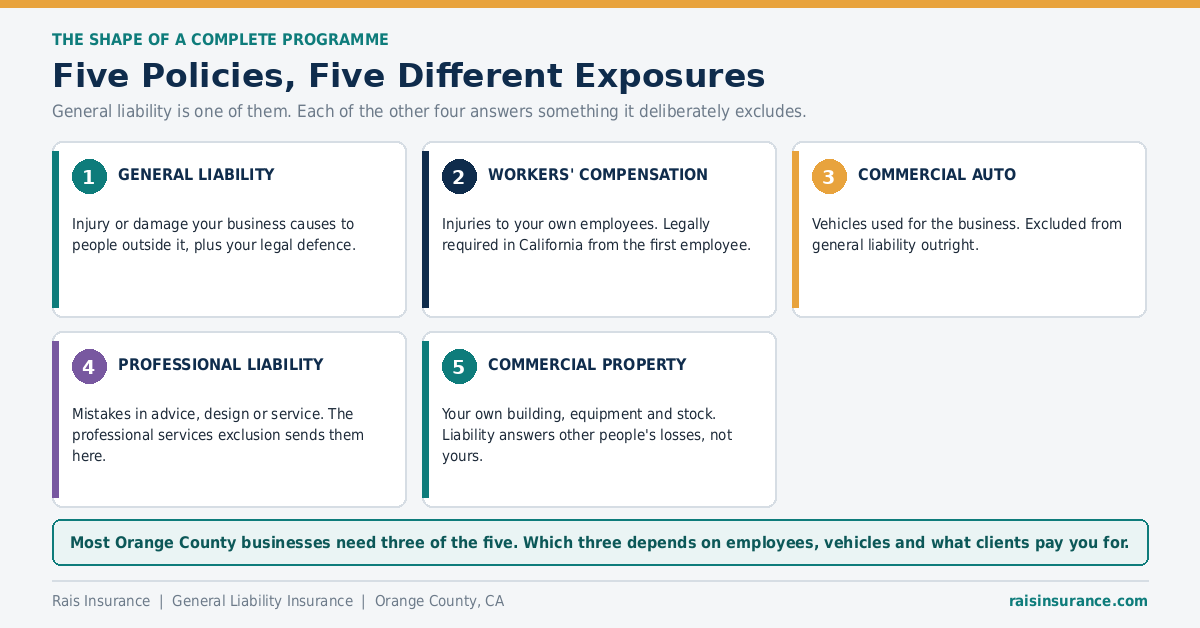
The original version of this page did something almost none of its siblings did: it correctly named what general liability cannot cover. Employee injuries to workers’ compensation, vehicle incidents to a company car policy, professional mistakes to professional liability. That was right, and it is worth building out rather than repeating.
- General liability. Injury or damage your business causes to people outside it, plus the cost of defending you. This is the one this page is about.
- Workers’ compensation. Injuries to your own employees. Legally required in California from your first employee, with no revenue threshold. See workers’ compensation and what California requires of employers.
- Commercial auto. Vehicles used for the business. Excluded from general liability outright, and a personal auto policy can decline a claim on business-use grounds.
- Professional liability. Mistakes in advice, design or service. The standard form carries a professional services exclusion precisely to send these here.
- Commercial property. Your own building, equipment and stock. Liability answers other people’s losses; property answers yours.
Most Orange County businesses need three of the five. The fuller list of what falls outside this policy is on our Escondido page – what general liability does not cover, in detail.
Which Ones Does Your Business Actually Need?
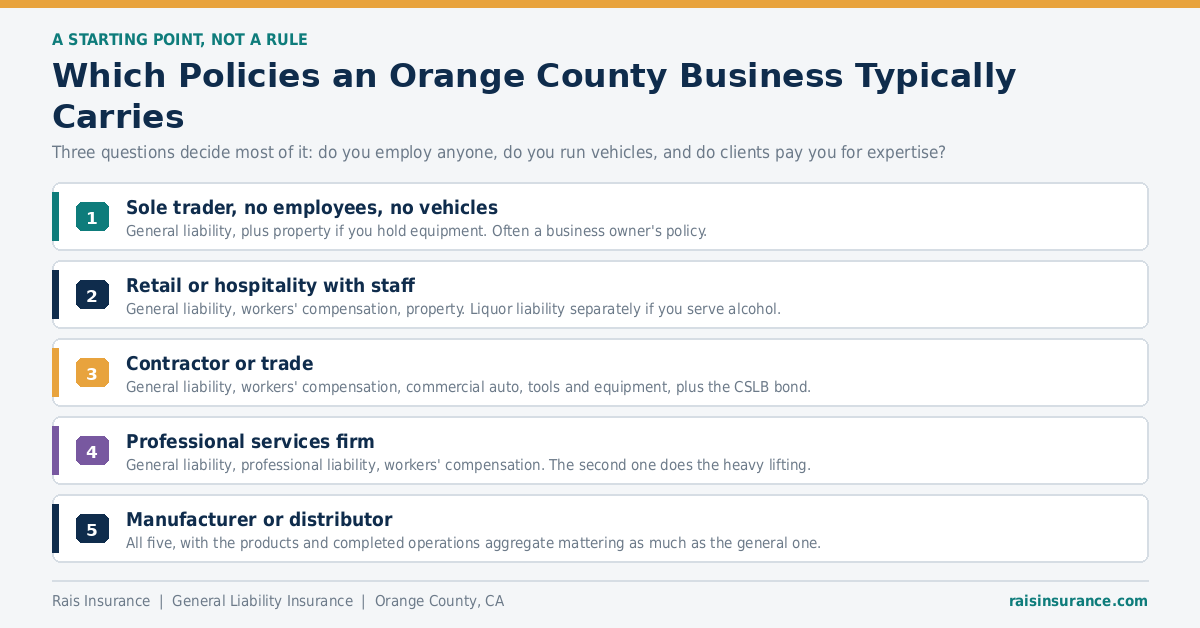
Three questions settle most of it: do you employ anyone, do you run vehicles for the business, and do clients pay you for expertise rather than for a physical product? Typical positions:
- Sole trader, no employees, no vehicles. Liability, plus property if you hold equipment or stock. Often bundled as a business owner’s policy, which is normally cheaper than buying the two apart.
- Retail or hospitality with staff. Liability, workers’ compensation and property. If you serve alcohol, liquor liability is a separate policy – the standard form excludes it.
- Contractor or trade. Liability, workers’ compensation, commercial auto, tools and equipment cover, plus the CSLB bond. See what a licensed California contractor has to carry.
- Professional services firm. Liability, professional liability and workers’ compensation. Here the second one does most of the heavy lifting, because the claims you are likely to face are about judgement rather than accidents.
- Manufacturer or distributor. Realistically all five, with the products and completed operations aggregate mattering as much as the general aggregate.
Those are starting points for a conversation rather than rules. Business liability insurance is sized to the operation, and what your contracts require frequently adds to the list.
What This Type of Liability Insurance Covers
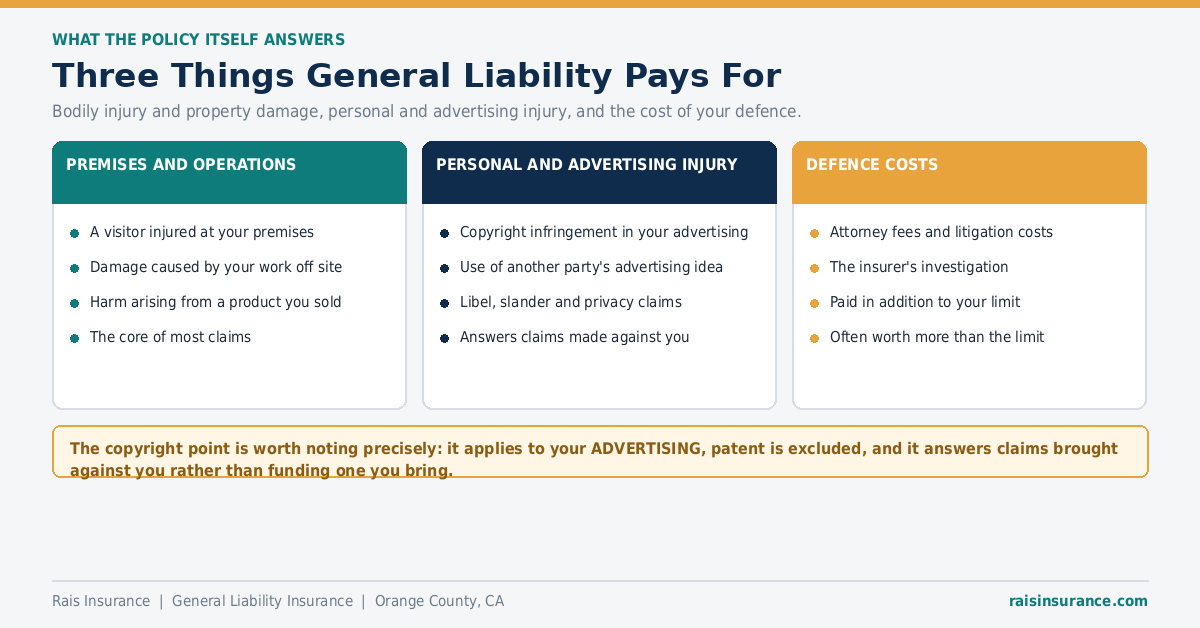
The policy keeps your business safe from claims arising from an incident on your premises – a factory, an office, a retail space – and from harm caused by your operations or your products. Accidents inside your own premises are included, with one significant exception the original stated correctly: not the injuries of an employee. Those are workers’ compensation.
It also covers personal and advertising injury, which is where the copyright point sits. If a claim is brought alleging that your advertising infringed a copyright, trade dress or slogan, or used another party’s advertising idea, the policy answers it – and the same section covers libel, slander and privacy allegations.
Three qualifications on that, because the scope is narrower than it sounds. It applies to your advertising, not to your products. Patent infringement is excluded. And it answers claims made against you rather than funding a claim you bring against somebody who copied your work.
And it keeps your business from carrying the full cost of a lawsuit. If damages are filed against you, the policy funds attorney costs, the insurer’s investigation and the litigation costs as the case develops – and under a standard form those sit in addition to your limit rather than eating into it. That distinction is worth more than most owners realise. See what the insurer pays on top of your limit and the duty to defend and how a false claim is handled.
For how the policy is structured internally – Coverage A, B and C, and the per-occurrence and aggregate limits – see Coverage A, B and C and how the limits work.
One Clarification: It Is Not a Catch-All
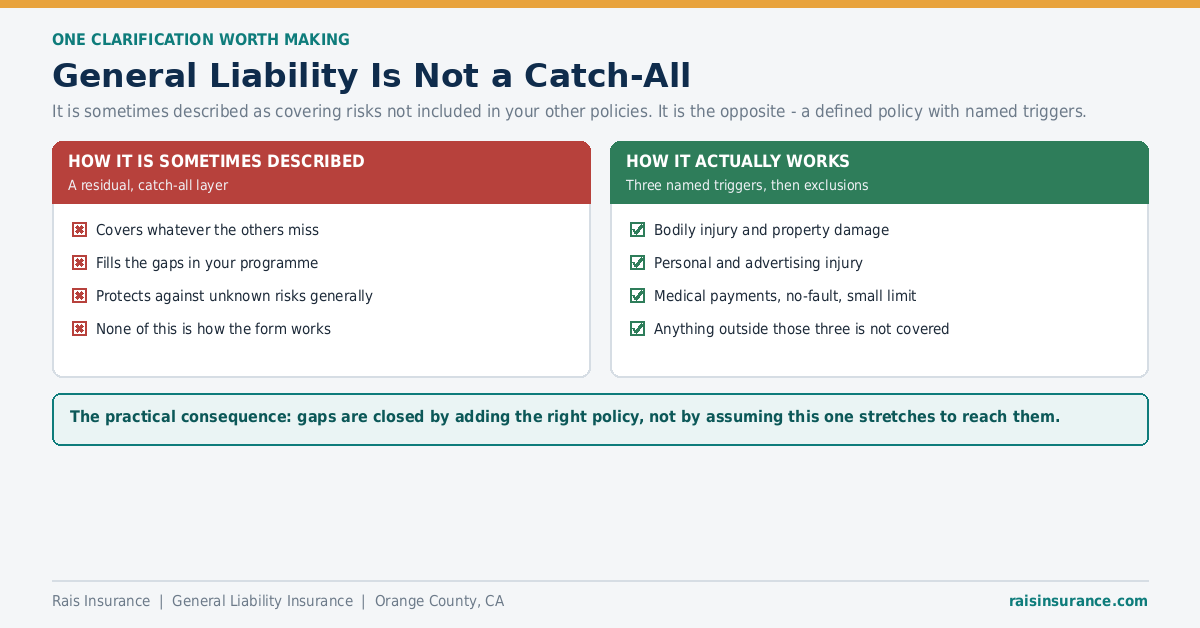
Liability cover is sometimes described as safeguarding a business against risks not included in its other policies. That framing is worth correcting, because it points in the wrong direction.
It is not a residual layer that catches whatever the others miss. It is a defined policy with three named triggers – bodily injury and property damage, personal and advertising injury, and medical payments – followed by a list of exclusions. If a loss does not fit one of those three, the policy does not respond, however unlucky the circumstances were.
The practical consequence is straightforward and it is the reason this page opens the way it does: gaps get closed by adding the right policy, not by hoping this one stretches to reach them.
What General Liability Cannot Cover
This is protection against unexpected events where your business may be at fault. There are specific cases where the costs of an accident fall to a different policy, and the original set them out correctly:
- Employee injuries on business premises belong to workers’ compensation, not here.
- Automobile-related incidents belong to a company car policy – commercial auto.
- Mishaps caused by professional mistakes belong to professional liability.
- Damage to your own property belongs to commercial property. Liability answers what you owe others.
- Employment practices claims – harassment, discrimination, wrongful termination – need their own policy again.
Where this policy cannot protect you, we can find the cover that does. That is genuinely the more useful service, and it is why the five-policy view above matters more than a description of any one of them.
What It Costs
There is no flat rate, and any figure quoted without knowing your operations is guesswork. Premium is built from your classification code, your gross receipts or payroll, the limits you buy, your claims history over three to five years, and how much work you subcontract out. Two Orange County businesses on the same street buying identical limits can pay very different amounts, because the exposures are not comparable.
The one thing worth checking yourself is the classification code on your declarations page. Businesses drift, and a firm still rated on what it did five years ago can be paying a multiple of the correct rate. More on this in what actually sets your premium, and the year-end audit.
Where to Read More
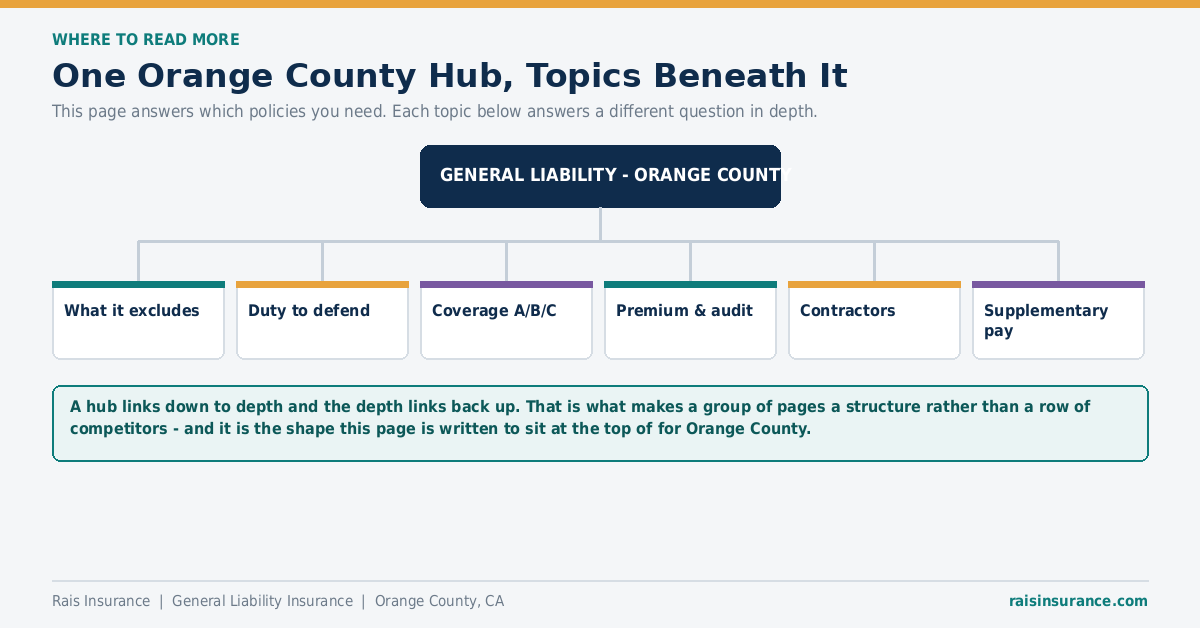
This page answers which policies an Orange County business needs. Each of the following covers one part of the same policy in depth:
- Coverage A, B and C and how the limits work – what is inside the policy and how much it pays
- what general liability does not cover, in detail – the full exclusions picture
- what actually sets your premium, and the year-end audit – deductibles, retentions and the audit
Working with Rais Insurance
As long-standing practitioners we have a reasonable idea of what a company needs and what it does not, and we would rather tell you the second than sell you the first. For most Orange County businesses the sequence is short: work out which of the five policies apply, check what your contracts require on top, then set the limits.
We serve Orange, Anaheim, Santa Ana, Irvine, Tustin and Villa Park from our Anaheim office, and we write across California.
General Liability Insurance Orange County – Frequently Asked Questions
Q1. What insurance does my Orange County business actually need?
Three questions settle most of it. Do you employ anyone – if yes, workers’ compensation is legally required from the first employee. Do you use vehicles for the business – if yes, commercial auto, because general liability excludes vehicles outright. Do clients pay you for expertise rather than a physical product – if yes, professional liability. Liability and property cover the rest, and for smaller operations both often come bundled in a business owner’s policy.
Q2. What does general liability insurance cover?
Three things. Bodily injury and property damage your business causes to people outside it, whether at your premises, through your operations or from a product you sold. Personal and advertising injury, which includes copyright infringement in your advertising, libel and privacy claims. And the cost of defending you, which under a standard form is paid in addition to your limit rather than out of it.
Q3. Does general liability cover copyright infringement?
Within limits, yes. The policy answers claims that you infringed a copyright, trade dress or slogan in your advertisement, or used another party’s advertising idea. Three qualifications matter: it applies to your advertising rather than to your products, patent infringement is excluded, and it answers claims brought against you – it will not fund a claim you bring against someone who copied your work.
Q4. Is general liability a catch-all policy for risks my other policies miss?
No, and this is worth being clear about. It is a defined policy with three named triggers, not a residual layer. If a loss does not fit bodily injury, property damage or personal and advertising injury, the policy does not respond however unlucky the circumstances. Gaps get closed by adding the right policy, not by assuming this one stretches to reach them.
Q5. Are employee injuries covered by general liability?
No. Injuries to your own employees are workers’ compensation, which California requires from your first employee. The policy is written for people who are not your employees – customers, visitors, members of the public, delivery drivers. The exclusion is deliberate, and it exists precisely because a separate compulsory system handles employee injuries.
Q6. Does general liability cover my business vehicles?
No. Auto liability is excluded from the policy and belongs to commercial auto. Worth separating two things here: liability for harm you cause while driving is commercial auto liability, while repairs to your own vehicle are physical damage cover, which is not liability insurance at all. A personal auto policy can decline a claim on business-use grounds.
Q7. What is the difference between general liability and professional liability?
General liability answers ordinary negligence – somebody is hurt or something is damaged because of how you operate. Professional liability, also called errors and omissions, answers claims about your professional judgement: advice that turned out wrong, a design that failed, a service that underperformed. The standard general liability form carries a professional services exclusion, so firms selling expertise need both.
Q8. Should I buy a business owner’s policy instead?
For many small Orange County businesses, yes. A BOP bundles liability with a property limit and usually business income, and it is normally cheaper than buying those separately. Eligibility rules on size, occupancy and hazard are strict, so larger or mixed-hazard operations move to a commercial package policy where you select which lines go in.
Q9. How much does general liability insurance cost in Orange County?
There is no flat rate. Premium is built from your classification code, gross receipts or payroll, the limits you buy, your claims history and how much work you subcontract. Two businesses on the same street buying identical limits can pay very differently because the exposures are not comparable. A broker can put the same information to several carriers and show you the spread.
Q10. Do you cover the city of Orange or the whole county?
Both. Rais Insurance is based in Anaheim and writes across Orange County – Anaheim, Santa Ana, Irvine, Orange, Tustin and the surrounding cities – as well as the rest of California. If you are looking specifically for cover in the city of Orange, that is included.
Get a General Liability Insurance Quote in Orange County
contact Rais Insurance and we will work out which policies apply before quoting a price. Call 714-761-4336, email rai@raisinsurance.com, or visit 2612 W. Lincoln Avenue, Suite 103, Anaheim, CA 92801.
Bring your current declarations page and any contract or lease that specifies insurance. Between them they usually show within ten minutes whether you are carrying a policy you do not need, or missing one you do.
