

Commercial building insurance Santa Ana
 Commercial building insurance in Santa Ana, California, placed by Rais Insurance.
Protect Your Commercial Property With Commercial Property Insurance Santa Ana
If your commercial building is destroyed by a fire or damaged by a burst water pipe or a windstorm, you can count on our commercial property insurance in Santa Ana to protect you. The price of commercial property insurance is determined largely by the value of the assets and properties owned by your business, the way the building is constructed, and how well the site is protected against loss. Rais Insurance places commercial building insurance in Santa Ana for owners, tenants and landlords across Orange County. This page covers the part most quotes leave out: how underwriters actually calculate your premium, which documents decide a claim before you ever file one, and how a California commercial property insurance claim runs from the first phone call to the payment. Two Santa Ana businesses on the same street can pay very different rates for the same limit. The difference is almost never negotiation. It sits in facts an underwriter can verify – and most of those facts are inside your control.
What Commercial Property Insurance Covers for a Santa Ana Business
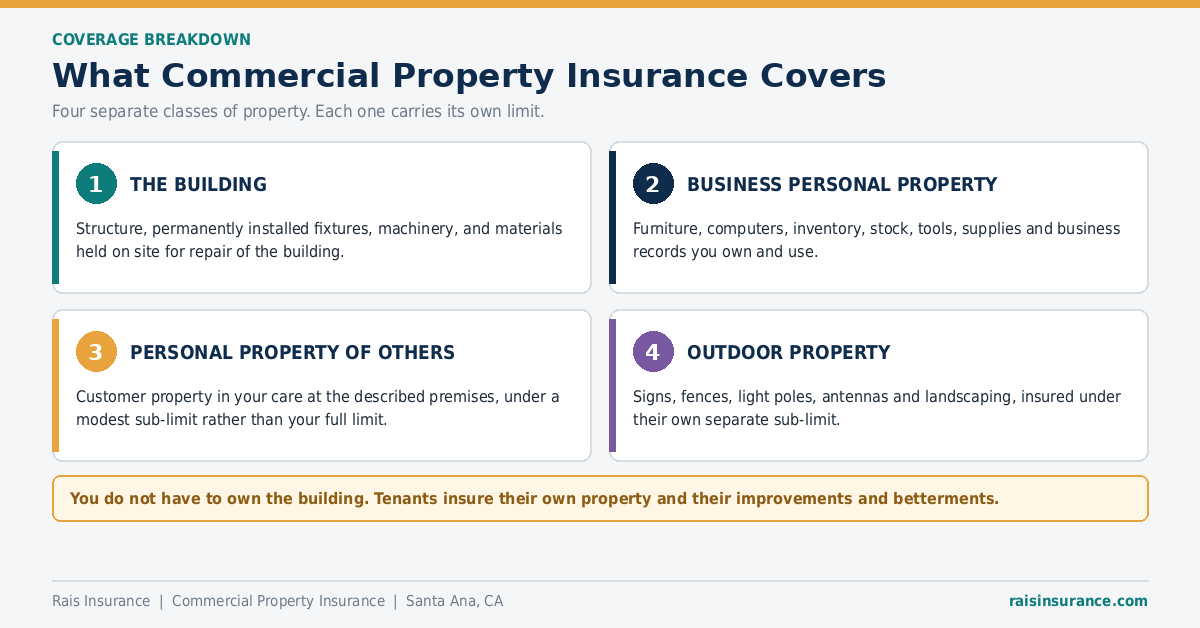
A commercial property policy would normally cover your office or building, computers, valuable documents, files, inventory, business furniture, supplies and business records. What the original description usually misses is that these are not one pool of money. They are four separate classes of property, each carrying its own limit.
1. The building
The structure itself, permanently installed fixtures, machinery and equipment, and materials held on site for maintenance or repair of the building. If you own a Santa Ana building and lease it out, this is the coverage that rebuilds it – your tenants insure their own contents.
2. Business personal property
Everything you own and use in the business: computers, tools, stock, inventory, furniture, supplies, valuable papers and business records. This is the limit most businesses set too low, because it is the one that quietly grows every year.
3. Personal property of others
Commercial property insurance also covers the property of others – but only in a specific way. The standard form covers personal property in your care, custody or control while it is at the described premises, and it does so under a sub-limit that is usually a small fraction of your own business personal property limit. If you routinely hold valuable customer property – a repair shop, a print house, a warehouse holding third-party stock – that sub-limit needs to be scheduled up, or the exposure belongs on a bailee form instead. This is one of the most common gaps we find on existing Santa Ana policies.
4. Outdoor property
Coverage additionally pertains to outdoor fixtures such as signs and fences, along with light poles, antennas, trees and shrubs. These sit under their own sub-limit rather than the building limit, and that limit is typically modest. The sibling page on all-risk and peril-specific policy forms goes through outdoor property sub-limits in detail.
You do not need to own a property to obtain commercial property insurance for your business. Renting an office space or equipment still leaves you with insurable business property – plus the improvements and betterments your lease almost certainly makes you responsible for.
A Home Office Is Not Automatically Cheaper – It Is Usually Uninsured
Commercial property insurance costs less for a home-based business than for a business operating from a physical location, and that is true as far as it goes. The problem is what people do with that fact. A homeowners policy does not stand in for commercial property insurance. Most homeowners forms cap business property at a very small on-premises limit – often a few thousand dollars – and exclude business activity outright once it passes a certain scale. A Santa Ana consultant with two laptops may be fine. A home-based e-commerce operation holding stock in the garage is not. Both have business property vulnerable to damage, and both need real business property insurance written for the exposure, whether that is a business owner’s policy or a standalone commercial property form.
How Insurers Price Commercial Property Insurance in Santa Ana
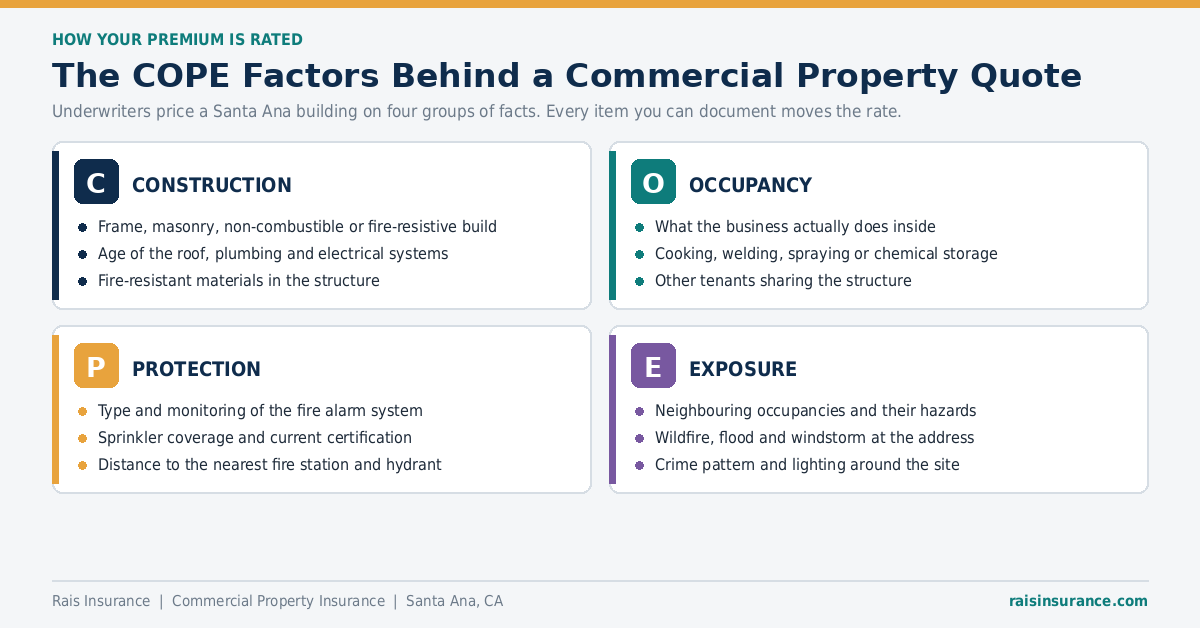
Insurance companies consider a consistent set of factors when pricing commercial property policies. In underwriting they are grouped under four headings – Construction, Occupancy, Protection and Exposure, shortened to COPE. Every factor a Santa Ana business owner asks about falls into one of them.
| COPE factor | What the underwriter is looking at | What you can influence |
|---|---|---|
| Construction | Frame, joisted masonry, non-combustible or fire-resistive build. Age of the roof, plumbing and electrical systems. Whether the commercial building is supported with fire-resistant materials. | Roof replacement, repiping, electrical panel upgrades – all of them rate-moving and all of them documentable. |
| Occupancy | What the business actually does inside the building, any hazardous process such as cooking, welding, spraying or chemical storage, and who else shares the structure. | Housekeeping, hazardous material storage, and an accurate description of operations on the application. |
| Protection | The kind of fire alarm system your business has, sprinkler coverage and certification, the distance between your business and the nearest fire station and hydrant, and the type of security system installed on-site to prevent thefts. | Central-station monitoring instead of a local sounder, current sprinkler certification, and a monitored intrusion system. |
| Exposure | Whether the location is susceptible to wind or rainstorms, wildfire and flood exposure at the address, neighbouring occupancies, and the crime pattern around the site. | Site lighting, defensible space, drainage – and choosing the address in the first place. |
One Santa Ana-specific note on Protection: fire service in the city is provided under contract by the Orange County Fire Authority, so the responding station and its rating are worth confirming for your exact address rather than assumed. On Exposure, California underwriters weigh wildfire and flood far more heavily than windstorm, which matters because parts of Santa Ana sit on the Santa Ana River flood plain.
Seven Ways Santa Ana Businesses Lower a Commercial Property Premium
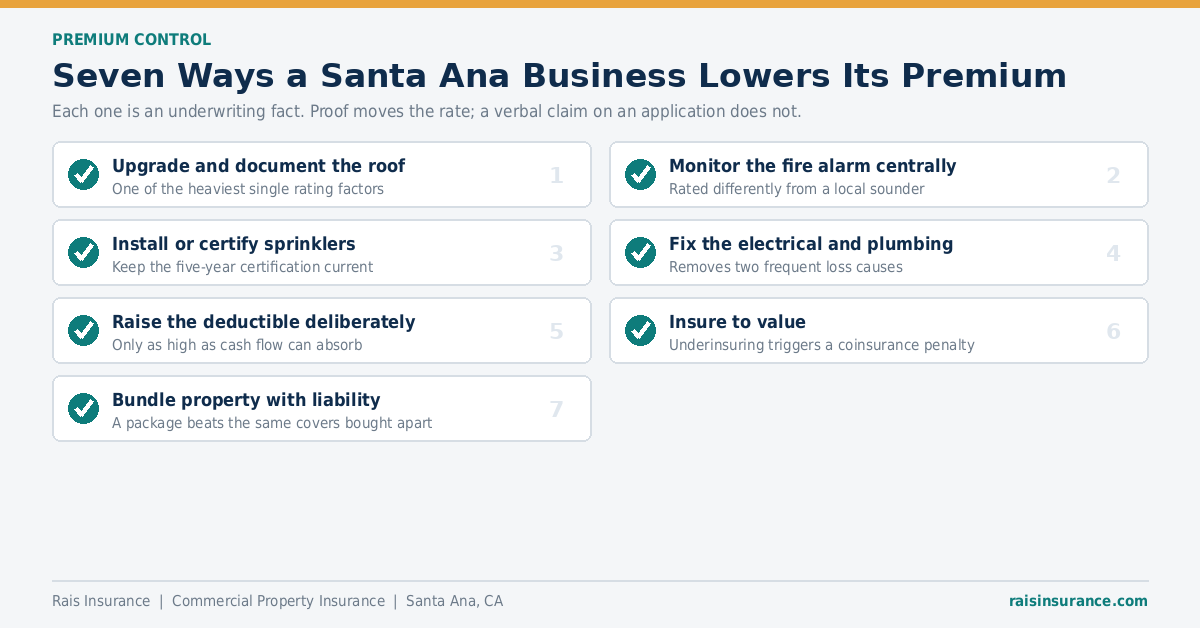
Commercial property insurance cost is not fixed at renewal – it is rebuilt every year from the facts you supply. Each of the following is an underwriting fact. Proof moves the rate. A verbal claim on an application does not.
- Upgrade and document the roof. Roof age is one of the single heaviest rating factors on older Santa Ana building stock. Keep the invoice and the permit.
- Move the fire alarm to central-station monitoring. A locally sounding alarm and a centrally monitored alarm are rated differently, and the certificate is what proves it.
- Install or certify sprinklers. Keep the five-year certification current and send the report to the carrier rather than waiting to be asked.
- Fix the electrical and the plumbing. Panel upgrades and repiping remove two of the most frequent commercial property loss causes at once.
- Raise the deductible deliberately. Only as high as the business can absorb out of cash without borrowing. A deductible you cannot fund is a coverage gap wearing a discount.
- Insure to value. Underinsuring triggers the coinsurance penalty at claim time and costs far more than the premium it saved. The commercial building insurance in Anaheim page works through a coinsurance example in full.
- Bundle property with liability. A package policy or business owner’s policy is normally cheaper than the same coverages bought separately, and it removes the gaps that appear between two carriers.
The Documentation That Decides Your Claim
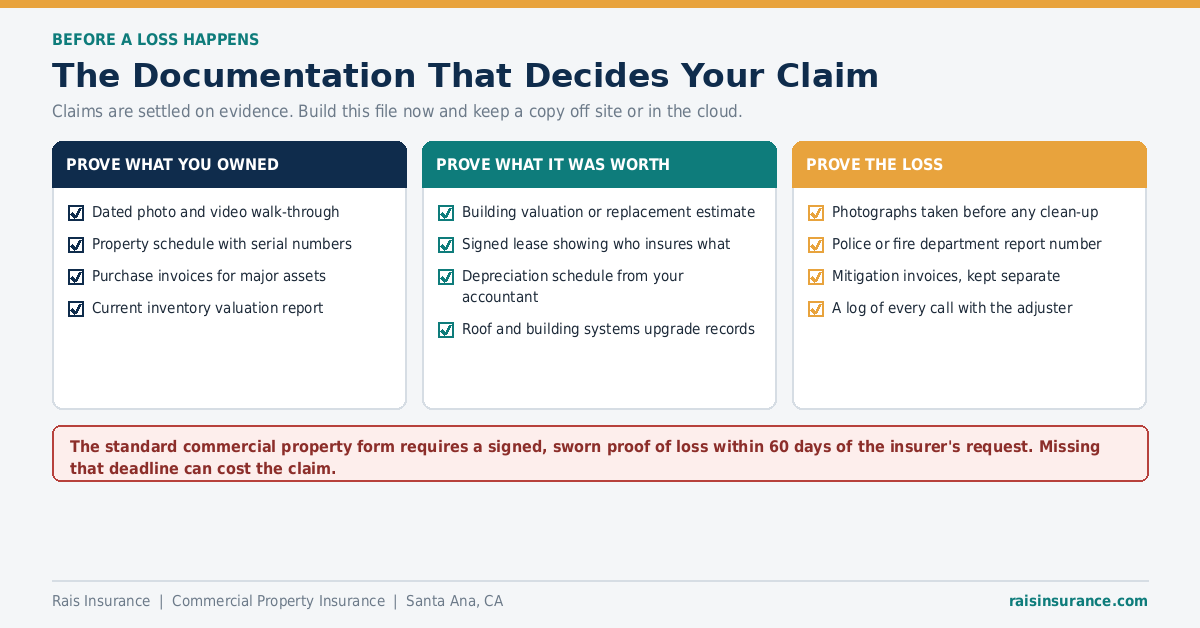
Commercial property claims are settled on evidence, not on recollection. The adjuster was not there before the loss, and the burden of showing what you owned and what it was worth sits with you. Nearly every underpaid claim we see traces back to a file that was never built. Build three sets of records now, and store a copy off site or in the cloud – an on-site file burns with the building.
Prove what you owned
- A dated photo and video walk-through of every room, including storage areas and the roof
- A property schedule listing equipment with make, model and serial number
- Purchase invoices and receipts for major assets
- A current inventory or stock valuation report
Prove what it was worth
- A recent building valuation or replacement-cost estimate
- The signed lease, showing who is responsible for insuring improvements and betterments
- A depreciation schedule from your accountant
- Maintenance and upgrade records for the roof, electrical and plumbing systems
Prove the loss
- Photographs taken before any clean-up begins – this is the one that cannot be recreated
- The police or fire department report number
- Emergency mitigation invoices, kept separate from repair invoices
- A running log of every call, email and site visit with the adjuster
The First 72 Hours After a Loss
What you do immediately after a fire, a burst pipe or a break-in has more effect on the settlement than anything that happens later.
- Make the site safe and stop the loss getting worse. Board up, tarp the roof, shut off the water. Your policy requires you to protect the property from further damage, and failing to do so can reduce the payment.
- Photograph everything before you clean up. Wide shots and close shots, with a timestamp.
- Report the claim in writing to both the carrier and your broker, the same day where possible.
- Keep mitigation costs on separate invoices. They are usually recoverable, but only if they can be told apart from repairs.
- Do not throw damaged property away until the adjuster has seen it or released it in writing.
- Do not sign a work authorisation that assigns your insurance benefits to a restoration contractor until your broker has read it.
How a Commercial Property Insurance Claim Runs in California
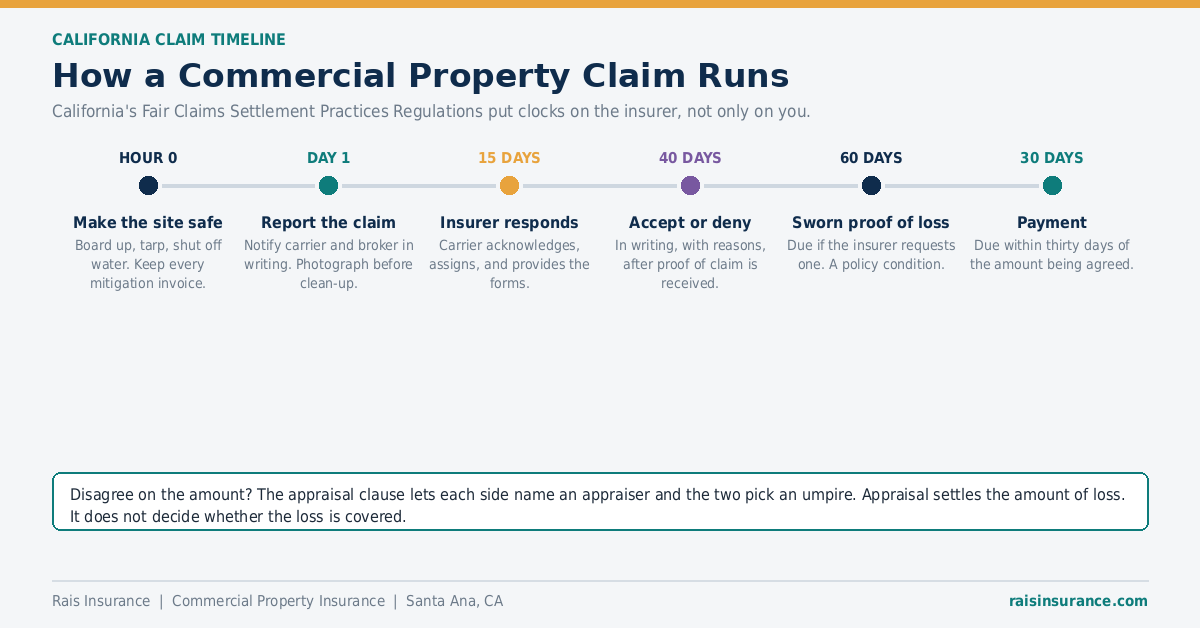
California is one of the more protective states for policyholders here. The Fair Claims Settlement Practices Regulations put clocks on the insurer, not only on you.
- Within 15 calendar days the insurer must acknowledge the claim, assign it, and provide the forms and instructions you need to file.
- Within 40 calendar days of receiving proof of claim the insurer must accept or deny it in writing, and give reasons for a denial.
- Within 30 days of the amount being agreed, payment is due.
- Within 60 days of the insurer requesting one, your signed and sworn proof of loss is due under the standard commercial property form.
The sworn proof of loss is the deadline that catches businesses out. It is a policy condition rather than paperwork, and missing it gives a carrier grounds to deny a claim that was otherwise perfectly valid. Regulations are amended from time to time, so confirm the current deadlines with your broker when you file.
When You and the Insurer Disagree on the Amount
Most commercial property policies contain an appraisal clause, and most business owners never learn it exists. Either side can demand appraisal. Each names an independent appraiser, the two appraisers select an umpire, and agreement by any two of the three sets the amount of loss. The distinction that matters: appraisal decides how much the damage is worth. It does not decide whether the loss is covered. A coverage dispute – the carrier saying the cause of loss is excluded – is a different argument, and appraisal will not resolve it. Knowing which of the two you are actually in is the first thing to establish, and it is where a broker earns their keep.
What Commercial Property Insurance Does Not Cover
Four gaps sit outside every standard commercial property policy in California, and each has its own solution:
- Earthquake – excluded everywhere in California, added back by endorsement or a difference in conditions policy.
- Flood – excluded, and placed separately through the NFIP or the private market. Parts of Santa Ana sit on the Santa Ana River flood plain, so see flood insurance in California before renewal rather than after.
- Third-party injury and damage claims – a customer hurt on your premises is a general liability insurance claim, not a property claim.
- Property that moves – tools, equipment and stock in transit or at a job site need inland marine cover. See property that moves between job sites.
Lost income while the building is unusable is not automatic either – it comes from a separate coverage. The business interruption and equipment coverage extensions page sets out how those extensions work.
Choose the Best Commercial Building and Property Insurance in Santa Ana
Rais Insurance is a reputable firm offering highly professional insurance agents backed by many years of experience. Through our comprehensive commercial property insurance policies, we can insure your business according to your specific insurance requirements. In addition to offering low-cost coverage options, we can bundle them into cost-effective packages that let us offer extremely competitive pricing. What that looks like in practice for a Santa Ana business: a walk-through of the building rather than a form filled in over the phone, a property schedule built with you so the limits reflect what you actually own, the protection and construction facts documented and marketed to several carriers rather than one, and a broker who reads the adjuster’s letter with you if a claim ever goes sideways. The safety and satisfaction of our customers are our prime concern, so your commercial property insurance needs are in good hands with us. As your trusted advisor, we will provide you with the guidance and protection you need, and our staff is available for assistance and answers to any questions you may have. We serve Santa Ana, Tustin, Orange, Irvine and Fountain Valley from our Anaheim office, and we write commercial property insurance across California.
Commercial Building Insurance Santa Ana – Frequently Asked Questions
Q1. How much does commercial building insurance cost in Santa Ana?
There is no flat rate. The premium is built from the replacement value of the building and its contents, the construction type, what the business does inside, the fire and security protection on site, and the exposures around the address. A small office suite and a light-manufacturing unit on the same Santa Ana street can differ by several multiples on the same limit. The fastest way to a real number is a walk-through and a quote from a broker who can market it to several carriers.
Q2. What does commercial property insurance cover?
A commercial property policy covers four separate classes of property, each with its own limit: the building itself including permanently installed fixtures and machinery; your business personal property such as computers, inventory, furniture, supplies and business records; the personal property of others in your care while at the premises; and outdoor property such as signs and fences. Coverage applies to the causes of loss named in the policy form you buy.
Q3. Do I need commercial property insurance if I rent my Santa Ana office?
Yes. You do not need to own a property to insure business property. As a tenant you still own your equipment, inventory, furniture and records, and your lease will usually make you responsible for the improvements and betterments you installed – flooring, partitions, fixtures and cabling. The landlord’s policy covers the landlord’s building, not your property or your build-out.
Q4. Does commercial property insurance cover my customers’ property?
Only partly. The standard form covers personal property of others in your care, custody or control while it is at the described premises, and it does so under a sub-limit that is normally far smaller than your own business personal property limit. If you regularly hold valuable customer property – a repair shop, a print house, a warehouse holding third-party stock – that sub-limit needs to be increased or the exposure moved onto a bailee form.
Q5. How is a commercial property insurance premium calculated?
Underwriters rate a building on four groups of facts, known in the industry as COPE: Construction, Occupancy, Protection and Exposure. Construction covers the build type and the age of the roof, plumbing and electrical systems. Occupancy is what happens inside. Protection is alarms, sprinklers and the distance to the nearest fire station and hydrant. Exposure is what surrounds the site, including wildfire, flood and neighbouring hazards.
Q6. How long does an insurer have to respond to a commercial property claim in California?
California’s Fair Claims Settlement Practices Regulations put deadlines on the carrier. The insurer must acknowledge a claim and provide the necessary forms within fifteen calendar days, must accept or deny the claim in writing within forty calendar days of receiving proof of claim, and must pay within thirty days of the amount being agreed. Confirm the current text of the regulations, as they are periodically amended.
Q7. What is a sworn proof of loss and when is it due?
A sworn proof of loss is a signed statement, made under oath, setting out what was damaged, what it was worth and what you are claiming. Under the standard commercial property form it is due within sixty days of the insurer asking for it. It is a policy condition, not a formality – missing the deadline gives the carrier grounds to deny an otherwise valid claim.
Q8. What happens if my insurer and I disagree on the claim amount?
Most commercial property policies contain an appraisal clause. Either side can demand appraisal: each names an independent appraiser, the two appraisers select an umpire, and agreement by any two of the three sets the amount of loss. Appraisal decides how much the damage is worth. It does not decide whether the loss is covered – a coverage dispute is a separate argument.
Q9. Does commercial property insurance cover earthquake or flood in Santa Ana?
No. Earthquake and flood are excluded from standard commercial property policies everywhere in California and have to be bought separately – earthquake by endorsement or a difference in conditions policy, flood through the NFIP or a private flood market. Santa Ana sits on the Santa Ana River flood plain in parts of the city, so the flood question is worth answering before renewal rather than after.
Q10. What documents should I keep before a loss happens?
Keep three sets. Proof of what you owned: dated photographs, a property schedule with model and serial numbers, and purchase invoices. Proof of what it was worth: a current valuation or replacement-cost estimate, your lease, and a depreciation schedule. Proof of maintenance: roof, electrical and plumbing upgrade records, and alarm and sprinkler certificates. Store a copy off site or in the cloud, because an on-site file burns with the building.
Get a Commercial Property Insurance Quote in Santa Ana
To learn more about how we can assist you with your commercial building and property insurance, contact Rais Insurance right now. Call 714-761-4336, email rai@raisinsurance.com, or visit us at 2612 W. Lincoln Avenue, Suite 103, Anaheim, CA 92801 – a short drive from Santa Ana. Bring your current declarations page and your lease. Ten minutes with both usually tells us whether you are underinsured, overpaying, or both.
