

General Liability Insurance La Habra
That trade-off between what you retain and what you pay is the subject of this page, because it is where most La Habra business owners have the least information and the most money at stake. Below: what actually sets your premium, why a deductible and a self-insured retention are not the same thing, and why a general liability premium is provisional until the carrier audits it.
At Rais Insurance we place general liability insurance in La Habra for businesses across north Orange County. Whether the policy stands alone or sits inside a bigger package, we can work out how much cover you actually need from the details of your operation rather than from a template.
How General Liability Insurance Protects Your Business
A general liability policy responds to bodily injury claims and property damage claims brought against your business, along with the legal costs of defending them. If a visitor is hurt at your premises, if you damage a client’s property while working, or if a product you sold causes harm, this is the policy that answers.
Historically, businesses facing the same perils banded together and pooled funds to protect one another against them. Modern insurers do that job at scale, which is why you can now assemble a policy around your specific exposures instead of accepting a generic bundle. For how the policy is structured internally, see what each coverage part of the policy actually does.
The more contact your work has with other people and other people’s property, the more this matters. If you visit clients regularly, if you work inside premises that are not your own, or if you represent your clients commercially, liability cover is frequently the only thing standing between an ordinary accident and a serious financial problem.
A Product Fault Is Covered. An Error in Your Service Is Not.
It is often said that a general liability policy responds whether the problem came from a product malfunction or from an error in your services. Half of that is right, and the half that is wrong is worth correcting carefully, because it is the difference between a paid claim and a declined one.
Product faults are covered. If something you sold, made or installed injures somebody or damages property, that falls under products and completed operations – a standard part of the policy, carrying its own annual aggregate limit separate from the general aggregate. This matters if you manufacture, retail, or do installation work of any kind.
Errors in your professional service are not covered. Advice that turned out wrong, a design or specification that failed, a flawed report, a missed deadline – the standard policy contains a professional services exclusion precisely to keep these out. They belong to professional liability, also called errors and omissions. If your clients pay you for expertise rather than for a physical product, that exclusion is the most consequential line in your policy, and you need a second policy sitting behind it. See the professional services exclusion and what else the policy excludes.
The same care applies to the broader claim that any lawsuit is covered. A great many are not – see what general liability does not cover.
Deductible or Self-Insured Retention? They Are Not the Same Thing
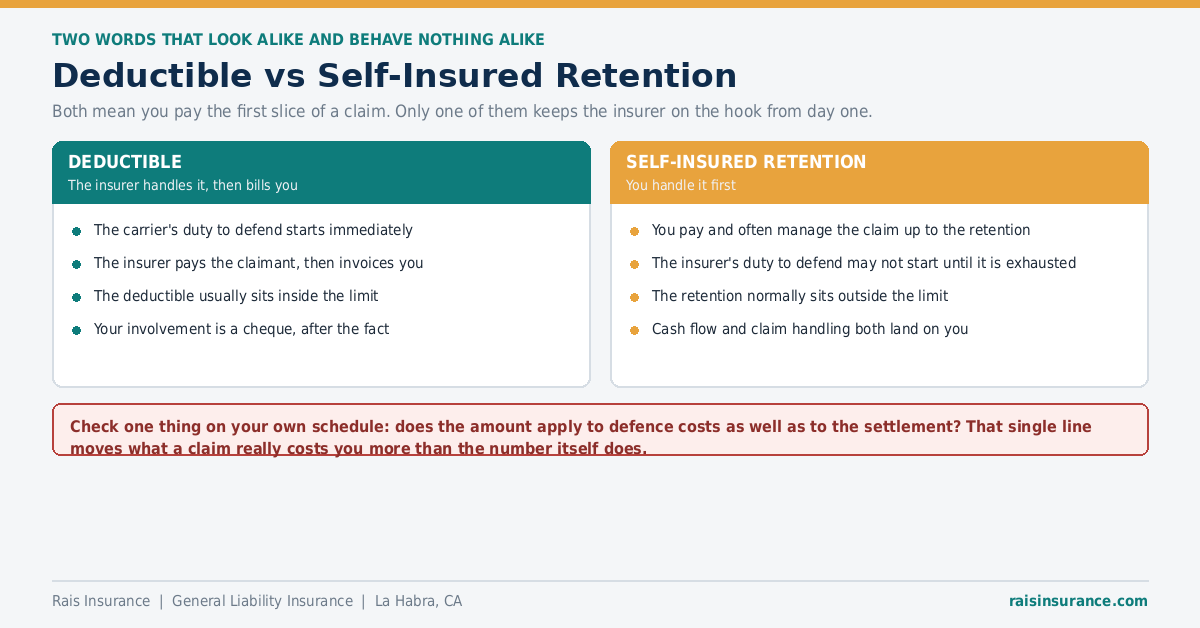
Both mean you carry the first slice of a claim yourself, and the two words get used interchangeably. They behave very differently.
With a deductible, the insurer takes the claim from the start. The duty to defend begins immediately, the carrier pays the claimant, and then invoices you for your share afterwards. The deductible usually sits inside the limit. Your involvement is writing a cheque after the fact.
With a self-insured retention, you are first in line. You pay – and frequently manage – the claim up to the retention amount, and the insurer’s duty to defend may not begin until the retention is exhausted. The retention normally sits outside the limit. Both the cash flow and the claim handling land on you.
One line on your schedule matters more than the number itself: does the amount apply to defence costs, or only to what is paid to the claimant? Most claims cost more to defend than to settle, so a deductible that applies to defence changes the real cost of a claim considerably.
What Actually Sets Your Premium
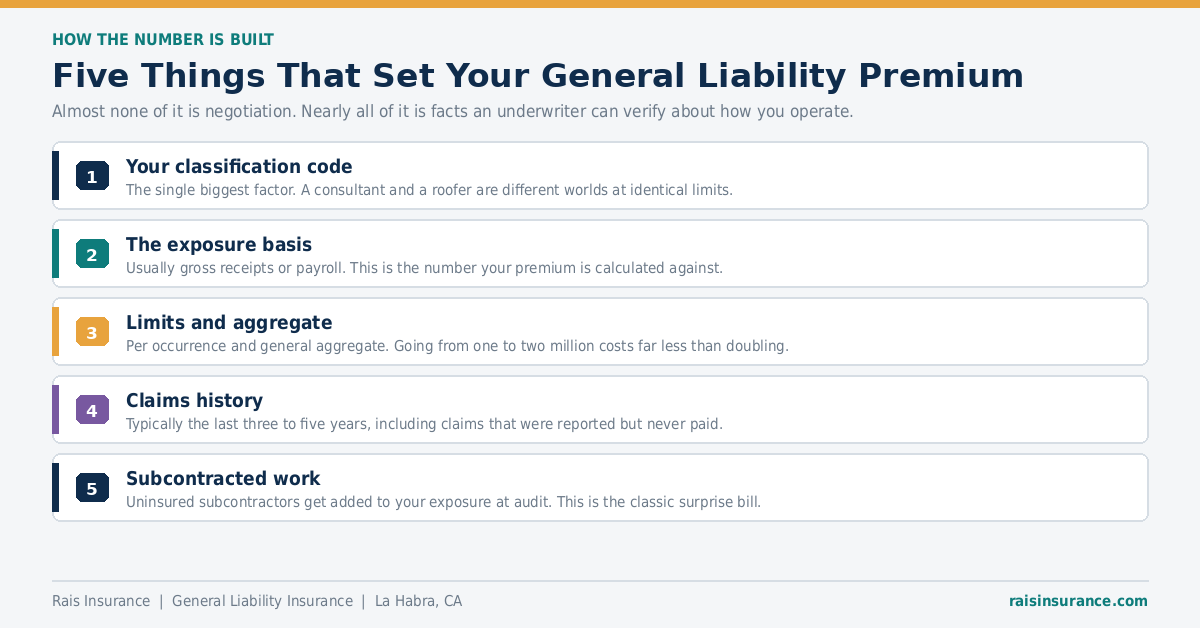
Almost none of it is negotiation. Nearly all of it is facts an underwriter can verify about how you operate:
- Your classification code. The single biggest factor. A consultant and a roofing contractor occupy different worlds at identical limits. A business filed under the wrong code can be paying a multiple of the correct rate, and it happens more often than you would expect.
- The exposure basis. Usually gross receipts or payroll. This is the number your rate is applied to, which is why an inaccurate estimate does not save money – it defers the bill.
- Your limits. Per occurrence and general aggregate. Moving from one million to two million typically costs far less than doubling the premium, because severe claims are rare relative to ordinary ones.
- Claims history. Usually the last three to five years, and it includes claims that were reported and then closed without payment. Open claims sitting in your history are worth closing out.
- Subcontracted work. How much you subcontract, and whether those subcontractors carry their own cover. See what a licensed California contractor has to carry.
Your Premium Is Provisional Until the Audit
A premium audit is the part that catches businesses out, and it is rarely explained at the point of sale.
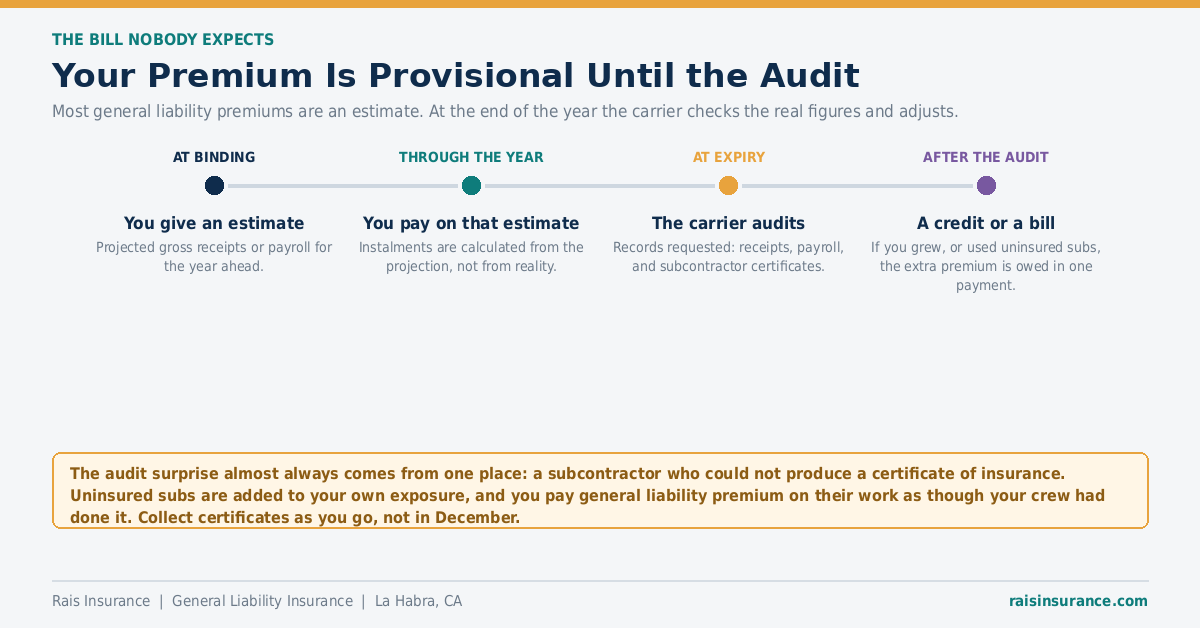
Most general liability premiums are an estimate. At binding you supply projected gross receipts or payroll for the year ahead, and your instalments are calculated from that projection rather than from what actually happens. When the policy expires, the carrier audits your real figures – requesting receipts, payroll records and subcontractor certificates – and adjusts. That end-of-year premium audit is where the real number is settled. If you over-estimated you get a credit. If you grew, you owe additional premium, and it usually arrives as a single payment rather than spread across instalments.
The audit surprise almost always comes from one place: subcontractors who could not produce a certificate of insurance. An uninsured subcontractor is added to your own exposure at audit and you pay general liability premium on their labour as though your own crew had done the work. This single item produces more unexpected bills than everything else combined.
The fix is unglamorous and completely effective: collect certificates as each job finishes, not in December when the auditor asks. A folder that is current costs nothing. A folder that is not can cost thousands.
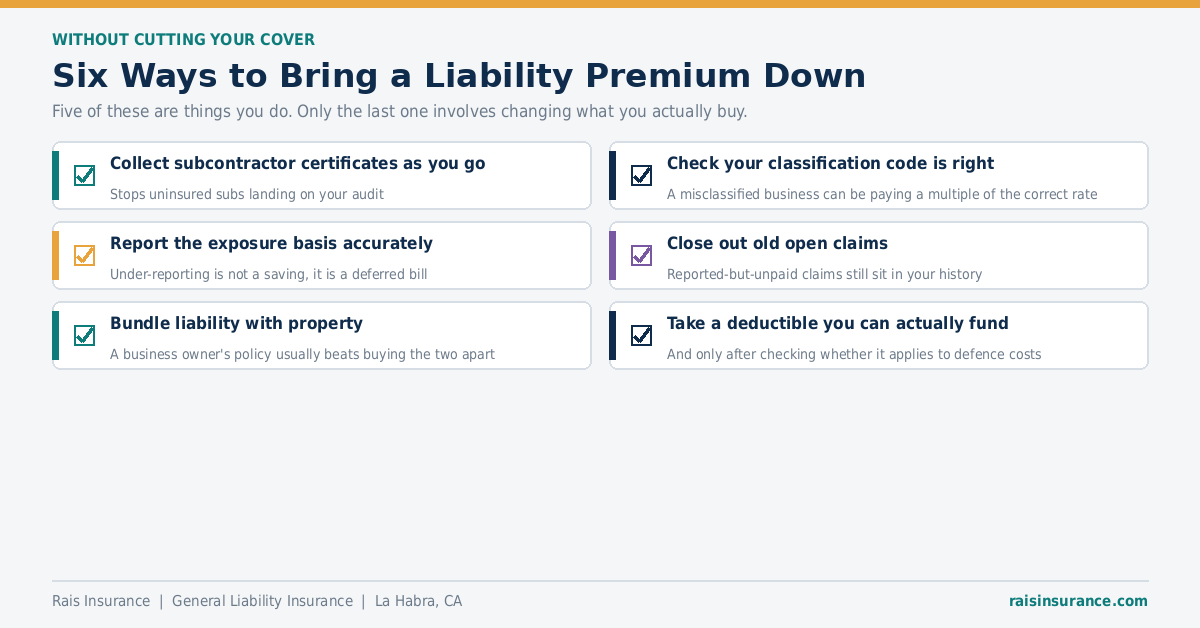
Six Ways to Bring the Premium Down Without Cutting Cover
Business liability insurance rewards housekeeping more than haggling. Five of these are things you do; only the last involves changing what you actually buy:
- Collect subcontractor certificates as you go. Stops uninsured subs landing on your audit.
- Check your classification code. A misclassified business can be paying a multiple of the correct rate for years without noticing.
- Report the exposure basis accurately. Under-reporting is not a saving, it is a deferred bill with no discount attached.
- Close out old open claims. Reported-but-unpaid claims still sit in your history and still affect your rate.
- Bundle liability with property. A business owner’s policy is normally cheaper than buying commercial property insurance and liability separately, and it removes the gaps that open up between two carriers.
- Take a deductible you can genuinely fund. Only as high as the business can absorb out of cash, and only after checking whether it applies to defence costs.
One item deliberately left off that list: switching carrier mid-term to chase a cheaper quote. Most liability policies carry a minimum earned premium – a portion the carrier keeps even if you cancel early, commonly a quarter of the annual figure and sometimes more on contractor policies. The saving has to clear that before it is a saving at all.
General Liability Insurance in La Habra, Brea and Fullerton
La Habra sits in the north-west corner of Orange County, on the Los Angeles County line, with Brea and Fullerton to the east and Whittier immediately across the border. It is a mixed commercial market – retail along Whittier Boulevard and Imperial Highway, light industrial to the south, and a substantial base of trades and home-service businesses working across both counties.
That cross-county working pattern has one practical consequence worth knowing. If your work crosses between Orange and Los Angeles County, or you hold contracts in both, confirm that your policy territory and limits satisfy the strictest contract you have signed rather than the average one. It is a five-minute check that occasionally saves a job.
Building the Right Policy with Rais Insurance
Whether you are a contractor or a small business owner, we work with you to build the package your operation actually needs, so you can run the business without worrying about which accident lands where. If you are looking for a genuinely good deal on general liability insurance in La Habra, we can put that policy together.
Four questions usually settle whether an existing policy is fit for purpose. Is your classification code right? Does your deductible or retention apply to defence costs? Is the exposure basis on your declarations page anywhere near your real figures? And is there an audit coming that you have not prepared for? Answer those four and you know where you stand – and how general liability fits alongside the other liability policies follows from there.
If a claim does arrive, the first two days matter more than most owners expect – see what to do in the first 48 hours after an incident.
General Liability Insurance La Habra – Frequently Asked Questions
Q1. How much does general liability insurance cost in La Habra?
There is no flat rate, and any figure quoted without knowing your operations is guesswork. Premium is built from your classification code, your gross receipts or payroll, the limits you buy, your claims history over the last three to five years, and how much work you subcontract out. A consultant and a roofing contractor buying identical limits will pay very different amounts, because the exposures are not comparable.
Q2. What is the difference between a deductible and a self-insured retention?
A deductible means the insurer handles the claim and then invoices you for your share – the duty to defend starts immediately and the deductible usually sits inside the limit. A self-insured retention means you pay, and often manage, the claim yourself up to the retention amount, and the insurer’s duty to defend may not begin until it is exhausted. The retention normally sits outside the limit. The practical difference is who is on the hook first.
Q3. Does my deductible apply to defence costs as well as the settlement?
That depends on your wording and it is worth checking, because it changes what a claim genuinely costs you. Some policies apply the deductible only to indemnity – what is paid to the claimant. Others apply it to defence costs as well, which matters because most claims cost more to defend than to settle. One line on the schedule, and it moves the real number more than the deductible amount itself does.
Q4. Why did I get a bill after my policy expired?
Because most general liability premiums are provisional. You give an estimate of gross receipts or payroll at the start of the year and pay instalments based on it. At expiry the carrier audits your actual figures and adjusts. If the business grew, or if you used subcontractors who could not produce certificates of insurance, additional premium is owed and it usually arrives as a single payment.
Q5. Why do uninsured subcontractors increase my premium?
Because at audit, a subcontractor who cannot produce a certificate of insurance is treated as though the work had been done by your own crew. Their labour is added to your exposure and you pay general liability premium on it. This is the most common cause of a surprise audit bill by a wide margin. Collect certificates as work is completed rather than trying to gather them in December.
Q6. Does general liability cover mistakes in the service I provide?
No. The standard policy excludes professional services, so advice that turned out wrong, a design that failed, or a flawed report belongs to professional liability, also called errors and omissions. What general liability does cover is a product fault – if something you sold or made injures someone or damages property, that is products and completed operations, and it is a standard part of the policy.
Q7. What is products and completed operations coverage?
It is the part of a general liability policy that responds after your product has left you or your work is finished. A product malfunctions and injures a customer; a repair fails months later and causes damage. It carries its own annual aggregate limit, separate from the general aggregate, which matters if you manufacture, sell goods, or do installation work.
Q8. What is a minimum earned premium and why does it matter?
It is the portion of the premium the carrier keeps even if you cancel the policy early – commonly a quarter of the annual figure, sometimes more on contractor policies. It matters if you are thinking about switching mid-term to chase a cheaper quote, because the saving has to clear what your current carrier retains before it is a saving at all. Check it before you move.
Q9. Is it worth taking a higher deductible to lower the premium?
Sometimes, and only up to what the business can pay out of cash without borrowing. A deductible you cannot fund is a coverage gap wearing a discount. Two things to establish first: whether the deductible applies to defence costs, and how frequently your trade actually generates claims. High-frequency, low-value claims make a large deductible a poor trade; rare, severe claims make it a reasonable one.
Q10. Can I reduce my premium without reducing my cover?
Usually yes. Confirm your classification code is correct, because a misclassified business can be paying a multiple of the right rate. Report the exposure basis accurately rather than optimistically. Collect subcontractor certificates. Close out old open claims. And consider bundling liability with property in a business owner’s policy, which is normally cheaper than buying the two separately.
Get a General Liability Insurance Quote in La Habra
contact Rais Insurance and we will build the policy around your business rather than around a template. Call 714-761-4336, email rai@raisinsurance.com, or visit 2612 W. Lincoln Avenue, Suite 103, Anaheim, CA 92801.
Bring your current declarations page and last year’s audit statement if you have one. Between them they show what you are being rated on and what the carrier found last time, which is usually where the savings are hiding.
