

General Liability Insurance Tracy
This page sorts that out. The list of protections usually attached to this policy contains six items, and only three of them are general liability. The other three are real, valuable and worth buying – they just need different policies.
Six Items, Three Different Products
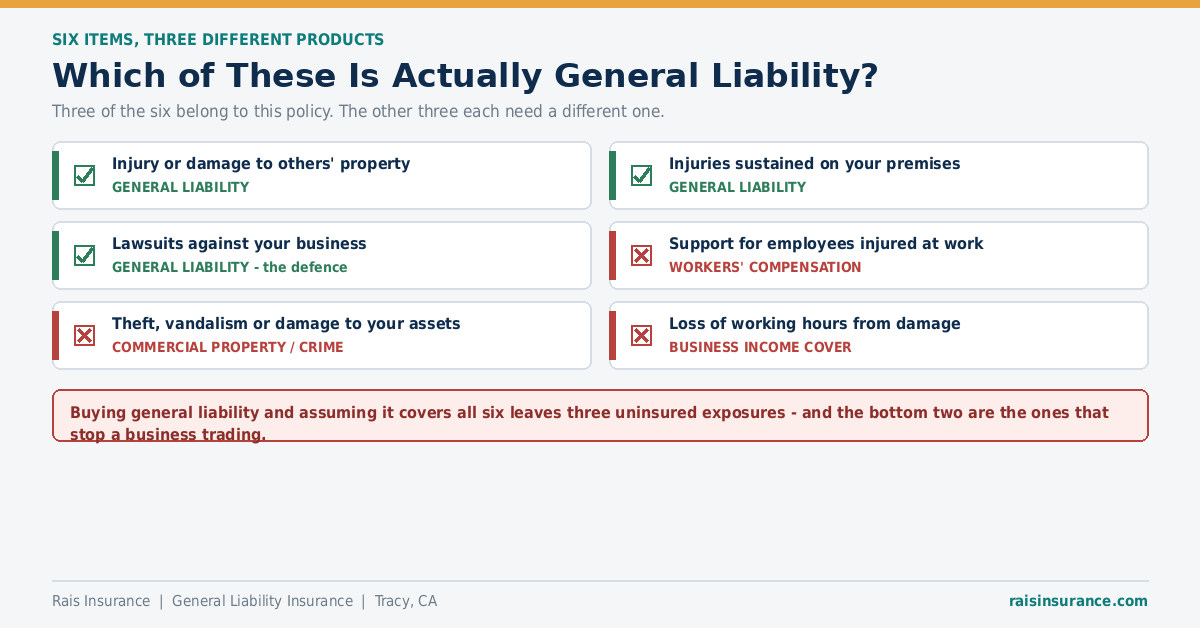
Taking the standard list in order, with the policy that genuinely answers each:
- Injury, damage or loss to other people’s property – this policy. It is the core of it.
- Injuries sustained on your business premises – covered, for anybody who is not your employee.
- Lawsuits against your business – covered, and specifically the duty to defend, which applies even to claims that turn out groundless.
- Support for employees injured at work – workers’ compensation, not this. California requires it from your first employee, and this policy specifically excludes employee injuries. See workers’ compensation and what California requires of employers.
- Theft, vandalism or accidental damage to your assets or premises – commercial property and crime cover. Liability answers damage you cause to other people’s things, never damage to your own. See commercial property insurance.
- Loss of working hours due to injury or damage – business income cover, which is the subject of the next section because it is the one most people have never heard of by name.
Three of six. Buying this policy and assuming it covers all six leaves three uninsured exposures – and the bottom two are precisely the ones that stop a business trading. On how the full set fits together, see which policies your business actually needs.
Loss of Working Hours – What Actually Pays
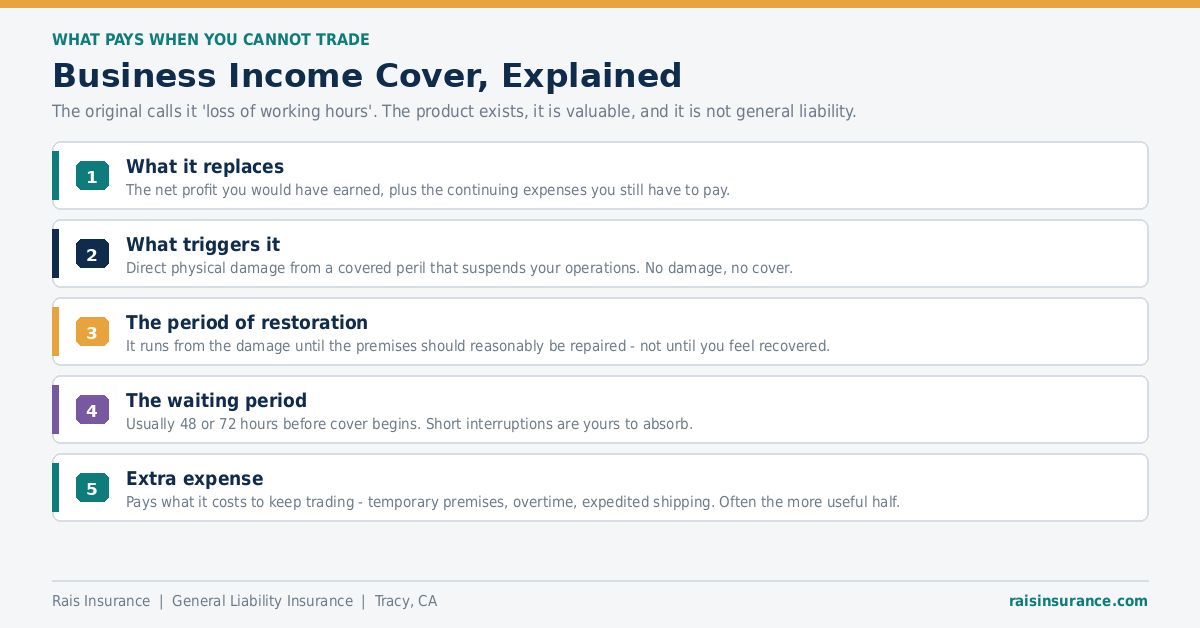
The original list calls this “loss of working hours due to injury or damage to property”, and the instinct behind it is right: losing the ability to trade is often more expensive than the damage that caused it. The product that answers it is business income cover, sometimes sold as business interruption, and it sits inside a commercial property policy rather than a liability one.
How it works, in the five parts that decide a claim:
- What it replaces. The net profit you would have earned, plus the continuing expenses you still have to pay – rent, loan payments, key payroll. Not revenue, and not a lump sum.
- What triggers it. Direct physical damage from a covered peril that suspends your operations. No physical damage means no cover, which is the point most people miss.
- The period of restoration. Cover runs from the damage until the premises should *reasonably* be repaired – the insurer’s assessment of a fair timeline, not how long you personally take to recover.
- The waiting period. Commonly 48 or 72 hours before cover begins. Short interruptions are yours to absorb.
- Extra expense. Pays what it costs to keep trading despite the damage – temporary premises, overtime, expedited shipping. For many businesses this is the more useful half of the pair, because staying partially open usually beats closing.
It is worth asking for both by name. Business income without extra expense pays you for being shut; extra expense helps you avoid being shut.
Which Direction the Policy Runs
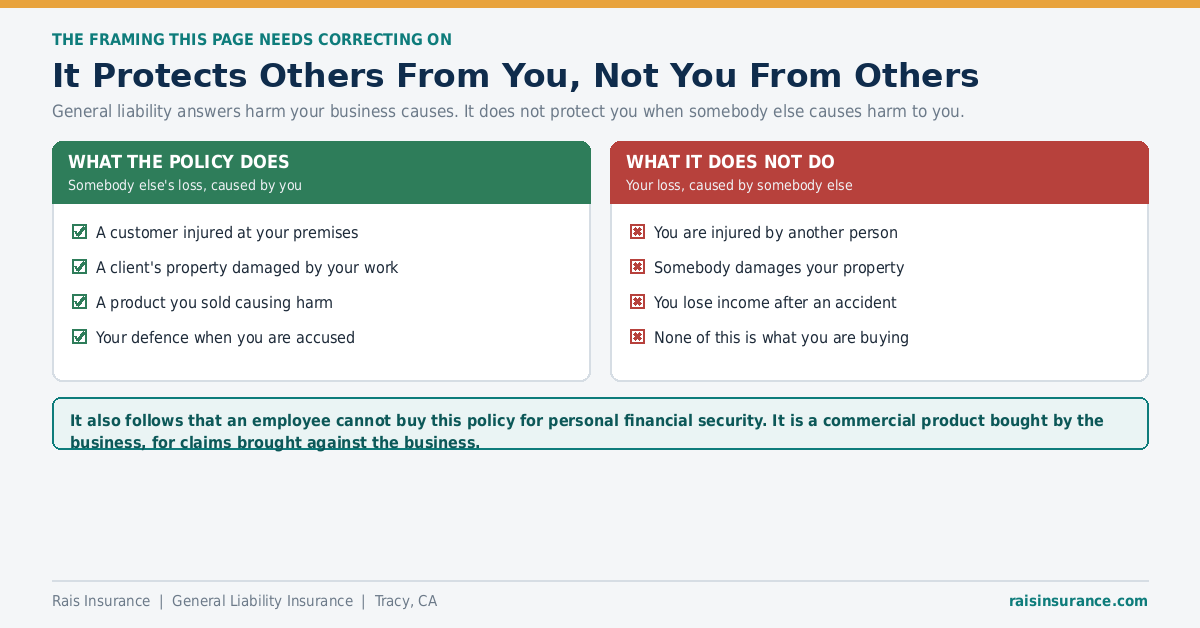
One framing correction that explains several of the others. The policy protects other people from your business – it does not protect your business from other people.
So it answers a customer injured at your premises, a client’s property damaged by your work, harm caused by a product you sold, and your defence when you are accused of any of those. What it does not answer is you being injured by somebody else, somebody damaging your property, or your income falling after an accident that was not your doing. Those are first-party questions, and first-party cover is a different family of products – see first-party cover versus third-party cover.
One consequence worth stating plainly: an employee cannot buy this policy for personal financial security. It is a commercial product, bought by a business, for claims brought against that business. If you are an employee looking for personal protection, the relevant products are the liability section of your homeowners or renters policy, a personal umbrella above it, and disability insurance for your earnings – see personal liability and where the line sits. That is a legitimate conversation and we are happy to have it. It is simply a different one.
The Package This Page Is Really Describing
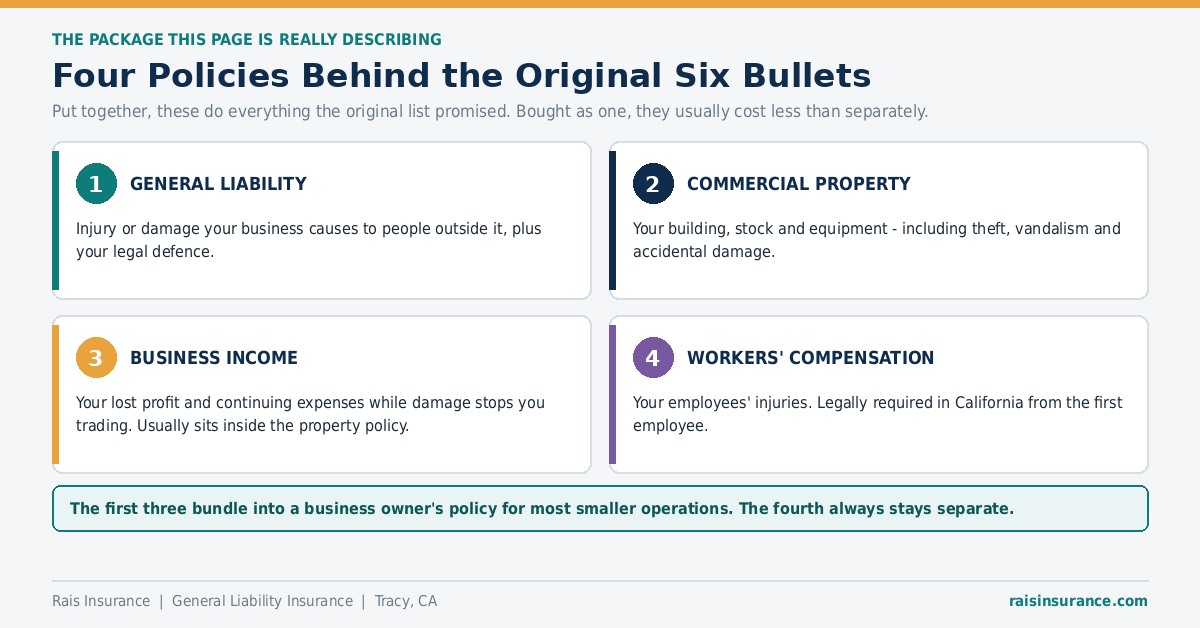
Put the corrections together and what the original list actually describes is a four-policy package – which is a perfectly sensible thing for a Tracy business to want, and worth naming properly:
- Commercial general liability – injury or damage your business causes to people outside it, plus your legal defence.
- Commercial property – your building, stock and equipment, including theft, vandalism and accidental damage.
- Business income – your lost profit and continuing expenses while covered damage stops you trading. Usually written inside the property policy.
- Workers’ compensation – your employees’ injuries. Legally required, and always a separate policy.
For most smaller operations the first three bundle into a business owner’s policy at a lower combined rate than buying them apart. Eligibility depends on size, occupancy and classification code, so it is worth asking early. Workers’ compensation stays separate whatever you buy, and so does commercial auto if you run vehicles.
A Central Valley Logistics Town
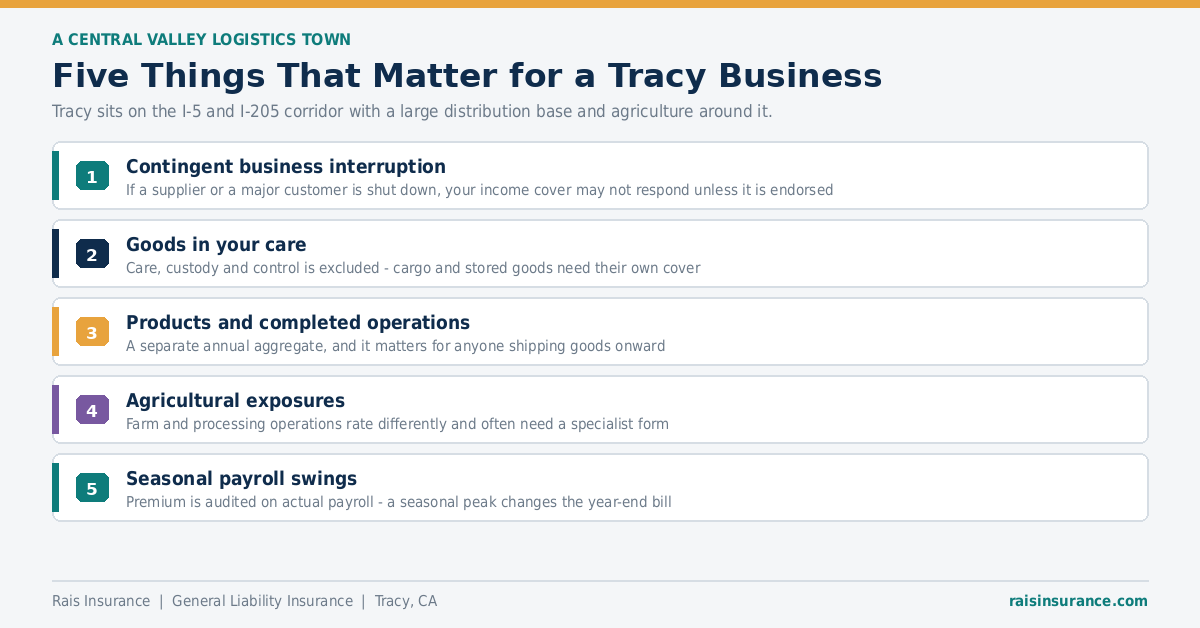
Tracy sits at the junction of the I-5 and I-205 corridors with a substantial distribution and warehousing base, agriculture around it, and a workforce that commutes in both directions. Five things matter more here than they would in a retail market:
- Contingent business interruption. If a key supplier or a major customer is shut down, standard business income cover generally will not respond – it answers damage at *your* premises. For a distribution business dependent on a few relationships, this needs adding deliberately.
- Goods in your care. Cargo and stored goods belonging to somebody else are excluded under care, custody and control. Warehouse legal liability, motor truck cargo or bailee cover handles them instead.
- Products and completed operations. A separate annual aggregate covering claims that arise after goods have left you – central to anyone shipping onward.
- Agricultural exposures. Farm and processing operations rate very differently from general commercial and often need a specialist form rather than a standard package.
- Seasonal payroll swings. Premium is provisional and audited on actual payroll, so a seasonal peak changes the year-end bill. Estimating low does not save money – it defers a cost. See what actually sets your premium, and the year-end audit.
What It Costs
There is no flat rate. Premium is built from your classification code, your gross receipts or payroll, the limits you select, your claims history and how much work you subcontract out. San Joaquin County’s mix of distribution, manufacturing and agriculture produces a wide spread between classes, so classification accuracy is worth checking at renewal. On how much cover to carry, see how much cover a business should carry.
Your Safety Net Against Sudden Expenses
Unexpected costs are close to inevitable in business, and the point of a properly built insurance programme is that they do not compromise the future of the company. What matters is buying business liability insurance that matches the risk rather than a package that sounds comprehensive.
At Rais Insurance we would rather tell you which of the four policies above your operation genuinely needs – and which it does not – than sell a bundle and let you find the gaps later. One note on geography: our office is in Anaheim, so Tracy is served remotely rather than from a local branch. For commercial insurance that changes very little in practice, but it is better said upfront.
We place the business insurance Tracy operations actually need, writing across Tracy, Mountain House, Lathrop and Manteca, and across California generally.
General Liability Insurance Tracy – Frequently Asked Questions
Q1. Does general liability cover lost income if my business cannot trade?
No. That is business income cover, sometimes called business interruption, and it sits inside a commercial property policy rather than a liability one. It replaces the net profit you would have earned plus the continuing expenses you still have to pay, and it is triggered by direct physical damage from a covered peril. General liability answers claims brought against you by other people – it never pays you for your own losses.
Q2. What does business income insurance actually cover?
Your lost net profit and your continuing expenses – rent, loan payments, key payroll – while covered damage suspends your operations. It runs for what the policy calls the period of restoration, which is how long the premises should reasonably take to repair rather than how long you personally take to recover. Most policies also carry a waiting period, commonly 48 or 72 hours, before cover starts.
Q3. What is extra expense cover?
It pays what it costs to keep trading despite the damage – temporary premises, overtime, expedited shipping, renting replacement equipment. For a lot of businesses it is the more useful half of the pair, because staying open partially is usually better than closing entirely. It is normally sold alongside business income and worth asking for by name.
Q4. Does general liability cover theft or vandalism at my premises?
No. Theft, vandalism and accidental damage to your own building, stock and equipment are commercial property and crime cover. General liability answers damage you cause to other people’s property, not damage to your own. The two are often bundled in a business owner’s policy, which is probably why they get confused.
Q5. Does general liability support employees who are injured at work?
No. Employee injuries are workers’ compensation, which California requires from your first employee and which general liability specifically excludes. The exclusion is deliberate – a separate compulsory system handles employee injuries. General liability covers people who are not on your payroll: customers, visitors, delivery drivers, members of the public.
Q6. Can I buy general liability insurance as an employee?
No. It is a commercial policy bought by a business for claims brought against that business. If you are an employee looking for personal financial protection, the relevant products are the liability section of your homeowners or renters policy, a personal umbrella above it, and disability insurance for your earnings. Those are a different conversation and a legitimate one.
Q7. Does the policy protect me if somebody else causes an accident that harms me?
No, and this is the most common misunderstanding about liability insurance. It runs one direction: it protects other people from harm your business causes, and defends you when you are accused. If somebody else damages your property or injures you, the cover that responds is your own first-party insurance or a claim against their policy.
Q8. What is contingent business interruption?
Cover for lost income when the damage happens to somebody else – a key supplier or a major customer is shut down and your trading suffers as a result. Standard business income cover generally responds only to damage at your own premises, so this has to be added. For a Tracy distribution business dependent on a small number of suppliers or clients, it is worth asking about specifically.
Q9. Should I buy these policies separately or together?
For most smaller operations a business owner’s policy bundles general liability, commercial property and business income at a lower combined rate than buying them apart. Eligibility depends on your size, occupancy and classification code. Workers’ compensation always stays separate whatever you buy, and so does commercial auto.
Q10. How much does general liability insurance cost in Tracy?
There is no flat rate. Premium is built from your classification code, gross receipts or payroll, the limits you select, your claims history and how much work you subcontract. San Joaquin County’s mix of distribution, manufacturing and agriculture means the spread between classes here is wide, and seasonal payroll swings show up at the year-end audit.
Get a General Liability Insurance Quote in Tracy
For details on the cover your business actually needs, contact Rais Insurance on 714-761-4336, email rai@raisinsurance.com, or write to 2612 W. Lincoln Avenue, Suite 103, Anaheim, CA 92801.
Worth mentioning in your first message: whether you hold goods belonging to anybody else, and how long your business could survive without trading. Those two answers shape the programme more than anything else.
