

Auto Insurance Cerritos California
That is worth stating precisely, because the obligation is not quite “buy a policy”. It is to demonstrate financial responsibility, and insurance is simply how virtually everyone does it. This car insurance guide covers what the law asks for, what counts as proof of insurance, and how the coverages fit around it. If you are looking at auto insurance Cerritos options, that is the ground to start from.
What the Law Actually Requires
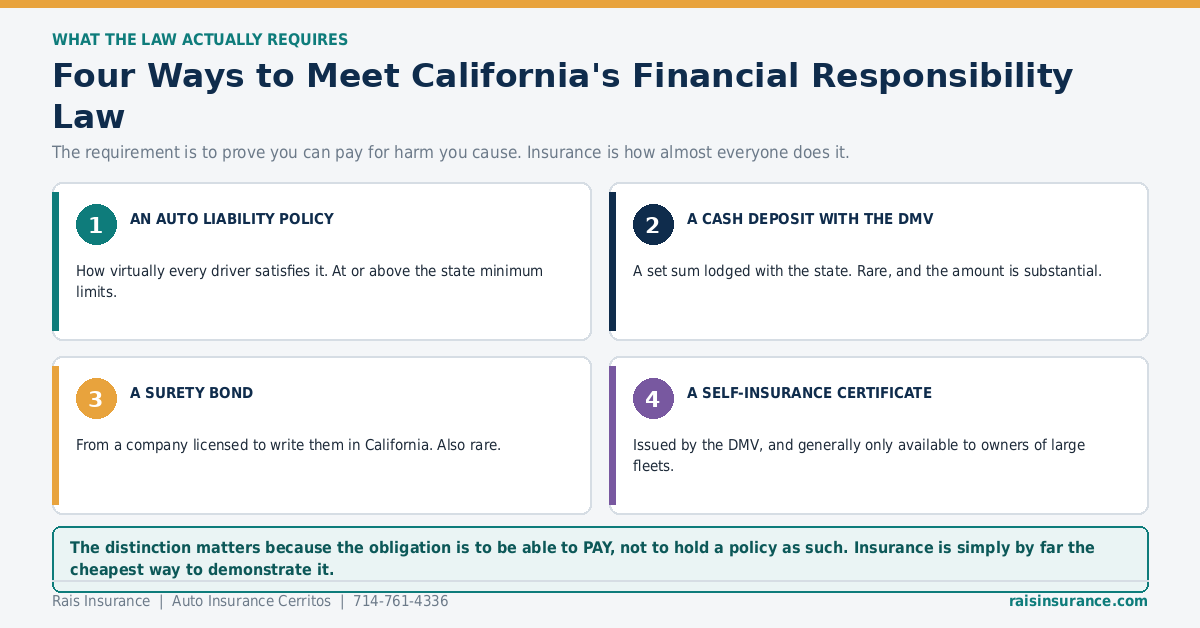
California recognises four ways to satisfy its financial responsibility law:
- An auto liability policy at or above the state minimum limits. This is how virtually every driver does it, and it is the only one of the four that is practical for a household.
- A cash deposit with the DMV – a set sum lodged with the state. Legally available, rarely used, and the amount is substantial.
- A surety bond from a company licensed to write them in California. Same picture: real, and rare.
- A self-insurance certificate issued by the DMV, generally available only to owners of large fleets.
The distinction matters more than it first appears. The obligation is to be able to pay, not to hold a policy as such – insurance is just by far the cheapest way to demonstrate it. The current minimum limits and the penalties for driving without cover are on our auto insurance in California page.
Tort States and No-Fault States
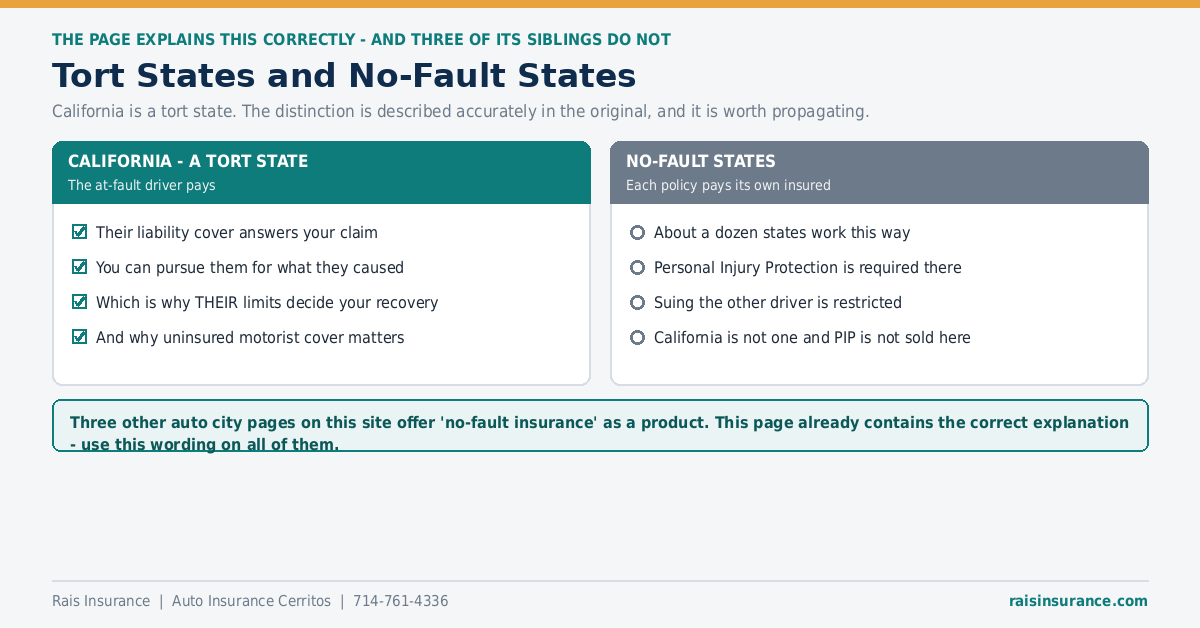
The original version of this page draws this distinction accurately, and it is worth keeping in full:
- California is a tort state. The at-fault driver is responsible for the harm caused, and their liability coverage answers the claim. You can pursue them for what they caused.
- No-fault states work the other way. In about a dozen states, car insurance is still mandatory, but each carrier pays the damages of its own client rather than the victim of the crash. Personal Injury Protection is required there, and suing the other driver is restricted.
California is not a no-fault state and PIP is not sold here. The practical consequence follows directly: because what you recover depends on the other driver’s limits, a driver with no coverage leaves you nothing to claim against. That is exactly what uninsured motorist cover exists for, and it is covered below.
Proving It When You Are Asked
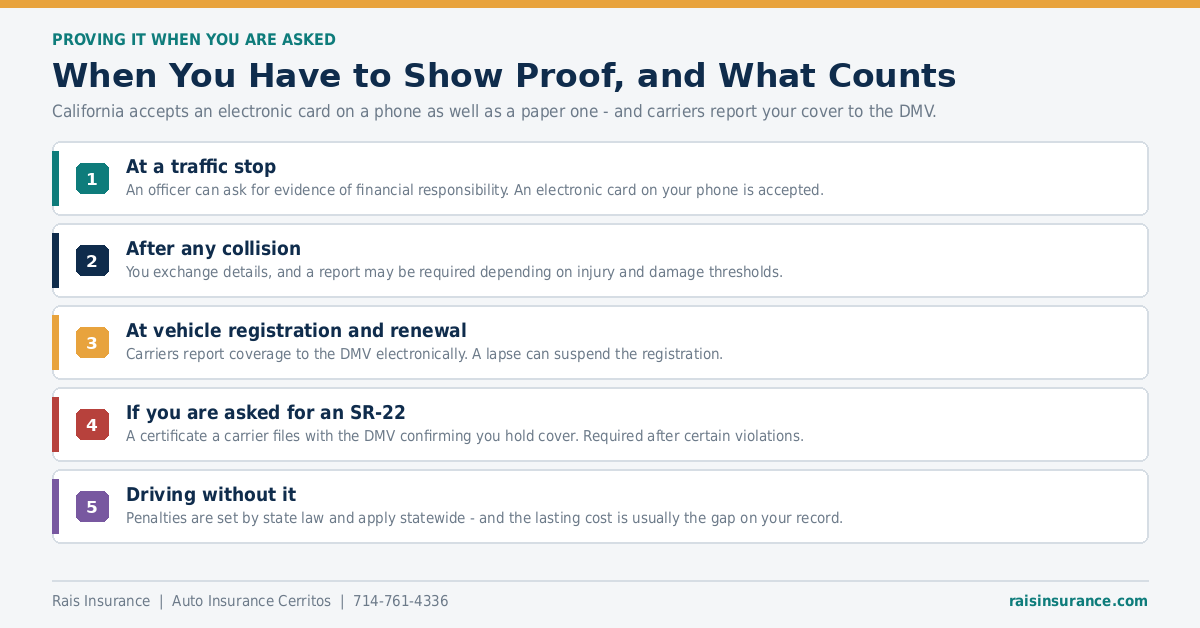
Five situations where proof of insurance and financial responsibility come up in practice:
- At a traffic stop. An officer can ask for evidence of coverage, and California accepts an electronic card displayed on a phone as well as a paper one.
- After a collision. You exchange details, and a report may be required depending on injury and damage thresholds.
- At registration and renewal. Carriers report coverage to the DMV electronically, so the state holds its own record – and a lapse can lead to the vehicle registration being suspended, separately from any driving penalty.
- If you are asked for an SR-22. That is a certificate your carrier files with the DMV confirming you hold cover, usually required for a period after certain violations. It is a filing, not a policy – and not every carrier will make one, which is a situation where access to several carriers matters more than a price comparison. See the insurance companies we represent.
- Driving without it. Penalties are set by state law and apply statewide. The lasting cost is usually the gap itself, which affects what you are quoted for years afterwards.
The Three Coverages, and Two More
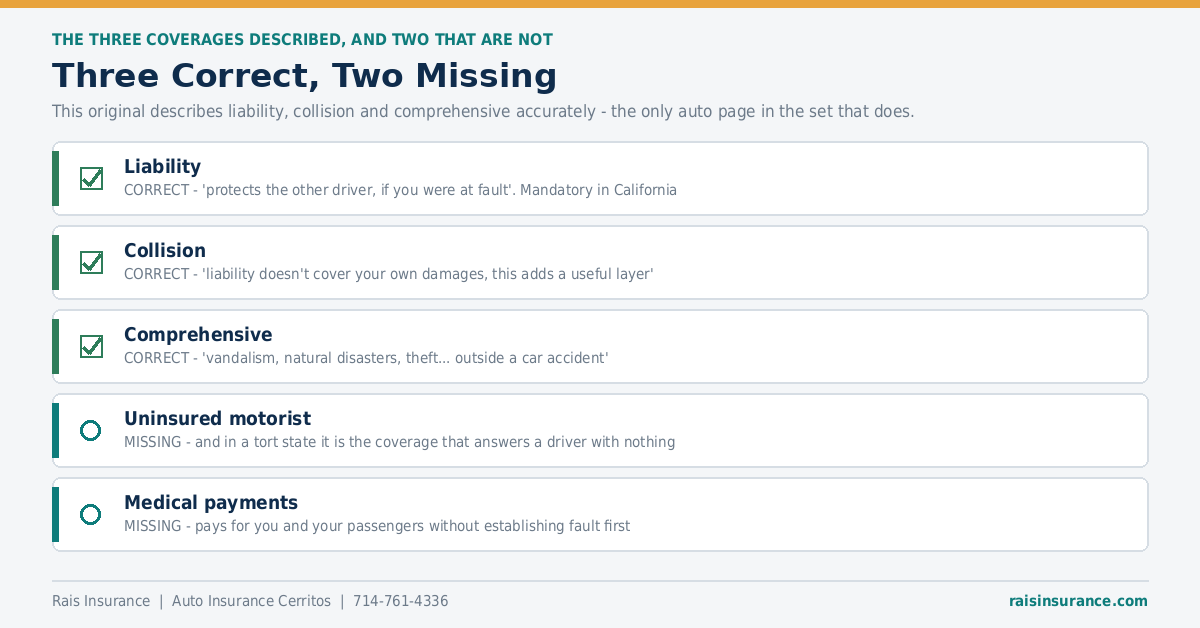
The original describes the three main auto insurance coverages accurately, so they are kept close to as written:
- Liability insurance protects the other driver when an accident occurs and you were at fault. It is the necessary and mandatory part of a California policy. It does not pay for your own vehicle or your own injuries. See how liability limits actually work.
- Collision insurance matters most where the car is newer and repair or replacement would be expensive. Since liability does not cover your own damage, this adds that layer – regardless of fault.
- Comprehensive insurance answers the other ways a car gets damaged: vandalism, natural disasters, theft, and damage that happens off the road or outside a collision entirely. See what comprehensive coverage actually covers.
Two things to add. First, both collision and comprehensive carry a deductible that comes off before the carrier pays anything – liability does not, because that coverage pays somebody else. On small damage the deductible can exceed the repair, so it is worth working out before claiming at all: see when collision and comprehensive stop earning their premium.
Second, two coverages belong on any California list and are missing from the original:
- Uninsured and underinsured motorist cover – optional here, and a carrier must obtain your decline in writing. In a tort state this is the coverage that answers a driver who has nothing.
- Medical payments – pays medical costs for you and your passengers without anyone establishing fault first. Optional, modest limits, inexpensive.
Driving in Cerritos
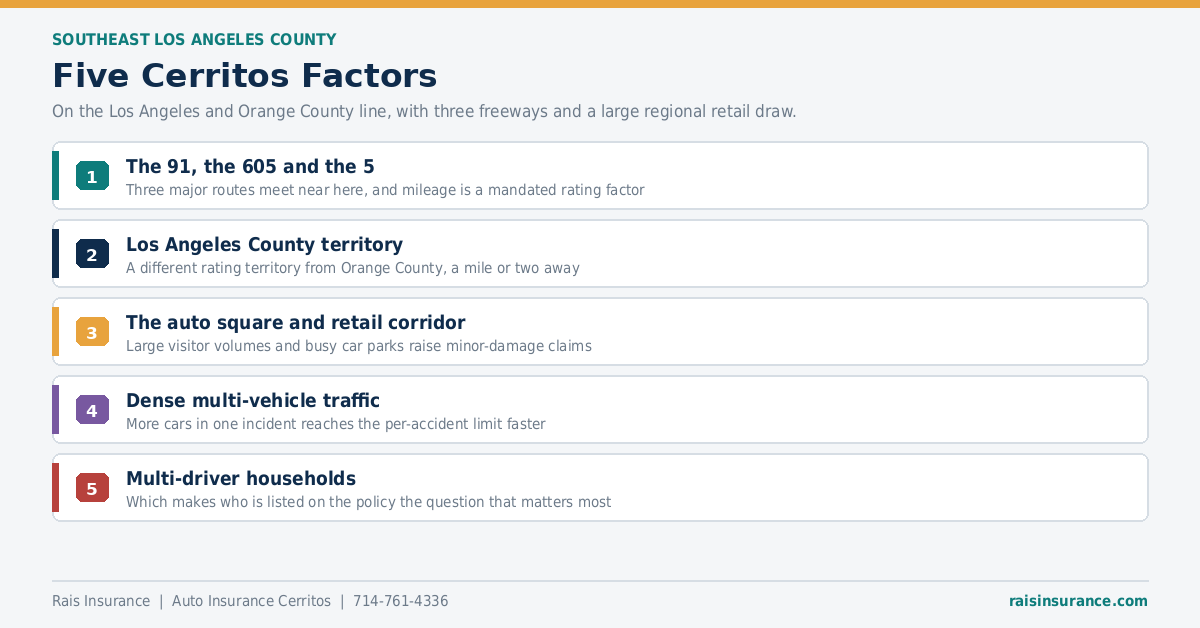
Five things shaping car insurance Cerritos rates in this part of Los Angeles County:
- The 91, the 605 and the 5. Three major routes converge nearby, and annual mileage is one of the factors California law requires to weigh most heavily in your rate.
- Los Angeles County territory. Cerritos sits on the county line, and rates are set by garaging territory – so a move of a mile or two can change the number.
- The auto square and retail corridor. Large visitor volumes and busy car parks raise minor-damage and door-ding claims.
- Dense multi-vehicle traffic. More cars involved in one incident means the per-accident limit is reached faster.
- Multi-driver households, which makes who is listed on the policy the question that matters most – see who is covered to drive your car.
What sets a California premium generally, and the three factors state law prohibits, is on our what determines your premium in California page.
Building the Policy Around You
We will help you build an auto insurance plan around your budget, your vehicle, your driving experience and the other factors that carriers actually weigh. One honest note on that: being as protected as possible and paying as little as possible pull against each other, and the useful work is finding where you want to sit between them rather than pretending both are available at once.
As an independent broker, we place car insurance Cerritos households need across a panel of carriers rather than selling one company’s products – so one set of details gets quoted several times. We are not an insurance company ourselves; the carrier issues the policy and pays the claim, and there is no fee to you for the comparison.
Auto Insurance in Cerritos – Frequently Asked Questions
Q1. Is car insurance legally required in California?
What the law requires is proof of financial responsibility – the ability to pay for harm you cause. An auto liability policy at or above the state minimum is how virtually every driver satisfies it, but it is not the only route: a cash deposit with the DMV, a surety bond from a licensed company, and a DMV self-insurance certificate are all recognised. The last three are rare and the amounts involved are substantial.
Q2. Is California a tort state or a no-fault state?
A tort state. The driver at fault is responsible for the harm they cause, and their liability coverage answers the claim. No-fault states – about a dozen of them – work the other way: each policy pays its own insured regardless of blame, and Personal Injury Protection is required. California does not use PIP.
Q3. What counts as proof of insurance in California?
An insurance identification card issued by your carrier, and California accepts an electronic version displayed on a phone as well as a paper one. Carriers also report coverage to the DMV electronically, so the state has a record independent of what you are carrying in the vehicle.
Q4. What happens if my insurance lapses?
Because carriers report coverage to the DMV, a lapse can lead to your vehicle registration being suspended, separately from any penalty for driving uninsured. The lasting cost is usually neither of those, though – a gap in coverage affects what you are quoted for years afterwards, and that generally exceeds the fine.
Q5. What is an SR-22?
A certificate your insurer files with the DMV confirming that you hold coverage, usually required for a period after certain violations. It is a filing rather than a policy – you buy a normal auto policy and the carrier makes the filing. Not every carrier will do it, which is one of the situations where having access to several carriers is worth more than a price comparison.
Q6. What does liability insurance actually do?
It pays the other party when you are at fault – their injuries and their property damage – up to your limits, and it funds your legal defence. It does not pay for your own vehicle or your own injuries. The original version of this page describes it correctly, which is worth saying because several of our other city pages did not.
Q7. What is the difference between collision and comprehensive?
Collision covers your vehicle when it hits something, regardless of fault. Comprehensive covers almost everything else that can damage it – theft, fire, vandalism, weather, falling objects, animal strikes. They are separate coverages with separate deductibles, and both are optional unless a lender requires them.
Q8. Do collision and comprehensive have a deductible?
Yes – both do, and it comes off before the carrier pays anything. Liability does not, because that coverage pays somebody else. On small damage the deductible can exceed the repair, which is worth working out before making a claim at all.
Q9. Do I need uninsured motorist coverage in California?
It is optional, and a carrier must offer it and obtain your decline in writing. Whether you need it follows directly from California being a tort state: because what you recover depends on the at-fault driver’s limits, a driver with no coverage leaves you nothing to claim against. Your own uninsured motorist cover is what responds.
Q10. How do I get a Cerritos auto insurance quote?
Call Rais Insurance on 714-761-4336, email rai@raisinsurance.com, or visit 2612 W. Lincoln Avenue, Suite 103, Anaheim, CA 92801. We are an independent broker, so one set of details is quoted across several carriers, and there is no fee to you for the comparison.
Get a Car Insurance Quote in Cerritos
contact Rais Insurance on 714-761-4336, email rai@raisinsurance.com, or visit 2612 W. Lincoln Avenue, Suite 103, Anaheim, CA 92801.
Have your car insurance declarations page to hand if you hold cover already. And if you have been asked for an SR-22 filing, say so at the start – it narrows which carriers can help, and it is better known at the beginning than discovered at the end.
