

Auto Insurance Hacienda Heights California
That is a fair opening, and the original version of this page is right to lead with it. What it does not do is explain how that happens, or name the coverage that prevents it. Both are worth doing, because auto insurance Hacienda Heights drivers buy is often chosen without either being understood.
How an Accident Becomes a Debt You Carry
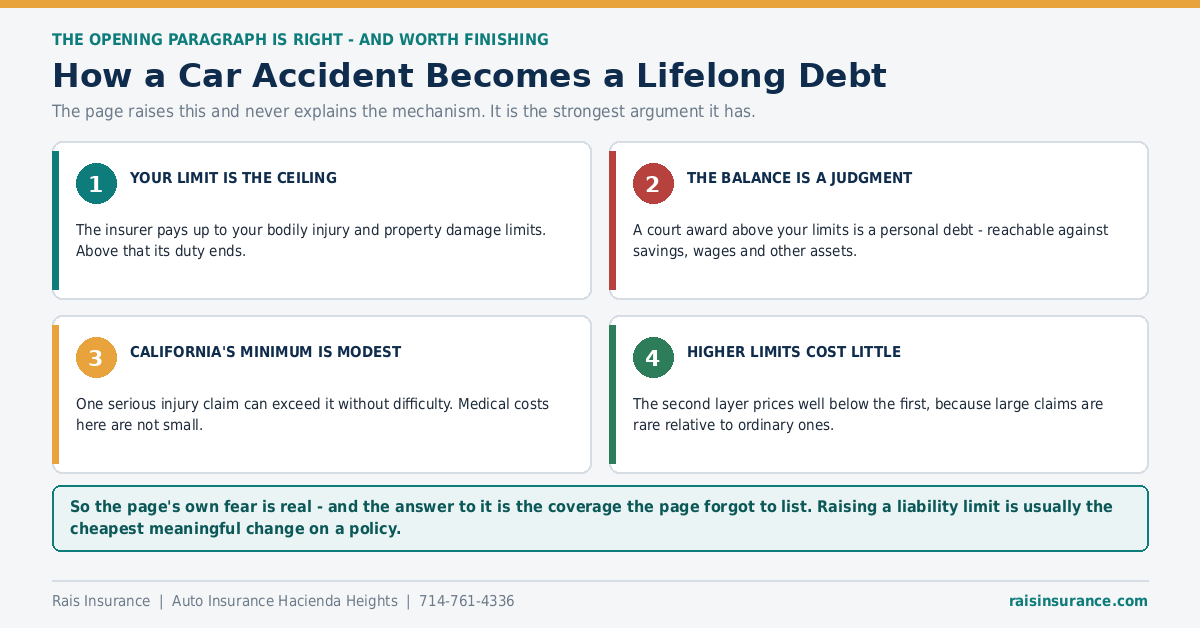
The car insurance mechanism is straightforward, and rarely stated plainly:
- Your limit is the ceiling. The insurer pays up to your bodily injury and property damage limits, and its duty to indemnify is then discharged. It does not pay a dollar more, whatever a judgment says.
- The balance becomes a personal debt. A court award above your limits is reachable against savings, wages and other assets. That is the lifelong obligation the original describes.
- California’s minimum is modest. One serious injury claim can exceed it without difficulty, and medical costs in Los Angeles County are not small.
- Higher limits cost less than people expect. The second layer prices well below the first, because serious claims are rare relative to ordinary ones. Raising a liability limit is usually the cheapest meaningful change on a policy.
How the limits themselves work – the three numbers and how they interact – is on our how liability limits actually work page.
The Coverage the List Leaves Out
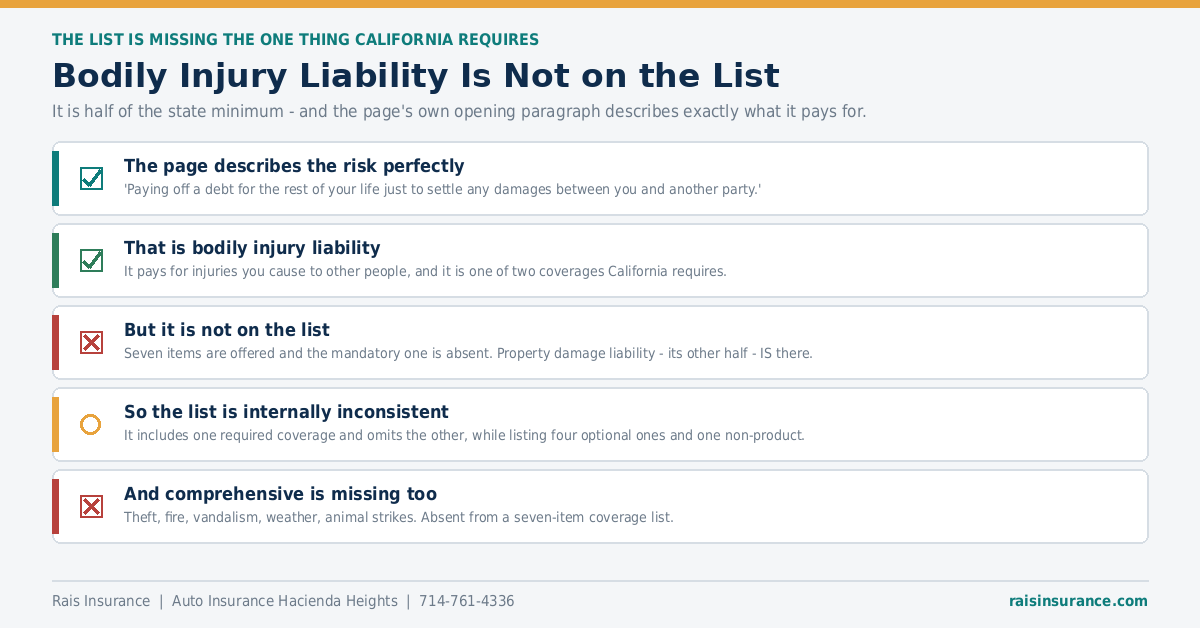
Here is the odd part. The coverage that answers everything above is bodily injury liability – and it is not on the original page’s list of what is offered. Property damage liability, its other half, is there.
Both are required in California. So the list includes one mandatory coverage and omits the other, while offering four optional ones alongside. Bodily injury liability pays for injuries you cause to other people: the other driver, their passengers, pedestrians and cyclists, and your own passengers – see whose injuries each coverage pays for.
Comprehensive is missing too – theft, fire, vandalism, weather, falling objects and animal strikes. That matters here specifically, because comprehensive is what answers wildfire damage to a vehicle, and Hacienda Heights sits below the Puente Hills. See what comprehensive coverage actually covers.
The seven items, sorted
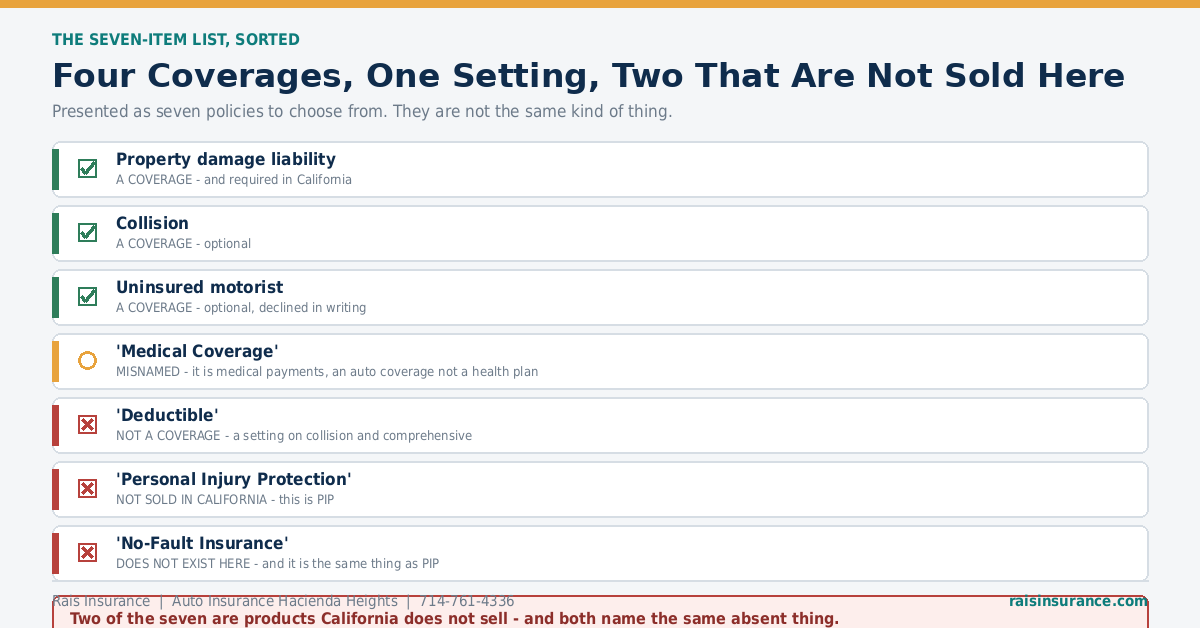
The other thing worth saying about that car insurance list is that its items are not the same kind of thing:
- Property damage liability, collision and uninsured motorist are genuine coverages, and all three are correctly named.
- “Medical Coverage” is medical payments – an auto coverage that pays for you and your passengers without anyone establishing fault. It is not a health plan, and calling it medical coverage invites exactly that confusion.
- “Deductible” is not a coverage at all. It is a setting – a number you choose that applies to collision and comprehensive claims, taken off before the carrier pays anything. Liability has none, because that coverage pays somebody else.
- “Personal Injury Protection” and “No-Fault Insurance” are not sold in California – and they are two names for the same thing. PIP is the coverage no-fault states require; California is an at-fault state and uses neither. See California is an at-fault state.
What a California Policy Actually Offers
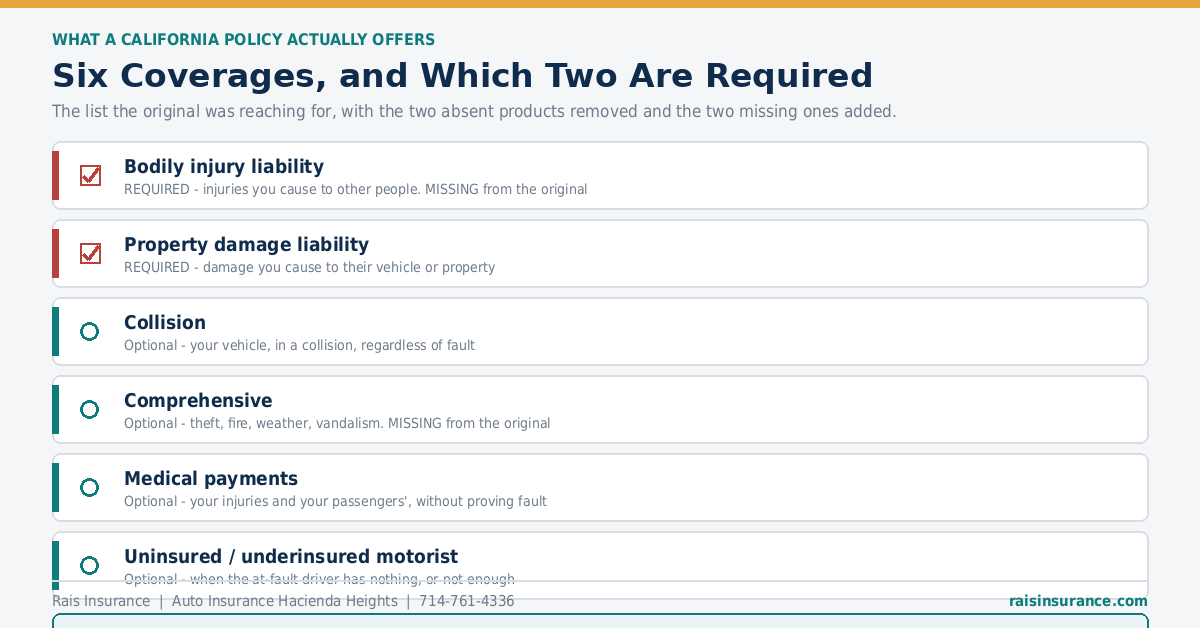
A California auto insurance policy holds six coverages, and it matters which two the law requires:
- Bodily injury liability – required. Injuries you cause to other people.
- Property damage liability – required. Damage you cause to their vehicle or property.
- Collision – optional. Your vehicle, when it hits something, regardless of fault.
- Comprehensive – optional. Theft, fire, vandalism, weather, falling objects, animal strikes.
- Medical payments – optional. Your own injuries and your passengers’, paid without establishing fault first.
- Uninsured motorist and underinsured motorist – optional, and a carrier must obtain your decline in writing. It responds when the at-fault driver has no insurance, or not enough of it.
Plus the deductible, which is a number you choose on two of those rather than a seventh product. The current minimum limits are on our auto insurance in California page.
Driving in Hacienda Heights
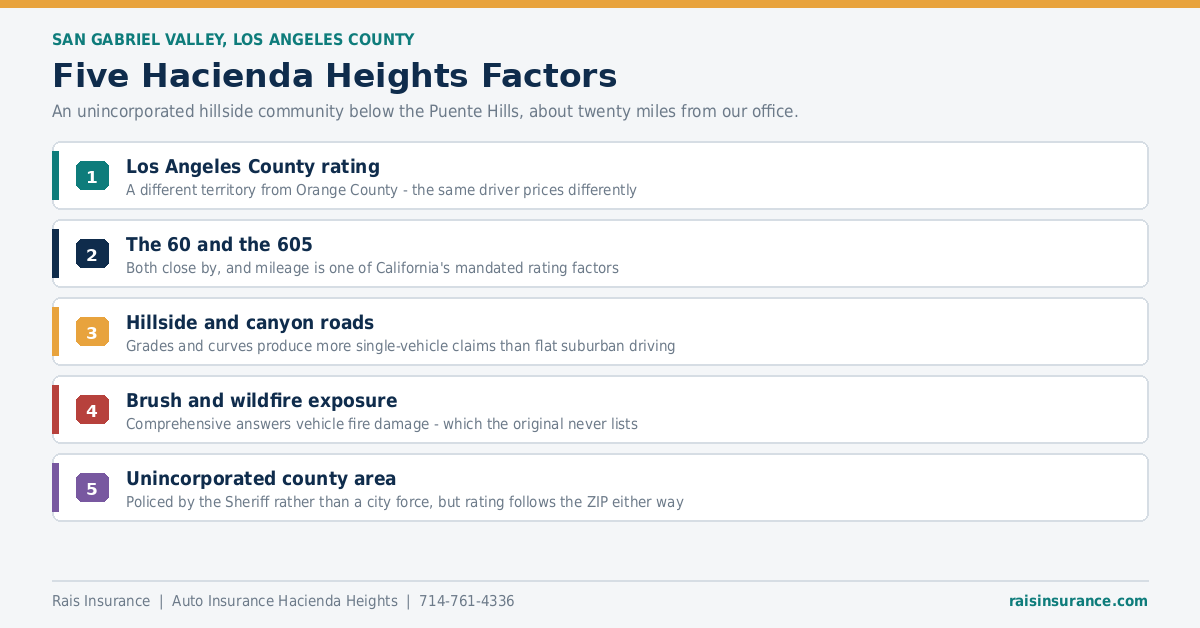
Five things that shape car insurance Hacienda Heights rates specifically, on top of the auto insurance Hacienda Heights basics above:
- Los Angeles County rating. A different territory from Orange County, and California rates by territory – so the same driver and vehicle can price differently here.
- The 60 and the 605. Both close by, and annual mileage is one of the three factors California law requires to weigh most heavily.
- Hillside and canyon roads. Grades and curves produce more single-vehicle claims than flat suburban driving – and those are collision claims, on your own policy.
- Brush and wildfire exposure below the Puente Hills, which is a specific argument for carrying comprehensive even on an older vehicle.
- An unincorporated community, policed by the Sheriff’s Department rather than a city force. Rating follows the ZIP code either way.
Choosing What You Actually Need
The original’s offer is to walk you through the car insurance options, and that is the right offer – the work is deciding each coverage deliberately rather than accepting whatever the last quote defaulted to.
As an independent broker we place business across a panel of carriers rather than selling one company’s products, so one set of details from you gets quoted several times – see the insurance companies we represent. We are not an insurance company; the carrier issues the policy and pays the claim, and there is no fee to you for the comparison.
Being straightforward about geography: our office is in Anaheim, about twenty miles south, so Hacienda Heights is served by phone and email rather than across a desk.
Auto Insurance in Hacienda Heights – Frequently Asked Questions
Q1. Can I be sued for more than my insurance limits?
Yes. Your insurer pays up to your bodily injury and property damage limits and its duty is then discharged. Any balance of a judgment is a personal debt, reachable against savings, wages and other assets. That is precisely the risk the original version of this page describes, and the answer to it is carrying liability limits above the state minimum.
Q2. What car insurance is legally required in California?
Two coverages: bodily injury liability and property damage liability. Everything else – collision, comprehensive, medical payments, uninsured and underinsured motorist – is optional, though a lender will usually require collision and comprehensive while a vehicle is financed.
Q3. What is bodily injury liability?
It pays for injuries you cause to other people when you are at fault – the other driver, their passengers, pedestrians and cyclists, and your own passengers. It does not cover your own injuries. It is one of the two coverages California requires, and it was missing from the original version of this page’s list.
Q4. Is a deductible a type of coverage?
No. A deductible is a setting rather than a product – a number you choose that applies to collision and comprehensive claims, taken off before the carrier pays anything. Liability has no deductible, because that coverage pays somebody else rather than you.
Q5. Is personal injury protection available in California?
No. PIP is a no-fault coverage required in about a dozen other states, where your own policy pays your injury costs regardless of blame. California is an at-fault state and does not use it. The equivalent sold here is medical payments coverage.
Q6. Does California have no-fault insurance?
No. California is an at-fault state – the driver responsible for a collision is responsible for the cost, and their liability coverage answers the claim. No-fault insurance and PIP are two names for the same system, and neither is available here.
Q7. What is medical payments coverage?
An optional coverage inside your auto policy that pays medical costs for you and your passengers without anyone having to establish fault first. The limits are modest and it is inexpensive. It is not health insurance and it does not replace a health plan – the original version of this page calls it ‘medical coverage’, which invites that confusion.
Q8. What does comprehensive cover, and why does it matter here?
Theft, fire, vandalism, weather, falling objects and animal strikes – damage that is not a collision. It was missing from the original list entirely, which matters below the Puente Hills because comprehensive is the coverage that answers wildfire damage to a vehicle.
Q9. How much liability coverage should I carry?
More than the minimum in almost every case. A useful rule is enough to protect what you could lose – savings, home equity, future earnings. Higher layers price well below the first, because serious claims are rare relative to ordinary ones, and a personal umbrella policy adds a further layer above both your auto and home liability.
Q10. How do I get a Hacienda Heights auto insurance quote?
Call Rais Insurance on 714-761-4336 or email rai@raisinsurance.com. Our office is in Anaheim, about twenty miles south, so Hacienda Heights is served by phone and email rather than across a desk. Have your declarations page to hand – the liability line is the one worth looking at first.
Get a Car Insurance Quote in Hacienda Heights
contact Rais Insurance on 714-761-4336 or email rai@raisinsurance.com.
Have your car insurance declarations page to hand, and look at the liability line first. It is the number that decides whether a serious claim ends at your policy or continues into everything you own.
