

Auto Insurance Costa Mesa California
Car insurance policies come in different shapes depending on the vehicle and the driver, and this auto insurance guide covers what each part actually does – starting with the most surprising thing on the original version of it, which turns out to be correct.
Your Car Is Covered for Things Your House Is Not
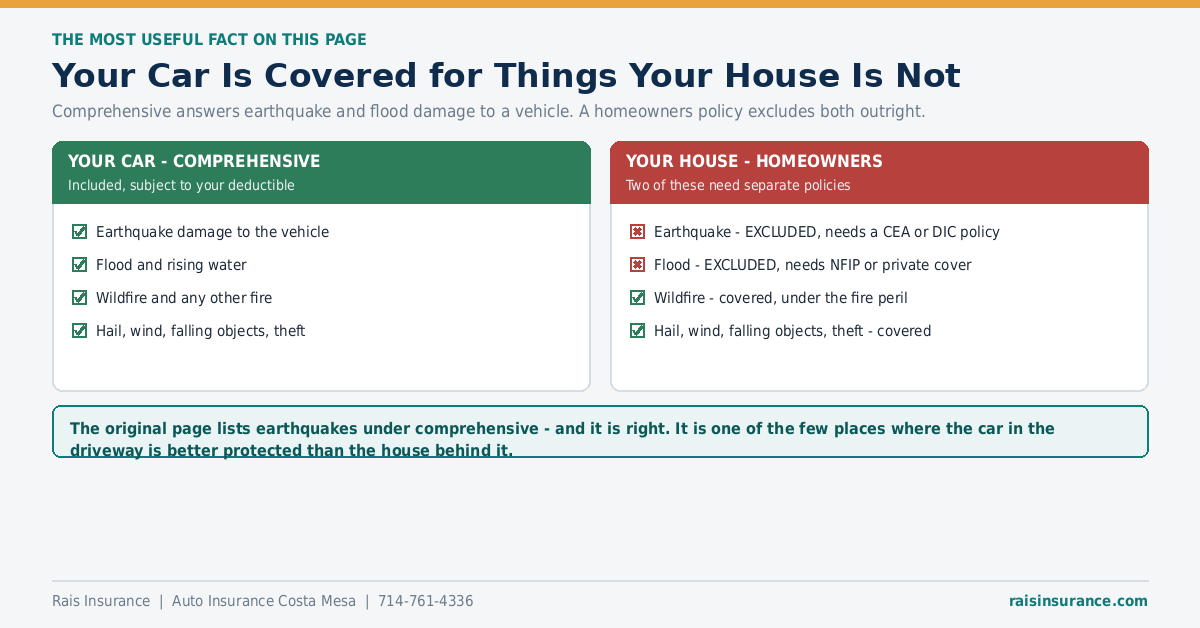
The original lists earthquakes among the events comprehensive coverage answers. That is right – and it is worth drawing out, because it produces one of the odder asymmetries in personal insurance:
- Earthquake damage to your car is covered by comprehensive. Earthquake damage to your house is not – a homeowners policy excludes it entirely, and cover has to be bought separately through the California Earthquake Authority or a private difference-in-conditions policy.
- Flood damage to your car is covered by comprehensive. Flood damage to your house is not – again excluded, again needing separate NFIP or private cover.
- Wildfire is covered on both, under the fire peril.
- Hail, wind, falling objects, theft and vandalism are covered on both.
So on the two perils that most define California risk, the car in the driveway is better protected than the house behind it. That is not intuitive and almost nobody says it. See home insurance in California for the property side of that comparison.
Which of These Actually Happen in California
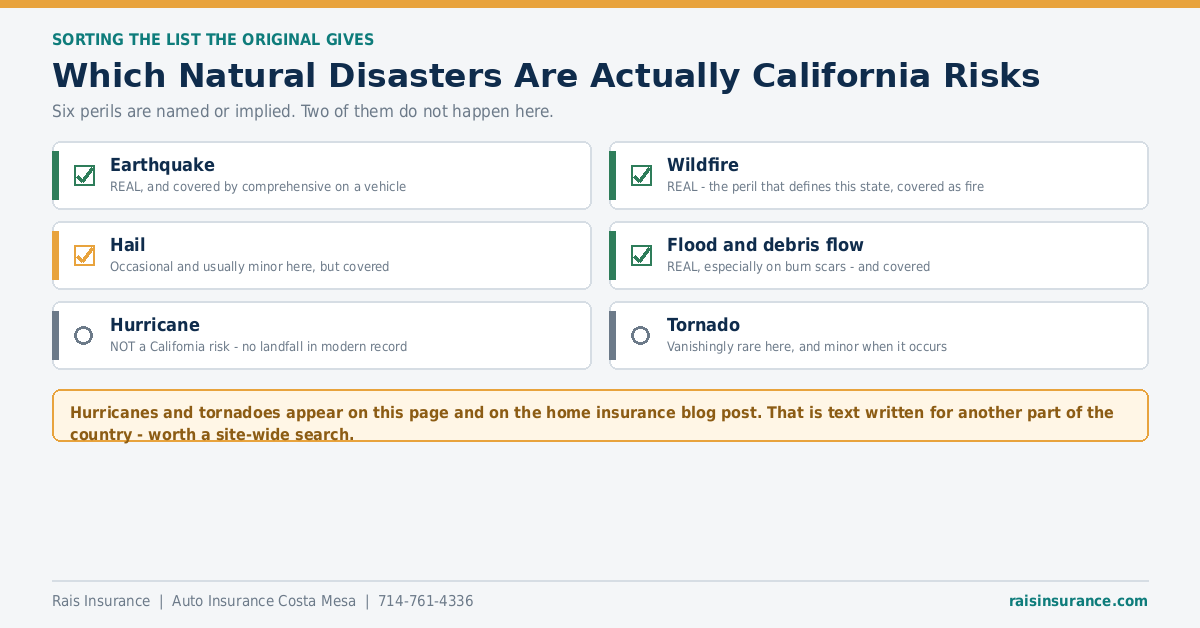
The original names extreme weather including hurricanes and tornados. Sorted for this state:
- Earthquake – real, and covered.
- Wildfire – real, and the peril that defines the state. Covered as fire.
- Flood and debris flow – real, particularly on burn scars after a fire. Covered.
- Hail – occasional here and usually minor, but covered.
- Hurricane – not a California risk. No hurricane has made landfall here in the modern record.
- Tornado – vanishingly rare, and minor when it occurs.
Where wind damage does happen it is already covered under comprehensive, so nothing is lost by removing the two that do not apply. The full list of what comprehensive answers is on our what comprehensive coverage actually covers page.
The Coverage List, Corrected
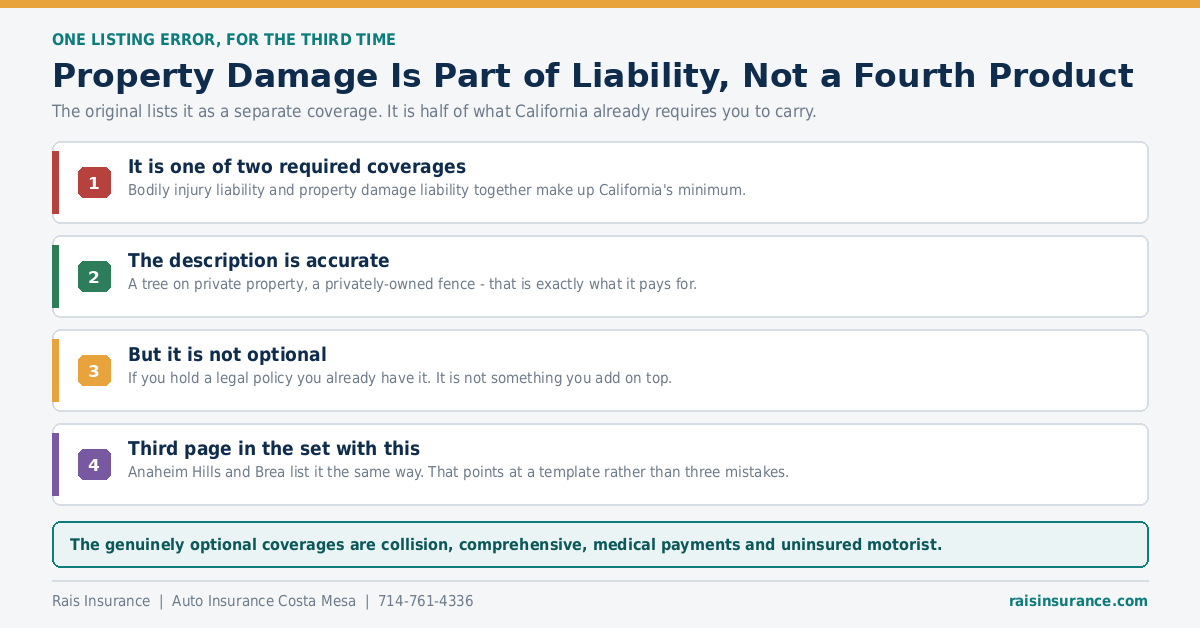
The original names four car insurance coverages. Three of the descriptions are sound; one is in the wrong category:
- Liability – correct as described. California is an at-fault state, this is the mandatory part, and it covers the other party’s damages and expenses when you were at fault. As the page rightly says, it does not take care of your own property, your own collision damage or your own injuries. See how liability limits actually work.
- Property damage – the description is accurate. Damage to property outside the vehicles involved, such as a tree on private land or a privately-owned fence, is exactly what it pays for. But it is not a separate product. Property damage liability is one of the two coverages California requires, alongside bodily injury liability – so if you hold a legal policy, you already have it.
- Collision – covers your own vehicle after a collision, regardless of fault and subject to your deductible. That is the gap the page correctly identifies in the liability section.
- Comprehensive – everything above, plus theft and vandalism.
Two coverages belong on the list and are absent:
- Uninsured motorist and underinsured motorist cover – optional in California, and a carrier must obtain your decline in writing. Because what you recover depends on the at-fault driver’s limits, a driver with nothing leaves you nothing to claim against.
- Medical payments – pays medical costs for you and your passengers without anyone establishing fault first.
And one thing that applies to both collision and comprehensive: each carries a deductible that comes off before the carrier pays anything. Liability does not, because that coverage pays somebody else. See when collision and comprehensive stop earning their premium.
What a Broker Can and Cannot Do Here
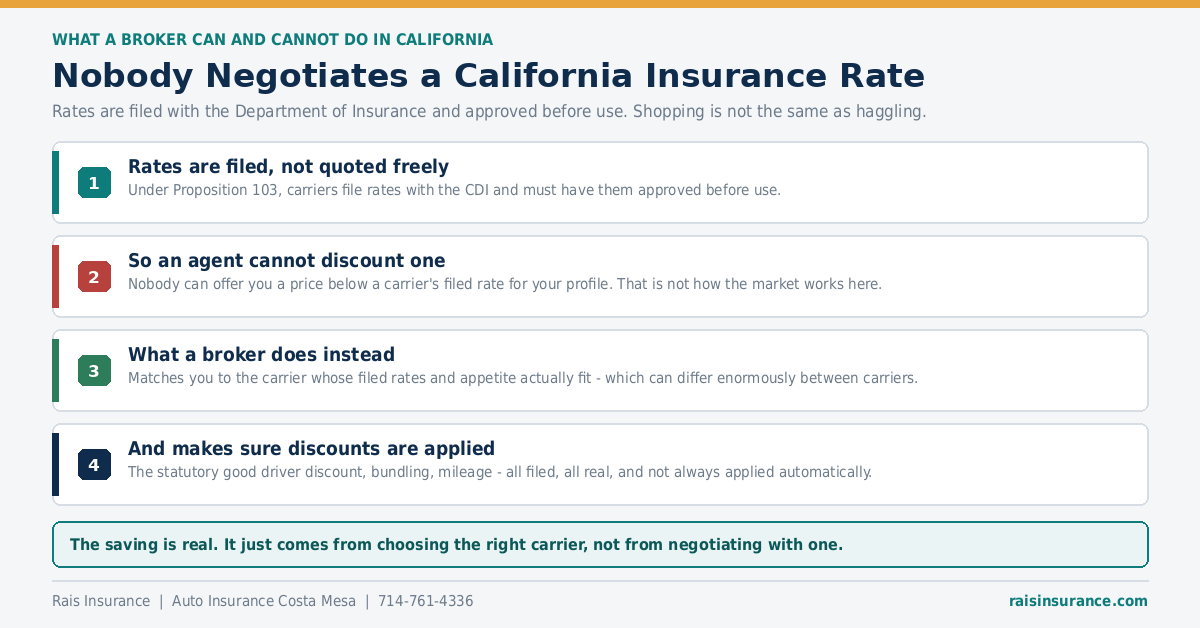
One correction on how the original describes our own work. It says we negotiate the best auto insurance plan. In California, nobody negotiates an insurance rate – and that is worth being straight about:
- Rates are filed, not offered freely. Under Proposition 103, carriers file their rates with the Department of Insurance and must have them approved before use.
- So no agent can discount one. Nobody can offer you a price below a carrier’s filed rate for your profile. That is not how this market works.
- What a broker actually does is match you to the carrier whose filed rates and appetite genuinely fit – and the difference between carriers for the same driver can be substantial.
- And makes sure your discounts are applied. The statutory good driver discount, bundling, accurate mileage. All filed, all real, and not always applied automatically.
The saving is real. It simply comes from choosing the right carrier rather than haggling with one. What drives a California rate in the first place is on our what determines your premium in California page, and the carriers we work with are listed on the insurance companies we represent.
Driving in Costa Mesa
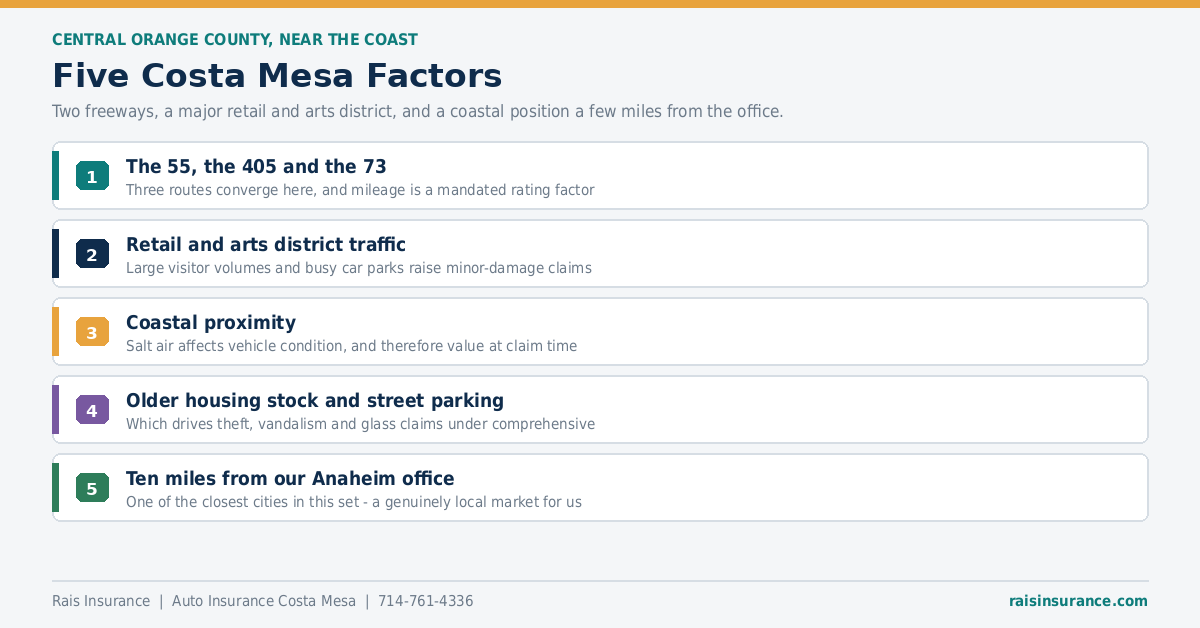
Five things that shape car insurance Costa Mesa rates specifically:
- The 55, the 405 and the 73. Three routes converge here, and annual mileage is one of the factors California law requires to weigh most heavily.
- Retail and arts district traffic. Large visitor volumes and busy car parks raise minor-damage and door-ding claims.
- Coastal proximity. Salt air affects vehicle condition over time, and condition affects actual cash value at claim time.
- Older housing stock and street parking, which drives theft, vandalism and glass claims – all comprehensive.
- About ten miles from our Anaheim office, which makes this one of the closest cities in our set and a genuinely local market for us.
Building the Right Policy
We will work through what car insurance Costa Mesa drivers actually need for their vehicle, their driving and their budget – and as an independent broker we put one set of details to several carriers rather than one. We are not an insurance company; the carrier issues the policy and pays the claim. There is no fee to you for the comparison.
The state minimum limits and the penalties for driving without cover are on our auto insurance in California page.
Auto Insurance in Costa Mesa – Frequently Asked Questions
Q1. Does car insurance cover earthquake damage?
Yes, under comprehensive coverage – and this is one of the more surprising facts in personal insurance, because a homeowners policy excludes earthquake entirely and needs a separate California Earthquake Authority or difference-in-conditions policy. Your car in the driveway is better protected from a quake than the house behind it.
Q2. Does car insurance cover flood damage?
Yes, again under comprehensive – and again the contrast with property insurance is sharp. A homeowners policy excludes flood and requires separate NFIP or private cover, while comprehensive auto responds to flood damage to the vehicle. That includes debris flow, which matters on burn scars after a wildfire.
Q3. Does insurance cover wildfire damage to my car?
Yes. Wildfire damage falls under the fire peril within comprehensive coverage – there is no separate wildfire product for a vehicle. It is one of the strongest arguments for keeping comprehensive in California, including on an older car, because it is usually the cheaper of the two physical damage coverages.
Q4. Do hurricanes and tornadoes affect California drivers?
Not meaningfully. No hurricane has made landfall in California in the modern record, and tornadoes here are rare and generally minor. Where wind damage does occur it is already covered under comprehensive. Articles listing hurricanes and tornadoes among California perils are usually written for other parts of the country.
Q5. Is property damage liability optional?
No. Property damage liability is one of the two coverages California requires, alongside bodily injury liability. It pays for damage you cause to somebody else’s vehicle or property – a fence, a tree, a light pole. If you hold a policy that meets the state minimum, you already have it rather than adding it on top.
Q6. Can you negotiate a lower insurance rate?
Not in California. Under Proposition 103, carriers file their rates with the Department of Insurance and must have them approved before use, so no agent can offer a price below a carrier’s filed rate for your profile. What genuinely saves money is being placed with the carrier whose filed rates suit you, and making sure every discount you qualify for is applied.
Q7. What does collision cover that liability does not?
Your own vehicle. Liability pays the other party when you are at fault; collision repairs your car after a collision regardless of fault, subject to your deductible. That is the gap the original version of this page identifies correctly – liability does not take care of your own damage.
Q8. Do I need uninsured motorist coverage?
It is optional in California and a carrier must obtain your decline in writing. It matters because California is an at-fault state: what you recover depends on the other driver’s limits, so a driver with no coverage leaves you nothing to claim against. Your own uninsured and underinsured motorist cover is what fills that gap.
Q9. Does comprehensive have a deductible?
Yes, and it comes off before the carrier pays anything – on earthquake, flood, fire, theft and everything else it covers. Glass is the usual exception, where many California policies apply a lower or waived deductible. The payout is also capped at the vehicle’s actual cash value.
Q10. How do I get a Costa Mesa auto insurance quote?
Call Rais Insurance on 714-761-4336, email rai@raisinsurance.com, or visit 2612 W. Lincoln Avenue, Suite 103, Anaheim, CA 92801 – about ten miles up the 55. We are an independent broker, so one set of details is quoted across several carriers, and there is no fee to you for the comparison.
Get a Car Insurance Quote in Costa Mesa
contact Rais Insurance on 714-761-4336, email rai@raisinsurance.com, or visit 2612 W. Lincoln Avenue, Suite 103, Anaheim, CA 92801.
One line worth checking on your auto insurance before you call: whether you carry comprehensive at all. It is the coverage that answers earthquake, wildfire and flood on your vehicle, and it is optional – so it is possible to have been driving without it for years without noticing.
