

Auto Insurance Anaheim Hills, California
That balance is what car insurance Anaheim Hills households actually need comes down to. The useful question is not “how much insurance can I buy” but which coverages this particular car needs, and which it can do without – and the answer changes as the car ages, as it gets paid off, and as your circumstances change.
California’s minimum requirements, the full list of coverages and the penalties for driving uninsured are all set out on our main auto insurance in California page. This one deals with the decisions on top of that.
The Coverages, Sorted
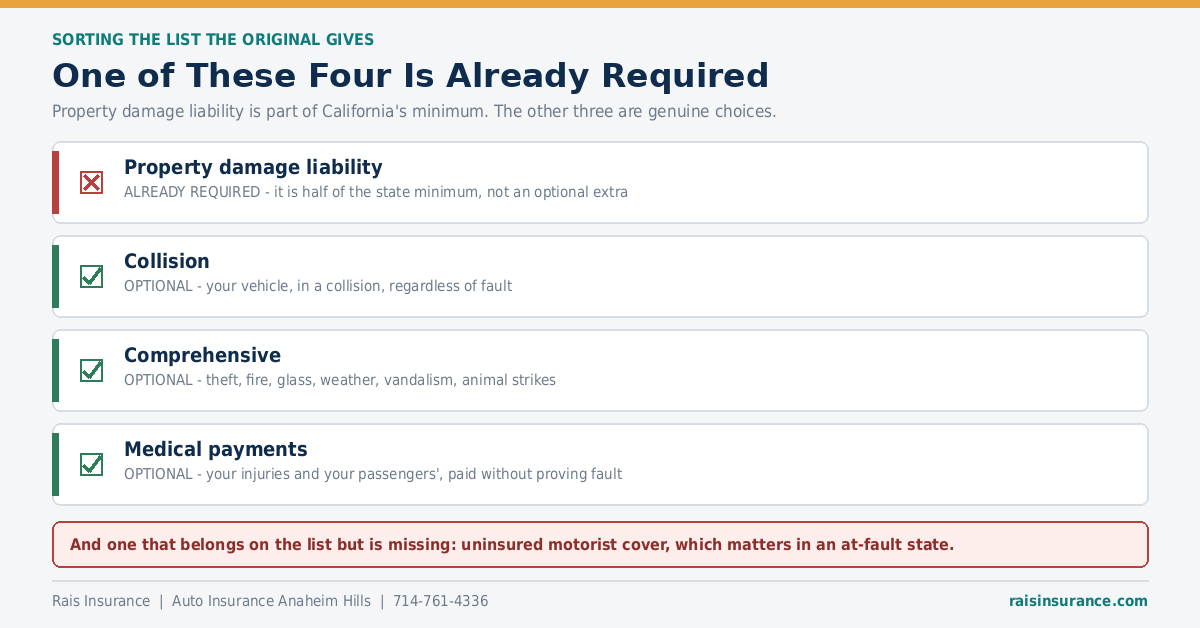
One correction on the usual list, because it makes the rest clearer. Property damage liability is not an optional extra – it is already required. It is half of California’s minimum, alongside bodily injury liability, and it is what pays for the broken fence or light pole the original page describes. If you hold a legal policy, you already have it.
So the genuine choices are these three:
- Collision – your vehicle, when it collides with something, regardless of fault.
- Comprehensive – almost everything else that can happen to your vehicle: theft, fire, vandalism, falling objects, weather, glass, and animal strikes.
- Medical payments – medical costs for you and your passengers, paid without anybody having to establish fault first. Modest limits, inexpensive, and not a substitute for health insurance.
And one that belongs on the list but is missing from it: uninsured motorist coverage. California is an at-fault state, so what you recover after an accident depends on the other driver’s limits. If they have none, your own uninsured motorist cover is what responds – see auto insurance in Anaheim for how the at-fault system works here.
What You Can Do Without
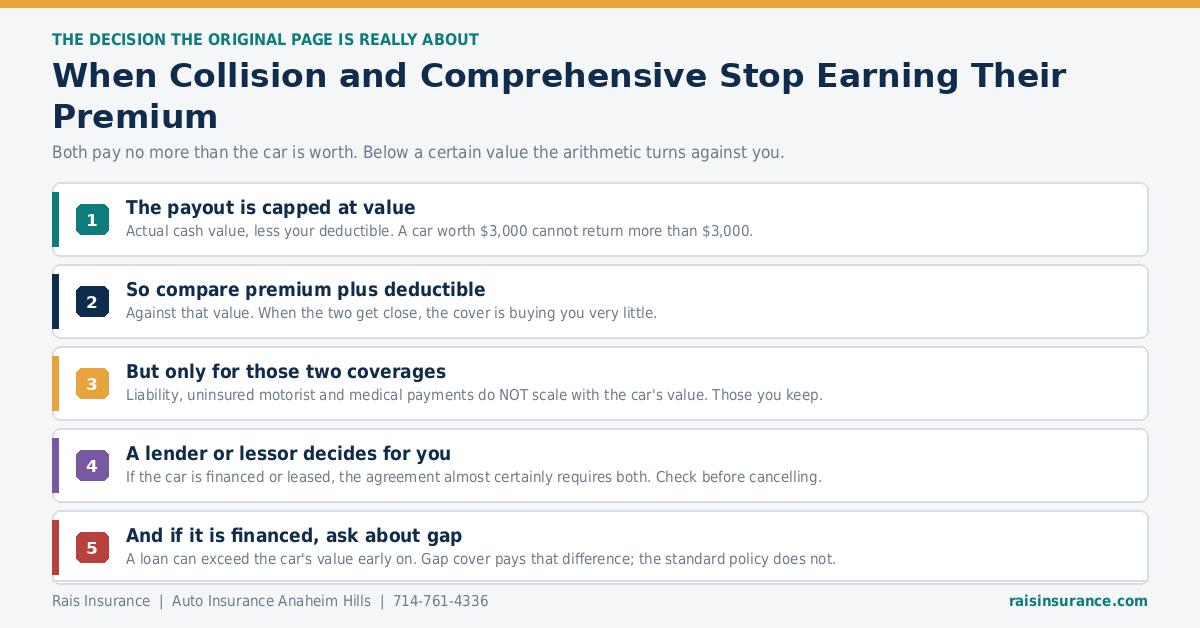
This is the auto insurance decision the original page points at, and it has a calculable answer. Collision and comprehensive both pay no more than the car’s actual cash value, less your deductible. A vehicle worth three thousand dollars cannot return more than three thousand dollars, however much you paid in premium.
So the comparison is straightforward: your annual premium for those two coverages, plus the deductible you would pay, against what the car would actually return. As those figures converge, the cover is buying you progressively less. There is no fixed threshold – it depends on the car, the premium, and how easily you could replace it tomorrow.
Two constraints on that decision, though:
- Liability, uninsured motorist and medical payments do not scale with the car’s value at all. They scale with what you could be sued for and what treatment costs. Those you keep regardless of what the vehicle is worth.
- If the car is financed or leased, the agreement decides. Lenders normally require both coverages for the life of the loan, and cancelling can put you in breach or trigger force-placed cover at a much higher price.
And if it is financed, ask about gap coverage while you are at it. Early in a loan the balance can exceed the car’s value, and a total loss pays the value – not the balance. Gap pays that difference, and a standard policy does not include it.
The Deductible Decision
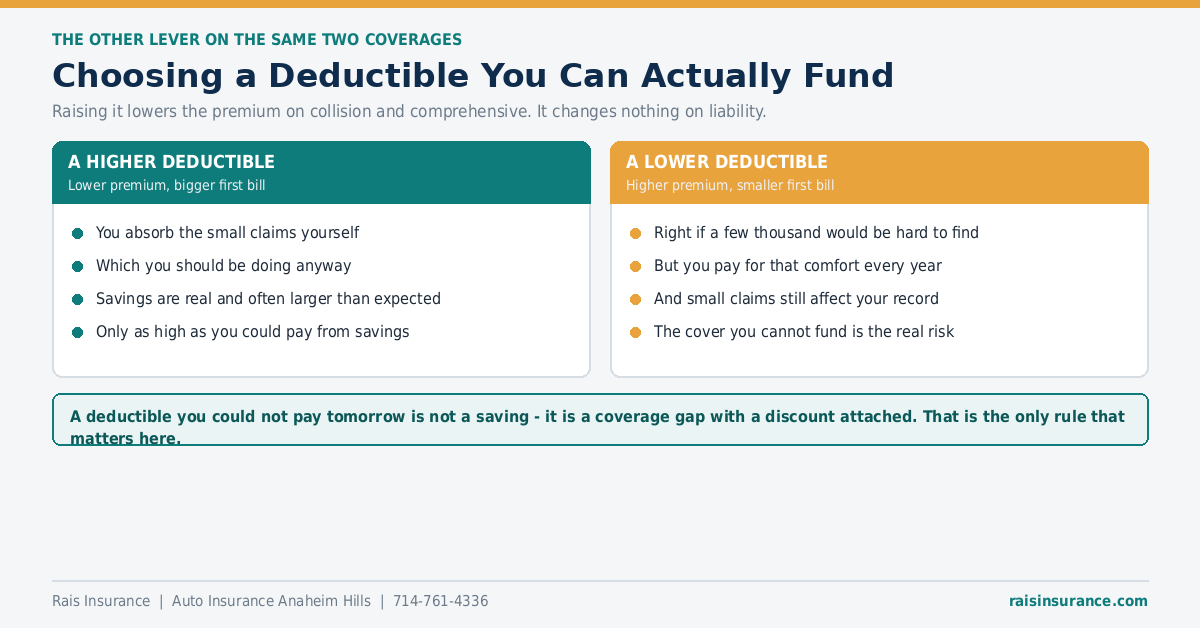
The other lever on those same two coverages. Raising your car insurance deductible lowers what you pay for collision and comprehensive, frequently by more than people expect – and it changes nothing at all on your liability premium.
The rule is short: set it as high as you could genuinely pay tomorrow, without borrowing, and no higher. A deductible you could not fund is not a saving, it is a coverage gap with a discount attached. If a few thousand dollars would be difficult to find at short notice, keep it lower and accept the higher premium – that is the right answer, not a failure of nerve.
What Is Different About Driving Up Here
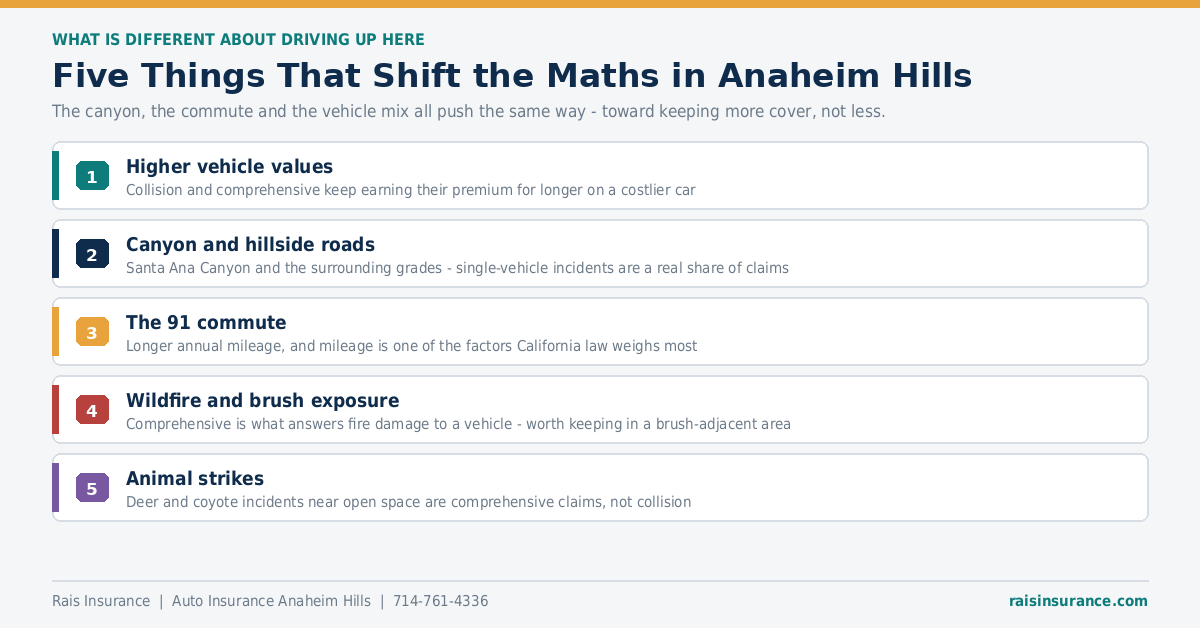
Anaheim Hills sits in the eastern part of the city, up against Santa Ana Canyon and the open space beyond it, and car insurance here is priced against that. Five things about that push the coverage arithmetic in the same direction – toward keeping more rather than less:
- Vehicle values run higher. Collision and comprehensive keep earning their premium for longer on a costlier car, so the drop-it calculation arrives later than it would elsewhere.
- Canyon and hillside roads. Grades, curves and limited shoulders mean single-vehicle incidents make up a real share of claims – and those are collision claims, on your own policy.
- The 91 commute. Longer annual mileage than a flatland Orange County address, and mileage is one of the three factors California law requires to weigh most heavily in your rate.
- Brush and wildfire exposure. Comprehensive is the coverage that answers fire damage to a vehicle. In a brush-adjacent area that is a specific argument for keeping it, even on an older car.
- Animal strikes. Deer and coyote incidents near open space are comprehensive claims rather than collision, which usually works in your favour at renewal.
For a classic or collector vehicle – and there are a good number up here – a standard policy is generally the wrong product entirely. Those are written on an agreed value basis with mileage and storage conditions attached: see classic car insurance.
Seven Questions Before You Renew
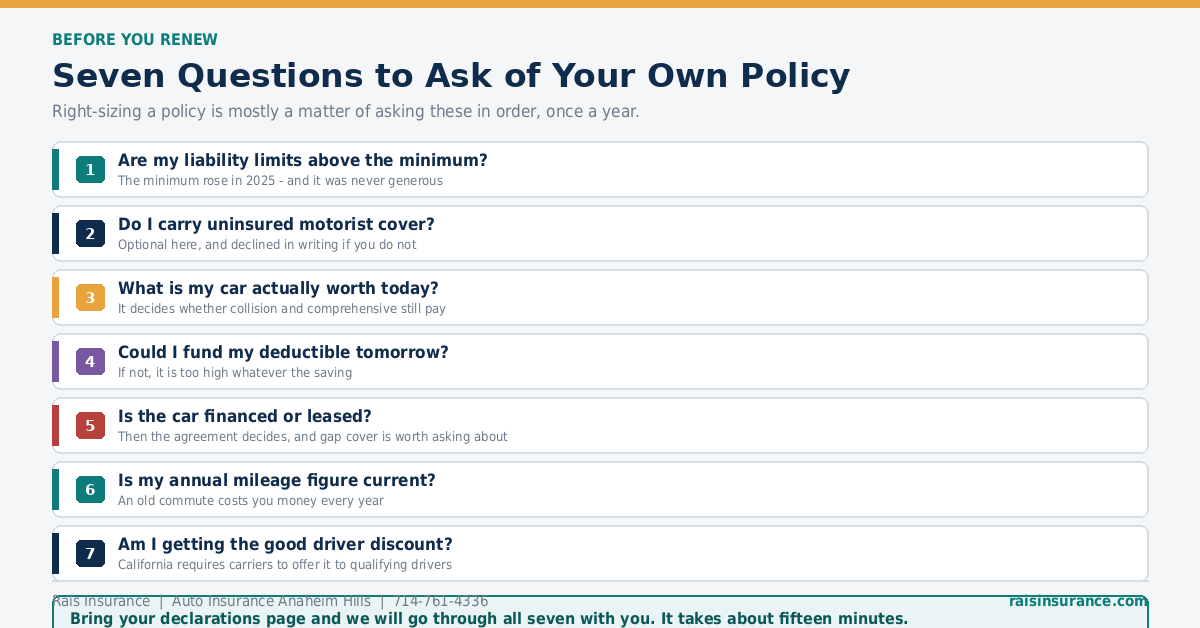
- Are my liability limits above the state minimum? The minimum rose in 2025, and it was never generous.
- Do I carry uninsured motorist cover? It is optional in California and has to be declined in writing.
- What is my car actually worth today? That decides whether collision and comprehensive still pay their way.
- Could I fund my deductible tomorrow? If not, it is too high whatever the saving looks like.
- Is the car financed or leased? Then the agreement decides, and gap cover is worth asking about.
- Is my annual mileage figure current? An out-of-date commute costs you money every year until it is corrected.
- Am I receiving the good driver discount? California requires carriers to offer it to qualifying drivers.
Working through those auto insurance questions takes about fifteen minutes with a declarations page in front of you, and it is the single most useful thing most drivers never do.
Getting the Policy Right
At Rais Insurance we can take you through this step by step and put the result to several carriers rather than one – we are an independent broker, so one set of details gets quoted across the panel. See the insurance companies we represent. There is no fee to you for that comparison; the carrier that writes the policy pays the broker.
Our office is at 2612 W. Lincoln Avenue in Anaheim, a short drive down the hill, and you are welcome to come in. Many households also bundle with home insurance in California, which is usually the largest single discount available.
Auto Insurance in Anaheim Hills – Frequently Asked Questions
Q1. Is property damage liability optional in California?
No – it is one of the two coverages the state requires, alongside bodily injury liability. It pays for damage you cause to somebody else’s vehicle or property, including things like a fence or a light pole. Any policy that meets the California minimum already includes it, so it is not an add-on you choose separately.
Q2. When is collision coverage no longer worth it?
Collision pays no more than your car’s actual cash value, less the deductible. So the comparison is your annual premium plus the deductible against what the car would actually pay out. As those figures converge the cover is buying you very little. There is no fixed threshold – it depends on the car, the premium and how easily you could replace it.
Q3. What is the difference between collision and comprehensive?
Collision covers your vehicle when it collides with something – another car, a barrier, a tree – regardless of fault. Comprehensive covers almost everything else that can happen to it: theft, fire, vandalism, falling objects, weather, glass, and animal strikes. They are separate coverages with separate deductibles and you can carry one without the other.
Q4. Does comprehensive cover hitting a deer?
Yes – animal strikes fall under comprehensive rather than collision, which surprises people because it feels like a collision. That distinction matters near open space and canyon roads, where wildlife incidents are a genuine share of claims. It usually works in your favour, since comprehensive claims are often treated more leniently at renewal.
Q5. Does car insurance cover wildfire damage to my vehicle?
Comprehensive coverage is what responds to fire damage, including wildfire. Liability-only policies do not cover your own vehicle at all. In brush-adjacent areas that is a specific argument for keeping comprehensive even on an older car, because the peril is real and comprehensive is usually the cheaper of the two physical damage coverages.
Q6. Can I drop collision if my car is financed?
Almost certainly not. Lenders and lessors normally require both collision and comprehensive for the life of the agreement, and cancelling can put you in breach or trigger force-placed coverage at a much higher cost. Check the agreement before making any change.
Q7. What is gap insurance and do I need it?
If your car is written off, the policy pays its actual cash value – which early in a loan can be less than you still owe. Gap coverage pays that difference. It is worth considering on a financed or leased vehicle, particularly with a small deposit or a long term, and it is not included in a standard policy.
Q8. How high should my deductible be?
As high as you could genuinely pay tomorrow without borrowing, and no higher. Raising it lowers the premium on collision and comprehensive – often by more than people expect – but a deductible you cannot fund is a coverage gap with a discount attached. Note it does not affect your liability premium at all.
Q9. What is medical payments coverage?
An optional coverage inside your auto policy that pays medical costs for you and your passengers without anyone having to establish fault first. The limits are modest and it is inexpensive. It is not health insurance, it does not replace a health plan, and it is not PIP – California does not use PIP.
Q10. How often should I review my auto policy?
Once a year at renewal, and whenever something changes – a new vehicle, a move, a change of commute, a driver added or removed, or a car paid off. The last of those is the one most often missed: paying off a loan removes the requirement to carry collision and comprehensive, which is the moment the decision becomes yours again.
Get an Auto Insurance Quote in Anaheim Hills
contact Rais Insurance on 714-761-4336, email rai@raisinsurance.com, or call in at 2612 W. Lincoln Avenue, Suite 103, Anaheim, CA 92801.
Bring your declarations page and, if the car is financed, the loan or lease agreement. Between them they answer most of the seven questions above before we start.
