

General Liability Insurance Cerritos
General Liability Insurance Cerritos, California
General liability insurance — also known as commercial general liability or business liability — is a type of insurance that applies specifically to businesses, and it sits inside the wider family of liability insurance. If you are being sued over an accident that was your fault, liability insurance is what covers the bills. The question most Cerritos business owners actually need answered is narrower: is general liability on its own enough for me, or have I outgrown it? That is what this page is about.
General, Professional, and Auto Liability: What the Difference Is
Liability insurance can also refer to professional liability and auto liability. These are different, specific instances of the same idea, and confusing them is where most coverage gaps start.
- General liability responds to harm you cause a third party through your premises, your operations, or your advertising. A customer trips in your showroom.
- Professional liability responds to financial harm caused by your advice, design, or professional judgment. It is important for service providers, from accountancy firms to massage studios: if a provider makes a mistake and damages a client’s property, health, or financial standing, they are liable for those damages — and that is where an insurer comes in.
- Commercial auto liability responds to injury or damage caused by a vehicle used for business. Auto liability is a legal necessity in most states, California included.
- Employer’s liability responds to suits brought by your own employees over work-related injury, and sits alongside workers’ compensation.
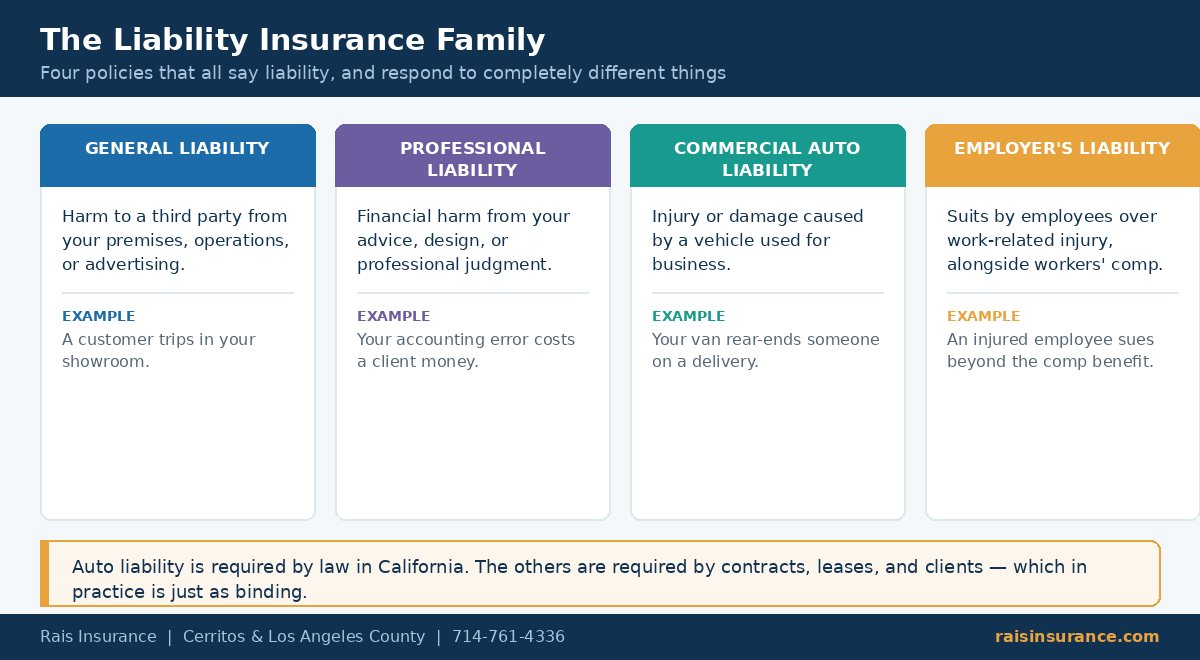
Only auto liability is required by California law. The others are required by contracts, leases, and clients — which in practice is just as binding.
The Three Things General Liability Responds To
General liability insurance is meant to protect your business — specifically, from the legal backlash of three things: advertising injury (reputation damage), bodily harm, and property damage. It helps you financially with the legal costs of facing any such claim, as long as it arises from an accident on the part of an employee, or an unforeseen problem with a product or service.
- Bodily injury — someone outside your business is physically hurt because of your premises or your work. The policy pays medical costs, any settlement, and your legal defense.
- Property damage — you or an employee damage property belonging to someone else. The policy pays to repair or replace it.
- Advertising injury — reputation harm through libel, slander, or copying someone’s work in your advertising. This is the one most owners forget they have, and for design, apparel, and marketing firms it is the coverage that matters most.
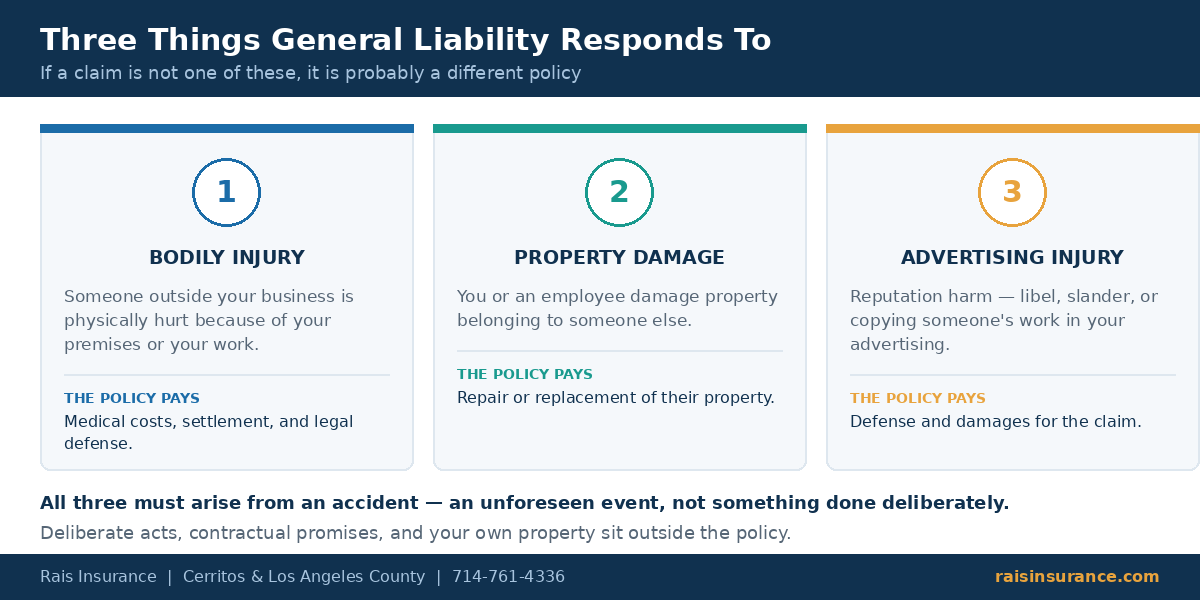
The word doing the work in all three is accident. Deliberate acts, obligations you took on in a contract that you would not otherwise have had, and damage to your own property all sit outside the policy.
Here at Rais Insurance we help you put together a policy that works best for you, built on your general liability coverage. If you are looking for advice on general liability insurance in Cerritos, we will do you one better than advice — we will show you exactly where your current cover stops.
When General Liability On Its Own Is Enough
Even small businesses need to be properly insured against accidents and injuries that could otherwise cost them the business. But some independent operators genuinely need nothing more than liability insurance. Contractors are the classic case: they typically keep nobody on a payroll, and they do not usually own office space or commercial vehicles. For them — and perhaps for you — general liability is enough.
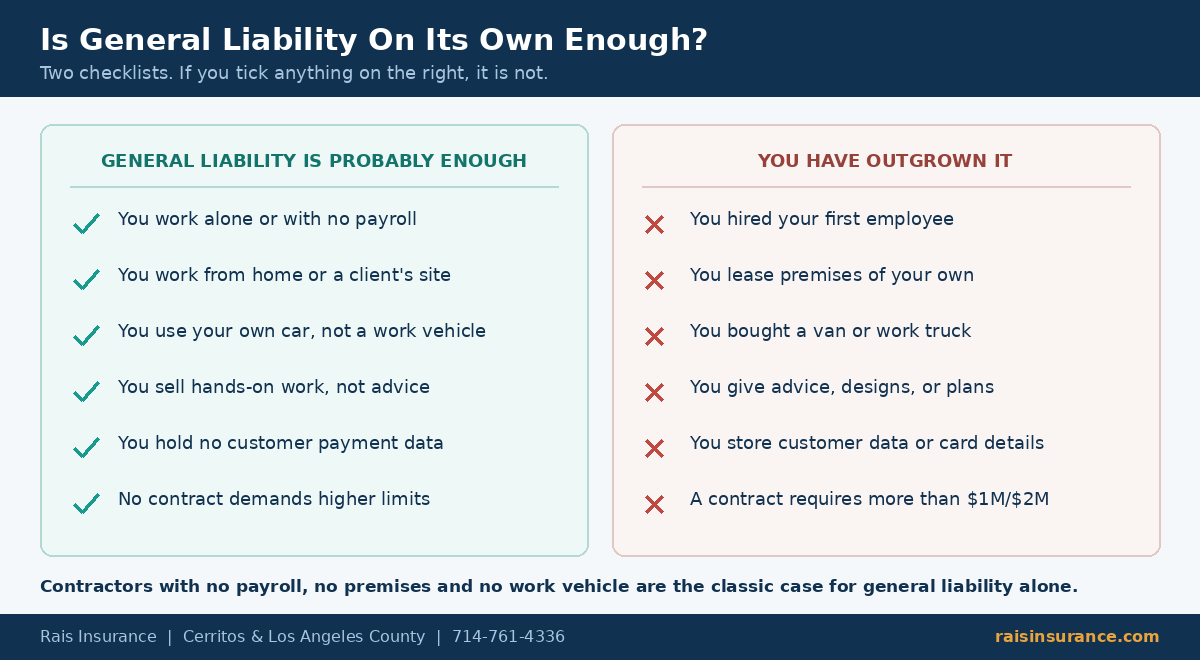
The test is short. General liability on its own is probably sufficient if all of these are true:
- You work alone, or with subcontractors rather than payroll employees
- You work from home or on your clients’ sites, with no premises of your own
- You use your own car for occasional travel, not a dedicated work vehicle
- You sell hands-on work rather than advice, designs, or plans
- You hold no customer payment or personal data
- No contract you have signed demands more than standard limits
Five Milestones That Mean You Have Outgrown It
On the other hand, if you are expanding your business, it is time to expand your insurance policy too. The trigger is never the calendar — it is a specific event, and each one adds a specific policy:
- You hire your first employee. California requires workers’ compensation from that point. Your general liability does not cover injuries to your own staff, and hiring also changes how the policy is rated, because payroll enters the calculation.
- You buy a work vehicle. A personal auto policy excludes business use beyond ordinary commuting. A van, a truck, or any vehicle registered to the business needs commercial auto.
- You lease premises. You now have contents, a build-out you paid for, and a landlord who will require general liability at a stated limit with additional insured status. This is usually where a business owner’s policy replaces standalone general liability.
- You start selling advice, designs, or plans. General liability will not respond to a recommendation that costs a client money. That is professional liability.
- You start holding customer data or card details. A breach is excluded from general liability. That is cyber liability.
A sixth trigger is not about growth at all: a contract demanding more than your current limits. When that arrives, an umbrella policy above your general liability is usually cheaper than raising the underlying limit to match.
How Your Insurance Grows With Your Business
Set out as a sequence, the whole path looks like this. You do not need all of it on day one — you need each piece the week its milestone happens, not at your next renewal.
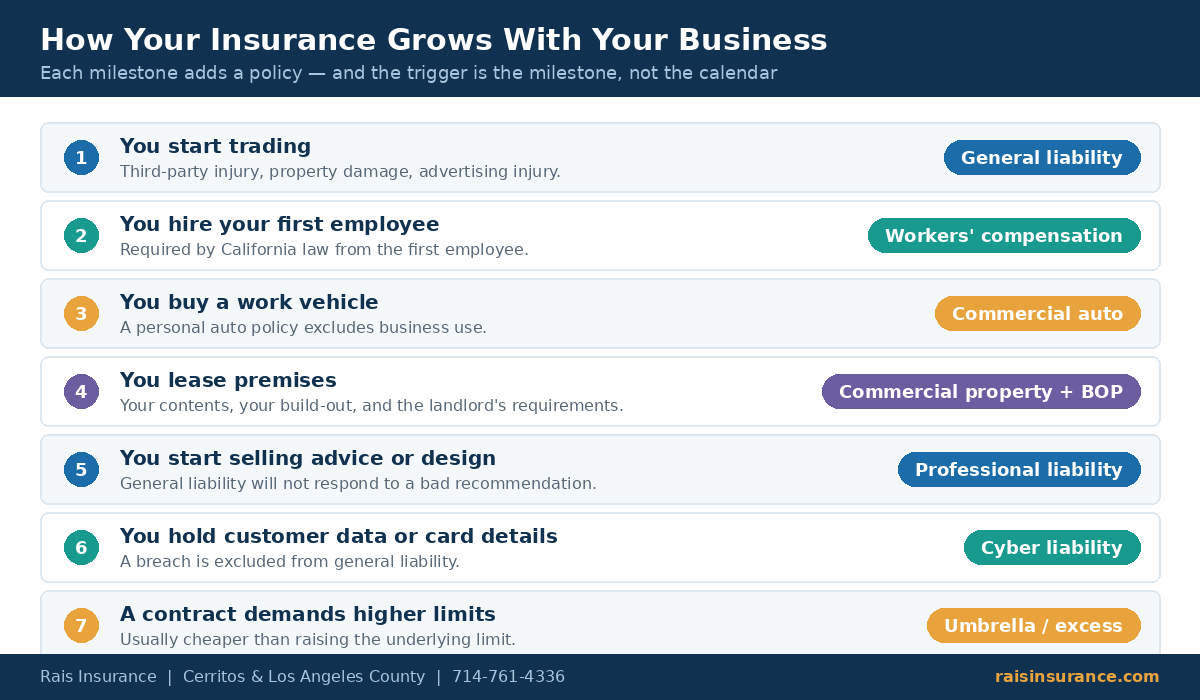
The gap between a milestone and the next renewal is where uninsured losses happen. It is also the easiest thing in commercial insurance to fix — a phone call, usually a same-day endorsement.
What This Costs as You Grow
Standalone general liability is the cheapest place to start, and for a sole operator it is normally the right one. Once you have premises, equipment, or stock worth insuring, a business owner’s policy that bundles general liability with commercial property is usually cheaper than buying the two separately — and simpler to administer, because one renewal date replaces several.
Above that, larger or higher-hazard operations move to a commercial package policy assembled coverage by coverage. We will tell you which of the three structures fits before we quote, rather than quoting the one that happens to pay best.
Serving Cerritos and Los Angeles County
Cerritos sits right on the Los Angeles County and Orange County line, about thirteen miles from our Anaheim office. We write general liability insurance across Los Angeles County — Cerritos, Artesia, Lakewood, Norwalk, La Palma, and Bellflower — and throughout Orange County. Most Los Angeles County business insurance work is handled by phone and email, with certificates issued the same day.
We at Rais Insurance will help you find the best general liability insurance in Cerritos for the stage your business is actually at. Because we also write commercial property insurance, workers’ compensation, and commercial auto insurance, the policies each milestone triggers come from the same place. See our full general liability insurance coverage, or our pages for businesses in Costa Mesa and Escondido.
Get a General Liability Insurance Quote in Cerritos
You can size most of a commercial programme from four answers: do you have employees, do you have a work vehicle, do you have a lease, and does any contract specify insurance limits. Tell us those and we will tell you what you need — including, quite often, that you need less than you thought.
Call 714-761-4336 or email rai@raisinsurance.com.
Cerritos General Liability Insurance FAQs
Q1. Do I need general liability insurance if I have no employees?
Usually yes. General liability responds to harm you cause to third parties, and that exposure exists whether or not you employ anyone. What having no employees does change is workers’ compensation, which California requires only once you have staff. A sole trader with no payroll often needs general liability and nothing else.
Q2. Is general liability insurance enough for a contractor?
It often is, for a contractor with no payroll, no premises of their own, and no dedicated work vehicle. Once any of those three changes, the answer changes with it. Most contractors also need to check whether their contracts demand higher limits or additional insured status before deciding.
Q3. Does my personal auto policy cover me when I drive for work?
Generally no. Personal auto policies exclude business use beyond ordinary commuting, so a delivery, a client visit with equipment, or a vehicle registered to the business usually needs commercial auto. This is one of the most common uninsured gaps among growing sole traders.
Q4. What insurance do I need when I hire my first employee?
Workers’ compensation, which California requires from the first employee. Your general liability does not cover injuries to your own staff. Hiring is also the point where many businesses first need employment practices liability, and where their general liability rating basis changes because payroll enters the calculation.
Q5. What is a business owner’s policy and when should I switch to one?
A business owner’s policy bundles general liability with commercial property into one form, usually cheaper than buying both separately. It becomes the obvious choice once you have premises, equipment, or stock worth insuring. Below that point, standalone general liability is normally the better value.
Q6. Does general liability cover advertising injury and reputation damage?
Yes. Advertising injury, sometimes called personal and advertising injury, covers libel, slander, and copying someone else’s work in your advertising. It is one of the three things the policy responds to, alongside bodily injury and property damage, and it is the one most owners forget they have.
Q7. What is the difference between general liability and product liability?
Product liability is not a separate policy for most businesses — it sits inside general liability as products and completed operations coverage. It responds to injury or damage caused by something you made, sold, or worked on after it has left your control. Manufacturers with heavy exposure sometimes buy additional limits.
Q8. Do I need general liability insurance if I work from home?
Often yes, and your homeowner’s policy will not do it. Home policies exclude business activities, so a client visiting your home office, or work you perform at someone else’s property, falls outside them. If you meet clients or work on site anywhere, general liability is the policy that responds.
Q9. Does general liability cover intentional acts?
No. The policy responds to accidents — unforeseen events. Damage you cause deliberately, obligations you took on in a contract that you would not otherwise have had, and harm you expected are all outside it. This is why the wording of a claim matters as much as the facts behind it.
Q10. How often should I review my business insurance?
At every renewal, and immediately whenever something structural changes: a first hire, a vehicle, a lease, a new service line, or a contract with insurance requirements in it. Waiting for renewal after one of those events leaves you uninsured for the gap, which is exactly when claims tend to arrive.
