

General Liability Insurance Artesia, California
Foresight is what keeps a business standing. The owners who take the time to prepare — who put real measures in place to protect what they have built — are the ones who come out on top when something goes wrong. That is why the right insurance coverage pays for itself. For most Artesia businesses that means two policies rather than one, and understanding where the first stops and the second starts.
General Liability and Workers’ Compensation
The right general liability insurance in Artesia protects your business against high-cost liabilities. As good as that policy is, it does not cover employee injuries. If someone on your team is hurt on the job — on site, on the road, or while acting for the company — that is workers’ compensation, and in California it is not optional.
Who Each Policy Actually Covers
The dividing line is not the accident. It is who was hurt.
- General liability covers other people. Customers, visitors, members of the public, and other businesses — injury or property damage you cause to someone outside your company. A client trips over your equipment on a job site.
- Workers’ compensation covers your own team. Employees injured or made ill by their work. Your own crew member falls from a ladder on that same job site, the same afternoon.
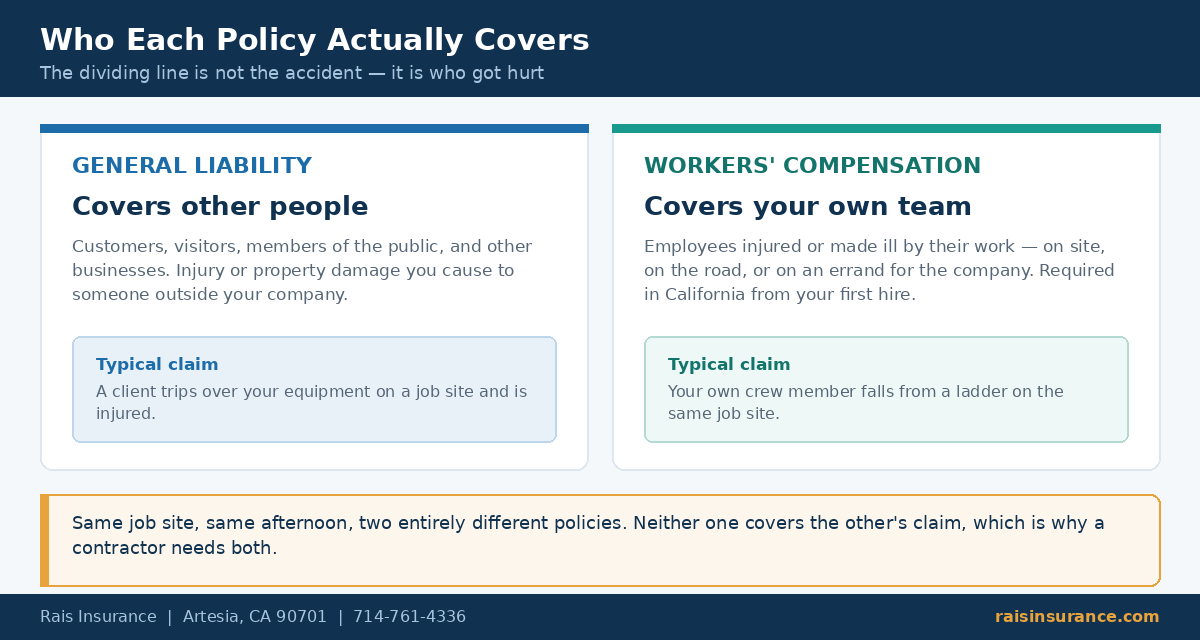
Neither policy covers the other’s claim. That is the whole reason a contractor needs both, and it is why buying one and assuming it stretches to the other is such an expensive mistake.
What Workers’ Compensation Pays in California
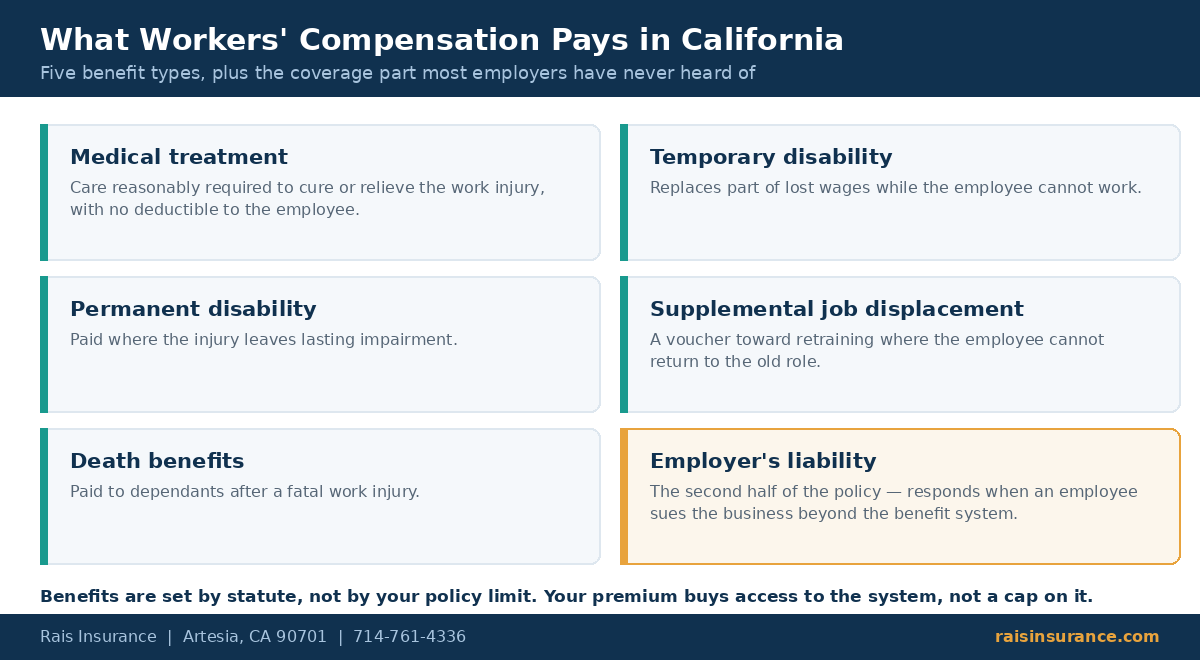
California requires workers’ compensation from your first employee. There is no headcount exemption. What the policy provides is set by statute rather than by you:
- Medical treatment reasonably required to cure or relieve the work injury, at no cost to the employee.
- Temporary disability replacing part of lost wages while they cannot work.
- Permanent disability where the injury leaves lasting impairment.
- Supplemental job displacement — a voucher toward retraining where they cannot return to the old role.
- Death benefits paid to dependants after a fatal injury.
Alongside those sits employer’s liability, the second half of the policy. It responds when an employee sues the business over a work injury outside the benefit system, and it is where the limits printed on your declarations page actually apply.
Is an Employee Covered on the Road?
Often, but not always, and the distinction is worth knowing before you need it. Travel that is part of the work is generally covered — a site visit, a delivery, an errand for the company, or driving between job sites. Ordinary commuting from home to a fixed workplace generally is not, under what is usually called the going-and-coming rule.
The test turns on whether the trip served the employer. That is why it is worth documenting the purpose of work travel as a matter of routine, rather than reconstructing it after an accident.
Contractors, Subcontractors, and the Certificate You Must Collect
If you work in construction, or you employ a team of contractors, making sure your people have proper coverage is what stands between an accident and a disaster. The part that catches most contractors out is not their own crew — it is their subs.
Payments to a subcontractor who cannot produce a certificate of insurance are typically treated as your own payroll at audit, and charged at your class rate on both your workers’ compensation and your general liability. The bill arrives retrospectively, after the job is finished and the money is spent.
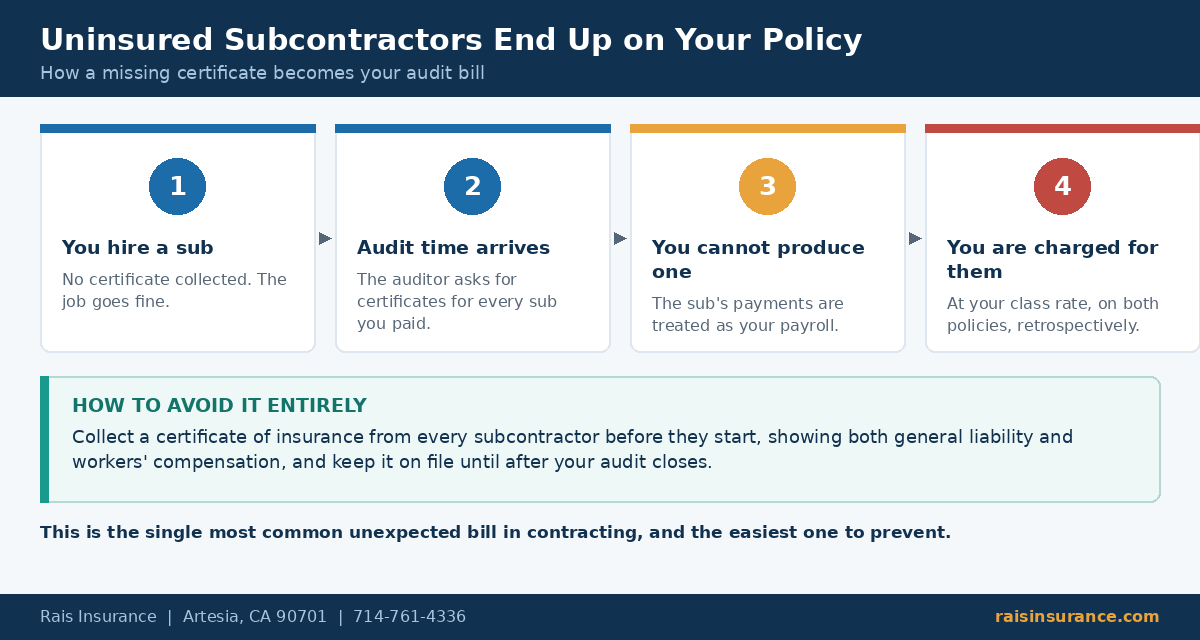
Preventing it is entirely mechanical: collect a certificate from every subcontractor before they start, showing both general liability and workers’ compensation, and keep it on file until after your audit closes. We will hold copies for you if that is easier.
Your Experience Modification Rate
One number on your workers’ compensation policy multiplies the rest of it. Your experience modification rate — the X-Mod — compares your actual claims history against what a business of your size and classification would be expected to have. In California it is calculated by the WCIRB, not by your insurer.
A rating of 1.00 is average. Below that is a discount and above it is a surcharge, applied directly to premium. Frequency of small claims moves it further than one large loss, and it follows the business for years — which is why a documented safety programme pays for itself rather than costing money.
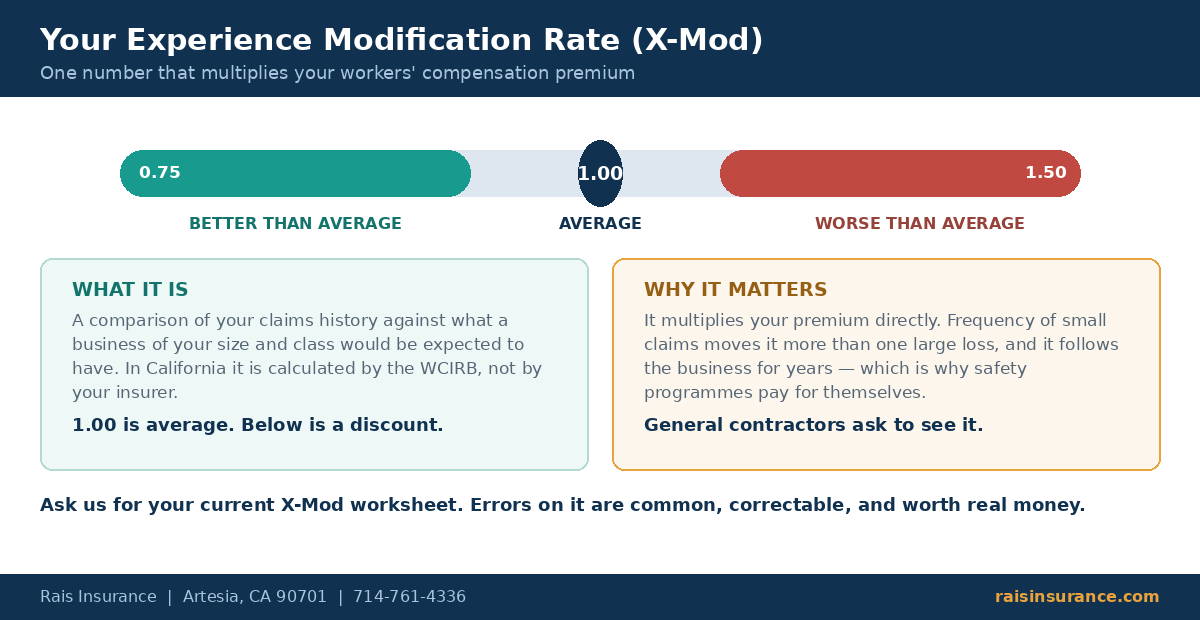
General contractors increasingly ask to see it before awarding work, so it is worth knowing yours. Ask us for your current X-Mod worksheet — errors on them are common, correctable, and worth real money.
Getting Help
At Rais Insurance we know how difficult these situations get. Costs climb quickly, and without proper coverage you can end up holding the bag — footing what feels like an endless stream of treatment costs and medical bills. Since we opened our doors in 1982, we have been providing companies with general liability insurance in Artesia alongside the rest of their business insurance.
Quoting both policies as one submission is not just convenient. One agency sees both sides of a job-site incident, holds your subcontractor certificates in a single file, and aligns your renewal dates — which removes the gap where each broker assumes the other handled something.
We also write commercial property insurance and commercial auto insurance, so the whole programme sits in one place. See our full general liability insurance coverage, or our pages for businesses in Cerritos, Bellflower, and Costa Mesa.
Serving Artesia and the Surrounding Cities
We write business insurance for companies in Artesia (90701) and the neighbouring cities of Hawaiian Gardens and Cypress, from our office in Anaheim about ten miles away. Most of it is handled by phone and email, and certificates for your subcontractors are issued the same day.
Get a General Liability and Workers’ Compensation Quote
To market both policies together we need payroll split by trade, your class codes, a description of the work you actually perform, three years of loss runs, your current experience modification worksheet, and your subcontractor arrangements.
With a wide range of products behind us, we have the plan and the features you need to cover all your bases — and in the event of an accident, you can count on us for the assistance to handle it properly. Call 714-761-4336 or email rai@raisinsurance.com.
Artesia Business Insurance FAQs
Q1. Is workers’ compensation insurance required in California?
Yes. California requires an employer to carry workers’ compensation from the first employee, with no small-business exemption for headcount. Failing to carry it exposes the business to penalties, stop orders, and personal liability for an injured worker’s costs. General liability does not satisfy this requirement and never has.
Q2. Do I need workers’ compensation for subcontractors?
Not if they genuinely carry their own and you can prove it. Collect a certificate of insurance from every subcontractor before they start work, showing both general liability and workers’ compensation, and keep it until after your audit closes. Without that certificate the exposure defaults back to you.
Q3. What happens if my subcontractor has no workers’ compensation?
At audit, payments to an uninsured subcontractor are typically treated as your own payroll and charged at your class rate — on both your workers’ compensation and your general liability. The bill arrives retrospectively, after the job is finished and paid for, which is what makes it painful.
Q4. What is an experience modification rate?
Your X-Mod compares your actual claims history against what a business of your size and classification would be expected to have. In California it is calculated by the WCIRB rather than by your insurer. A rating of 1.00 is average; below that is a discount and above it is a surcharge applied directly to your premium.
Q5. Is an employee covered driving to work or driving to a meeting?
Ordinary commuting is generally not covered, under what is often called the going-and-coming rule. Travel that is part of the work usually is — a site visit, a delivery, an errand for the employer, or driving between job sites. The distinction turns on whether the trip served the employer, so document the purpose of work travel.
Q6. What is employer’s liability coverage?
It is the second half of a workers’ compensation policy. The first half pays statutory benefits to an injured employee; employer’s liability responds when someone sues the business over a work injury outside that benefit system. It is where the limits printed on your declarations page actually apply.
Q7. Are business owners and officers covered by workers’ compensation in California?
It depends on your structure and on whether an exclusion has been filed. Certain officers, directors, and owners can in some circumstances waive coverage for themselves in writing, but the rules are specific and have changed over the years. Treat this as a question to settle with us in writing rather than assume either way.
Q8. What does workers’ compensation actually pay for?
Medical treatment reasonably required to cure or relieve the injury, temporary disability while the employee cannot work, permanent disability where impairment lasts, a supplemental job displacement voucher toward retraining, and death benefits to dependants. Benefits are set by statute, so your premium buys access to the system rather than a capped payout.
Q9. Can I buy general liability and workers’ compensation from the same agency?
Yes, and it is usually better. One agency sees both sides of a job-site incident, holds your subcontractor certificates in one file, and can align both renewal dates. It also removes the gap where each broker assumes the other handled something.
Q10. What do you need to quote both policies together?
Payroll split by trade, your class codes, a description of the work you actually perform, three years of loss runs, your current experience modification worksheet, and your subcontractor arrangements. With those, both policies can go to market as a single submission.
