

General Liability Insurance Carlsbad, California
General liability insurance in Carlsbad protects your business investment against another business’s or individual’s claims of property damage, bodily injury, and the associated medical expenses. Below are three things a general liability policy from Rais Insurance protects you against — and, because it matters just as much, what to do on the day one of them actually happens.
Property Damage
In the course of your normal business operations, you or an employee accidentally damages a client’s server. We cover the resulting claim up to the limits of liability on your general liability policy. That covers the machine. The data stored on it is a separate question, and an important one — the next section explains why.
Bodily Injury
A client slips and falls on your premises, or trips over equipment owned by your business, and you are legally liable for the injury. We offer policies that cover the subsequent claim and any related medical costs.
Personal and Advertising Injury
In the course of your business, an employee says something unflattering and false about one of your clients. The client learns of it and sues your business for slander. We can help with the resulting claim and, if necessary, pay for an attorney to defend your business. This coverage part also picks up libel, copyright infringement in your advertising, and wrongful eviction.
Does General Liability Cover Lost Data?
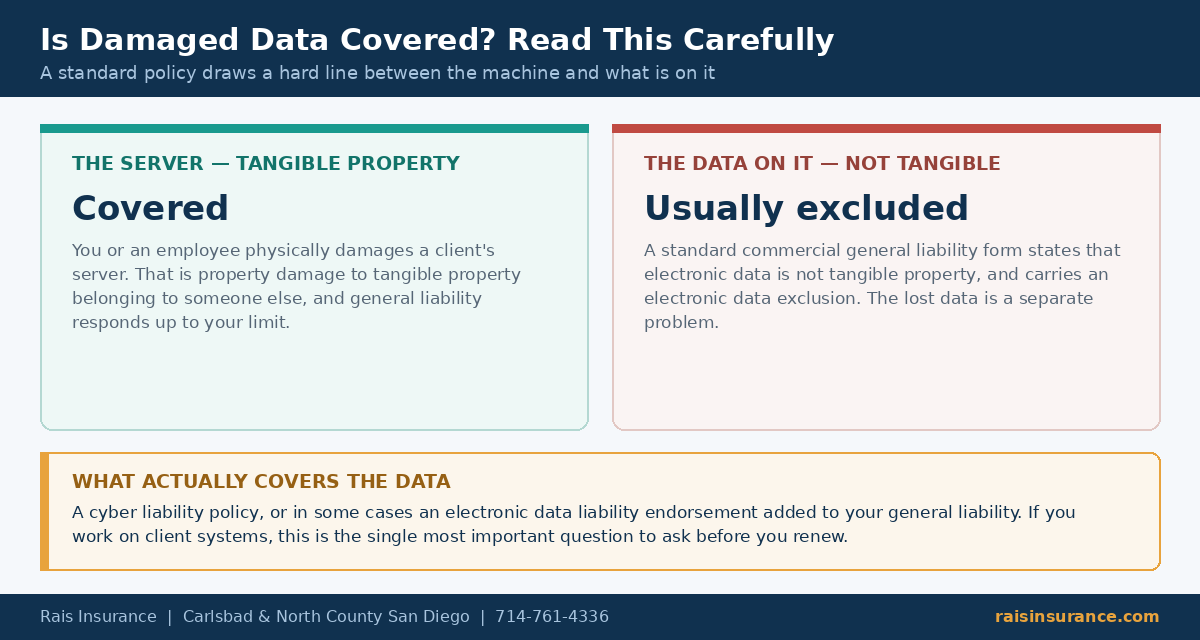
This is worth stating precisely, because it is where a lot of businesses discover a gap. A standard commercial general liability form defines property damage as damage to tangible property, and it says explicitly that electronic data is not tangible property. Most forms also carry an electronic data exclusion.
In practice that means the two halves of the same incident are treated differently. Physically damage a client’s server and the hardware is covered property damage. The information that was on it generally is not.
What does cover it is a cyber liability policy, or in some cases an electronic data liability endorsement added to your general liability. If your business works on client systems, handles their equipment, or stores their information, this is the first question to ask us before your next renewal.
Negligence: What the Policy Does and Does Not Cover
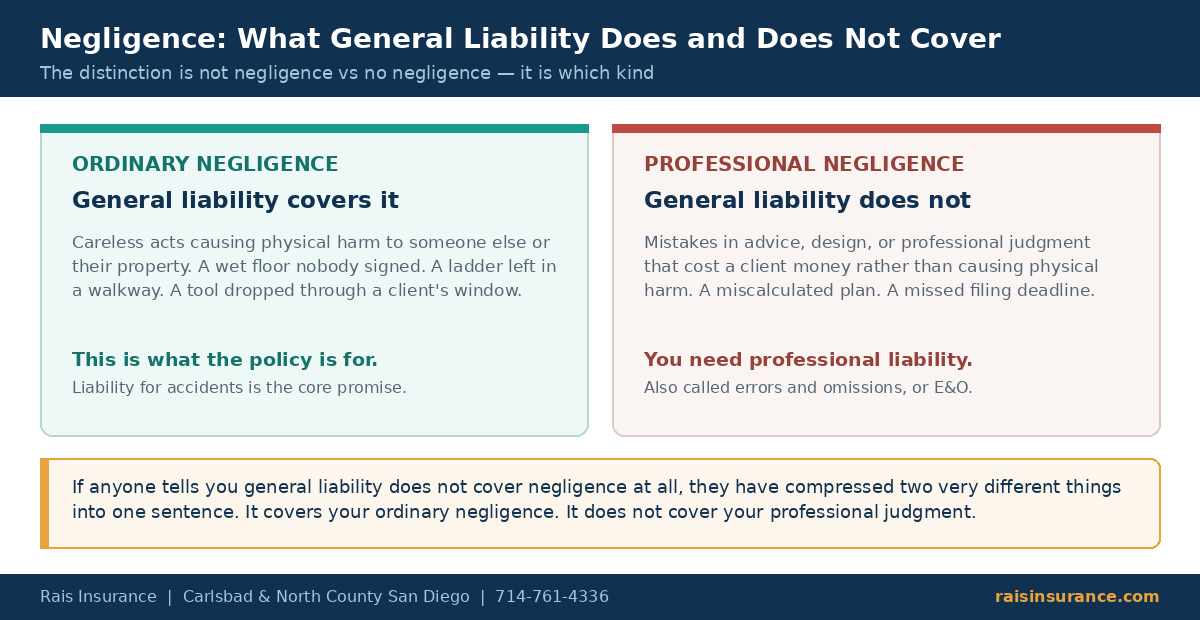
General liability insurance does not protect you from every risk out there. The line that matters most is not between negligence and no negligence — it is between two kinds of negligence.
- Ordinary negligence is exactly what general liability is for. Careless acts causing physical harm to someone else or their property: a wet floor nobody signed, a ladder left in a walkway, a tool dropped through a client’s window. Liability for accidents is the core promise of the policy.
- Professional negligence is not covered. Mistakes in advice, design, or professional judgment that cost a client money rather than causing physical harm — a miscalculated plan, a missed filing deadline, a recommendation that lost money. That needs professional liability, also called errors and omissions.
Professional liability is usually the second policy a Carlsbad service business buys, immediately after general liability. If you are paid for judgment rather than for physical work, ask us about it before you renew.
When You Need More Than General Liability
You may decide to choose one of our other business liability products alongside general liability:
- A Business Owner’s Policy (BOP) combines your general liability with commercial property insurance in a single form. Once you have premises, equipment, or stock worth insuring, it is normally cheaper than buying the two separately.
- Professional liability covers you where you offer personal or professional services. This is the policy that answers the professional negligence gap above.
- Cyber liability covers the data your general liability will not, along with breach response costs.
- Workers’ compensation covers injuries to your own employees, and California requires it from your first hire.
The First 48 Hours After an Incident
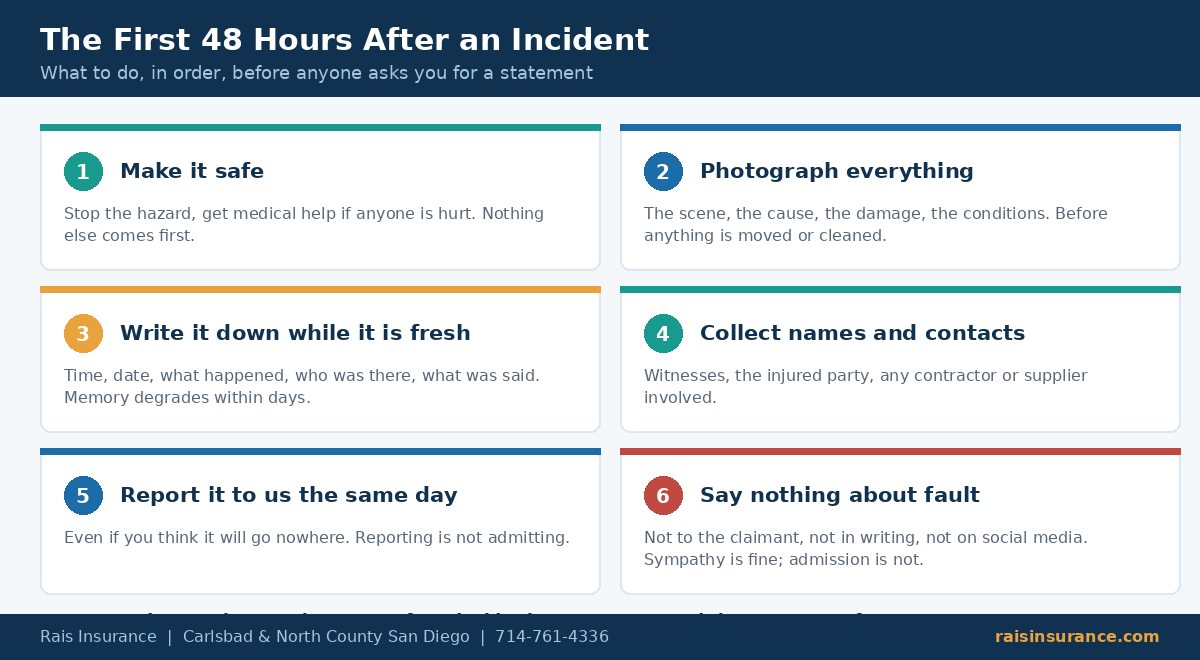
Buying the policy is the easy part. What decides how a claim turns out is usually what happens in the two days after something goes wrong, before anyone has thought about insurance at all. In order:
- Make it safe. Stop the hazard and get medical help if anyone is hurt. Nothing else comes before this.
- Photograph everything. The scene, the cause, the damage, the lighting, the floor — before anything is moved or cleaned up.
- Write it down while it is fresh. Time, date, what happened, who was present, what was said. Memory degrades within days and statements taken months later are worth far less.
- Collect names and contact details. Witnesses, the injured party, and any contractor or supplier involved.
- Report it to us the same day. Even if you are certain it will go nowhere. Reporting an incident is not admitting anything, and it is not a claim until someone makes one.
- Say nothing about fault. Not to the claimant, not in an email, not on social media. Checking whether someone is alright is decent and expected; saying it was your fault is a legal conclusion you are not in a position to reach.
How a General Liability Claim Actually Runs
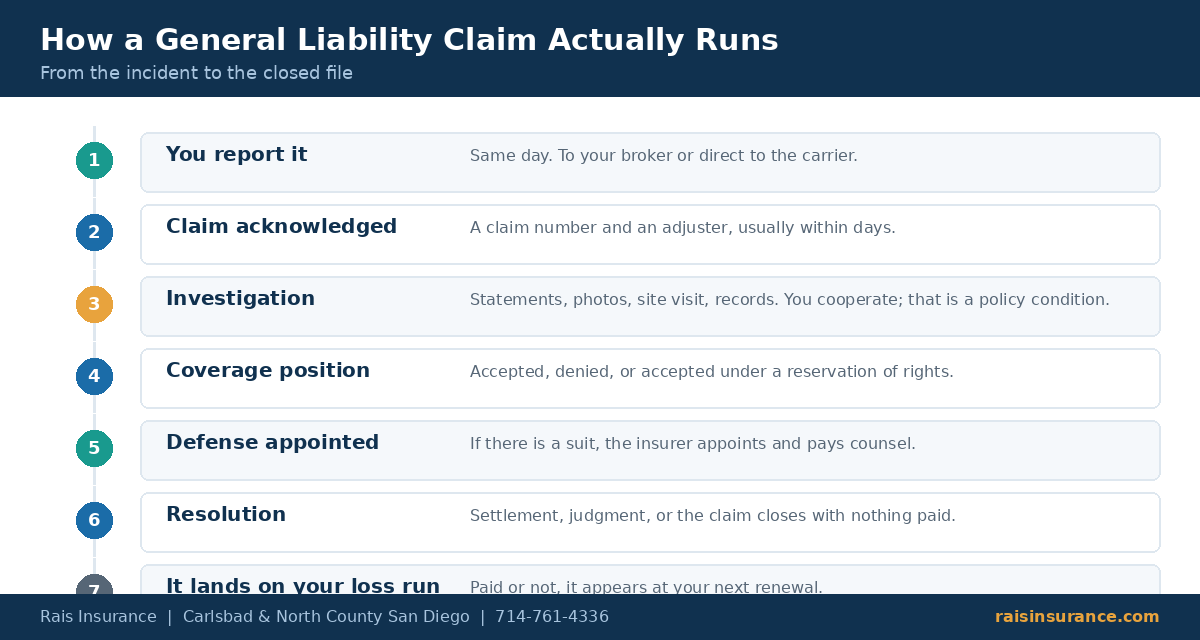
Most business owners have never seen a claim through and reasonably assume it is a black box. It is not:
- You report it — same day, to us or direct to the carrier.
- The claim is acknowledged — a claim number and a named adjuster, usually within days.
- Investigation — statements, photographs, records, sometimes a site visit. Cooperating is a condition of your policy, not a courtesy.
- Coverage position — accepted, denied, or accepted under a reservation of rights, which means the insurer will proceed while reserving the right to deny later if the facts change.
- Defense appointed — if a suit is filed, the insurer appoints and pays counsel, and on a standard form those costs sit outside your limit.
- Resolution — settlement, judgment, or the file closes with nothing paid.
- It appears on your loss run — paid or not, it shows up when you next go to market.
Why Late Reporting Is the Costliest Mistake
Nearly every policy requires prompt notice of an incident that might give rise to a claim. Wait, and evidence disappears, witnesses become unreachable, and the insurer can argue its ability to defend you was prejudiced — which in the worst case costs you the coverage entirely.
The instinct to wait and see is understandable and almost always wrong. Report it, let it close with nothing paid if that is what happens, and keep the coverage you paid for.
Should Your Carlsbad Business Carry General Liability Insurance?
You should consider getting general liability insurance in Carlsbad if you or your employees:
- Have to work on a client’s equipment
- Use third-party locations for business-related activities
- Interact with your clients face to face
- Are required to carry general liability insurance before entering into a contract
If any of those is true, the exposure already exists — the only open question is whether it sits with your business or with an insurer.
Serving Carlsbad and North County San Diego
We write general liability insurance for businesses in Carlsbad and along the North County San Diego coast — Oceanside, Encinitas, La Costa, Solana Beach, and Del Mar — from our office in Anaheim. Most business insurance Carlsbad companies need is handled by phone and email, and certificates are issued the same day.
At Rais Insurance we specialise in businesses like yours and tailor coverage to the risks in your industry. We offer a full-service insurance shop for all your business insurance requirements. Because we also write commercial property insurance, workers’ compensation, and commercial auto insurance, the policies general liability leaves out come from the same place. See our full general liability insurance coverage, or our pages for businesses in Escondido, Costa Mesa, and Cerritos.
Get a General Liability Insurance Quote in Carlsbad
To quote it we need what your business actually does, your annual revenue or payroll, any limits your contracts require, and three years of loss runs if you have had claims.
Contact us today and learn more about what it means to partner with us. Call 714-761-4336 or email rai@raisinsurance.com. And if something has already happened, call first and worry about the paperwork afterwards.
Carlsbad General Liability Insurance FAQs
Q1. What should I do immediately after an incident at my business?
Make the scene safe and get medical help first. Then photograph everything before anything is moved, write down what happened while it is fresh, collect witness names, and report it to your broker the same day. Do not discuss fault with anyone, in person or in writing.
Q2. How do I report a general liability claim?
Call your broker or the carrier’s claims line and give the date, location, what happened, who was involved, and any injuries or damage. You do not need to know whether the claim is valid, or even whether anyone intends to pursue it. Reporting an incident is not an admission of anything.
Q3. What happens after I report a claim?
You receive a claim number and an adjuster, usually within a few days. The adjuster investigates — statements, photographs, records, sometimes a site visit — and then issues a coverage position. If a lawsuit follows, the insurer appoints and pays defense counsel. Cooperating with that process is a condition of your policy.
Q4. What is a reservation of rights letter?
It is a letter saying the insurer will investigate and may defend the claim, while reserving the right to deny coverage later if the facts fall outside the policy. It is not a denial and it is not unusual. It does mean the coverage question is genuinely open, and it is worth reading carefully rather than filing.
Q5. Does general liability cover lost or damaged data?
Usually not the data itself. A standard commercial general liability form states that electronic data is not tangible property and carries an electronic data exclusion. Physical damage to a client’s server is covered as property damage; the information stored on it generally needs cyber liability or a specific electronic data endorsement.
Q6. Will reporting a claim raise my premium?
It can, though not automatically. Underwriters look at frequency as much as amounts paid, so several small claims usually affect pricing more than one large one. A claim that is investigated and closed with nothing paid still appears on your record, but carries far less weight than a paid loss.
Q7. What is a loss run and why does my broker ask for it?
A loss run is your claims history from a carrier, normally covering three to five years. Every insurer asks for one before quoting, because your claims record is the single strongest predictor of future claims. Requesting your own loss runs early makes a renewal or a market search significantly faster.
Q8. Can I settle a small claim myself without telling my insurer?
It is a bad idea, and often a breach of your policy. Voluntary payments made without the insurer’s consent are typically not reimbursed, and settling directly can prejudice the defense of a larger claim that grows out of the same incident. Report it, then discuss whether paying it makes sense.
Q9. How long does a general liability claim take to resolve?
A straightforward property damage claim can close in weeks. A disputed bodily injury claim that becomes litigation can run for years. The variables are whether liability is contested, whether injuries are still being treated, and whether a suit is filed. Your adjuster should give you a realistic picture early.
Q10. What can I do if my insurer denies my claim?
Ask for the denial in writing with the specific policy provision relied on, then read that provision. Denials sometimes rest on incomplete facts, and providing what was missing resolves them. If you still disagree, California policyholders can raise the matter with the Department of Insurance, and your broker should be advocating for you throughout.
